

Tailless Whip Scorpion Care: Identify the Animal, Build Climbing Space and Observe Safely
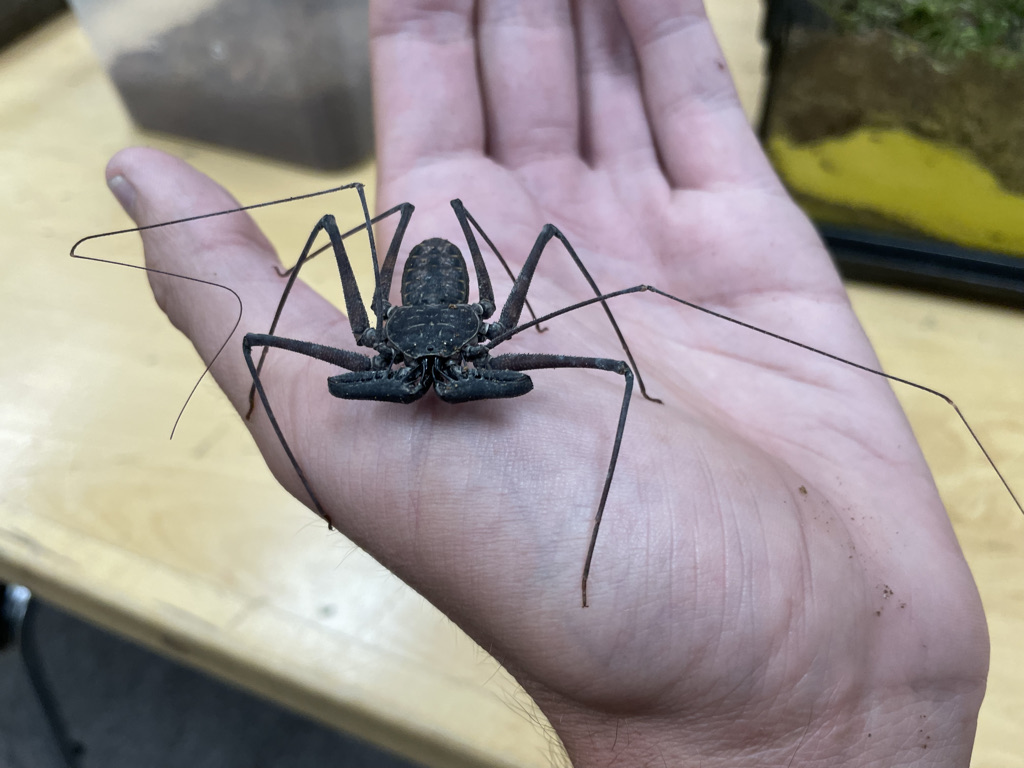
A tailless whip scorpion looks as though it belongs in a monster film: an extremely flat body, long threadlike front legs and heavy, spined grasping appendages. In reality it is a specialised nocturnal arachnid, not a true scorpion and not a spider in the usual sense. Its unusual anatomy makes buying one for a standard low plastic terrarium a poor starting point. You need to know which amblypygid you are getting, how it uses vertical surfaces and how to avoid disrupting it during the vulnerable stages of a moult.
The name covers the arachnid order Amblypygi, not one species. A generic internet care sheet may refer to Damon diadema, a Phrynus species or a different amblypygid altogether. The American Arachnological Society's introduction to Amblypygi is a sound starting point for understanding that distinction. This guide offers an enclosure-planning method and species-identification questions, not an invented all-species temperature formula or a claim that Patify has reared these animals. Responsible care begins with confirmed identity and a secure enclosure designed before arrival.
What is a tailless whip scorpion, exactly?
Amblypygids belong to the order Amblypygi within Arachnida. Their first walking-leg pair is modified into long, sensitive antenniform legs, which probe their surroundings rather than carry most of the animal's weight. The grasping pedipalps near the mouth are muscular and spiny; they help capture insect prey. Unlike true scorpions, amblypygids do not have a tail with a stinger. Unlike the related vinegaroons, they also lack the characteristic whip-like tail appendage. The word “whip” in this common name refers principally to those extremely long sensory legs.
The American Arachnological Society describes amblypygids as lacking venomous fangs or silk glands, but that does not make them toys to handle. Their bodies and sensory legs are vulnerable to mechanical injury, and the spined pedipalps can grip. If a listing calls an animal a harmless scorpion and suggests frequent handling, that is a warning about the seller's care advice, not a benefit. The reward in keeping this arachnid is observing its unusual behaviour in a properly arranged environment.
Never buy from a common name alone
Ask the supplier for the scientific identification actually attached to the specimen. “Tailless whip scorpion” is not sufficient because several genera are traded or photographed under that heading. Damon diadema and some Phrynus are familiar examples in specialist sources, but requirements can differ by species, age and origin. Ask whether the animal is captive-bred or otherwise legally sourced, when it last fed, whether it has moulted under the supplier's care and which temperature and humidity conditions have been used. Do not treat a shop's generic care card as the same thing as a verified species profile.
A useful identification record includes dated photographs from above and the front, without grabbing the animal for the camera. Keep the supplier's name, scientific label, acquisition date and any documented previous enclosure details. A photograph of a Phrynus species on Wikimedia Commons can illustrate the general Amblypygi body plan, but it is not proof that an unlabelled pet in your home is that exact species. Scientific uncertainty should remain visible rather than be hidden beneath a confidently written care table.
Is this a suitable first arachnid?
Amblypygids appeal to people who enjoy watching nocturnal behaviour and building structured habitats. They are a less suitable match for anyone expecting a pet that enjoys being carried, a simple ground-level display or guaranteed visibility during daytime. A keeper needs to maintain an enclosed climbing space, preserve appropriate humidity and ventilation, supply safe insects and avoid handling during moulting. They must also be comfortable with an animal that may remain out of view for long intervals. Its apparent stillness is not a sign that it is ready to be picked up.
Before purchase, think through the practical scenario of a maintenance day: how will you open the enclosure without exposing the animal to an escape route? Where will it be if you need to remove a dead cricket? Can you replace a vertical hide without dislodging an animal hanging behind it? How will you move it safely if the terrarium breaks? If your answers depend on catching the animal by hand, the setup needs redesigning first.
| Ownership question | Reason it matters | Better answer |
|---|---|---|
| Species known? | Care ranges differ | Supplier provides documented identification |
| Vertical surface available? | Climbing and moulting may depend on it | Secure bark with unobstructed hanging clearance |
| Escape plan ready? | Very long legs complicate capture | Catch-cup, clear access and secured doors |
| Live feeder source? | Food is not interchangeable with pellets | Appropriate captive-raised insects and maintenance plan |
| Can it remain undisturbed? | Handling can damage legs and moults | Observation-first approach |
Enclosure geometry: vertical space is functional space
A tall enclosure with rough cork bark and a secure lid is often more useful than a much longer tank with low clearance. Arboreal amblypygids use vertical surfaces, narrow crevices and protected retreats; the exact arrangement depends on species. Deadpan Exotics' husbandry guide describes vertically oriented terraria with bark climbing surfaces for commonly kept larger amblypygids. That example is a starting model, not a universal minimum that applies automatically to every member of the order.
Plan from the adult animal's legspan and climbing behaviour, not solely its compact body length. A creature that looks small when resting can occupy surprising space when its sensory legs extend. Leave room behind and around at least one stable bark surface, and ensure that its upper edges are accessible without the animal being pressed against the lid. Heavy decorations need mechanical stability. Avoid loose bark that can fall during a routine enclosure move. A smooth glass wall does not replace the textured structures that allow secure gripping.
Design a protected hanging area before adding décor
Moulting in many amblypygids is associated with hanging from a secure surface. A useful habitat therefore offers accessible vertical or angled bark with unobstructed clearance beneath. The goal is not an attractive pile of branches; it is a region where the animal can grip and extend its body without striking the substrate, an ornament or a shallow shelf. Do not wedge cork so tightly that a large animal has no safe route around it, but do secure it enough that it will not shift when the door opens.
Check the enclosure from the animal's perspective. Are there narrow points where long sensory legs could snag? Is a hanging animal likely to contact the door when it is opened? Can you remove an old feeder without reaching through the preferred hiding space? These questions are easier to solve before the animal arrives. During the vulnerable period before or after a moult, reconfiguring the enclosure can be a greater risk than postponing a cosmetic adjustment.
A simple vertical section plan
Imagine the terrarium in three layers. The lower layer contains a modest moisture-retaining substrate and, where appropriate, a shallow accessible water source. The middle layer contains tall cork, retreat space and climbing routes. The upper layer allows movement and hanging clearance but still has a secure barrier against escape. Air enters and leaves through suitable vents without directing a constant cold draft at the main hide. This conceptual section can be drawn on paper before buying any supplies; it is not a prescription for an exact number of centimetres.
When reviewing a retailer's suggested enclosure size, compare all three dimensions and the location of the doors. Some terraria have excellent height yet awkward front openings that expose the main climbing surface every time the keeper feeds. Others have large mesh tops but are difficult to keep suitably moist during a Canadian heating season. An enclosure only works if you can maintain it with minimal disturbance to the animal's preferred route and retreat.
Humidity and ventilation are separate controls
Many commonly traded amblypygids come from habitats with moist refuges, but “humid” is not the same as “sealed.” The enclosure must provide breathable air exchange and appropriate substrate moisture. Deadpan Exotics gives a keeper reference around 65–80% humidity for particular commonly kept examples, while other species and sources may specify different targets. Use the supplier's verified species information and monitor the actual animal's enclosure. Never apply one exact percentage to the entire order Amblypygi.
A room thermometer and a correctly placed hygrometer can help reveal trends, but placement affects what they measure. A probe directly in a misted corner will not represent the upper climbing area. Similarly, water droplets on a glass wall do not prove that the lower substrate is safe or that the hide has sufficient air exchange. Keep a moisture-retaining section and an airier region where the species can use them, and adjust carefully if condensation persists everywhere or the substrate begins to smell stagnant.
Temperature in a Canadian room
Canadian homes change conditions dramatically between seasons. A terrarium near a winter window may experience cold overnight drops, while a cabinet above a radiator can become too warm and dry. A specialist care sheet may describe a warm-room range for a named species, but the safe range should be verified for your specific animal. Do not convert a single number from an online listing into a mandatory set point for all whip spiders. The practical first step is to measure the space where the terrarium will actually stand across a full day.
If supplemental heating is considered, think about gradients and safe equipment positioning before increasing power. A concentrated heater beside the only hiding bark could eliminate the cooler choice; a poorly controlled mat under the entire damp substrate can change water movement and create local extremes. Check equipment specifications and avoid direct sun. The goal is predictable conditions without repeated emergency adjustments. A simple maximum/minimum temperature log is more useful than saying the animal is “in a warm room.”
Water provision without creating hazards
Water management depends on species, size and enclosure style, so avoid claiming that misting alone or a dish alone is always sufficient. Some specialist setups use a shallow water dish alongside controlled humidity; others emphasise small droplets and damp substrate. Whatever method you choose should not create deep uncovered water that endangers small individuals or prey insects. A shallow, stable dish may be suitable for a larger animal when the keeper's species guidance supports it; use a safe location that can be cleaned without reaching into the main hide.
Check for dehydration risk by monitoring habitat conditions and behaviour over time rather than waiting for dramatic signs. Persistent wetness is not automatically protective: stagnant, waterlogged conditions may lead to other problems. Avoid spraying directly onto an animal to force activity or photograph it. If the setup needs more moisture, adjust the substrate or watering strategy in a measured way while maintaining air exchange and documenting the change.
Feeders: choose suitable live insects and remove leftovers
Tailless whip scorpions are predators that capture small animals with their specialised pedipalps. Captive-raised feeder insects of an appropriate size are the usual basis of care; the exact prey and schedule should reflect the animal's body size, condition and species. Deadpan Exotics discusses captive feeder options and different feeding intervals across life stages. Those intervals describe one husbandry approach, not a universal timed requirement. Overfeeding can leave unwanted insects in the enclosure, while feeding too little without observation can conceal an ongoing problem.
Observe discreetly during a normal active period. The point is to confirm that prey is taken, not to cause a dramatic hunting display for a camera. Remove uneaten feeder insects when appropriate, especially if the animal may be nearing a moult. Some insects can disturb or injure vulnerable arachnids. A record of prey offered, whether it was consumed, and visible body condition makes later decisions possible. Never collect unknown wild insects from pesticide-exposed areas or introduce prey from an unverified source.
Feeding refusals: normal variation versus a warning
An amblypygid may refuse prey because of recent feeding, disturbance, environmental conditions or an approaching moult. A single refused insect is not enough to diagnose illness, and pushing additional prey into the enclosure is not a safe automatic response. Record the date, prey type, apparent body condition and any recent habitat changes. Look for broader signals: repeated unexplained refusals, inability to grip surfaces, significant changes in posture or conditions outside the confirmed species range.
If concern persists, consult a qualified exotic invertebrate professional or experienced specialist with the record in hand. Do not invent a medical diagnosis from abdominal shape alone, and do not apply mammal or reptile medications without appropriate expert direction. During suspected premoult, reducing disturbance and avoiding live prey left roaming may be more important than achieving a scheduled feeding target. That is why feeding routines must remain adaptable to the animal rather than controlling it.
Moulting: the most important reason to minimise handling
Moulting requires an animal to separate from an old exoskeleton while its new exterior is vulnerable. In an arboreal amblypygid, the position and stability of the climbing surface can matter greatly. Give the animal secure room to suspend itself and avoid handling or moving the bark during this period. A keeper who constantly opens the enclosure to check progress can cause the very disturbance they are trying to prevent. Do not pull off exoskeleton pieces, prod an immobile individual or mist directly onto it to stimulate movement.
Document suspicious changes from outside the enclosure where possible. If an animal refuses food around a moult, avoid leaving crickets or other potentially troublesome feeders roaming nearby. After moulting, provide time for the exoskeleton to harden before offering food again, guided by species-specific specialist advice. If there is a serious failure to moult, seek help rather than improvising forceful extraction. A beautiful display is not worth a high-risk attempt to “help” an animal that cannot safely be handled.
Sensory legs are not handles
The long whip-like front legs are sensitive structures used to explore the environment. Never grasp them, restrain them or lift the animal by them. Do not use forceps to pull an amblypygid out of a crevice, even if it seems reluctant to move. A frightened animal may retreat swiftly and could lose or damage appendages during an uncontrolled capture. The safest everyday practice is usually hands-off observation and enclosure maintenance that does not require touching it.
For an unavoidable transfer, prepare a clean catch cup and a secure secondary container before opening the door. Use gentle barriers and ample clear space rather than grabbing the animal. Work close to a stable surface in a room where an escape can be contained. Keep other pets and people away. If the animal appears to be moulting, postpone non-emergency transfers. This approach protects both the arachnid and the keeper and is consistent with the minimal-handling emphasis in specialist husbandry sources.
Do whip scorpions bite or sting?
Tailless whip scorpions do not possess the stinging tail of a true scorpion. The American Arachnological Society also notes the lack of venomous fangs and silk glands in Amblypygi. That information is valuable when a frightening common name leads people to assume a venomous scorpion is in the room. It does not justify careless handling. The animal has strong pedipalps with spines, and injury may result from pinching or defensive contact. More importantly, the animal itself can be harmed by a drop or by pressure on its delicate legs.
Rather than rating the animal as “safe to hold,” define safety as a successful no-contact husbandry routine. A secure enclosure and prepared catch-cup transfer minimise risk. Wash hands after working with substrate or feeder equipment and keep materials away from food-preparation areas. If someone is injured or has a medical concern, seek appropriate human medical advice; a general pet article cannot assess an individual's reaction.
Would a bioactive terrarium help a whip spider?
A bioactive enclosure can provide planted cover and a functioning substrate ecosystem, but those benefits must not override the arachnid’s access to secure vertical surfaces, moulting clearance and safe prey removal. The Patify bioactive terrarium setup guide explains why the primary animal sets the environmental requirements, not the clean-up crew. A decorative planting design that blocks the animal’s preferred bark retreat is a poor trade even if its soil layers are beautifully constructed. Likewise, a deep drainage reservoir or wet substrate may not suit every species merely because a vivarium is described as tropical.
Do not introduce an isopod colony without evaluating the whip spider’s specific welfare and the potential interactions around prey, moults and hiding spaces. Our Dairy Cow isopod care article explains why active, protein-seeking isopods are not automatic companions for delicate animals. Linking these articles offers a compatibility warning, not an endorsement of cohabitation. A simple, well-controlled enclosure is often easier to observe and maintain than one crowded with additional organisms whose needs are not fully understood.
Solitary or communal housing?
Amblypygids are a diverse order, and reports of social tolerance differ among species and circumstances. An assertion that every tailless whip scorpion should live communally—or that every one is guaranteed to fight—is too broad. A single-animal enclosure is easier for most new keepers to monitor: feeding, body condition, moulting and access to hides remain attributable to one individual. Cohousing requires species-specific evidence, enough safe refuges and a credible separation plan.
Do not use internet photographs of several individuals close together as proof of permanent peaceful captivity. Crowding, group size, prey availability and reproductive state can change outcomes. If a shop suggests buying multiple animals because they are “social,” ask for documented experience with the actual species and age group. When evidence is uncertain, it is more responsible to plan individually rather than gamble on conflict that would be hard to interrupt safely.
Behaviour worth recording after lights go down
Amblypygids are often most active after dark. Quiet observation can reveal exploration with the antenniform legs, movement between hides and occasional hunting. Use a low-disturbance observation method; do not repeatedly flash a bright light or remove bark to see an animal that prefers concealment. A brief record at roughly the same time on several nights is more comparable than a single long observation during an unusual disturbance. Note whether the animal remains able to grip and move normally.
Create separate fields for feeding, activity and environment. “No movement observed” during one short daytime check is not the same as “unable to move.” If a keeper sees persistent abnormal posture or difficulty climbing, however, that is more actionable than merely reporting that the animal was hidden all day. Document enough conditions for a specialist to understand the situation. This practice avoids treating normal nocturnal behaviour as evidence of disease or inadequate enrichment.
| Date and time | Location in enclosure | Grip/movement seen | Food offered / taken | Environment | Action |
|---|---|---|---|---|---|
| Blank example | Cork / hide / floor | Normal / not observed / concern | Type and result | Temp, moisture observation | None or documented change |
Cleaning and maintenance without destroying the habitat
Good maintenance removes specific problems while preserving a safe structure. Take out uneaten insects, check water provision and spot-clean visible waste as needed. Avoid repeated wholesale substrate changes without cause; major renovations can destroy useful microhabitats and force an animal to relocate. Inspect doors, hinges, mesh and bark stability every time you work on the terrarium. A loose lid is an escape risk regardless of how perfect the temperature readings appear.
Build maintenance access into the original design. A small dish that can be removed from the front is useful; a dish tucked behind the primary moulting bark creates unnecessary risk. Some keepers prefer side access rather than an entirely removable top for tall arachnid enclosures, but the right design depends on where the animal rests and how the door opens. Evaluate your own geometry rather than copying a photograph whose access points are hidden.
Common setup mistakes
A low tank with no hanging clearance is a mismatch for a vertically oriented species. So is a bare glass terrarium with no bark for secure climbing. A fully sealed enclosure can encourage stagnant conditions; unrestricted mesh and direct forced airflow can allow damaging drying. Using wild-caught prey of unknown provenance creates avoidable uncertainty. And routinely transferring a whip spider by hand because it “does not sting” misunderstands both its anatomy and its welfare needs.
The better response is to address one design issue before purchase. Make a paper enclosure plan with three dimensions, door placement and the main bark arrangement. Test temperature and moisture without animals. Confirm the scientific label and feeding history. Obtain a catch cup and a safe transport container. Decide in advance when you will conduct observations and how you will avoid disturbing a premoult animal. Preparation removes more risk than a collection of last-minute care gadgets.
Understanding Canadian regulatory requirements
Canada's import rules for live invertebrates require careful reading, but they should not be exaggerated. The CFIA's D-12-02 Appendix 1 lists Amblypygi among organisms for which a plant-protection import permit is not required under its specified category. That is narrower than saying any whip spider can be shipped or kept in any circumstances without restriction. Other federal, provincial and municipal requirements, border documentation, wildlife rules and transport conditions may still apply. Associated substrate, plants or other organisms can have their own requirements.
Before importing or buying an unfamiliar species, confirm its scientific identity with the supplier and verify current requirements with the relevant authorities. If the animal is sold with soil or live botanical material, ask what documentation accompanies those materials. Do not release a captive amblypygid outdoors or discard potentially live terrarium contents into natural habitat. The fact that the animal is not a native scorpion pest-control agent does not make environmental release acceptable.
A Canadian equipment budget without invented prices
Start by separating the live animal from the necessary enclosure. The major one-time items may include an adequately tall secure terrarium, cork slabs, substrate, a reliable thermometer, appropriate humidity monitoring and a catch cup. Recurring costs can include captive-raised feeder insects, replacement water or substrate supplies and electricity if climate control is actually needed. Prices vary between Canadian provinces and merchants, and the cost of one imported specimen cannot responsibly be generalised into a national average.
Use current CAD quotes and record the exact product. For a terrarium, dimensions and door layout matter more than comparing only litres or gallons. If two options cost the same, choose the one whose opening and rough vertical surfaces suit the identified animal. Do not pay extra for an impressive decorative kit that leaves no secure moulting space. Planning a spare containment vessel and access to expert advice is more valuable than buying ornamental lighting solely for visual effect.
| Cost line | CAD quote | Why it belongs in the budget | Confirm before purchase |
|---|---|---|---|
| Species-identified animal | Enter real quote | Responsible acquisition | Scientific ID, sourcing and shipping |
| Tall secure terrarium | Enter real quote | Movement and hanging space | Dimensions and door position |
| Cork and substrate | Enter real quote | Grip, shelter, moisture | Stable mounting and untreated material |
| Thermometer / humidity checks | Enter real quote | Trend monitoring | Placement and repeatability |
| Captive-raised feeders | Enter real quote | Ongoing diet | Suitable size and reliable supply |
| Catch cup and spare container | Enter real quote | Safe transfers | Fit and closure |
An arrival checklist, not a promised acclimation timetable
Before the shipment arrives, ensure that the enclosure has reached stable conditions with its hides fixed and vents secure. Prepare a quiet place where the animal will not be exposed to bright light, household pets or constant vibration. Review the seller's species information. On arrival, use a gentle low-contact transfer method and avoid offering multiple feeders immediately just to elicit activity. The first priority is safe settling, not getting an impressive photograph.
During subsequent checks, record environmental stability, normal gripping and signs of activity without dismantling the bark. It may take time before you observe feeding, and there is no evidence for one guaranteed “settling period” for the entire order. If the animal remains hidden but the habitat is stable, avoid forcing an inspection without cause. If signs of injury, serious difficulty moving or prolonged abnormal behaviour develop, seek species-specific expert advice promptly with your actual records.
Sources and the limits of a generic care guide
The American Arachnological Society's Amblypygi profile supports the anatomy and taxonomic explanations. Deadpan Exotics' tailless whip scorpion guide provides a specialist captive-husbandry example, not a formal care standard for every amblypygid species. CFIA's import appendix covers a specific Canadian plant-health import requirement. These sources have different evidentiary roles; they should not be collapsed into a single authoritative “species caresheet.”
The strongest decision a prospective keeper can make is to identify the animal first and build around its actual needs. A secure tall enclosure, unobstructed hanging space, conservative feeding and minimal handling help make that decision practical. This article does not claim a zoo endorsement, first-hand trial, veterinary treatment or a universal life-history table for Amblypygi. Where a species-specific source conflicts with a general guide, prioritise verified information about the species in your possession and the animal's observed condition.