

Last verified: October 1, 2026
How to Clean a Fish Tank Without Destroying the Biological Filter
Quick answer: routine aquarium cleaning is a partial maintenance job, not a teardown. Test the water, clean algae from viewing surfaces, unplug equipment that cannot safely run exposed, siphon detritus while removing part of the water, gently clean filter media only when needed, refill with temperature-matched dechlorinated water and restart equipment.
You usually leave the fish in the aquarium. Do not drain the tank, scrub every surface sterile, boil gravel or replace all biological filter media at once. Aqueon explicitly warns against completely tearing down an established aquarium because it destroys biological balance.
Patify cleaning rule: remove accumulated waste while preserving the living biofilter. “Clean” means controlled export of detritus and dissolved waste—not sterilization.
Fish Tank Cleaning Kit
- aquarium siphon / gravel vacuum;
- dedicated aquarium bucket;
- algae scraper or aquarium-safe pad;
- water conditioner/dechlorinator;
- thermometer;
- water tests appropriate to the tank;
- small toothbrush or filter brush used only for aquarium equipment;
- plant scissors/tweezers if planted;
- towels;
- optional magnetic glass cleaner.
Do not use a household bucket or sponge that has contacted soap, cleaners, pesticides or other chemicals. Aqueon specifically warns against reusing chemically contaminated cleaning tools.
How Often Should You Clean a Fish Tank?
There is no universal “every Sunday” volume because aquarium size, stocking, feeding, plant mass, filtration and nitrate production differ.
Aquarium Co-Op says cleaning frequency should be guided by the system rather than one calendar rule. Aqueon gives common starting schedules ranging from roughly 10% weekly to 25% every two weeks, while its broader maintenance guidance also notes some stable aquariums may use 25% every 2–4 weeks.
The better question is: how much waste and nitrate does this tank accumulate between maintenance sessions?
Clean sooner when you see:
- rising nitrate beyond the target for your livestock;
- visible detritus or uneaten food accumulation;
- reduced filter flow;
- algae covering viewing surfaces or plant leaves;
- plant debris breaking down;
- heavier-than-normal feeding or stocking.
How Much Water Should You Change?
For routine freshwater maintenance, small-to-moderate partial changes are the default. Aqueon commonly recommends 10–25% on regular schedules. Aquarium Co-Op emphasizes that the exact amount depends on nitrate accumulation and the needs of the livestock.
Do not treat “never change more than X%” as a medical law. Large water changes can be appropriate in emergencies—such as dangerous ammonia/nitrite or contamination—when replacement water is correctly conditioned and matched. Routine maintenance is different: consistency reduces sudden parameter swings.
Top-off is not a water change. Evaporation removes water but leaves nitrate and dissolved minerals behind. Adding water restores volume; it does not export accumulated waste.
Step-by-Step: How to Clean a Freshwater Aquarium
- Observe the fish first. Note appetite, breathing, injuries and anything you may want to investigate before disturbing the tank.
- Test water if the tank is new, unstable or species-sensitive. Record ammonia, nitrite, nitrate and other relevant parameters.
- Prepare replacement water. Use water conditioner and plan to match aquarium temperature.
- Clean the inside glass. Scrape algae before siphoning so loose material can be removed.
- Prune dead plant material. Remove decaying leaves before they break down.
- Unplug heater/filter if the water level will expose them. Aqueon warns equipment can be damaged if operated dry.
- Siphon substrate and old water. Remove detritus while completing the planned partial change.
- Service the filter only if needed. Preserve wet biological media.
- Clean accessible equipment/décor selectively. Do not sterilize every surface.
- Refill slowly. Add conditioned, temperature-matched water.
- Restart equipment. Confirm filter prime/flow and heater submersion.
- Observe fish again. Check for unusual stress and verify temperature.
How to Vacuum Gravel or Sand
Aquarium Co-Op recommends working systematically rather than removing all substrate for washing. Push the siphon into gravel so lighter detritus is lifted while heavier gravel falls back down.
Its practical method is to clean roughly one-third of the substrate during a maintenance session and rotate areas next time. That protects stability and makes large aquariums manageable.
For sand
Hover the siphon slightly above the surface or briefly pinch the hose when sand rises. Waste is lighter than sand and can often be removed without stripping the substrate.
For nutrient-rich planted substrate
Do not plunge the gravel vacuum deeply around plant roots or soil-style substrates. Aqueon’s planted-tank guidance recommends siphoning debris from the surface while avoiding deep disturbance of root systems and nutrient layers.
How to Clean an Aquarium Filter Without Killing the Biofilter
Filters collect physical waste and also house nitrifying bacteria. You need to remove clogging debris without treating the filter like a kitchen appliance that must be disinfected.
| Filter component | How to clean | What not to do |
|---|---|---|
| Coarse sponge | Squeeze/rinse in removed aquarium water or dechlorinated water | Soap, boiling, disinfecting routine |
| Bio rings / permanent bio-media | Gently swish to remove loose sludge | Scrub until sterile or replace all at once |
| Fine floss | Replace when clogged/exhausted | Assume it is the only biological media |
| Activated carbon / chemical media | Replace according to product life/use | Confuse chemical media with permanent bio-media |
| Impeller/intake | Brush off slime/mineral buildup as needed | Ignore declining flow |
Aquarium Co-Op says filter-cleaning frequency varies by filter size, feeding and bioload; declining flow or obvious clogging is a stronger trigger than an arbitrary date. It gives examples from roughly monthly sponge maintenance to several months for larger canisters.
How to Clean a Planted Aquarium
Planted tanks need debris removal without repeatedly uprooting the aquascape.
- siphon open areas more deeply than densely rooted zones;
- hover over aquasoil rather than churning it;
- remove melting/dead leaves;
- trim stems before the water change so cuttings can be siphoned;
- thin floating plants so lower plants still receive light;
- wipe algae from slow-growing Anubias/Java fern gently;
- avoid cleaning all hardscape biofilm at once.
The goal is controlled nutrient export while leaving roots, beneficial microorganisms and the aquascape intact.
For the broader plant-light/substrate system, see Patify’s planted aquarium setup guide.
Cleaning Algae From Aquarium Glass
Use an aquarium-safe scraper or pad. Keep sand/gravel away from the pad because trapped grains can scratch glass—and acrylic scratches even more easily.
Algae is not automatically proof the tank is dirty. It can reflect light intensity, photoperiod, nutrient balance, young-tank biology or plant competition. Clean the visible algae, then investigate why it grows back if the amount is excessive.
Should You Scrub Rocks, Wood and Decorations?
Only as much as necessary. Biofilm and microorganisms on hardscape are part of the aquarium ecosystem and can be useful grazing surfaces for shrimp, snails and some fish.
Remove décor for cleaning when it is heavily coated with unwanted algae/sludge or blocks maintenance access. Use aquarium water and a dedicated brush rather than soap.
If you must disinfect décor after a disease event, follow a species-/pathogen-appropriate protocol and keep disinfectants out of the stocked aquarium.
Should You Take Fish Out While Cleaning the Tank?
Usually no. Netting and moving fish creates additional stress, and routine siphoning can be done safely with fish in the aquarium.
Move fish only when the maintenance itself cannot be performed safely with them present—for example, a major repair, substrate replacement, contamination emergency or treatment plan that requires temporary housing.
Cleaning Decision Tree: What Problem Are You Actually Solving?
| Problem | Best first action | What not to do |
|---|---|---|
| High nitrate, normal ammonia/nitrite | Appropriate partial water change + detritus removal | Replace the entire filter |
| Visible gravel waste | Targeted siphon/gravel vacuum | Remove and boil all substrate |
| Reduced filter flow | Clean intake, impeller and clogged mechanical media | Throw away mature bio-media |
| Green/brown film on glass | Scrape + review light/nutrients | Sterilize the tank |
| Ammonia/nitrite detected | Water change + test biofilter/feeding/stocking | Assume clearer water means the problem is fixed |
| Chemical contamination | Emergency water changes, contaminant-specific treatment/advice | Follow an ordinary weekly-clean routine |
| Suspected infectious outbreak | Diagnosis and pathogen-specific protocol | Randomly disinfect everything without knowing the disease |
Should You Clean the Filter and Substrate on the Same Day?
In a mature stable aquarium, it can be reasonable to service both during one maintenance session if you are cleaning rather than sterilizing. The risk rises when a keeper simultaneously deep-vacuums all substrate, replaces all filter media, scrubs all décor and performs a huge water change.
If the aquarium is newly established, unstable or relies on a small amount of biological media, stagger major disturbances. Preserve at least one mature biological surface while cleaning another.
Five-Minute Post-Clean Safety Check
- filter is primed and flowing normally;
- heater is fully submerged and restarted safely;
- temperature has not shifted abruptly;
- fish are breathing/swimming normally;
- no livestock was trapped behind moved décor;
- water conditioner was actually added;
- hoses/lids are secure and the floor/stand is dry.
Recheck ammonia/nitrite after unusually heavy maintenance, a filter failure or accidental media replacement.
When Is a Deeper Aquarium Clean Justified?
A complete teardown is rarely routine maintenance. Consider a more extensive intervention when you have:
- chemical contamination;
- a leaking tank or structural repair;
- severe substrate failure/anaerobic problem that cannot be corrected locally;
- pathogen-control instructions from an aquatic veterinarian or validated protocol;
- major redesign where livestock already have a safe cycled temporary home.
Even then, preserve mature biological media when medically and chemically safe to do so. Do not “start fresh” just because the aquarium looks a little dirty.
Freshwater Aquarium Maintenance Schedule
| Frequency | Typical jobs |
|---|---|
| Daily | Fish observation, temperature/equipment glance, remove obvious dead livestock/large uneaten food |
| Weekly or as tests dictate | Water testing, partial water change, surface siphon, glass cleaning, plant pruning |
| Monthly-ish / flow dependent | Inspect/clean prefilter, sponge or filter; service intake/impeller if flow declines |
| As needed | Thin plants, remove mineral deposits, clean hardscape selectively, replace exhausted chemical media |
This is a framework, not a compulsory calendar. A lightly stocked 75-gallon planted tank and a heavily fed 10-gallon livebearer tank do not accumulate waste at the same rate.
15 Fish Tank Cleaning Mistakes
- Draining 100% of the water for routine cleaning.
- Taking all fish out every week.
- Washing gravel in soap.
- Replacing all biological filter media at once.
- Scrubbing every surface sterile.
- Leaving heater/filter running while exposed to air.
- Refilling with untreated tap water.
- Adding replacement water at a very different temperature.
- Using household cleaning spray near/in the aquarium.
- Deep-vacuuming plant substrate and damaging roots.
- Treating top-offs as water changes.
- Cleaning the filter only because a calendar says so despite good flow—or ignoring obvious clogging because the date has not arrived.
- Using algae removal as a substitute for correcting excessive light/nutrients.
- Doing a complete teardown during a bacterial bloom in a new tank.
- Forgetting to restart/prime equipment after refill.
Frequently Asked Questions About Cleaning a Fish Tank
How often should I clean my fish tank?
Frequency depends on stocking, feeding, filtration, plants and nitrate buildup. Many tanks use weekly or biweekly partial maintenance, but testing and visible waste should guide the schedule.
How much water should I change?
Common routine starting points are around 10–25%, adjusted to nitrate accumulation and livestock needs. Emergencies may require larger properly matched changes.
Do I remove fish when cleaning the tank?
Usually no. Routine siphoning, glass cleaning and partial water changes are less stressful with fish left in place.
Can I clean the whole tank at once?
Avoid routine complete teardown/sterilization because it can destabilize the biological filter.
Can I wash filter media in tap water?
Removed aquarium water or dechlorinated water is the safer default for biological media because chlorine/chloramine can damage bacteria.
How often should I clean the filter?
Clean when flow declines or waste buildup is significant. Depending on filter/bioload this may be around monthly or several months for large canisters.
Should I replace filter cartridges every month?
Disposable mechanical/chemical cartridges follow manufacturer guidance, but permanent biological media should not be routinely discarded.
Do I need a gravel vacuum?
It is one of the easiest ways to remove detritus while completing a partial water change.
Should I vacuum all the gravel every time?
Not necessarily. Aquarium Co-Op suggests rotating roughly one-third sections; planted tanks may need only surface siphoning near roots.
Can I use vinegar?
Vinegar can help remove mineral scale from empty equipment, but rinse thoroughly and never mix it with other household cleaners.
Can I use soap?
No. Soap/detergent residues can harm aquatic animals.
Why is the tank cloudy after cleaning?
Fine particles may be suspended temporarily. Persistent cloudiness warrants checking feeding, filtration and water parameters rather than immediately doing another full clean.
Does clear water mean the tank is clean?
No. Ammonia, nitrite and nitrate are invisible, so water testing matters even in a crystal-clear aquarium.
Sources Checked for This Guide
- Aqueon — Aquarium Cleaning Checklist: safe maintenance sequence, filter handling and partial water change.
- Aqueon — Aquarium Do’s and Don’ts: teardown warning, conditioned replacement water and routine maintenance.
- Aquarium Co-Op — How to Properly Clean Your Aquarium: testing, siphoning, filter and refill sequence.
- Aquarium Co-Op — Gravel Vacuum Guide: rotating substrate sections and siphon technique.
- Aquarium Co-Op — How to Clean Aquarium Filters: flow-based filter maintenance and media handling.
- Aqueon — Maintaining a Planted Aquarium: surface siphoning around plant roots and pruning.
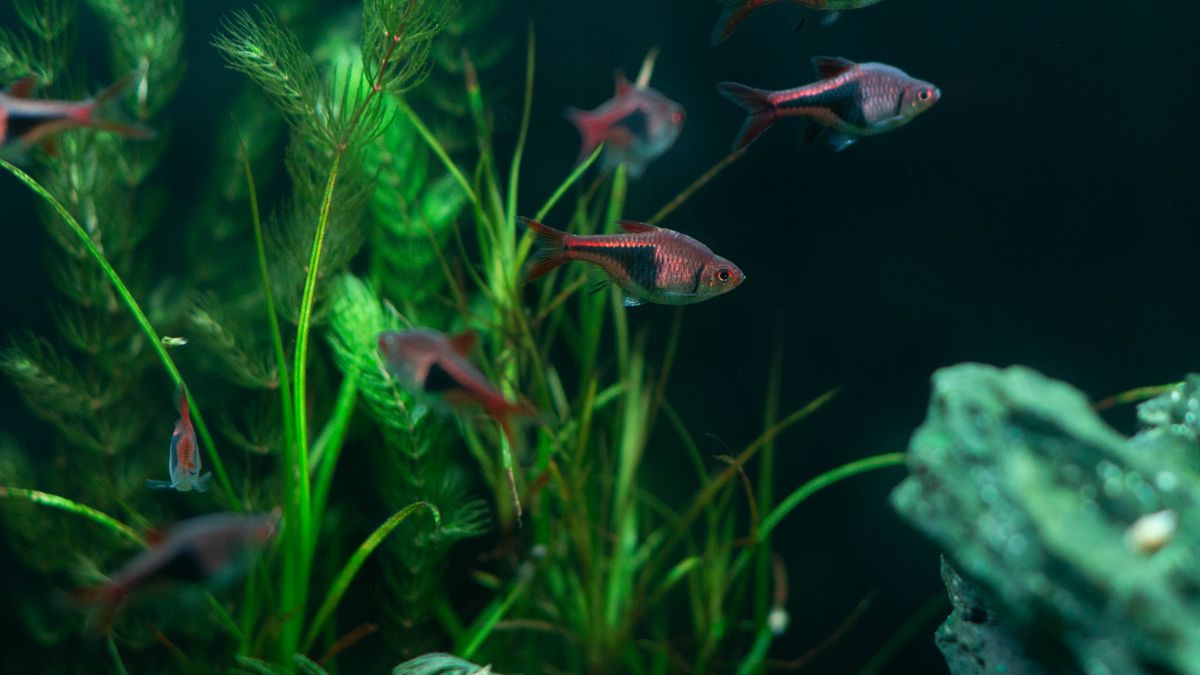
- Pexels — freshwater planted aquarium image
- Pexels License
Editorial note: routine cleaning is framed as selective waste export that protects the nitrogen cycle; water-change percentages are presented as starting ranges rather than universal rules. Sources were reviewed October 1, 2026.