
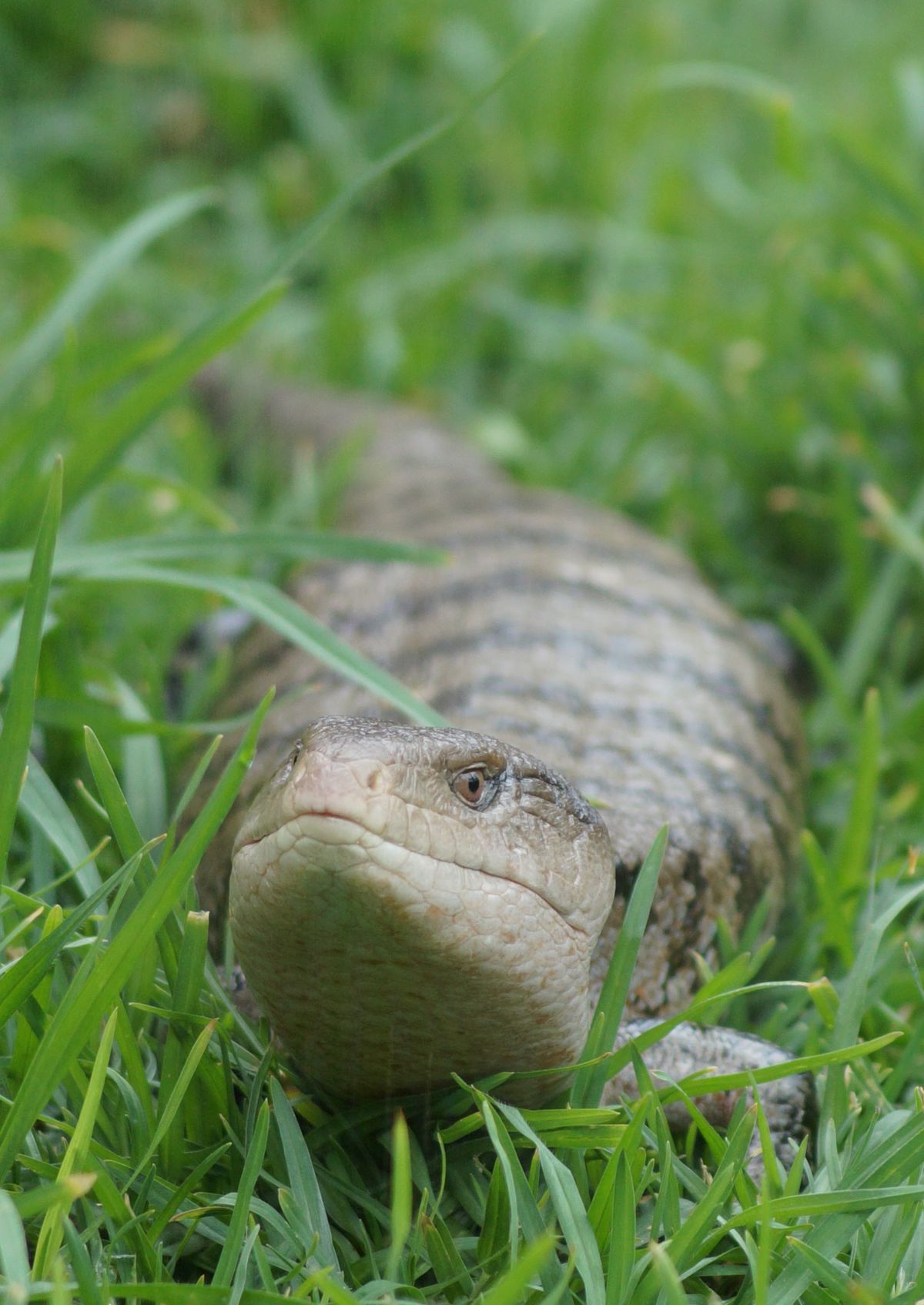
Blue-Tongue Lizard in Your Backyard: Is It Safe Around Dogs and Cats?
Yes — a blue-tongue lizard is generally safe to have around dogs and cats. Blue-tongues are not venomous or poisonous, and Australian wildlife guidance says they do not pose a significant threat to pets. The bigger risk usually runs the other way: dogs and cats can badly injure or kill a slow-moving blue-tongue. If you find one in the yard, the best approach is usually to bring your pets inside, give the lizard space and let it move on by itself.
What should I do right now?
If the lizard is healthy and your pets are calm: keep the dog/cat away and leave the blue-tongue alone.
If your pet is chasing or cornering it: secure the pet first. Give the lizard a clear escape route.
If the lizard has been bitten, mouthed or scratched: contact a wildlife rescue service or wildlife-friendly vet. Small punctures can be more serious than they look.
If you are not completely sure it is a blue-tongue rather than a snake: do not handle it. Move people and pets away and get professional identification/advice.
Are blue-tongue lizards dangerous to dogs or cats?
South Australia’s official backyard blue-tongue guidance is unusually direct: dogs and cats can do more harm to a blue-tongue than the lizard can do to them. Blue-tongues are not venomous and are not considered a significant threat to companion animals.
They do have a defensive display. A frightened blue-tongue may:
- flatten or puff up its body;
- turn to face the threat;
- open its mouth;
- show its bright blue tongue;
- hiss;
- bite if grabbed, cornered or attacked.
The display looks dramatic because it is supposed to. It is primarily a warning designed to make a predator hesitate.
The blue tongue is not a sign of venom. ACT Government specifically warns that these common garden lizards are sometimes mistaken for snakes even though they are non-venomous.
Why dogs and cats are the bigger danger
Blue-tongues are large skinks but they are comparatively slow-moving. That makes them vulnerable to pets that chase, pounce or shake wildlife.
NSW Environment and Heritage lists domestic dogs as a threat to native lizards including blue-tongues. Victorian wildlife material likewise warns that cats are natural hunters and that blue-tongues are common prey. RSPCA guidance for reptiles states that dog and cat bites can cause severe or fatal injuries.
Dog
A curious dog may paw, grab or shake the lizard. Even a “playful” interaction can cause crushing injury or punctures.
Cat
Stalking, pouncing and claw/bite wounds can be serious even when the lizard initially crawls away.
Blue-tongue
Its main defence is bluff, hissing and a bite if physically threatened. It cannot envenom your pet.
Best intervention
Control the pet rather than chasing the lizard. Once the threat disappears, the lizard will often move to shelter.
What if the blue-tongue bites my dog or cat?
A blue-tongue bite is a mechanical bite, not an envenomation. A defensive bite can still hurt and can break skin, particularly around a pet’s nose, lips or paw.
Separate the animals without putting your hands between them. Once your pet is calm, look for:
- bleeding that does not stop promptly;
- an eye injury;
- a deep puncture around the mouth or nose;
- marked swelling;
- persistent pain or pawing at the face;
- difficulty eating or closing the mouth normally.
If any of those are present, or if you are unsure how deep the wound is, contact your veterinarian. The key point is that you are treating a physical wound — there is no blue-tongue antivenom issue.
My dog or cat grabbed the lizard — what should I do?
Assume the lizard may be injured even if there is little visible blood. Reptile skin and scales can hide punctures, and crushing injuries may not be obvious immediately.
- Secure the dog or cat indoors.
- Do not repeatedly pick up or examine the lizard.
- If it is injured, immobile or unable to escape normally, contact wildlife rescue or a vet experienced with wildlife/reptiles.
- Keep people and other pets away while you wait for advice.
WIRES provides 24/7 wildlife rescue advice nationally on 1300 094 737 and can direct callers outside NSW to the appropriate local service.
Do not release an obviously injured lizard simply because it starts crawling again. Bite and crush injuries may need professional assessment.
What if I am not sure whether it is a blue-tongue or a snake?
Do not use this article as a reptile-identification test.
ACT Government specifically notes that blue-tongues can be confused with snakes. A confirmed blue-tongue has a stout body, obvious short legs and the characteristic fleshy blue tongue, but partial views through grass, mulch or a drain can be misleading.
If you did not get a clear look:
- bring dogs and cats indoors;
- keep children away;
- do not reach into vegetation or under objects;
- do not try to pick up the animal;
- get wildlife/snake-handler advice if identification matters.
If your dog had an unknown reptile encounter and then collapses, becomes weak, trembles or develops abnormal breathing, treat the situation as a possible snake emergency. Patify’s Australian snake-bite warning-sign guide explains the red flags.
Should I move the blue-tongue out of my yard?
Usually no.
Blue-tongues have a home range and know where shelter, food and water are within it. South Australian guidance warns that moving them away can put them in unfamiliar territory and may cause them to cross roads trying to return.
If the lizard is in immediate danger from your pet and you cannot simply secure the pet, SA guidance recommends moving the lizard only as a last resort, to the closest suitable sheltered location on the same property.
It describes using an open cardboard box placed beside the lizard and gently guiding it into the box, rather than carrying it a long distance.
Do not “relocate” a healthy backyard blue-tongue to bushland. Removing it from its known home range can create more risk than leaving it where it lives.
Can I catch it and keep it as a pet?
Wild blue-tongues are native wildlife, not free pets.
NSW Environment and Heritage states that all native reptiles are protected under the Biodiversity Conservation Act 2016 and that taking a native reptile from the wild — including from your backyard — is illegal without the appropriate authority. Native reptiles kept as pets must come through the lawful licensing/breeder system.
South Australian guidance likewise says it is illegal to catch wild blue-tongues to sell or keep as pets.
The safest rule anywhere in Australia is simple: leave a healthy wild blue-tongue wild, and check your state wildlife authority before capturing, keeping or moving native reptiles.
Why a blue-tongue can actually be good for your backyard
Blue-tongues eat garden invertebrates including snails, slugs and insects. NSW Environment and Heritage describes them as useful garden residents because they help control common pests.
You do not need to feed them. A wildlife-friendly garden gives them the resources they need naturally.
Useful habitat includes:
- dense low vegetation;
- leaf litter and mulch;
- rocks and logs for shelter;
- safe gaps under suitable garden structures;
- shallow clean water in a protected place;
- escape routes that dogs and cats cannot easily enter.
The garden hazard that matters: snail bait
This is one of the biggest practical reasons to rethink chemical pest control when a blue-tongue lives in the yard.
South Australian and Victorian wildlife guidance warns against snail pellets around blue-tongues. Blue-tongues eat snails and slugs, so poisoned prey can expose the lizard even when it does not deliberately eat the bait pellet itself.
Snail bait is also an emergency risk for dogs. If your dog may have eaten pellets directly, see Patify’s Australian snail-bait poisoning guide.
How to make one backyard work for pets and blue-tongues
| Backyard issue | Safer approach | Why it helps |
|---|---|---|
| Dog chases lizards | Supervise outdoor time, train a reliable leave-it/recall, create fenced refuge zones | Prevents direct attack without removing native wildlife |
| Outdoor cat | Keep cat indoors or use a secure cat enclosure | Reduces stalking and predation on lizards and birds |
| No hiding places | Retain shrubs, logs, rocks and safe pipe/refuge spaces | Gives blue-tongues somewhere to escape pets |
| Snails/slugs | Avoid broad use of toxic snail pellets | Protects lizards from poisoned prey and lowers household bait exposure |
| Fruit-tree netting | Use wildlife-safe netting and keep it taut/off the ground | Reduces reptile entanglement |
| Mowing/whipper snipping | Check long grass and edges first | Blue-tongues are slow and can be badly injured by garden equipment |
Should I feed a blue-tongue in my yard?
Usually no. South Australian guidance recommends allowing wild blue-tongues to find their own food rather than teaching them to rely on handouts.
A shallow dish of fresh water in a protected area can be useful in hot weather, provided it is cleaned regularly and the animal can get in and out safely.
Do not leave dog or cat food out specifically for wildlife. Food bowls can attract multiple animals and can change natural behaviour.
I found a baby blue-tongue — does it need rescuing?
Not simply because it is small.
Unlike many baby birds, blue-tongue young are born independent. South Australian guidance specifically states that baby blue-tongues do not need rescuing just because they are alone.
A baby does need help if it is:
- injured;
- attacked by a dog or cat;
- trapped;
- unable to move normally;
- in immediate danger that cannot be removed.
Why is the lizard barely moving?
Blue-tongues are ectothermic, so their activity changes with environmental temperature. In cool weather they enter a low-activity period known as brumation.
A lizard basking quietly or moving slowly on a cool morning is not automatically sick. South Australian guidance notes that blue-tongues may spend winter sheltered under vegetation, logs, debris or even drain pipes and emerge on warmer days to bask.
Concern is greater if the animal has obvious wounds, cannot right itself, has been attacked by a pet, is exposed in a dangerous location for a prolonged period or behaves abnormally under otherwise warm conditions.
Do blue-tongues carry germs?
Like other reptiles, they can carry bacteria including Salmonella. This is mainly a human-hygiene issue rather than a reason to remove a healthy wild lizard from the garden.
Healthdirect advises washing hands after handling animals, and people who are immunocompromised should be especially cautious around reptiles.
Since wild blue-tongues generally do not need handling at all, the simplest hygiene measure is also the best wildlife measure: observe rather than touch.
When should I call wildlife rescue?
Contact a wildlife service or wildlife-friendly veterinarian when a blue-tongue:
- has been bitten or scratched by a dog or cat;
- is bleeding;
- has an obvious limb, jaw, spine or tail injury;
- cannot move normally;
- has been hit by a car or mower;
- is trapped in netting or a structure;
- is repeatedly rolling or unable to right itself;
- remains unresponsive when environmental temperature is appropriate.
WIRES provides 24/7 wildlife rescue advice on 1300 094 737 and maintains national referral contacts for callers outside NSW.
Frequently Asked Questions
Are blue-tongue lizards poisonous to dogs?
No. Australian wildlife guidance states that blue-tongues are not poisonous or venomous and do not pose a significant toxic threat to dogs or cats. The more common danger is a pet injuring the lizard.
Can a blue-tongue lizard bite a dog?
Yes, if the lizard is cornered or attacked. The bite can be painful and may break skin, but it is not venomous. Contact your vet if your pet has a deep wound, eye/face injury, ongoing bleeding, marked swelling or persistent pain.
Should I remove a blue-tongue from my backyard?
Usually no. Blue-tongues have a home range and are valuable garden wildlife. Secure your pets and let the lizard move on. If it is in immediate danger, move it only to nearby suitable shelter rather than relocating it to another area.
Will a blue-tongue attack my cat?
Blue-tongues are defensive rather than predatory toward cats. They may hiss, display the blue tongue or bite if the cat attacks or corners them. Cats are generally the greater threat to the lizard.
What if my dog picked up a blue-tongue in its mouth?
Separate the animals and have the lizard assessed by wildlife rescue or a wildlife-friendly vet, even if obvious bleeding is minimal. Dog bites and crushing injuries can be serious for reptiles.
Do baby blue-tongues need their mother?
No. Blue-tongues give birth to live young that are independent. A small blue-tongue does not need rescue simply because it is alone, unless it is injured, trapped or in immediate danger.
Australian wildlife sources — checked 22 September 2026
- South Australia Department for Environment and Water — Blue-tongues in your backyard: non-venomous status, dog/cat interactions, nearby relocation, garden habitat, snail bait and independent young.
- NSW Environment and Heritage — Reptiles in Sydney: blue-tongues as useful garden residents; all native reptiles protected in NSW.
- NSW — Reptile keeper licences: taking native reptiles from the wild/backyard is unlawful without appropriate authority.
- ACT Government — Snakes and blue-tongue identification warning: blue-tongues are common Canberra garden lizards and are not venomous.
- RSPCA Knowledgebase — Blue-tongue in the backyard: low threat to people/pets, defensive behaviour and coexistence.
- RSPCA Knowledgebase — Reptiles and other pets: dog/cat bites can cause severe or fatal reptile injuries and warrant veterinary attention.
- WIRES — Contact / Rescue: 24/7 wildlife rescue advice on 1300 094 737 and national referrals.
- WIRES — Snake or blue-tongue in the garden: blue-tongues are commonly mistaken for snakes and are harmless garden neighbours.
- Healthdirect Australia — Animals and human health: reptiles can carry Salmonella; hand hygiene matters after contact.
Educational wildlife and pet-safety information only. If you are unsure whether an animal is a blue-tongue or a snake, keep people and pets away and seek professional identification rather than handling it.