
Is Cat Declawing Illegal in California? AB 867, Exceptions and Tenant Rights
Short answer: California law now prohibits non-therapeutic cat declawing statewide. Assembly Bill 867 took effect on January 1, 2026 and added Business and Professions Code § 4826.8, which allows onychectomy, tendonectomy, surgical claw removal, or another procedure that prevents normal claw function only for a medically necessary therapeutic purpose that protects the feline's health. Routine nail trimming and nonsurgical claw-tip devices remain expressly allowed.
California declawing law at a glance
Statewide rule: Non-therapeutic declawing is prohibited.
Effective date: January 1, 2026.
Key statute: California Business and Professions Code § 4826.8.
Medical exception: A medically necessary procedure for an existing or recurring infection, disease, injury, or abnormal condition involving the claws, nail bed, or toe bone that jeopardizes the feline's health.
Not a medical exception: Cosmetic reasons, furniture protection, or making a cat easier to keep or handle.
Still allowed: Nail trimming and nonsurgical scratching-mitigation devices such as temporary claw caps.
What AB 867 actually changed
AB 867 was signed in October 2025 and became effective January 1, 2026. The enacted law amended California's Veterinary Medicine Practice Act and added a statewide rule that applies to feline declawing procedures. The core provision is now codified at Business and Professions Code § 4826.8.
The rule in plain English
A veterinarian may not perform an onychectomy, tendonectomy, surgical claw removal, declawing, or another procedure that alters a feline's toes, claws, or paws so normal claw function is prevented or impaired unless the procedure is for a therapeutic purpose. California defines that therapeutic purpose by the feline's medical need, not by owner convenience.
This distinction matters because "declawing" is broader than simply removing visible nail tissue. Onychectomy removes the part of the digit from which the claw grows, while tendonectomy disables normal claw extension without removing the claw itself. California's wording is deliberately broad enough to cover procedures that impair normal function even if they use a different surgical label.
What counts as a "therapeutic purpose"?
The statute gives a much narrower definition than "my veterinarian thinks it might help." A therapeutic purpose must be a medically necessary procedure addressing an existing or recurring infection, disease, injury, or abnormal condition in the claws, nail bed, or toe bone that jeopardizes the feline's health.
| Reason for procedure | How California law treats it |
|---|---|
| Serious claw, nail-bed, or toe-bone disease that jeopardizes the cat's health | May qualify if the procedure is medically necessary |
| Severe injury involving a claw or toe | May qualify if medically necessary to address the injury |
| Recurring infection involving the claw, nail bed, or toe bone | May qualify if the statutory medical-necessity threshold is met |
| Scratching furniture | Does not qualify as a therapeutic purpose |
| Owner preference or convenience | Does not qualify |
| Cosmetic or aesthetic preference | Expressly excluded |
The statute's definition is tied to the cat's health. Unlike laws in some other jurisdictions, California's § 4826.8 does not create a separate therapeutic exception based on an owner's medical condition. A household member's fear of scratches or health concerns therefore should not be treated as if they automatically satisfy the California definition.
Can an owner perform declawing on their own cat?
No ordinary owner-care exception makes non-therapeutic declawing lawful. California Business and Professions Code § 4826 treats tendonectomy, onychectomy, and claw removal as the practice of veterinary medicine. Section 4827 preserves a limited owner exemption for some veterinary acts but specifically excludes the procedures covered by § 4826.8 from that owner exemption.
In practical terms, this means declawing is not treated like home nail trimming. The surgery falls within regulated veterinary practice, and the therapeutic-purpose restriction still applies.
Penalties and Veterinary Medical Board enforcement
The safest way to describe enforcement is to separate professional discipline from the broader penalties that can apply to violations of the Veterinary Medicine Practice Act.
| Provision | What it does |
|---|---|
| BPC § 4883(u) | Makes non-therapeutic feline declawing a specific ground for Veterinary Medical Board discipline. |
| BPC § 4875 | Allows the Board, for causes listed in § 4883, to assess a fine of up to $5,000 against a licensee, registrant, or permit holder, in lieu of or in addition to suspension or revocation. |
| BPC § 4831 | Provides misdemeanor penalties for a person who violates or aids or abets a violation of the chapter. The application of criminal provisions depends on the facts and enforcement decision in a particular case. |
That is more precise than saying every elective declaw automatically produces a particular criminal charge or a fixed fine. For licensed veterinarians, the current statute expressly creates disciplinary exposure, and the Board has authority to fine, suspend, revoke, deny, or place a license or registration on probation under the Veterinary Medicine Practice Act.
California renters: landlords were already barred from requiring declawing
AB 867 is not the only California law that matters to renters. California Civil Code § 1942.7 separately protects tenants and applicants where an animal is allowed on the premises. It bars a landlord or property-related business from requiring a tenant or occupant to declaw or devocalize an allowed animal, and it also restricts denying occupancy because a person refuses to do so.
A landlord may still have lawful rules about whether ordinary pets are allowed at all, subject to other housing laws and disability-accommodation rules. But a "cats allowed only if declawed" condition conflicts with California's specific declawing protection for occupancy. If a current lease still contains that wording, keep a copy of the lease and get advice from a California tenant-rights professional if the landlord tries to enforce it.
What declawing actually removes
Declawing is not the same as clipping a cat's nails. Feline veterinary guidance describes onychectomy as amputation of the third phalanx (P3), the bone associated with the claw. That anatomical difference is why veterinary organizations distinguish permanent surgical declawing from routine grooming.
The Feline Veterinary Medical Association opposes elective declawing and recommends that caregivers first use behavioral and environmental approaches that preserve normal scratching behavior. Scratching serves normal feline functions, including stretching, claw maintenance, and communication.
Legal and veterinary alternatives to declawing
California's statute expressly says it does not prohibit nail trimming or nonsurgical scratching-mitigation solutions. Those options also align with feline veterinary guidance.
Regular nail trimming
Shortening the sharp tip can reduce accidental scratches and damage without changing paw anatomy. Ask a veterinarian or veterinary technician to demonstrate safe trimming if you are unsure where the quick begins.
Stable scratching posts and pads
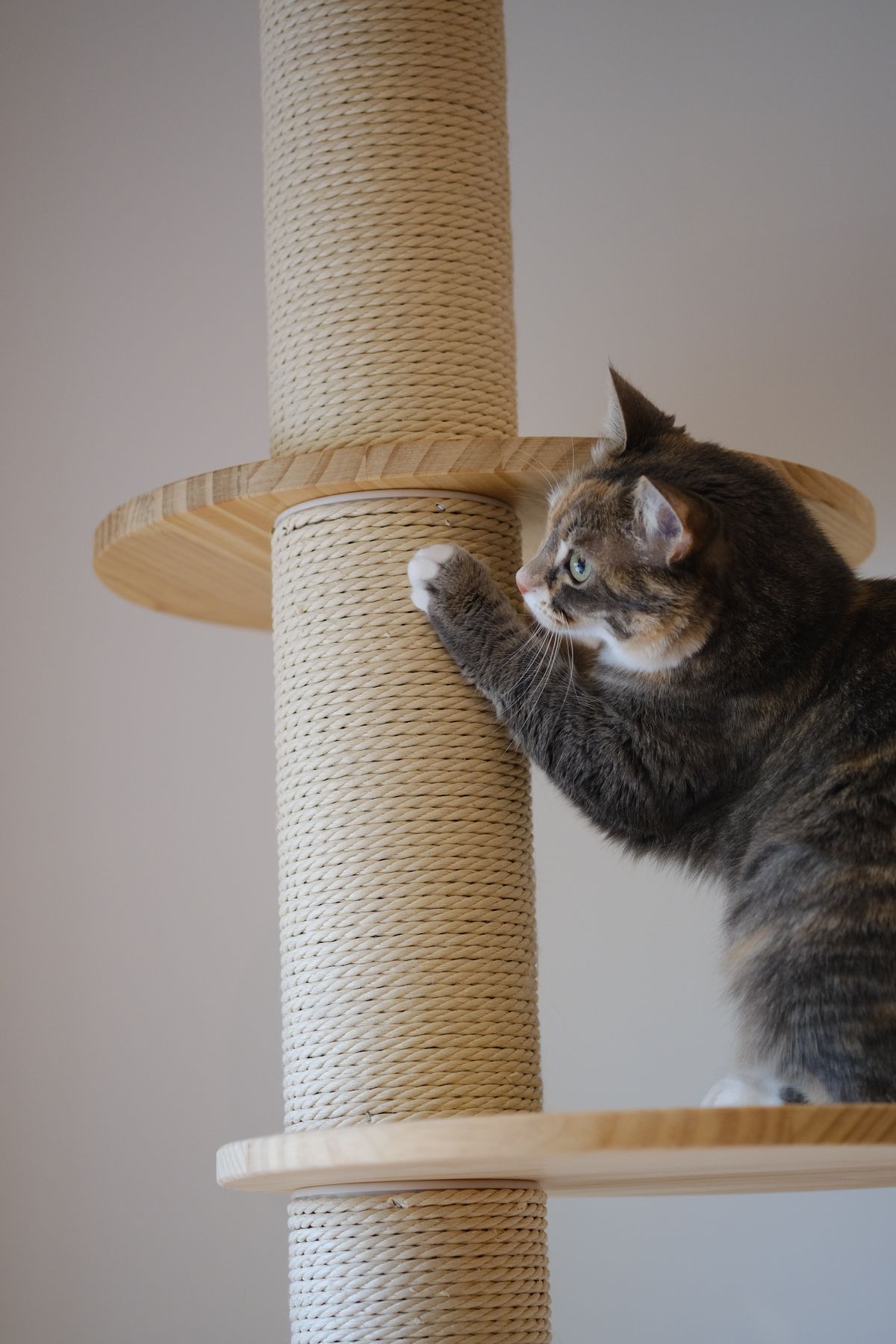
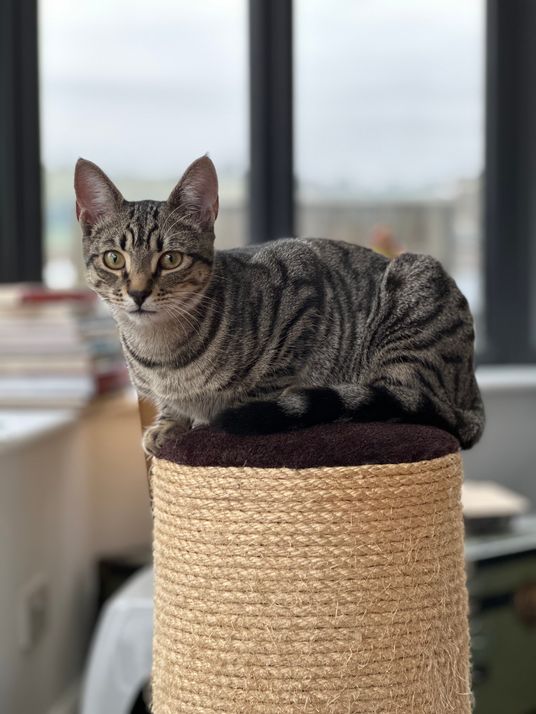
Offer both vertical and horizontal surfaces and place them close to the furniture, doorway, or location your cat already chooses. Stability and enough height for a full-body stretch matter.
Temporary synthetic nail caps
California law expressly permits nonsurgical claw-tip devices. They are temporary and require correct sizing, application, and replacement rather than permanent alteration of the paw.
Environmental enrichment
Play, climbing opportunities, resting areas, and predictable routines can reduce stress-related or redirected scratching. Reward use of appropriate scratching surfaces instead of punishing normal scratching behavior.
If your cat is scratching doors or other surfaces excessively, Patify's cat scratching behavior guide explains how to separate normal scratching, learned attention-seeking, frustration, and separation-related distress before choosing a response.
What should you do if a veterinarian recommends declawing?
- Ask for the diagnosis. What infection, disease, injury, or abnormal condition involving the claw, nail bed, or toe bone is being treated?
- Ask why surgery is medically necessary. The statutory exception is not simply "the cat scratches" or "the owner requested it."
- Ask what less invasive options exist. The answer will depend on the medical condition, but routine behavioral scratching has nonsurgical management options.
- Keep the medical record. If the procedure is genuinely therapeutic, the record should clearly reflect the condition being treated and the clinical reasoning.
- Consider a second veterinary opinion if the reason given sounds cosmetic, behavioral, or convenience-based rather than medical.
Frequently asked questions
Is cat declawing illegal everywhere in California?
Non-therapeutic declawing is prohibited statewide under Business and Professions Code § 4826.8. A medically necessary procedure that meets the statute's therapeutic-purpose definition remains permitted.
Can my California landlord require my cat to be declawed?
If the animal is allowed on the premises, California Civil Code § 1942.7 bars requiring a tenant or occupant to declaw the animal and bars specified occupancy discrimination based on a person's refusal to declaw or devocalize an animal.
Are nail caps illegal under AB 867?
No. Section 4826.8 expressly says the law does not prohibit nail trimming or nonsurgical scratching-mitigation solutions, including a device applied to the tip of a claw.
Does an immunocompromised owner's health automatically qualify as a therapeutic exception?
The California statute defines therapeutic purpose around a medically necessary procedure addressing a condition in the feline's claws, nail bed, or toe bone that jeopardizes the feline's health. The text does not create a separate owner-health exception.
Can I take my cat to another state for elective declawing?
AB 867 governs conduct under California law and does not by itself state the law of another jurisdiction. Other states have their own rules, and those rules can change. If this question matters in a real case, check the current law in the state where the procedure would occur rather than assuming it is permitted.
Does AB 867 apply only to domestic cats?
The enacted § 4826.8 uses the broader term "feline." California also has separate protections for exotic or native wild cat species under Penal Code § 597.6. Exotic-animal situations can involve additional state and federal rules.
Why this page is designed to stay current
The core rule is tied to the enacted statute rather than a calendar-year headline: non-therapeutic feline declawing is prohibited in California, while medically necessary therapeutic procedures remain possible. If the Legislature later amends § 4826.8, § 4883, or the related tenant statute, this page should be revised at that point rather than rewritten simply because the year changes.
Track your cat's care with Patify

Keep veterinary and behavior notes in one place
Record appointments, nail-trim dates, scratching patterns, and questions for your veterinarian so you can compare what changes over time.
Get Patify- California Legislature — Business and Professions Code §§ 4825–4831, including § 4826.8
- California Veterinary Medical Board — Veterinary Medicine Practice Act
- California Civil Code § 1942.7 — rental-property declawing protections
- Office of Governor Gavin Newsom — AB 867 signing announcement
- Feline Veterinary Medical Association — declawing position and alternatives