
California Cat Declawing Ban 2026: AB 867, Los Angeles Rules, Penalties & Landlord Rights
California now has a statewide restriction on elective feline declawing, but many summaries online still cite the wrong bill number, the wrong effective date, or Los Angeles enforcement claims that are not supported by public records. The statewide law is AB 867, signed October 9, 2025 and effective January 1, 2026. It added Business and Professions Code §4826.8, allowing declawing and related claw-disabling procedures only for a defined therapeutic purpose. Los Angeles is a special case because the City of Los Angeles already had a local declawing ordinance before the statewide law. This guide separates state law, City of Los Angeles law, Los Angeles County geography, veterinary discipline, and tenant rights so cat owners do not mix them together.
Quick answer: what is the law in California in 2026?
Statewide law: AB 867 (2025), effective January 1, 2026.
What it restricts: onychectomy, tendonectomy, surgical claw removal, declawing, or another procedure that alters a feline's toes, claws, or paws to prevent or impair normal function, unless performed for a therapeutic purpose.
Therapeutic purpose: a medically necessary procedure addressing an existing or recurring infection, disease, injury, or abnormal condition in the claw, nail bed, or toe bone that jeopardizes the cat's health.
Veterinary consequences: non-therapeutic declawing is grounds for Veterinary Medical Board discipline. The Board can assess a fine of up to $5,000 under Business and Professions Code §4875, and violations of the Veterinary Medicine Practice Act can also carry misdemeanor consequences under §4831.
Rentals: California Civil Code §1942.7 separately prohibits a housing provider that allows animals from requiring a tenant or occupant to declaw an animal. That tenant protection has been effective since January 1, 2013.
The most important correction: it is AB 867, not AB 1230
California's 2026 statewide feline declawing restriction comes from Assembly Bill 867 (Lee), Chapter 479, Statutes of 2025. The Governor approved it on October 9, 2025. Its relevant provisions became effective January 1, 2026.
AB 1230 was an earlier California declawing proposal from 2019. It is not the statute that created the current statewide 2026 rule. That distinction matters because legal articles that cite AB 1230 as a law effective in 2024 can mislead readers about both the governing code section and the actual enforcement framework.
| Claim | Correct 2026 position | Authority |
|---|---|---|
| "AB 1230 created the statewide ban in January 2024" | Incorrect | Current statewide law comes from AB 867, effective Jan. 1, 2026 |
| California restricts non-therapeutic feline declawing statewide | Correct | Bus. & Prof. Code §4826.8 |
| City of Los Angeles had a local ban before 2026 | Correct | L.A. Municipal Code §53.72, effective Nov. 20, 2009 |
| "Los Angeles County documented $1,000–$5,000 declawing fines in 2025–2026" | Not established by the public sources reviewed | Do not state this as fact without a specific enforcement record |
What AB 867 actually prohibits
Business and Professions Code §4826.8 is broader than the everyday word “declawing.” It covers an onychectomy, tendonectomy, surgical claw removal, declaw, or another procedure that alters a feline's toes, claws, or paws in order to prevent or impair their normal function.
| Procedure or care | California status in 2026 | Why |
|---|---|---|
| Elective onychectomy / surgical declaw | Not permitted | May be performed only for a statutory therapeutic purpose |
| Tendonectomy intended to impair normal claw function | Not permitted | Expressly included by §4826.8 |
| Other surgery altering toes, claws, or paws to prevent normal function | Not permitted | The statute is written to cover function-impairing alternatives, not only one surgical technique |
| Procedure medically necessary for qualifying infection, disease, injury, or abnormal condition | Potentially permitted | Falls within the therapeutic-purpose exception when the statutory medical standard is met |
| Routine nail trimming | Permitted | The statute expressly says nail trimming is not prohibited |
| Temporary nonsurgical claw-tip devices / nail caps | Permitted | The statute expressly preserves nonsurgical scratching-mitigation solutions |
The therapeutic exception: narrower than “my vet recommends it”
The statute defines a therapeutic purpose as a medically necessary procedure used to address an existing or recurring infection, disease, injury, or abnormal condition in the claws, nail bed, or toe bone when that condition jeopardizes the feline's health. Cosmetic or aesthetic reasons and reasons of convenience in keeping or handling the cat are expressly excluded.
That means a serious localized problem—such as diseased tissue, a damaging injury, or another qualifying abnormal condition—may justify removal of an affected claw or digit when medically necessary. It does not mean that a healthy cat may be declawed because scratching is inconvenient.
Owners should ask the veterinarian what diagnosis is being treated, what less-invasive options were considered, and exactly which claw, toe, or paw structure requires intervention. Those are sensible medical-record questions regardless of the legal issue.
California penalties: three different systems people often mix together
There is no single “California declawing fine.” Different provisions govern veterinary discipline, criminal violations of the Veterinary Medicine Practice Act, and landlord conduct.
Veterinary Medical Board discipline
AB 867 added non-therapeutic feline declawing to the grounds for discipline in Business and Professions Code §4883. Under §4875, the Board may assess a fine of up to $5,000 against a licensee, registrant, or permitholder for causes specified in §4883, in lieu of or in addition to suspension or revocation.
Practice Act misdemeanor
Business and Professions Code §4831 provides that a person who violates or aids or abets a violation of the chapter is guilty of a misdemeanor, with a statutory fine of $500–$2,000, county jail exposure of 30 days to one year, or both. Actual charging and sentencing depend on the case.
Landlord civil penalties
Civil Code §1942.7 carries a civil penalty of up to $1,000 per advertisement for prohibited advertising and up to $1,000 per animal for specified refusal/declawing-demand violations. Enforcement standing is given to specified public prosecutorial entities.
Los Angeles: City law, County geography, and the statewide rule
City of Los Angeles: Los Angeles Municipal Code §53.72 was added by Ordinance No. 180,986 and became effective November 20, 2009. It prohibits causing or performing onychectomy or flexor tendonectomy on a cat or other animal in the City except for a therapeutic purpose. A violation is a misdemeanor.
Los Angeles County: “Los Angeles County” includes the City of Los Angeles plus many other incorporated cities and unincorporated areas. The City ordinance is not a countywide ordinance. Since January 1, 2026, however, AB 867's feline rule applies statewide, including throughout Los Angeles County.
AB 867 specifically says it does not preempt a local ordinance adopted before January 1, 2026 that limits the covered feline declawing procedures or imposes penalties for violating that ordinance. That preserves older local rules such as Los Angeles City's ordinance.
Was there documented LA County declawing enforcement in 2025–2026?
The public sources reviewed for this update do not support the claim that Los Angeles County documented a series of veterinary declawing cases with $1,000–$5,000 fines in 2025–2026. The statewide law did not even become effective until January 1, 2026.
As of this September 5, 2026 review, searches of the California Veterinary Medical Board's public 2026 disciplinary-actions page for “declaw,” “onychectomy,” and “tendonectomy” did not return a matching public entry. That does not prove no complaint, investigation, citation, or nonpublic matter exists; Board investigations can be confidential. It simply means a public article should not invent or imply specific Los Angeles County enforcement cases without a traceable case record.
How to report suspected unlawful declawing
For conduct by a California veterinarian or veterinary facility, the California Veterinary Medical Board is the primary state licensing authority. The Board says the most effective complaint method is its BreEZe online complaint system and recommends factual, chronological information plus supporting documents.
- Write down the facts: clinic name, veterinarian name, date, what procedure was offered or performed, and the stated medical reason.
- Preserve documents: estimates, invoices, discharge instructions, consent forms, emails, photographs, and medical records you already have.
- Request the patient record: keep the request and the response. Do not alter records or ask anyone to rewrite the medical history.
- File with the Veterinary Medical Board: use the Board's BreEZe complaint process and present facts rather than conclusions.
- If the conduct occurred inside the City of Los Angeles: the local ordinance may also be relevant, so consider asking Los Angeles Animal Services or the City Attorney's appropriate consumer/enforcement channel which local reporting route applies to the facts.
Can a California landlord require a cat to be declawed?
California addressed this issue years before the 2026 statewide veterinary law. Civil Code §1942.7 applies to a person or corporation connected with real property that allows an animal on the premises. It prohibits discouraging applicants because an animal is not declawed or devocalized, denying occupancy because a person refuses to declaw or devocalize an animal, and requiring a tenant or occupant to declaw or devocalize an animal that is allowed on the property.
The careful distinction is important: §1942.7 does not convert every California rental into a pet-friendly property. A housing provider may still have a lawful general pet policy where other laws do not require an exception. But if the provider allows the animal, it cannot make declawing the price of keeping that animal.
| Rental scenario | 2026 California rule |
|---|---|
| “Your cat may live here only if you declaw it.” | Prohibited by Civil Code §1942.7 |
| Advertising meant to discourage applicants because their allowed animal is not declawed | Prohibited by §1942.7 |
| Landlord allows pets and refuses tenancy because applicant will not declaw the cat | Prohibited by §1942.7 |
| General no-pets rule for an ordinary pet | A separate question; depends on the lease and other applicable law |
| Service or assistance animal | Separate fair-housing/disability rules may apply; do not analyze it as an ordinary pet |
For the separate and fast-changing assistance-animal deposit issue, see Patify's 2026 ESA deposit and landlord guide.
What about a pet deposit in California?
A pet deposit is treated as part of the security deposit for California residential rentals. The California Attorney General explains that, for most residential properties, the security-deposit limit is one month's rent. California's 2025 tenant guide also notes a limited small-landlord exception that can allow up to two months' rent when the statutory requirements are met. A separate label such as “pet deposit,” “cleaning fee,” or “key fee” does not allow a landlord to evade the total statutory cap.
This deposit rule is independent of declawing. A landlord cannot turn a legal security-deposit right into a demand that the tenant surgically alter the cat.
Legal, evidence-based alternatives to declawing
The Feline Veterinary Medical Association (formerly AAFP) strongly opposes elective declawing and describes scratching as normal feline behavior. Its alternatives include scratching posts or pads, routine claw trimming, temporary synthetic nail caps, environmental enrichment, and behavior-focused management.
- Offer stable vertical and horizontal scratchers: different cats prefer different materials and orientations.
- Place scratchers where the behavior already happens: beside a favored sofa corner, sleeping area, doorway, or other target zone.
- Trim claws regularly if the cat tolerates it: ask a veterinarian or feline-friendly technician to demonstrate safe technique if needed.
- Consider temporary nail caps: these are nonsurgical and are expressly consistent with the type of claw-tip mitigation preserved by California's statute.
- Use positive reinforcement: reward the cat for using appropriate scratching surfaces instead of punishing normal scratching behavior.
- Investigate sudden behavior changes: abrupt or excessive scratching can reflect stress, environmental change, or another behavioral/medical issue.
If scratching at doors is the main problem rather than furniture damage, Patify's cat scratching at the door behavior guide explains how to separate attention-seeking patterns from distress-related behavior.
Frequently asked questions
Is elective cat declawing illegal throughout California in 2026?
California Business and Professions Code §4826.8 allows the covered feline claw-disabling procedures only for a therapeutic purpose as defined by the statute. The statewide rule has been effective since January 1, 2026.
Was the statewide ban AB 1230?
No. The operative 2026 statewide law is AB 867 (Lee), Chapter 479, Statutes of 2025. AB 1230 was an earlier proposal and should not be cited as the source of the current statewide law.
Can a California veterinarian remove one claw because of a tumor or serious injury?
Potentially. The law has a therapeutic-purpose exception for medically necessary treatment of qualifying infection, disease, injury, or abnormal conditions in the claw, nail bed, or toe bone that jeopardize the cat's health. The legal and clinical question is medical necessity, not whether tissue is being removed.
Is the maximum veterinary fine exactly $5,000 for every illegal declaw?
No. Business and Professions Code §4875 gives the Veterinary Medical Board authority to assess a fine of up to $5,000 for disciplinary causes specified in §4883. It is a maximum disciplinary authority, not a declawing-specific automatic fine schedule.
Can my Los Angeles landlord require nail caps instead?
California's anti-declawing tenant statute prohibits requiring surgical declawing or devocalization in the circumstances covered by Civil Code §1942.7. Whether a particular nonsurgical lease condition is enforceable depends on the lease and other housing law. A landlord and tenant can often resolve property-protection concerns with routine nail care, scratchers, or other nonsurgical measures without changing the cat's anatomy.
Does Los Angeles County have the same ordinance as the City of Los Angeles?
Do not treat them as interchangeable. Los Angeles Municipal Code §53.72 is a City of Los Angeles ordinance. AB 867 is statewide and therefore applies across Los Angeles County, but a local ordinance must be checked for the specific city or unincorporated area where the conduct occurred.
Bottom line for California cat owners
The 2026 rule is clearer than many online summaries make it sound: AB 867 is the statewide law, it took effect January 1, 2026, and elective claw-disabling procedures on felines are not permitted outside the statute's therapeutic exception. Los Angeles City had already prohibited declawing locally since 2009, while California tenant law has prohibited covered landlord declawing demands since 2013.
The safest way to use this information is to identify the exact jurisdiction, read the current statutory text, preserve veterinary or rental documents, and use the appropriate regulator or legal-aid channel when there is a real dispute. This article provides general educational information and is not individualized legal advice.
California Business & Professions Code §§4826, 4826.8, 4831, 4875 and 4883
California Civil Code §1942.7 — landlord declawing/devocalization restrictions
California Veterinary Medical Board — 2026 Veterinary Medicine Practice Act; complaint guidance; 2026 public disciplinary actions
Los Angeles Municipal Code §53.72 — City of Los Angeles declawing prohibition, effective Nov. 20, 2009
California Attorney General / Department of Real Estate — California tenant and security-deposit guidance
Feline Veterinary Medical Association — Declawing Position Statement and Claw Friendly resources
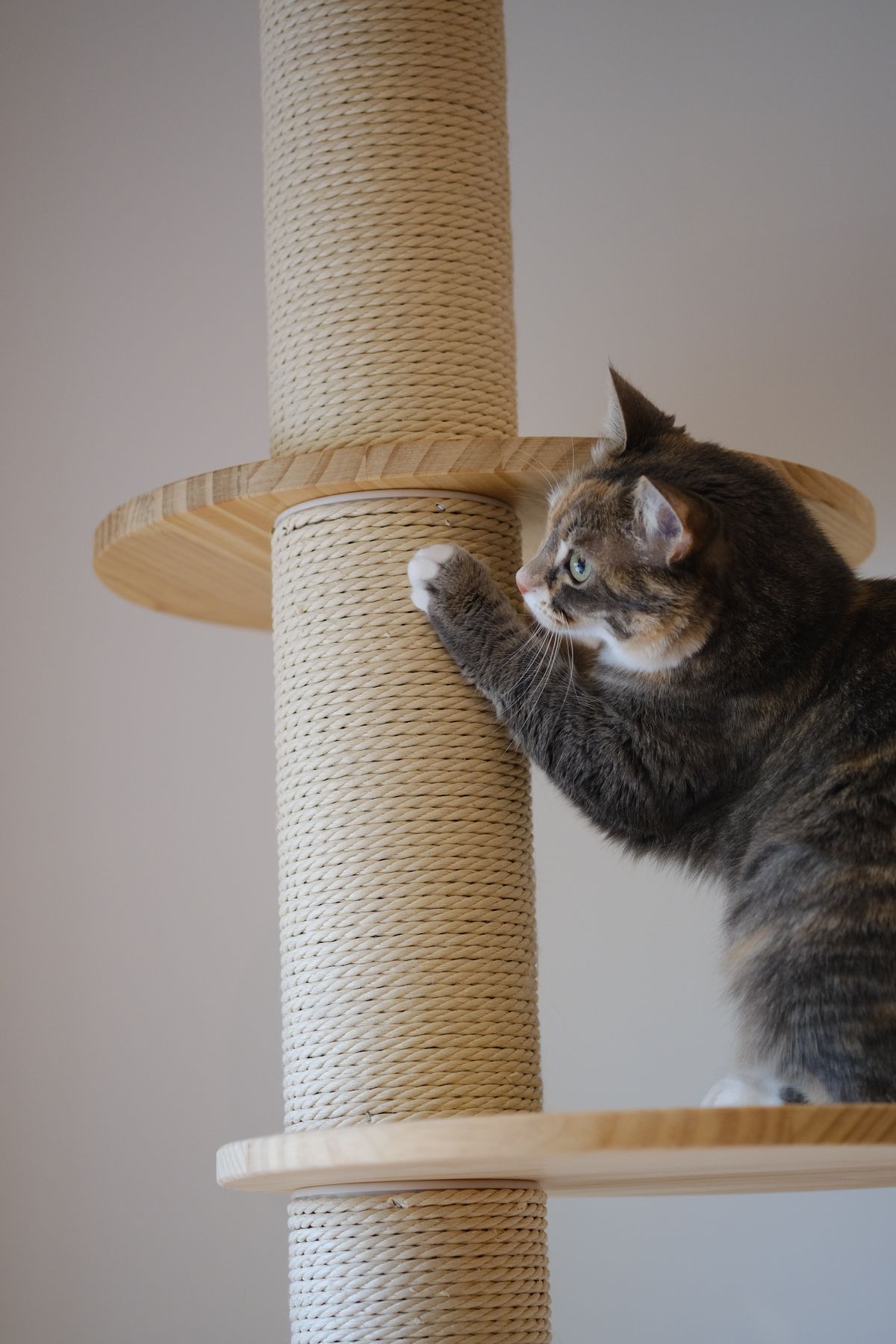
Pexels — Jasmine Pang, “A Cat Scratching a Cat Tree,” free-to-use image