
Chartreux breed guide · Temperament · Care · Health · Buying
Chartreux Cat: Temperament, Care, Health, Price & Breed Guide
Last updated: September 5, 2026
Quick answer: the Chartreux is a rare French pedigree cat known for an all-blue coat, gold-to-copper eyes, a dense slightly woolly double coat, a muscular body on comparatively fine legs, and a generally quiet, adaptable temperament. The breed is often called France's “national cat” by cat registries and breed writers, but that is best treated as a cultural description rather than an official government title.
The biggest buying mistake: assuming that any blue-gray cat with amber eyes is a Chartreux. Appearance alone cannot establish pedigree. If breed identity matters, verify the cat through recognized registration/pedigree records and the breeder—not a photo, color, or marketplace label.
The biggest health correction: patellar luxation has genuinely been reported in the breed by CFA. PKD is more nuanced: a published case exists and GCCF breeding programs require PKD1 testing, but GCCF describes the mutation as extremely uncommon in Chartreux. That is not the same as proving a high breed-wide PKD prevalence.
Chartreux at a glance
| Trait | What the breed standards support |
|---|---|
| Origin / identity | Historic French breed; the exact ancient origin is debated. Modern selective breeding in France began in the 1920s. |
| Coat | Blue-gray only, from lighter ash/blue to deeper slate shades depending on registry wording; dense, short-to-medium-short, resilient and slightly woolly. |
| Eyes | Gold/copper in CFA; LOOF describes yellow to orange. Green eyes are not correct for the breed standard. |
| Build | Robust, muscular body with comparatively fine-boned legs; males are usually larger and slower to mature. |
| Maturity | CFA notes that full maturity can take roughly 3–5 years. |
| Voice | Often quiet, with some cats using chirps, trills or a small voice; individual cats vary. |
| Temperament | Commonly described by CFA/TICA/GCCF as calm, adaptable, affectionate and intelligent—but breed tendencies are not personality guarantees. |
| Availability | Relatively rare in North America and the UK; waitlists are normal with established breeders. |
Is the Chartreux really France's national cat?
TICA and FIFe both describe the Chartreux as France's national cat, and the breed is deeply associated with French culture. CFA calls it a “French treasure.” However, that phrase should not be presented as though the French government issued a formal legal designation.
For an evergreen breed guide, the more defensible wording is: the Chartreux is one of France's best-known historic native cat breeds and is widely referred to in the cat fancy as France's national cat.
History: what is documented—and what is legend?
The monastery story is famous: Chartreux cats are said to have lived with Carthusian monks and become quiet companions or mousers. It is a charming story, but CFA explicitly presents it as legend, and France's LOOF says the breed was not bred by the monks.
The deeper origin is also uncertain. LOOF and FIFe discuss a possible route from the Middle East into Europe, but this should be treated as historical theory rather than a proven 13th-century migration story.
What is much firmer is the modern history:
- Blue cats associated with France appear in historical literature for centuries.
- In the 1920s, the Léger sisters began selective breeding using a natural blue-cat population on Belle-Île-sur-Mer.
- The breed later became entangled with the blue British Shorthair in European registry history.
- FIFe restored separate Chartreux and British standards in 1977 after breeders argued that the Chartreux's identity was being lost.
- CFA accepted the Chartreux for registration in 1979 and granted championship status in 1987.
Better than the monk myth: the real Chartreux story is the preservation of a distinctive French blue-cat population through organized 20th-century breeding.
How to recognize a Chartreux
Breed standards focus on a specific combination rather than one “magic” feature.
Blue coat only
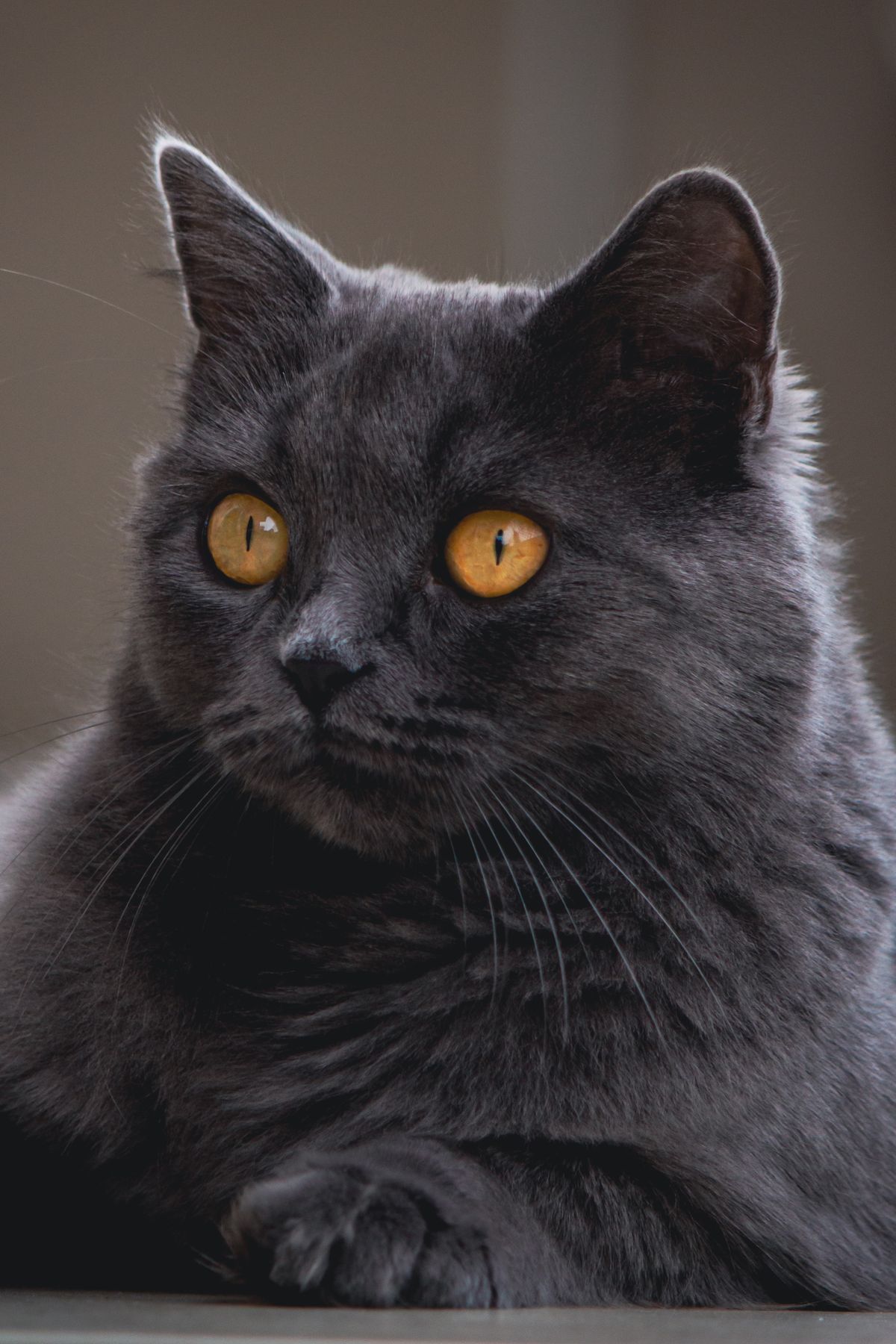
CFA accepts any shade of blue-gray from ash to slate, prioritizing an even, clear color. LOOF likewise recognizes blue as the breed color.
Gold-to-copper eyes
CFA prefers clear deep orange within a gold-to-copper range. LOOF describes yellow to orange. Bright green adult eyes point away from Chartreux type.
Woolly double coat
The coat is dense and slightly woolly, with a resilient undercoat and protective outer coat. Texture is a major breed-standard feature.
Robust body, finer legs
The famous “potato on toothpicks” nickname describes the contrast: broad shoulders and muscular torso carried on comparatively fine legs.
Distinctive head
LOOF describes a broad trapezoidal head with full cheeks; CFA describes a broad rounded head tapering toward a smaller muzzle.
The “smile”
Full whisker pads and the tapered muzzle can create the impression of a gentle smile. It is an expression created by head structure, not a behavioral sign.
Color is not pedigree. Blue British Shorthairs, Russian Blues, Korats, domestic shorthairs and mixed-breed cats can all be gray/blue. A genuine pedigree claim should come with traceable registry records.
Chartreux temperament: quiet and affectionate, not a personality template
CFA, TICA and GCCF consistently describe the breed as calm, adaptable, intelligent and affectionate. Many Chartreux are relatively quiet and some retrieve toys, follow people from room to room, learn routines or communicate with chirps and subtle body language.
Still, avoid statements such as “every Chartreux hates noise,” “they are never lap cats,” or “they always love children and dogs.” Temperament is shaped by genetics, early socialization, handling, health, environment and the individual cat.
Likely good fit
You enjoy an affectionate but often less vocally demanding companion, can provide play and climbing opportunities, and are comfortable allowing the cat to choose how much physical contact it wants.
Think carefully
You want a guaranteed lap cat, expect a fixed breed personality, have unmanaged rough handling from children, or cannot provide enrichment and veterinary care.
Chartreux care: coat, food, activity and routine health
Coat care
CFA recommends occasional combing with more frequent grooming when seasonal shedding is heavy. GCCF similarly describes regular combing as appropriate for the dense woolly coat. There is no need to force a rigid “once every seven days” schedule on every cat.
- Use a comb or grooming tool that reaches loose undercoat without scraping the skin.
- Increase grooming when loose undercoat and matting risk rise.
- Most Chartreux do not need routine baths; CFA notes that fully wetting the water-resistant coat can be difficult.
- Watch body condition under the dense coat rather than judging weight by appearance alone.
If shedding becomes the bigger household problem, see Why Is My Cat Shedding So Much? What's Normal & What Helps.
Feeding
The Chartreux does not need a special “high-protein/low-carb breed diet.” Cats do require species-appropriate nutrition, but the practical standard is a complete and balanced diet appropriate for life stage, with portions adjusted to body condition, activity, age and veterinary needs.
- Do not judge food quality only by “meat is the first ingredient” or “grain-free” marketing.
- Use measured portions when weight is creeping up; CFA specifically notes weight gain as a concern in some mature Chartreux.
- Wet food, dry food or a combination can work when the overall diet is nutritionally complete and the cat maintains appropriate hydration and body condition.
- Do not add fish oil, vitamins or joint supplements automatically because of the breed name.
Activity and enrichment
Chartreux are often described as skilled hunters and intelligent problem-solvers. Give the cat opportunities to stalk, chase, climb, scratch and solve simple food puzzles. The useful target is regular voluntary activity, not an arbitrary “exactly 10–15 minutes per day” rule.
Teeth, nails and ears
AAHA/AAFP feline guidelines support proactive dental care, including acclimating cats to tooth brushing or wiping where possible. Trim nails as needed. Healthy ears generally do not need routine weekly cleaning; discharge, odor, crusting or repeated head shaking deserves veterinary attention.
Chartreux health: what is actually supported?
| Issue | Evidence level for Chartreux | What an owner/buyer should do |
|---|---|---|
| Patellar luxation | Breed-relevant. CFA states that a heritable patellar luxation has been seen in some Chartreux. | Ask whether breeding cats have had patellar evaluation. See a vet for skipping gait, intermittent hind-limb lameness or mobility change. |
| PKD / PKD1 | Real but easy to overstate. A 2010 peer-reviewed case report documented PKD in a Chartreux. GCCF calls PKD1 extremely uncommon in the breed but requires testing in its breeding program. | Ask what PKD1 testing is required by the breeder's registry and request the actual result where relevant. Do not assume every Chartreux needs annual kidney ultrasound solely because of breed. |
| Weight gain / obesity | Practical breed concern. CFA notes weight gain can be a problem in some mature Chartreux. | Use body-condition scoring and weight trends; adjust calories with veterinary guidance rather than relying on the cat's fluffy silhouette. |
| Urinary stones | No strong breed-specific evidence established here. | Do not feed an “urine-acidifying” diet prophylactically without a diagnosis. Straining to urinate, repeated box trips or inability to pass urine requires urgent veterinary care. |
| Routine feline disease | Chartreux still face the same dental, infectious, renal, endocrine and age-related problems as other cats. | Minimum annual veterinary exams are sensible for adults; AAHA/AAFP recommends at least every 6 months for seniors. |
Do not confuse a case report with prevalence. “PKD has been reported in a Chartreux” is true. “Chartreux commonly get PKD” is not established by that single report.
UK buyer bonus: GCCF has unusually specific Chartreux breeding tests
This is a useful example of why breed-health advice should be registry-specific. GCCF's Chartreux breeding policy requires breeding cats in its program to be clear/appropriately documented for:
- PKD1;
- blood group, including relevant alleles;
- coat length, including at least the M4 longhair allele.
GCCF's own policy says the PKD1 gene is extremely uncommon in Chartreux, but still important to exclude because the disease can be severe. A U.S. buyer should not assume the exact same registration scheme applies under CFA or TICA.
How much does a Chartreux kitten cost?
There is no official global Chartreux price. Country, pedigree, breeder program, veterinary work, import costs, neuter status and availability all change the quote.
| Market snapshot | Published reference | How to use it |
|---|---|---|
| United States | PetMD currently cites roughly $1,300–$1,700 for a Chartreux kitten. | A reference point, not a price ceiling or guarantee. Rare lines, transport and breeder terms can change the total. |
| United Kingdom | Chartreux Cat Club UK currently says buyers should expect about £1,200 and may face a wait of up to 10 months. | Useful because it comes from the breed club, but confirm the current quote before joining a list. |
| Canada / other markets | No single current authoritative price is used in this guide. | Ask recognized breeders for written all-in quotes rather than converting a U.S. price and presenting it as local market data. |
Price snapshot checked: September 5, 2026. Prices are the deliberately non-evergreen part of this otherwise evergreen guide and should be rechecked periodically.
A low price does not prove a scam, and a high price does not prove quality. The safer signals are breeder identity, traceable pedigree, veterinary records, contract, kitten-rearing practices, health-testing transparency and willingness to answer detailed questions.
How to buy a real Chartreux without getting scammed
- Start with recognized sources. CFA and TICA maintain breeder-finding resources; in the UK, use GCCF and the established Chartreux breed club.
- Verify the pedigree claim. A blue coat and copper eyes are not enough. CFA registration rules require certified pedigrees for Chartreux in relevant registration situations.
- Ask for health evidence, not “health-tested” as a slogan. Request the actual patellar evaluation and any registry-required DNA results.
- Ask how kittens are raised and when they leave. TICA says knowledgeable breeders commonly place kittens at 12 weeks or older; CFA guidance often favors around 16 weeks and advises caution below 14 weeks except special circumstances.
- Expect a written agreement. Health guarantee, registration status, neuter/spay terms, return policy and what happens if ownership later changes should be clear.
- Verify the breeder as a real person. CFA warns that scam sites may show many “available” kittens and stolen photos. Ask for a live video call or other current verification when an in-person visit is not possible.
- Do not pay because you feel rushed. Artificial urgency, unusual payment demands, refusal to discuss parents or records, and a huge inventory of rare kittens are red flags.
Chartreux vs. Russian Blue vs. blue British Shorthair
| Feature | Chartreux | Russian Blue | Blue British Shorthair |
|---|---|---|---|
| Adult eye color | Gold to copper / yellow-orange | Vivid green in CFA standard | Blue solid: gold or copper in CFA standard |
| Body | Robust, muscular; comparatively fine legs | Longer, lithe, fine-boned and graceful | Broad, compact/cobby-looking and heavy-set compared with the other two |
| Head | Broad/trapezoidal or rounded with smaller tapered muzzle and full cheeks | Medium wedge; larger ears; cleaner facial lines | Very round head and fuller, rounder overall expression |
| Coat | Dense, slightly woolly, resilient double coat | Short, plush, soft double coat with distinct silver tipping | Very dense plush coat; blue is only one of many accepted colors |
| Accepted color range | Blue only | Blue only in CFA | Many colors and patterns; “British Blue” is one variety |
| Can a photo prove the breed? | No | No | No |
Fast visual clue, not proof: bright green adult eyes strongly favor Russian Blue over Chartreux; a very round, plush “teddy bear” build favors British Shorthair; Chartreux combines gold/copper eyes with the muscular body + finer-leg contrast. Pedigree still decides a pedigree claim.
Is a Chartreux right for you?
Likely yes if...
- You like quieter, observant cats.
- You can provide play, climbing and hunting-style enrichment.
- You are comfortable with seasonal shedding and regular combing.
- You can wait for a responsible breeder rather than buying the first gray kitten advertised.
- You can budget for routine and emergency veterinary care.
Think twice if...
- You want a guaranteed personality trait such as “always cuddly.”
- You need a hypoallergenic cat.
- You dislike fur in the home.
- You are choosing primarily because the breed is rare or fashionable.
- You are unwilling to verify pedigree and breeder records.
Frequently asked questions
Are Chartreux cats really mute?
No. The breed is known for a relatively small or infrequently used voice, and some individuals chirp or trill more than they meow. A Chartreux is not anatomically “mute” as a breed.
Is the Chartreux the official national cat of France?
TICA and FIFe describe it as France's national cat, and the phrase is common in the cat fancy. This guide treats that as a cultural/breed-world label rather than claiming a formal French government designation.
How can I tell a Chartreux from a Russian Blue?
Adult eye color is a strong clue: Chartreux standards call for yellow/orange to gold/copper, while CFA's Russian Blue standard calls for vivid green. Chartreux also have a more robust body and different head shape. A pedigree is needed to establish breed identity.
Are Chartreux cats hypoallergenic?
No cat breed is reliably allergen-free. CFA specifically notes the Chartreux's abundant woolly undercoat and does not recommend the breed for allergy sufferers.
Do Chartreux need a special diet?
No breed-specific high-protein or low-carb prescription is required for a healthy Chartreux. Feed a complete and balanced diet for the cat's life stage and adjust portions to maintain healthy body condition.
How often should a Chartreux be groomed?
Comb regularly and increase frequency when loose undercoat or matting rises. CFA specifically recommends more frequent grooming during heavier seasonal shedding rather than one rigid year-round schedule.
Is PKD common in Chartreux?
Current evidence does not justify calling PKD common in the breed. A peer-reviewed Chartreux case has been published, and GCCF requires PKD1 testing in its breeding program while describing the gene as extremely uncommon.
What health test should I ask a breeder about?
Ask what is required by that breeder's registry and country. Patellar evaluation is particularly relevant because CFA reports heritable patellar luxation in some Chartreux. In GCCF breeding programs, PKD1, blood group and coat-length testing are specified.
How much is a Chartreux kitten?
There is no official fixed price. As of September 2026, PetMD cites about $1,300–$1,700 in the U.S., while Chartreux Cat Club UK lists about £1,200. Verify current breeder quotes because availability and terms change.
Can a gray shelter cat be a Chartreux?
It can resemble one, but appearance alone cannot establish a pedigree breed. Unless ancestry is documented, it is safer to describe the cat by its appearance rather than guarantee a Chartreux identity.
Sources & editorial standard
This revision prioritizes primary breed registries, veterinary guidance and peer-reviewed evidence. It removes unsupported or exaggerated claims such as a proven monk origin, an official state “national cat” title, guaranteed personality traits, mandatory high-protein/low-carb feeding, routine urine-acidifying diets, fixed kidney-ultrasound schedules and the implication that one PKD case proves high breed prevalence.
- Cat Fanciers' Association (CFA): Chartreux profile and breed standard
- LOOF France: Chartreux history, appearance and breed information
- TICA: Chartreux breed profile
- FIFe: Chartreux breed overview
- GCCF: Chartreux breed profile
- GCCF Chartreux Breeding Policy: PKD1, blood group and coat-length testing
- Journal of Feline Medicine and Surgery: PKD case report in a Chartreux
- PetMD: Chartreux care and current U.S. price reference
- Chartreux Cat Club UK: buying a kitten, current price/wait reference
- CFA: buying a pedigreed kitten responsibly
- TICA Pet Buyer's Guide
- Merck Veterinary Manual: proper nutrition for cats
- AAHA/AAFP Feline Life Stage Guidelines
Breed tendencies describe populations, not guarantees for an individual cat. Health information is educational and does not replace examination or advice from your veterinarian.
Track your Chartreux's health with Patify

Track the cat you actually have—not a breed stereotype
Log weight, body-condition changes, mobility, dental notes, grooming, veterinary results and breeder health documents in one place. Long-term trends are more useful than generic breed averages.
View Patify on Google PlayBottom line
The Chartreux is easy to recognize only after you know what not to overclaim. Blue coat + copper eyes are useful clues, but pedigree establishes the breed. Quiet and affectionate are tendencies, not guarantees. Patellar luxation is a legitimate breed-health consideration; PKD deserves testing nuance, not alarmism. And rarity should make you more patient with breeder verification—not less.