Last updated: September 11, 2026 · Reading time: approx. 12 minutes
Cane Toad Poisoning in Dogs in Florida: First Aid, Symptoms and Emergency Care

Pet emergencies & Florida wildlife · Reviewed against FWC, UF/IFAS, MSD Veterinary Manual and current veterinary toxicology guidance.
If your dog has just mouthed, licked or bitten a suspected cane toad, treat it as an emergency. Cane-toad toxin is absorbed rapidly through the mouth and can affect the heart and nervous system within minutes. Start safe oral decontamination immediately and contact a veterinarian or emergency hospital — but do not let a rigid countdown delay transport.
The critical facts
Rapid progression is real: drooling, red gums, vomiting, disorientation, tremors, seizures, abnormal heart rhythms and collapse can develop quickly.
No routine specific antidote: treatment focuses on decontamination and supportive veterinary care.
No universal countdown: severe cases can deteriorate within minutes, but outcome depends on dose, dog size, signs and speed of care.
Year-round awareness: activity rises in warm, wet conditions and after rain, but South Florida encounters can occur outside a fixed “season.”
If exposure just happened: do this now
1. Move your dog away from the toad
Prevent another bite or lick. Do not spend precious time catching or photographing the toad before helping your dog.
2. Do not induce vomiting
Toad toxin is absorbed through oral tissues and neurologic signs can appear rapidly. Do not give home antidotes unless a veterinarian or poison specialist tells you to.
3. Remove toxin from the mouth
Wipe the lips, gums and tongue repeatedly with a damp cloth. If your dog is alert enough to protect its airway, rinse with fresh running water for roughly 10–15 minutes, keeping the head angled so water flows forward and out of the mouth rather than down the throat.
4. If the dog is seizing, collapsed or poorly responsive, do not force water into the mouth
Aspiration is a serious risk. Use a damp cloth only if it is safe and start transport immediately.
5. Call a veterinarian or emergency hospital and go
Do not wait to see whether drooling resolves. Call ahead if possible so the veterinary team can prepare for cardiac and neurologic monitoring.
Can cane-toad poisoning become fatal within minutes?
Yes. Florida Fish and Wildlife Conservation Commission warns that untreated cane-toad exposure can become fatal very rapidly, including in roughly 15 minutes in severe cases. Veterinary poison guidance also notes that damaging clinical signs may appear within minutes.
The safer interpretation is not “every dog has exactly 15 minutes.” Toxic dose, the dog's size, how the toad was mouthed, the amount of toxin removed and the speed of veterinary treatment all matter.
Symptoms to watch for
| Early signs | Severe signs | Action |
|---|---|---|
| Heavy drooling or foaming | Stumbling / loss of coordination | Decontaminate and call a vet. |
| Very pink or red gums | Tremors or seizures | Emergency transport. |
| Pawing at mouth / head shaking | Abnormal heart rate or rhythm | Emergency monitoring. |
| Vomiting | Difficulty breathing / collapse | Emergency transport now. |
No single sign confirms cane-toad poisoning. Diagnosis is usually based on exposure history, geography and clinical signs; there is no simple point-of-care test that reliably grades the exposure.
What does the veterinarian do?
There is no routine specific antidote for cane-toad toxicosis. MSD Veterinary Manual recommends immediate oral decontamination and supportive treatment. Severe cases may require IV support, seizure control, oxygen or ventilation, treatment of abnormal heart rhythms and continuous monitoring.
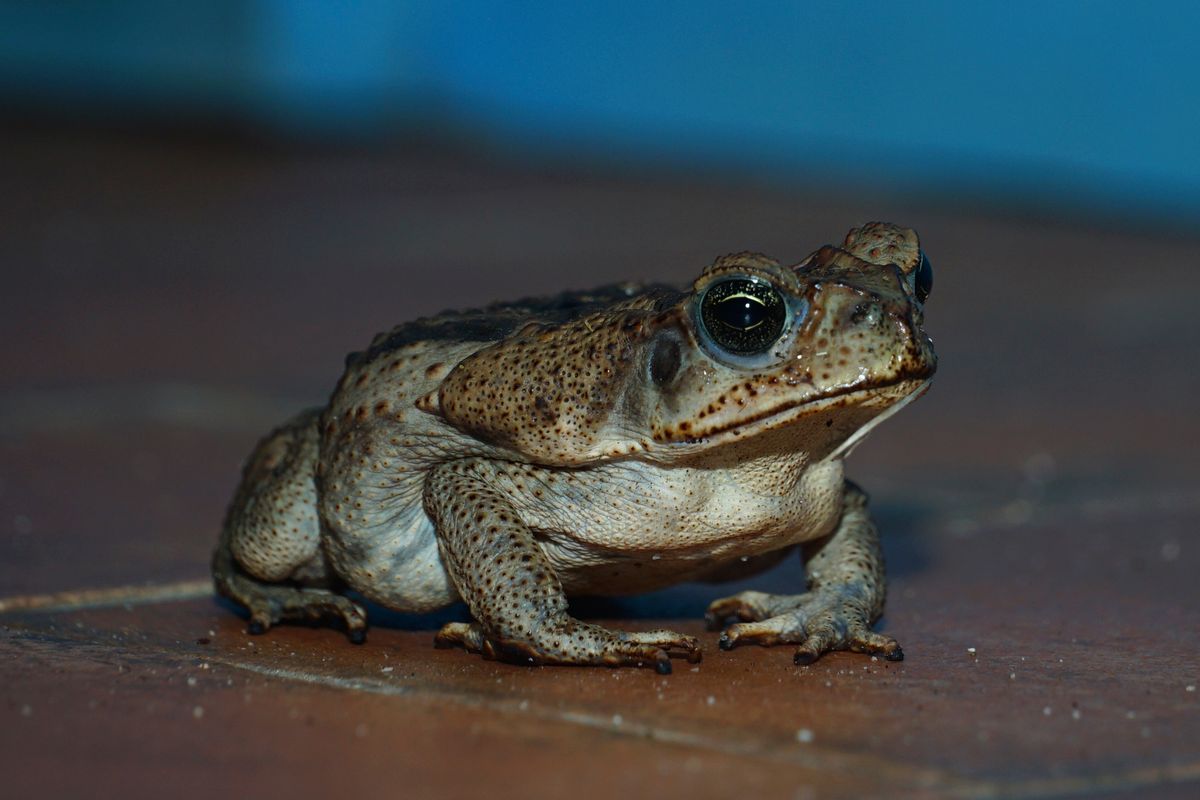
How to identify an adult cane toad
Florida's invasive cane toad is Rhinella marina, formerly often called Bufo marinus. “Bufo toad” remains common language in Florida, but “cane toad” is the clearer current name.
| Feature | Adult cane toad | Native southern toad |
|---|---|---|
| Adult size | Usually about 3–6 inches; some reach 8–9 inches | Usually no more than about 3–4 inches |
| Parotoid glands | Large, triangular and angled toward the shoulders | Smaller and more oval |
| Top of head | No prominent southern-toad-style cranial ridges | Distinct ridges / crests in adults |
| Color | Brown, reddish-brown or grayish-brown; variable | Also variable; color alone is not reliable |
Are eggs and tadpoles toxic?
Yes. UF/IFAS reports that cane toads are toxic throughout their life cycle, including eggs and tadpoles. Adult animals generally contain the greatest amount of toxin in their enlarged parotoid glands.
Where are cane toads established in Florida?
FWC currently describes established populations in central and southern Florida, generally south of the I-4 corridor. Cane toads are especially associated with human-modified habitats such as yards, around buildings, golf courses, canals and ponds.
The old county-by-county “Extreme / High / Elevated” risk map has been removed because it was not an official FWC risk classification. Local sightings change; use current FWC sighting resources rather than a permanent county ranking.
When are encounters more likely?
After rain
Warm, wet conditions increase cane-toad activity.
Dusk and nighttime
Adult cane toads are mainly nocturnal.
Near standing water
Canals, ponds, ditches and other standing-water areas can support breeding.
Yards with attractants
Outdoor pet food, water, insects, clutter and hiding places can draw cane toads close to homes.
Rainy-season exposure matters, but UF/IFAS notes that cane toads may be encountered at almost any time of year in South Florida.
Prevention around a Florida home
Supervise night bathroom breaks
Use a leash where practical and scan grass, shrubs and water edges with a flashlight.
Bring pet food and water indoors at night
FWC and UF/IFAS warn that outdoor food can attract cane toads and other wildlife.
Reduce hiding places
Keep grass short, trim low shrubs, fill holes around structures, remove brush piles and reduce clutter.
Teach a reliable “leave it” cue
Training cannot eliminate risk, but it can reduce wildlife-mouthing behavior.
Do not relocate captured cane toads
FWC says captured cane toads may not be relocated and released. If you need removal help, follow current FWC guidance or use a qualified wildlife professional.
Emergency contacts — verified September 2026
The old version listed individual South Florida emergency hospitals as permanent recommendations. Those were removed because hours, ownership, service areas and specialty availability can change.
How much does treatment cost?
There is no reliable Florida-wide fixed price for cane-toad treatment. Cost depends on severity, ECG monitoring, diagnostics, medications, oxygen, hospitalization, referral and local emergency pricing.
Pet insurance reimbursement also cannot be promised as a fixed percentage. Coverage depends on the policy, deductible, exclusions, waiting period and whether coverage was active before the exposure.
Frequently asked questions
My dog only drooled after mouthing a toad. Is that still urgent?
Should I rinse for exactly 10 or 15 minutes?
Are small cane toads safe?
Can a dog learn to avoid cane toads after one poisoning?
Is there an antidote?
Are cane toads protected in Florida?
Bottom line
Cane-toad poisoning is a genuine Florida veterinary emergency, but owners do not need a dramatic second-by-second countdown. The durable rule is: remove the dog from the toad, do not induce vomiting, remove toxin from the mouth without forcing water down the throat, call a veterinarian and seek emergency care immediately.
For prevention, supervise dogs after dark, especially after rain; bring pet food and water indoors at night; reduce hiding places; and learn adult cane-toad features without relying on size alone.
This article provides general emergency information and does not replace veterinary evaluation. If cane-toad exposure is suspected, contact a veterinarian or emergency animal hospital immediately. Wildlife distribution, poison-control fees and local services can change.