
Crested gecko health · Tail autotomy · First aid
Crested Gecko Dropped Its Tail? What to Do Now & When to See a Vet
Updated: September 4, 2026
Quick answer: a clean, complete tail autotomy in an otherwise alert crested gecko is usually not a veterinary emergency. Do not try to reattach the tail, do not grab or trim the stump, and do not automatically apply human antiseptics or antibiotic creams. Keep the wound away from dirty loose substrate, reduce handling, maintain normal species-appropriate husbandry, continue access to food and water, and watch the stump and the whole gecko for worsening signs.
Call a reptile veterinarian promptly if bleeding will not stop, tissue is hanging or torn, bone/deep tissue is visible, the tail was injured by a cat or other animal, the stump becomes progressively swollen/dark/foul-smelling, there is discharge, or your gecko becomes weak, uncoordinated, persistently anorexic, or otherwise ill.
Two myths to drop immediately: autotomy is natural, but that does not prove it is painless; and a “partial drop” does not automatically mean tissue will rot within hours or cause sepsis. Incomplete traumatic injuries do need veterinary assessment because tissue viability and wound depth cannot be judged reliably from a checklist.
First 10 minutes: the safest response
- Stop handling and secure the enclosure. Give the gecko a quiet place to settle. If you must move it, guide it gently into a ventilated container rather than grabbing the body or tail area.
- Look at the stump without manipulating it. A complete autotomy usually leaves a relatively clean base. Do not pull on attached tissue and do not cut anything yourself.
- Remove contamination risk. If the enclosure uses soil, coco fiber, bark, moss fragments, sand, or another loose material that can contact the fresh wound, temporarily use clean paper towels in the recovery area.
- Leave a clean uncomplicated wound alone. Routine alcohol, hydrogen peroxide, iodine scrubs, powders, glue, bandages, and human antibiotic creams are not required for a normal tail drop. If the wound is contaminated, traumatic, or abnormal, ask a reptile veterinarian what cleansing or topical treatment is appropriate.
- Keep normal food and water available. There is no evidence-based reason to starve a crested gecko for 1–2 days after an uncomplicated tail drop. Remove uneaten live insects so they cannot bite or irritate the wound.
Best home-care principle: clean environment, normal husbandry, minimal stress, and observation. “Doing more” to the stump is not automatically better.
What is tail autotomy?
Autotomy is an evolved defense response in which a lizard releases its tail when threatened or physically stressed. The detached tail may continue moving for a while because local neuromuscular circuits can remain active after separation. Research in geckos shows that detached tails can generate complex movements; the exact duration varies, so there is no useful “30–60 minute rule” for a crested gecko owner.
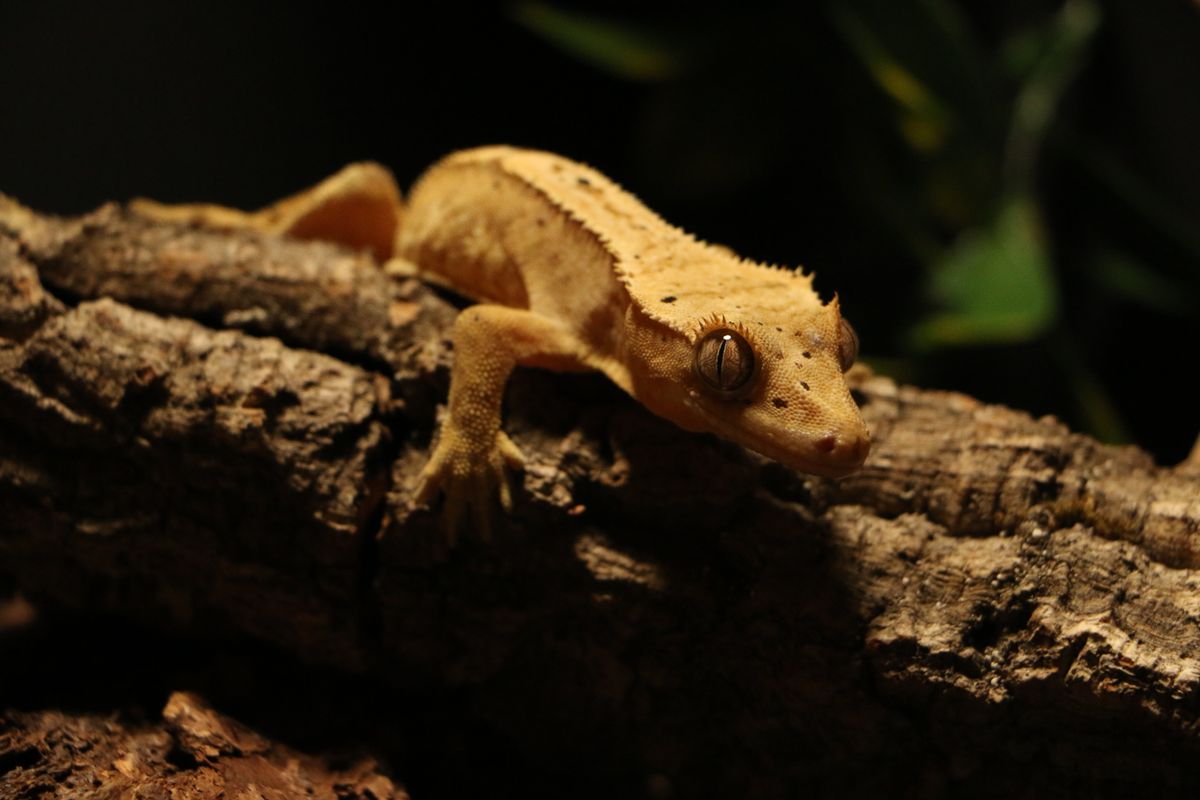
The crested gecko's tail is not merely decorative. Peer-reviewed work on Correlophus ciliatus shows that the tail is prehensile and carries an adhesive pad at the tip, contributing to arboreal function. After autotomy, the animal loses that structure and must adapt to climbing without it.
Crested geckos do not regrow the tail. RSPCA and veterinary care references agree on this point. The permanent rounded appearance is commonly called a “frogbutt.”
Complete autotomy vs. traumatic/partial injury
| What you see | What it suggests | Action |
|---|---|---|
| Tail fully detached; stump relatively clean; bleeding minimal/stopped; gecko alert | Typical complete autotomy | Clean recovery setup + observation is often appropriate. |
| Tail or tissue still hanging from the body | Incomplete traumatic injury or uncertain tissue viability | Same-day reptile-vet advice. Do not pull, twist, or cut it. |
| Persistent or substantial bleeding | More than routine autotomy / possible trauma or clotting problem | Urgent veterinary assessment. |
| Exposed deep tissue, crushed tissue, punctures, or major laceration | Traumatic wound rather than a simple clean drop | Prompt reptile-vet evaluation. |
| Cat/dog bite or attack | Hidden crush/puncture injury and contamination risk | Urgent same-day veterinary care, even if the stump looks small. |
| Progressive blackening, swelling, pus/discharge, foul odor | Necrosis or infection is possible | Reptile vet promptly. |
Do not diagnose “necrosis” from normal darkening alone. A healing surface can change color. The concerning pattern is progressive tissue death, swelling, discharge, odor, worsening pain/behavior, or systemic illness.
Should you use Neosporin, Betadine, peroxide, or another antiseptic?
For a clean, uncomplicated crested-gecko tail drop, routine topical medication is usually unnecessary. A veterinarian answering a crested-gecko tail-loss case specifically advised that the stump can heal without Neosporin and warned that some topical products—especially formulations containing pain-relief ingredients—may be unsafe for reptiles.
- Do not use hydrogen peroxide or alcohol routinely: they can damage healing tissue.
- Do not automatically apply antibiotic ointment: an uncomplicated autotomy does not automatically need antibiotics.
- Do not use “pain-relief” human ointments: added local anesthetic ingredients can be inappropriate for reptiles.
- If the wound is dirty, bitten, crushed, infected, or otherwise abnormal: ask a reptile vet whether saline, diluted antiseptic, topical medication, systemic medication, or debridement is indicated.
Do you need a “hospital tank”?
Not every gecko needs to be moved into a tiny new enclosure. Moving a stressed reptile can itself add stress. The purpose of a temporary recovery setup is simply to keep the wound clean and make monitoring easier.
Use paper towel when contamination is likely
If loose substrate can stick to the fresh stump, paper towels are practical because they are clean, absorbent, and easy to replace.
Keep useful cover and climbing options
Do not create a barren box that leaves the gecko exposed. Provide a secure hide and stable, low-risk structure while avoiding sharp or unstable decor near the wound.
Keep the usual thermal gradient
RSPCA husbandry guidance uses a basking zone around 26–28°C, a cooler area around 20–24°C, and a nighttime drop around 18–20°C. Do not overheat a recovering gecko.
Do not keep the enclosure constantly saturated
RSPCA guidance uses a lower background humidity with temporary humidity boosts up to around 80%, alongside good ventilation. Waterlogged conditions can encourage bacterial problems.
Recovery setup ≠ permanent husbandry downgrade. Once the stump is closed, dry, clean, and no longer at meaningful contamination risk, return toward normal well-designed arboreal husbandry rather than keeping the gecko in a stripped-down box for an arbitrary number of weeks.
Food after tail loss: do not automatically fast your gecko
The previous “no food for 1–2 days” rule is not evidence-based for an uncomplicated autotomy. Offer the normal complete crested-gecko diet and fresh water as usual. If you feed live insects, remove uneaten insects rather than leaving them in the enclosure where they could disturb the wound or the recovering gecko.
A short stress-related dip in appetite can happen, but persistent refusal to eat, weight loss, lethargy, dehydration, or abnormal droppings should move the case out of “simple tail drop” territory and into veterinary assessment.
How long does healing take?
There is no reliable owner-facing clock such as “scab at 24 hours, fully healed at exactly 2–3 weeks.” Reptile wound healing is temperature- and husbandry-dependent, and an individual wound can close at a different pace.
| What matters more than the calendar | Reassuring direction | Concerning direction |
|---|---|---|
| Bleeding | Stops promptly and does not restart | Continues, restarts repeatedly, or is substantial |
| Stump surface | Becomes clean, dry/closed, and stable | Opens, ulcerates, or develops exposed tissue |
| Swelling/color | No progressive swelling | Increasing swelling, spreading redness, progressive dark/necrotic appearance |
| Discharge/odor | None | Yellow/green discharge or foul smell |
| Whole gecko | Alert, climbing, drinking/eating, normal droppings | Weakness, poor coordination, persistent anorexia, weight loss, abnormal breathing |
When can you handle your crested gecko again?
Do not use a universal “10–14 days” rule. Resume handling only when the stump is clearly closed, the gecko is behaving normally, and handling will not rub or contaminate the healing area. Start with very short, low-stress sessions and let the gecko climb onto your hand voluntarily.
RSPCA husbandry guidance recommends voluntary handling and specifically warns never to grasp a crested gecko by the tail because tail loss is stressful and permanent.
Life after tail loss: “frogbutt” is normal, but the tail was functional
A tailless crested gecko can often live normally in captivity with good husbandry, and many keepers use the affectionate term “frogbutt.” However, avoid replacing one myth with another: the original tail was not just cosmetic.
- It is prehensile and assists with arboreal positioning.
- The tail tip has an adhesive pad. Research has measured its adhesive performance in crested geckos.
- RSPCA notes loss of energy/fat reserves with tail loss. This does not mean you should overfeed or add unneeded supplements; monitor body condition and continue a balanced diet.
- Adaptation varies. Do not promise that every gecko will have zero locomotor change within “a few days.” Keep climbing structures stable while it adjusts.
Do not compensate with extra calcium or vitamin D3 unless your husbandry plan requires it. More supplement is not automatically better. Use a nutritionally complete crested-gecko diet and supplement feeder insects according to an evidence-based husbandry plan.
Why did the tail drop?
Sometimes there is an obvious trigger; sometimes there is not. Common triggers include restraint, grabbing the tail, a fall/entrapment, a cage-mate interaction, predator pressure from a household cat or dog, or intense disturbance.
Do not turn one tail drop into a diagnosis of calcium deficiency, chronic stress, or disease. Metabolic bone disease is an important reptile health problem, but “low calcium causes autotomy” is not a reliable explanation for an isolated tail drop.
Prevention: reduce the triggers you can control
- Never grab or restrain a crested gecko by the tail.
- Use voluntary handling: let the gecko step/climb onto your hand.
- Keep household predators away: cats and dogs should not have access to the enclosure or a gecko during handling.
- Check doors, lids, and decor: prevent pinching, crushing, unstable branches, and escape gaps.
- Keep crested geckos singly when possible. RSPCA states that keeping them singly is best; social conflict can include chasing, squeaking, tail shaking, and biting.
- Maintain correct temperature, humidity, UVB, diet, and sanitation. Good husbandry supports overall health and wound healing even though it cannot guarantee that autotomy will never occur.
When is it an emergency?
| Situation | Priority |
|---|---|
| Collapse, severe weakness, breathing difficulty, major trauma, uncontrolled/significant bleeding | Emergency reptile veterinary care |
| Cat/dog attack, deep tear, exposed tissue/bone, hanging tissue, crushed tail base | Urgent same-day reptile vet |
| Progressive swelling, discharge, foul odor, necrotic-looking tissue, worsening lethargy | Prompt reptile vet |
| Clean complete drop; bleeding stopped; gecko alert and otherwise normal | Home monitoring is often reasonable |
If you do not already have an exotics veterinarian, the Association of Reptile and Amphibian Veterinarians directory can help locate reptile-focused veterinary professionals.
Frequently asked questions
Will a crested gecko's tail grow back?
No. Unlike many other geckos, crested geckos do not regenerate the tail after it is dropped.
Does tail dropping hurt?
Autotomy is a specialized natural defense mechanism that limits injury and blood loss compared with a random traumatic amputation, but “natural” does not prove “painless.” Treat the event as physically and behaviorally stressful and minimize handling.
Should I put Neosporin on the stump?
Not routinely. A clean uncomplicated autotomy often heals without topical medication. Human antibiotic products can contain added ingredients that are inappropriate for reptiles. Ask a reptile veterinarian before applying medication.
Should I withhold food until a scab forms?
No universal fasting period is recommended. Keep normal food and water available. Remove uneaten live insects so they cannot irritate the wound.
Do I need a hospital tank?
You need a clean, monitorable environment—not necessarily a completely different small tank. Paper towel is useful temporarily when loose substrate could contaminate the stump.
What if part of the tail is still attached?
Do not pull or cut it. An incomplete traumatic injury should be assessed by a reptile veterinarian because depth and blood supply are difficult to judge at home.
How long should I avoid handling?
Use the wound and the gecko—not a fixed calendar. Wait until the stump is closed and the gecko is back to normal behavior, then restart gently.
Can a crested gecko live normally without a tail?
Often yes, and the tailless appearance is commonly called “frogbutt.” But the tail had real prehensile and adhesive functions, so give the gecko time and stable climbing opportunities to adapt.
Sources & editorial standard
This 2026 revision removes unsupported home-treatment timers and medication rules and separates a routine complete autotomy from trauma, infection, predator injury, and incomplete tail wounds.
- RSPCA: Caring for Your Crested Gecko
- PetMD: Crested Gecko Care Sheet
- PetMD: Lizard Tail Loss
- Royal Society Open Science: Morphology and Biomechanics of Crested Gecko Adhesive Tails
- Merck Veterinary Manual: Emergencies of Reptiles
- Association of Reptile and Amphibian Veterinarians
Educational information only. Wound depth, infection, tissue viability, pain, and internal trauma cannot be assessed reliably from an online article or photograph alone.
Track recovery with Patify

Track the wound trend, not an arbitrary countdown
Log the date of tail loss, photos of the stump, appetite, weight, droppings, activity, substrate changes, and any veterinary treatment. A trend is more useful than “day 7 should look like X.”
View Patify on Google PlayBottom line
A clean crested-gecko tail drop is usually a wound-management problem, not an automatic emergency. Keep it clean, avoid unnecessary products and handling, maintain correct husbandry, continue food and water, and watch the whole gecko—not just the stump. The moment the event looks traumatic, contaminated, infected, or systemically abnormal, switch from home monitoring to a reptile veterinarian.