
Florida Cat Hurricane Evacuation 2026: Pet-Friendly Shelters, Laws & Emergency Kit
Florida hurricane season runs from June 1 through November 30. For cat owners, the safest plan is not a static list of school addresses: counties decide which facilities open for each storm, rules differ by shelter type, and capacity can change quickly. This guide explains Florida's pet-sheltering law, the federal PETS Act, the real scope of Trooper's Law, the current status of the 2026 PETSAFE Act, verified planning rules in Miami-Dade, Pinellas, Palm Beach, Monroe and Lee counties, and the carrier, records, medication and backup plans that remain useful every hurricane season.
Florida cat evacuation: the verified essentials
Florida shelter law: Florida Statutes §252.3568 says that if a county maintains designated emergency shelters, it must designate a shelter that can accommodate persons with pets.
PETS Act: federal emergency planning must account for individuals with household pets and service animals; it does not require private hotels to accept cats.
Trooper's Law: effective October 1, 2025. Its felony subsection applies specifically to a dog restrained outside during a natural disaster and then abandoned.
Cats are still protected: Florida's broader abandonment statute applies to “any animal” and can punish abandonment that leaves an animal without care, sustenance, protection or shelter.
PETSAFE Act: H.R. 7438 and S. 4558 remain proposed federal legislation as of September 7, 2026; neither is current law.
Storm-day rule: check the county emergency page before driving. Not every listed facility opens for every storm.
Florida's pet-friendly shelter requirement
Florida Statutes §252.3568 requires state and local emergency planning to address evacuation strategies for people with pets. If a county maintains designated shelters, it must designate a shelter that can accommodate persons with pets.
That does not mean every general-population shelter must take household pets. Counties may use co-located pet areas, separate pet facilities or selected storm-specific locations.
What the federal PETS Act actually requires
The Pets Evacuation and Transportation Standards (PETS) Act of 2006 amended federal disaster law so state and local preparedness plans address the needs of individuals with household pets and service animals before, during and after major disasters. FEMA guidance also recognizes eligible evacuation, rescue, shelter and essential-needs activities involving household pets and service animals.
The law is not a private-hotel mandate. Hotels, motels and vacation rentals still set their own household-pet policies unless another legal obligation applies. Service animals are a separate legal category.
Trooper's Law: the cat-specific correction
Trooper's Law was enacted through Florida SB 150 and took effect October 1, 2025, not January 1, 2026. It was inspired by Trooper, the dog rescued after being tied to a fence along I-75 during the evacuation ahead of Hurricane Milton in 2024.
Florida §828.13 defines “restrain” for this felony provision as attaching a dog to a stationary object or trolley system. A person who restrains a dog outside during a qualifying natural disaster and thereafter abandons the dog commits a third-degree felony; the statute authorizes a fine up to $10,000 in addition to the applicable felony sentence.
For cats, §828.13(3) is more relevant: it applies to any animal and makes certain abandonment without care, sustenance, protection and shelter a first-degree misdemeanor.
PETSAFE Act 2026: legislation to watch, not current law
The Providing Essential Temporary Shelter Assistance for Emergencies (PETSAFE) Act would expand how existing emergency-management grant funding can support companion-animal evacuation, sheltering, veterinary care, training and rescue equipment.
The House bill, H.R. 7438, was introduced February 9, 2026 and referred to the House Transportation and Infrastructure Committee and its emergency-management subcommittee. The Senate companion, S. 4558, was introduced by Senators Adam Schiff and Thom Tillis and referred to the Senate Committee on Homeland Security and Governmental Affairs.
As of September 7, 2026, neither has become law.
County shelter snapshot: checked September 7, 2026
These are planning rules from current official county pages. Treat them as a dated snapshot; actual openings remain storm-specific.
| County | Current planning model | Cat requirements / limits | Registration |
|---|---|---|---|
| Miami-Dade | Pet-friendly evacuation centers announced as needed | Current rabies record; carrier/control; supplies; limit four pets per household; at least one family member remains | No pre-registration required |
| Pinellas | Multiple pet-friendly shelters may open; not all open for every storm | Cats/dogs only; pet housed separately in owner's carrier/crate; owner remains and handles care/medication | No advance registration |
| Palm Beach | Current planning page lists West Boynton Recreation Center pet shelter | Qualifying county residents; pets housed separately; records, medications and ID supplies required | Pre-registration opens May 1 but does not guarantee space |
| Monroe | In-county pet-friendly shelters for Category 1–2; stronger storms use mainland plans | Carrier, current medical/vaccination records and Monroe County pet license for cats | Annual pet pre-registration required |
| Lee | Event-specific pet shelter location announced when activated | Carrier/crate and vaccination records; owner must stay and care for pet | No reservation |
Miami-Dade
Miami-Dade says pet-friendly evacuation centers are announced as needed and pre-registration is not required. Current rules include proof of residency in an evacuation zone, current medical/vaccination records, supplies for both owner and pet, and current rabies vaccination for cats.
The county's current requirement section lists a limit of four pets per household and says at least one family member must remain at the evacuation center. Cats should remain securely crated or otherwise controlled.
Pinellas
Pinellas County says pet-friendly shelters are for cats and dogs and that not all shelters open for every storm. Owners must remain at the shelter and care for their pets, while the animals are housed in a separate area in crates or carriers. Advance registration is not required.
Pinellas currently recommends a robust pet emergency kit, including two weeks of food and water, identification/microchip information, immunization records, medications, litter supplies and a carrier.
Special Needs sheltering is different. Household pets do not stay in the special-needs shelter. As a last resort, Animal Services may care for a registered resident's cat or dog separately, but the county warns that animals requiring certain chronic or specialty care—including insulin-dependent pets, seizure medication or special food—cannot be handled through that arrangement.
Palm Beach
Palm Beach County's current page lists the Pet Friendly Shelter at West Boynton Recreation Center for qualifying residents, including people in mandatory evacuation zones, mobile homes or substandard housing. Owners check the animal into the pet facility and shelter separately nearby.
The online pre-registration form opens May 1, but the county explicitly states that pre-registration does not guarantee a spot. Recheck the storm activation page before departure.
Monroe County / Florida Keys
Monroe County's in-county shelters are pet-friendly for Category 1 and 2 hurricanes. For Category 3–5 storms, there are no in-county hurricane shelters and county residents may be directed to mainland shelter options announced for the event.
Pet pre-registration is valid for the calendar year in which it is submitted. Cats must be properly caged, current medical/vaccination records must be presented, and Monroe County requires a local pet license for cats, dogs and ferrets.
Lee County
Lee County says the evacuation pet-shelter location is announced for the event. Owners cannot simply drop off the cat: they must stay at the shelter and provide care. A carrier/crate, collar/leash as appropriate and up-to-date vaccination records are required.
The county recommends making alternate arrangements outside the storm path when possible, with public pet sheltering serving as a safety net.
Florida cat hurricane kit
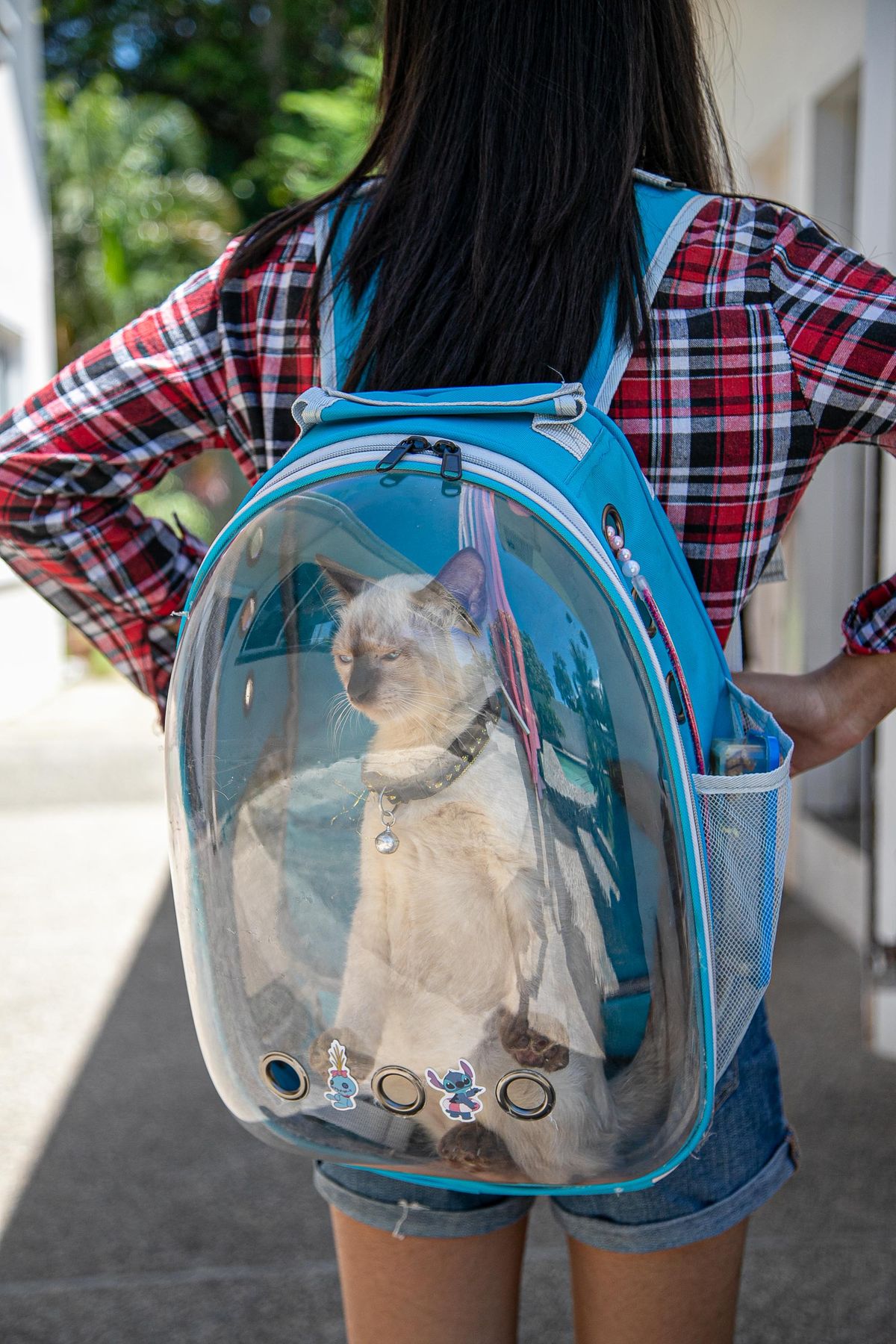
- Secure carrier: large enough for the cat to stand and turn around; label with owner and backup contact.
- Identification: collar/tag when safe, microchip number and current registry contact information.
- Vaccination/medical records: waterproof paper copy plus a secure digital copy.
- Medication: an evacuation-ready supply when feasible, in original labelled containers with written directions.
- Food and water: follow your county's current supply recommendation rather than a universal 72-hour rule.
- Litter kit: litter, pan, scoop, waste bags and cleanup supplies.
- Recent photos: clear cat photos plus a photo of you with the cat.
- Comfort item: familiar bedding that can safely fit in the carrier or shelter setup.
- Vet contacts: regular clinic, 24-hour emergency hospital and an out-of-area backup.
- Backup destination: at least two pet-friendly options outside the evacuation zone.
Medication-dependent cats need a separate plan
A public pet-friendly shelter is not a veterinary hospital. Even if owners may administer routine medication, the shelter may not provide refrigeration, injection support, oxygen, laboratory testing, advanced monitoring or emergency stabilization.
If your cat depends on insulin, seizure medication, subcutaneous fluids or tightly timed specialty treatment, ask the county program exactly what it can support and identify a veterinary hospital or boarding facility outside the evacuation zone before hurricane season.
When an evacuation order is issued
- Check your exact evacuation zone and county emergency page.
- Confirm which pet-friendly shelter is actually open.
- Choose an out-of-zone family/hotel option first when it is safer and practical.
- Load the cat before wind, flooding and traffic make handling harder.
- Keep the carrier closed during transport, parking and shelter intake.
- Tell staff about medications and medical needs immediately.
Frequently asked questions
Does every Florida shelter have to accept cats?
No. Florida §252.3568 requires a county that maintains designated shelters to designate a shelter that can accommodate persons with pets. It does not make every shelter pet-friendly.
Does the PETS Act require hotels to take cats?
No. It requires emergency planning to account for household pets and service animals; private lodging businesses set their own household-pet policies.
Does Trooper's Law make it a felony to abandon a cat during a hurricane?
The new felony subsection is specifically written for a dog that is restrained outside during a natural disaster and then abandoned. Florida's broader abandonment/cruelty rules apply to any animal and can still protect cats.
When did Trooper's Law take effect?
October 1, 2025.
Is the PETSAFE Act law?
No. As of September 7, 2026, H.R. 7438 and S. 4558 remain pending federal bills.
Do I need to pre-register my cat for a hurricane shelter?
It depends on the county. Miami-Dade and Pinellas currently say no advance registration is required; Palm Beach opens pre-registration May 1 but does not guarantee space; Monroe requires annual pet pre-registration.
Can a diabetic cat use a public pet-friendly shelter?
Do not assume so. Medical capabilities vary. Confirm your county's current program in advance and keep an out-of-zone veterinary/boarding backup.
Bottom line
Florida's emergency-planning system accounts for household pets, but successful cat evacuation is local and storm-specific. Know the statewide legal framework, then follow the county emergency page that tells you which shelter is actually open.
The evergreen plan is simple: carrier, identification, records, medication continuity and a verified destination outside the hazard area. Laws, facilities and bill status may change; those preparations remain useful every hurricane season.
Florida Statutes §828.13 — Abandonment / Trooper's Law
Florida Statutes §252.3568 — Emergency Sheltering of Persons With Pets
Florida SB 150 — Enrolled Trooper's Law Text
Governor of Florida — Trooper's Law Signing
FEMA — Federal Evacuation Support Annex / PETS Act
U.S. House — H.R. 7438 PETSAFE Act Status
U.S. Senate — S. 4558 PETSAFE Act Status
Miami-Dade — Pet Preparedness During a Hurricane
Pinellas County — Preparing Pets for Emergencies
Palm Beach County — Pet Friendly Shelter
Monroe County — Pets at Shelters
Monroe County — Hurricane Shelters
Lee County — Evacuation Pet Shelter
Pexels — Denniz Futalan, cat in carrier (free to use)