

Parrot Suddenly Screaming: Pain, Stress, Contact Calling or Learned Behaviour? (2026)
A parrot that suddenly becomes much louder is telling you that something has changed, but the sound by itself does not diagnose the cause. Loud calling can be normal social communication. It can also reflect fear, environmental stimulation, reproductive behaviour or a learned attention pattern. A sudden vocal change accompanied by appetite loss, weakness, abnormal breathing, balance problems or cage-floor sitting should be treated as a medical problem first.
Start with three questions: Is this truly new compared with your bird's normal pattern? What happened immediately before the call? And are there any changes in posture, breathing, appetite, droppings, sleep, balance or activity? Those observations are more useful than trying to diagnose a parrot from the pitch of one scream.
First triage: behaviour problem or veterinary problem?
Emergency now
Screaming or vocal change plus open-mouth breathing, marked tail bobbing with breathing, collapse, inability to perch, severe weakness, active bleeding, seizure, major trauma or sitting unresponsive on the cage floor.
Prompt avian-vet assessment
Sudden persistent vocal change plus reduced food intake, sleeping much more, fluffed feathers for long periods, changed droppings, voice change, regurgitation/vomiting, new balance problems or decreased interaction.
Behavioural investigation is reasonable
The bird is bright, eating, moving and breathing normally; the calling is linked to a repeatable situation such as a person leaving, household noise, a new object or a predictable social context.
Important: Merck lists fluffed feathers, sleeping more, reduced activity/vocalisation, cage-floor sitting, weakness, loss of balance, tail bobbing and breathing difficulty among signs of illness in pet birds. A behavioural explanation should not be used to explain away these signs.
Do different screams have fixed meanings?
No. Tone and timing can provide context, but there is no reliable owner-level sound chart in which one type of scream equals pain, another equals fear and another proves learned behaviour. The same bird can use loud calls in several contexts, and different species have very different normal vocal repertoires.
| Pattern you notice | What it may suggest | What to check next |
|---|---|---|
| One sharp cry during movement, handling or landing | Pain or startle is possible | Trauma history, wing/leg use, appetite, posture; vet if repeated or abnormal movement follows |
| Repeated call when you leave the room | Contact calling, social need or learned attention pattern | What happens after the call? Does a whistle or other alternative call work? |
| Predictable louder periods in morning/evening | Normal social/flock vocalisation can occur | Species and individual baseline; there is no universal 15–20-minute rule |
| Panic vocalisation after a new object, pet, noise or movement | Fear/startle | Identify the antecedent and reduce intensity/distance |
| Voice changed, bird quieter or louder, breathing abnormal | Medical disease must be considered | Avian-vet examination |

Common reason 1: normal contact calling
Parrots are social and highly vocal. LafeberVet notes that parrots use vocal signals to maintain social connections, warn of danger and communicate with flock members. Contact calling is therefore not automatically a behaviour disorder.
If a bird calls when you leave the room, a brief predictable response such as a whistle can sometimes serve as an alternative contact signal. The Association of Avian Veterinarians has highlighted the same behavioural principle: understand what outcome the bird is seeking and teach a more acceptable behaviour that achieves the same function.
The goal is not to make a naturally vocal species silent. The goal is to separate expected communication from a new, excessive or functionally reinforced pattern.
Common reason 2: fear, stress or environmental change
A new person, animal, appliance, cage location, loud household noise or unfamiliar object may trigger alarm vocalisation. Parrot body language should be read together with the sound: leaning away, escape attempts, rigid posture, defensive display or repeated avoidance can indicate that the stimulus is too intense.
Do not use flooding — forcing the bird to remain close to something frightening until it “gets used to it.” LafeberVet's avian behaviour guidance favours recognising early fear responses, reducing aversive exposure and using the least intrusive approach.
Air-quality exception: if screaming or agitation starts around smoke, fumes or overheated non-stick/PTFE equipment, treat the environmental exposure itself as a safety issue. Respiratory signs after suspected fumes require emergency veterinary care.
Common reason 3: learned attention-seeking screaming
Some parrots learn that a particular loud call produces a valuable consequence: a person enters the room, talks, opens the cage, provides food or begins an exciting interaction. That is a learning process, not stubbornness.
Use the ABC method
LafeberVet recommends analysing behaviour as Antecedent → Behaviour → Consequence:
What happened immediately before the scream? You left, answered the phone, began cooking, another bird called, the room became noisy.
Describe exactly what the bird did instead of labelling it “attention seeking”: duration, volume, body posture and context.
What happened immediately afterward? Did someone look at the bird, return, shout, uncover the cage, provide food or let the bird out?
Better training goal: reinforce a quieter alternative such as a whistle, speech sound, independent foraging or calm periods. Do not simply “ignore every scream.” First make sure the call is not illness, fear, a legitimate contact call or an unmet welfare need.
Why “any response reinforces screaming” is too simple
If a bird is screaming specifically because screaming has historically produced attention, attention delivered during that behaviour can maintain it. But not every scream has that function. A frightened bird, a sick bird and a contact-calling bird are different cases.
- Do not shout back, bang on the cage, spray the bird or use frightening punishment.
- For confirmed attention-maintained screaming, avoid delivering the usual reward during the scream.
- Actively notice and reward calm behaviour and acceptable contact calls; do not only interact when the bird becomes loud.
- If the bird is socially isolated or under-stimulated, solve that welfare problem rather than relying on extinction alone.
- Expect behaviour change to be gradual; there is no universal “3–5 seconds, then 10 seconds next week” schedule.
Common reason 4: insufficient stimulation or social opportunity
Merck's 2026 owner guidance states that birds can develop unwanted behaviours such as screaming, biting or feather damaging when they are socially deprived or insufficiently stimulated. Helpful options include training, foraging, safe exploration and regular social interaction.
There is no evidence-based universal rule that every parrot needs exactly “2–3 active interaction hours per day.” Species, age, housing, companion birds, flight opportunities and individual temperament matter. Judge welfare by the bird's full daily routine rather than one fixed number.
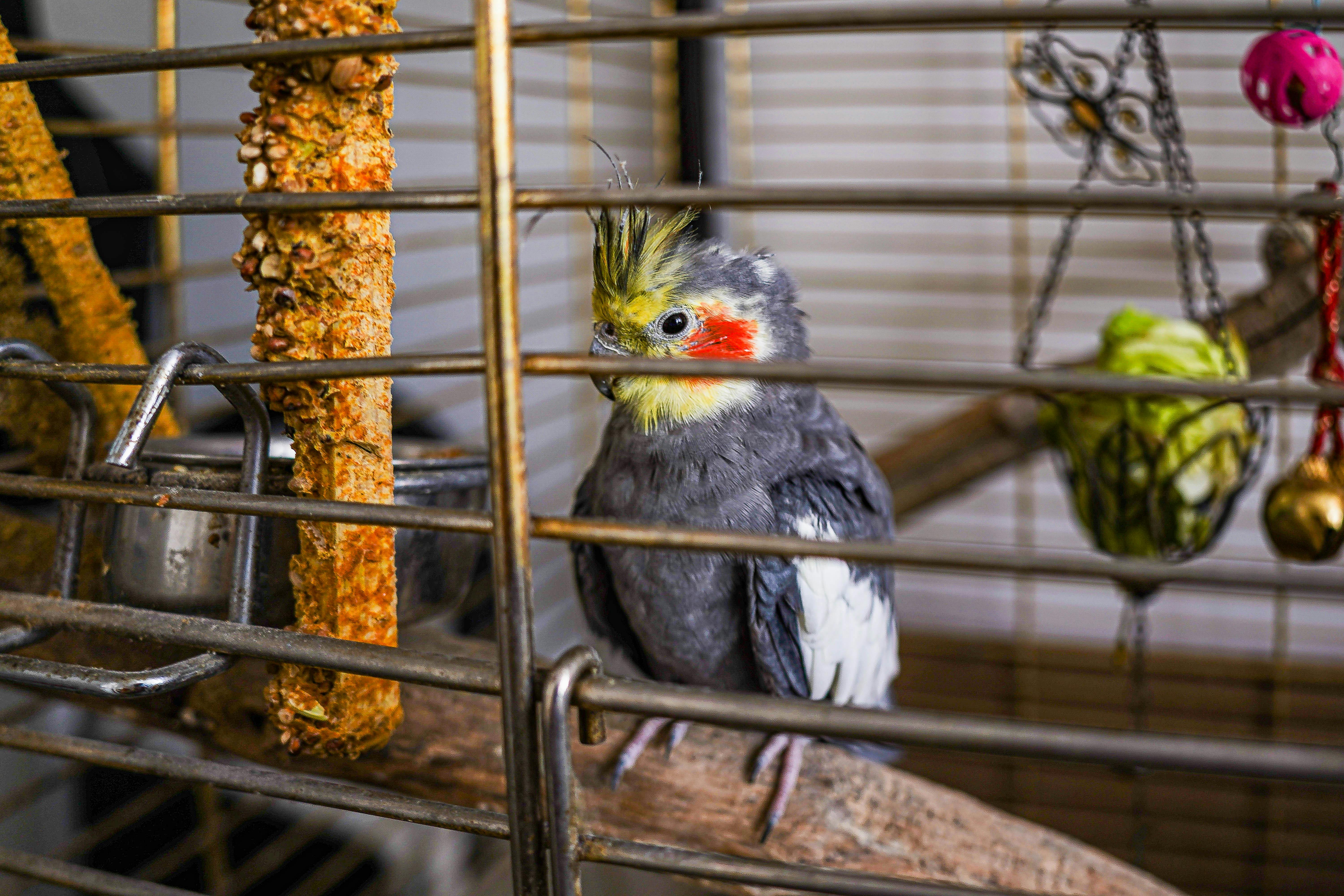
Enrichment that supports quieter, healthier behaviour
Foraging
Hide part of the normal food ration in safe foraging opportunities so the bird performs more natural food-searching behaviour.
Positive-reinforcement training
Short sessions can provide mental activity and build useful alternative behaviours such as stationing, targeting or a quieter contact call.
Safe chewing and shredding
Use bird-safe materials appropriate for the species. Introduce new items gradually because novelty itself can frighten some parrots.
Movement and exploration
Provide species-appropriate climbing, flight or supervised out-of-cage opportunities when medically and environmentally safe.
Common reason 5: reproductive behaviour
Merck notes that reproductive and owner-bonding patterns can contribute to excessive contact calling and screaming in some parrots. Captive birds may receive year-round food, stable temperatures and long photoperiods that promote reproductive behaviour outside a simple spring/summer season.
Management usually focuses on the whole reproductive environment: avoiding nest-like dark spaces, reducing sexualised petting/body contact, correcting high-calorie diet patterns when appropriate and reviewing the light/sleep schedule with an avian veterinarian.
No universal 11–12-hour prescription: extended photoperiod can be a reproductive trigger, but the correct schedule depends on species, current reproductive problems and husbandry. Do not use a single number as a treatment for every screaming parrot.
What about a second parrot?
A second bird is not a guaranteed treatment for screaming. Some birds benefit greatly from compatible avian companionship; others may be territorial, frightened or incompatible. Merck recommends discussing whether birds should live together or separately because individual social preferences differ.
If adding another bird is considered, plan quarantine, veterinary screening, separate housing at first and gradual introductions. Do not acquire a second bird solely as a noise-control device.
Body-language signs that change the urgency
| Sign | Interpretation | Priority |
|---|---|---|
| Fluffed for long periods, sleeping more, reduced activity | Common nonspecific illness signs | Veterinary assessment |
| Sitting low on perch or cage floor | Weakness or significant illness possible | Urgent; emergency if weak/unresponsive |
| Open-mouth breathing or marked tail bobbing with breathing | Respiratory distress | Emergency |
| Loss of balance, falling, inability to perch | Neurologic, metabolic, toxic or severe systemic disease possible | Emergency |
| Changed droppings plus appetite/activity change | Medical disease possible | Prompt avian-vet assessment |
| Bright, active, eating normally; predictable social call | Normal communication or learned pattern more likely | Behaviour log and management |
A practical seven-day investigation
This is not a promise that screaming will disappear in a week. It is a way to collect useful information before changing the environment randomly.
- Record the time and approximate duration of each major screaming episode.
- Write the immediate antecedent: person left, appliance started, bird saw another animal, household became noisy.
- Write what every person did immediately afterward.
- Track appetite, droppings, body weight if your bird is already safely trained to a gram scale, activity and sleep.
- Record a short video/audio sample for your avian veterinarian if the pattern is new.
- Reward acceptable alternative communication and independent foraging.
- Change one management variable at a time so you can tell what actually helped.
What not to do
- Do not punish a parrot for screaming by hitting, shaking, spraying, frightening or yelling.
- Do not use prolonged daytime cage covering as a routine punishment.
- Do not assume a sudden scream proves pain based on sound alone.
- Do not assume morning/evening calling must last a fixed number of minutes.
- Do not force exposure to a feared object or person.
- Do not add a second bird solely to “fix” noise.
- Do not delay veterinary care when screaming is accompanied by illness or respiratory signs.
Frequently asked questions
Can pain make a parrot scream suddenly?
Yes, pain or trauma can cause a sudden vocal reaction, especially when the bird moves or is handled. But sound alone cannot confirm pain. Repeated cries plus abnormal posture, guarding a limb, weakness or appetite change need veterinary assessment.
Do all parrots scream at sunrise and sunset for 15–20 minutes?
No. Many parrots have predictable periods of louder social calling, but species and individuals differ. There is no universal duration that proves a call is normal.
Should I completely ignore my parrot when it screams?
Only if you have good evidence that the behaviour is maintained by attention and medical, fear and welfare causes have been addressed. Even then, pair reduced attention for the unwanted call with active reinforcement of quieter alternatives.
Can I teach a quieter contact call?
Often, yes. A whistle or short word can be reinforced as an alternative way to check in with you. AAV's behaviour guidance specifically highlights teaching an alternative response that achieves the same outcome.
Will getting a second parrot stop the screaming?
Not reliably. Compatible birds may provide social companionship, but introductions can also create stress or aggression. Quarantine, veterinary screening and gradual introduction are important.
Can hormones make a parrot louder?
Yes. Reproductive behaviour can include excessive contact calling or screaming in some birds. Management should address photoperiod, nest cues, diet and owner-bird interactions as a whole rather than using one universal light-hour prescription.
Does tail bobbing always mean respiratory disease?
A slight tail movement can occur normally, but marked bobbing synchronized with increased respiratory effort — especially with open-mouth breathing, weakness or inability to perch — is concerning and needs urgent veterinary assessment.
Can feather plucking and screaming be related?
They can occur in the same bird because of medical disease, reproductive factors, stress or husbandry problems, but neither behaviour proves the cause of the other. Feather damaging behaviour deserves medical evaluation before being labelled purely behavioural.
Veterinary and behaviour sources
- Merck Veterinary Manual — Behavior of Pet Birds, updated March 2026
- Merck — Illness in Pet Birds
- Merck — Injuries and Accidents of Pet Birds, updated May 2026
- Merck — Reproductive Diseases and Behavioural Problems of Pet Birds
- LafeberVet — Reading Bird Body Language
- LafeberVet — Psittacine Behavior: ABC analysis and low-stress handling
- Association of Avian Veterinarians — Reinforcing alternative behaviours
- Lafeber Pet Birds — Normal vocalisation, contact calling and screaming patterns
Related Patify guides: Parrot Not Moving but Breathing: Emergency Guide · Parrot Foaming at the Mouth: Poison, Infection or Emergency?
Track vocal changes with Patify

Trigger log, appetite, droppings and veterinary notes in one timeline
Record when the vocal change happens and what occurs immediately before and after it. A short behavioural history plus video can help an avian veterinarian distinguish medical concerns from learned patterns.
Download Patify freeBottom line
Sudden screaming is a change to investigate, not a diagnosis. First compare the bird with its normal baseline and look for medical red flags. If the bird is physically well, analyse the antecedent and consequence of the call, meet social and enrichment needs, and reinforce a quieter alternative instead of punishing noise. Emergency breathing, weakness or cage-floor signs always take priority over behaviour training.