

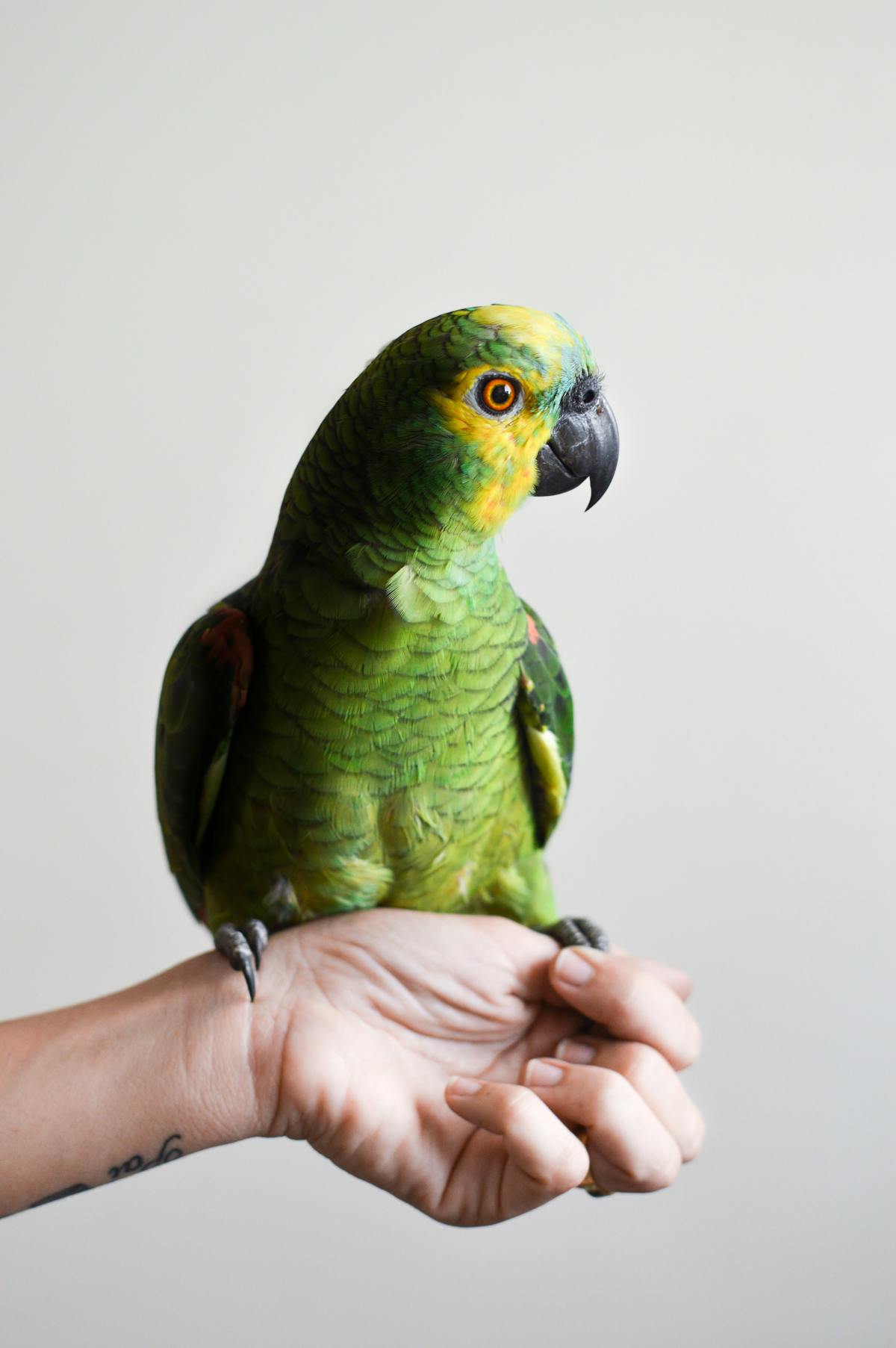
Parrot behavior · Sudden biting · Hormones & health
Why Is My Parrot Suddenly Biting? Hormones, Fear, Pain & What to Do
Quick answer: A parrot that suddenly starts biting is not automatically going through “bluffing” or a hormonal season. Common explanations include fear, overstimulation, cage or person guarding, learned bite-success, reproductive behavior, redirected aggression, and pain or illness. If the change is genuinely sudden—especially in a previously stable adult bird—rule out a medical problem before treating it as attitude.
Avian-vet priority: sudden biting plus reduced appetite, fluffed feathers, lethargy, weight change, abnormal droppings, weakness, vomiting/regurgitation that is not normal courtship, breathing difficulty, or tail bobbing is a health concern. Birds often hide illness; a behavior or personality change can be one of the first visible clues.
About “bluffing”: bird owners commonly use this word for a young parrot that becomes nippy or less predictable around sexual maturation. It is useful as informal shorthand, but it is not a precise veterinary diagnosis. Puberty, hormones, independence, fear, reinforcement history, environment and individual temperament can overlap, so do not let the label replace a functional assessment.
First question: is this behavior-only, or could your bird be sick?
VCA lists irritability, agitation and biting among possible behavior changes in sick birds. Because parrots are prey animals that can conceal weakness, a new personality change deserves more respect than “he is just being hormonal.”
🟢 More consistent with context/learning
- bites happen in one predictable situation
- appetite, droppings, weight and activity are normal
- bird gives clear avoidance/arousal signals first
- behavior changes when the trigger changes
🟠 Book an avian-vet check
- sudden unexplained personality change
- previously gentle bird now resists touch everywhere
- new weight, appetite or droppings change
- persistent reproductive behavior or repeated egg laying
🔴 Urgent / emergency signs
- open-mouth or labored breathing
- tail bobbing with each breath
- collapse, severe weakness or inability to perch
- significant bleeding, trauma or neurologic signs
7 common reasons a parrot suddenly starts biting
1. Fear or loss of trust
A hand entering the cage, a new person, forced handling, toweling, grabbing, nail trims, a frightening event or an unfamiliar object can make a parrot use its beak to increase distance. If retreating, leaning away or other subtle signals were ignored repeatedly, the bird may learn that a harder bite is the only signal humans respect.
2. Overstimulation or high arousal
Eye pinning, a tense posture, open beak, lunging, a fanned tail or dramatic feather posture can occur during intense arousal. Importantly, arousal is not always “anger”: excitement, courtship, territoriality and aggression can share visual signals. Read the whole bird and the situation rather than treating one sign as a bite prediction.
3. Reproductive or hormonal behavior
Sex hormones can increase territorial behavior, vocalization, nest seeking, courtship displays and biting. VCA notes that reproductive behavior varies by species and individual and may be influenced by daylight, temperature, environment, diet, favorite people, toys and nest opportunities. Some birds become aggressive; others become unusually affectionate.
4. Pain or illness
A painful foot, wing, beak, skin lesion, reproductive problem or systemic illness can make handling suddenly aversive. In birds, “aggression” can be the visible consequence of discomfort. Medical causes move higher on the list when the biting is abrupt, generalized and accompanied by any change in appetite, weight, droppings, breathing, posture, activity or vocalization.
5. Cage, nest or favorite-person guarding
Many companion birds defend a cage, play stand, dark corner, cabinet, box or preferred person. Reaching into that zone can predict a bite even when the same bird is cooperative elsewhere. Reproductive state can amplify territoriality, but guarding can also be a learned context-specific behavior.
6. Redirected aggression
A parrot highly aroused by another bird, pet, person or outdoor stimulus may bite the nearest available person instead. VCA describes this as displaced aggression. If the bite seems “random,” look at what happened in the room immediately before it.
7. The bite has worked before
Behavior that reliably changes the environment tends to repeat. If a parrot bites when a hand approaches and the hand immediately disappears, the bird may learn that biting is an efficient way to say “stop.” The answer is not to force the bird to endure bites; it is to notice earlier communication, arrange easier situations and reinforce cooperative alternatives.
Is “parrot bluffing” real?
“Bluffing” is a common companion-bird term for adolescent or pubescent parrots that become more nippy, assertive or unpredictable. Puberty itself is real, and veterinary avian texts recognize that hormonal changes around sexual maturity can alter temperament. What is less defensible is treating bluffing as a single, universal stage with an exact age, duration and behavior pattern for every species.
| Internet claim | Safer interpretation |
|---|---|
| “Every parrot goes through bluffing.” | No. Development and behavior vary by species and individual. |
| “Bluffing happens once and then disappears.” | Puberty is a developmental period, but biting can persist if fear, reinforcement, territoriality or husbandry triggers remain. |
| “The bird is testing dominance/social hierarchy.” | Do not assume a dominance contest. Analyze what the bite achieves and what happened immediately before it. |
| “Use the age table to diagnose bluffing.” | Sexual maturity varies widely; age can add context but cannot diagnose the cause of biting. |
| “Never back off or the bird wins.” | Respect warning signals. Prevention and positive reinforcement are safer than forcing contact to prove a point. |
So keep “bluffing” as a search term and owner shorthand—not as the final explanation.
Hormonal biting: what makes it more likely?
Reproductive behavior is more convincing when biting appears alongside several other sexual or nesting signs:
- regurgitating toward a person, toy or mirror;
- seeking dark enclosed spaces, boxes, drawers or cabinets;
- nest-material gathering or intense shredding associated with a nest site;
- territorial defense of a cage, nest-like location or chosen person;
- courtship postures, tail/wing displays or cloacal rubbing;
- egg laying in a female—even without a male;
- a repeating seasonal/environmental pattern.
Hormones are context-sensitive. VCA notes that daylight, temperature, environmental conditions, diet and interactions with people or favorite objects can influence sexual behavior. This is why one universal “spring aggression calendar” does not fit every household or species.
What body language really means before a bite
Body language reduces bites only when it is read in context. Several signs in the old guide were too absolute.
| Signal | What it can mean | What you should do |
|---|---|---|
| Eye pinning / flashing | Strong arousal or excitement—positive or negative | Pause and read posture, feathers, beak and context before reaching. |
| Tail fanning | Excitement, courtship, territorial display or other high arousal depending on species/context | Avoid assuming “mating” from tail fan alone. |
| Open beak / lunge | Clear distance-increasing warning in many contexts | Stop advancing; create an easier training setup. |
| Retreating / leaning away | “I do not want this interaction” | Respect it. Do not wait until the bird escalates to a bite. |
| Beak clicking | Can accompany excitement and may be a warning in some birds | Read the whole posture before handling. |
| Beak grinding | Often relaxation/contentment, especially before sleep | Do not label normal grinding as an aggression warning. |
| Soft/fluffed relaxed plumage | Can indicate comfort when the bird is otherwise bright and normal | Differentiate relaxed fluffing from persistent sick-bird fluffing with lethargy. |
| Persistent fluffed posture + lethargy | Possible illness | Contact an avian veterinarian. |
Your parrot bit you: what should you do in the next minute?
The goal is not to prove that you can tolerate a bite. World Parrot Trust specifically argues against simply taking bites and pretending they do not hurt. Prevention, communication and positive reinforcement are better long-term tools.
- Get everyone safe without drama. Avoid shouting, hitting, beak tapping, spraying or deliberately frightening the bird.
- End the unsafe interaction calmly. Use a stable perch or safe surface when possible rather than wrestling with the bird.
- Do not immediately repeat the exact trigger at higher intensity. Give arousal time to fall.
- Write down the antecedent. Where was the bird? What were you doing? Who entered? Was food, cage, nest space or a favorite person involved?
- Next session, make the task easier. Reinforce calm approach, target behavior, stationing or voluntary step-up before the bird needs to escalate.
Avoid punishment. World Parrot Trust recommends positive reinforcement rather than shouting, hitting or aggressive spraying. Punishment can add fear and increase defensive biting.
A 5-step biting-management plan that does not depend on “winning”
1. Rule out medical change
If the behavior is abrupt, generalized or out of character, schedule an avian-vet exam—especially when any other health sign is present.
2. Map the trigger
For one week, record location, person, time, body language, what happened immediately before the bite and what happened afterward. Patterns often become obvious: cage-door handling, end-of-play return, a preferred person, dark spaces, shoulder access or another pet entering the room.
3. Prevent rehearsal
Repeated bites strengthen the pattern. Change the setup so the bird can succeed: use a perch for transfers, ask for a target instead of reaching into defended space, move training away from the cage, and stop sessions before arousal peaks.
4. Reinforce an alternative
Reward the behavior you actually want—remaining relaxed as a hand approaches, targeting, stationing, stepping onto a perch or voluntarily stepping up. Positive reinforcement creates a reliable alternative to biting.
5. Reassess hormones and environment
If reproductive signs are present, reduce avoidable triggers and discuss persistent cases with an avian veterinarian rather than treating “hormones” as an excuse for every bite.
Reducing reproductive triggers safely
For a bird showing clear sexual or nesting behavior, avian sources commonly recommend environmental management. The exact plan should fit the species and medical context.
- Pet the head/neck rather than the back, pelvis or under the wings. VCA and Lafeber note that body stroking can be interpreted as sexual interaction.
- Remove nest-like spaces such as huts, boxes and access to dark enclosed cavities when they are stimulating reproductive behavior.
- Review mirrors/favorite objects if the bird courts, feeds or guards them intensely.
- Keep a consistent light/dark cycle. Persistent reproductive behavior may warrant a shorter daylight period under avian-vet guidance; recommendations commonly fall around 8–10 hours of light in problem cases rather than a universal rule for every healthy bird.
- Keep training and enrichment high. Foraging, movement and reward-based training give the bird non-reproductive outlets.
Do not make abrupt husbandry changes to a sick bird just to “turn off hormones.” If appetite, breathing, droppings, weight or energy are abnormal, prioritize veterinary assessment.
Chronic egg laying changes the medical stakes
Repeated egg laying is more than a behavior problem. VCA notes that chronic egg laying can deplete calcium and protein, contribute to weakness and hypocalcemia, and increase the risk of egg binding and reproductive-tract disease.
Female bird repeatedly laying eggs? Arrange an avian-vet evaluation. Do not wait for an arbitrary “2–3 clutches per year” threshold. Chronic laying is defined by excessive eggs for the species or repeated clutches, and treatment can include environmental management and, when medically appropriate, medications such as leuprolide or a deslorelin implant.
When to see an avian vet
| Situation | Action |
|---|---|
| Open-mouth/labored breathing, tail bobbing with breathing, collapse, severe weakness, major trauma or bleeding | Emergency avian/exotics care now |
| Sudden biting plus appetite, droppings, weight, activity or posture change | Prompt avian-vet examination |
| Previously stable adult suddenly becomes touch-sensitive/aggressive everywhere | Rule out pain or illness |
| Repeated egg laying or reproductive behavior causing health/behavior problems | Avian-vet appointment |
| Biting only in one predictable context, bird otherwise healthy | Behavior plan + monitor; professional help if severe/persistent |
| Serious human injury risk | Use management immediately and consult an avian behavior professional/vet |
Frequently asked questions
Why is my parrot biting me suddenly?
Common causes include fear, overstimulation, territorial or favorite-person guarding, reproductive behavior, redirected aggression, learned bite-success and pain/illness. Sudden unexplained change in a previously stable bird deserves an avian-vet check.
Is my parrot going through the “bluffing” phase?
Possibly, if the bird is around sexual maturation, but “bluffing” is informal owner terminology rather than a precise diagnosis. Age alone cannot distinguish puberty from fear, territoriality, reinforcement history or illness.
How do I know if my parrot is hormonal?
Look for a cluster: nest seeking, courtship/regurgitation, territoriality, guarding a person or cavity, reproductive postures, egg laying and a repeatable environmental/seasonal pattern. Biting alone does not prove hormones.
Should I ignore a parrot bite so they do not get a reaction?
No. Do not deliberately accept bites. Stay calm and avoid punishment, but prioritize prevention: respect earlier “no” signals, change the setup and reinforce a cooperative alternative.
Does eye pinning mean my parrot will bite?
Not necessarily. Eye pinning indicates high arousal/excitement and can occur in positive, sexual, territorial or aggressive contexts. Read it together with posture, feathers, beak and the situation.
Does beak grinding mean aggression?
Usually no. LafeberVet describes beak grinding as a common relaxed/contentment behavior, often seen before sleep. Beak clicking is different and can occur with excitement or warning.
Will hormonal biting go away on its own?
Some reproductive behavior is seasonal and VCA notes many birds return toward baseline after several weeks, but exceptions are common. If environmental triggers, learned biting, chronic reproductive drive or illness remain, the problem may persist.
Should I get another parrot to stop biting?
Do not acquire another bird as a behavior treatment. Compatibility, disease screening, quarantine, housing, welfare and introductions are separate major decisions, and a second bird can add social or territorial complexity rather than solve the original trigger.
Related Patify bird guides
Sources & editorial standard
This guide was rebuilt around avian-veterinary and evidence-based behavior sources. It treats “bluffing” as informal shorthand, removes unsupported species-by-species puberty calendars and corrects body-language claims that were too absolute.
- VCA Animal Hospitals: Biting and Screaming in Birds
- VCA Animal Hospitals: Sexual Behavior in Birds
- VCA Animal Hospitals: Recognizing Signs of Illness in Pet Birds
- VCA Animal Hospitals: Chronic Egg Laying in Birds
- World Parrot Trust: Biting Behaviour in Companion Parrots
- World Parrot Trust: The Power of Positive Reinforcement
- LafeberVet: Reading Bird Body Language
- IVIS Clinical Avian Medicine: Pubescent & Adult Psittacine Behavior
Educational information only. A sudden behavior change can have a medical cause and should not be diagnosed online as “hormones” or “bluffing.”
Track the pattern with Patify

Capture what happened before the bite
Log the time, location, person, body language, reproductive signs, trigger, bite severity and what happened afterward. Add appetite, droppings and weight changes so your avian vet can see whether the pattern is behavioral, medical or mixed.
View Patify on Google PlayBottom line
Do not ask only “bluffing or hormones?” Ask what the bite is communicating and whether health has changed. Rule out illness when the change is sudden, identify the trigger, respect earlier body-language signals, prevent repeated bites and reinforce cooperative behavior. When reproductive signs are truly present, manage the reproductive environment rather than using punishment or dominance-based handling.