
Last verified: October 1, 2026
Cat Eye Colors: Read the Iris as a Spectrum, Not a Paint Chip
Quick answer: the Cat Fanciers' Association lists the main domestic-cat eye colors as orange, copper, yellow, hazel, green, blue-green and blue. In everyday descriptions you will also see words such as gold, amber and aqua. Those labels overlap: there is no universal hex-code chart that turns every photographed iris into one official color name.
Two more distinctions matter. Odd eyes describe two differently colored eyes rather than an eighth pigment color, and a sudden change in an adult cat's iris is not the same thing as a kitten's normal color development. New darkening, cloudiness, redness, squinting, unequal pupils or vision change deserves veterinary attention.
Patify eye-color rule: identify base hue → intensity → one-eye/two-eye pattern → age → change over time. A single phone photo can distort hue, but history can tell you whether the color is lifelong or newly acquired.

Cat Eye Color Chart: Seven Useful Color Families
| Color family | What it usually looks like | Useful distinction |
|---|---|---|
| Blue | Ice blue through deeper sapphire tones | Common in Siamese-influenced colorpoint phenotypes and can occur in white cats |
| Blue-green / aqua | Blue with a green cast or turquoise appearance | CFA uses blue-green as a main category; aqua is strongly associated with mink-pattern Tonkinese standards |
| Green | Pale celadon through vivid emerald | Some breed standards specifically require green |
| Hazel / green-gold | Green mixed with yellow/gold, sometimes changing with lighting | Often hard to label from a phone photo alone |
| Yellow / gold | Clear yellow through rich golden iris | “Gold” is common owner language; formal breed wording varies |
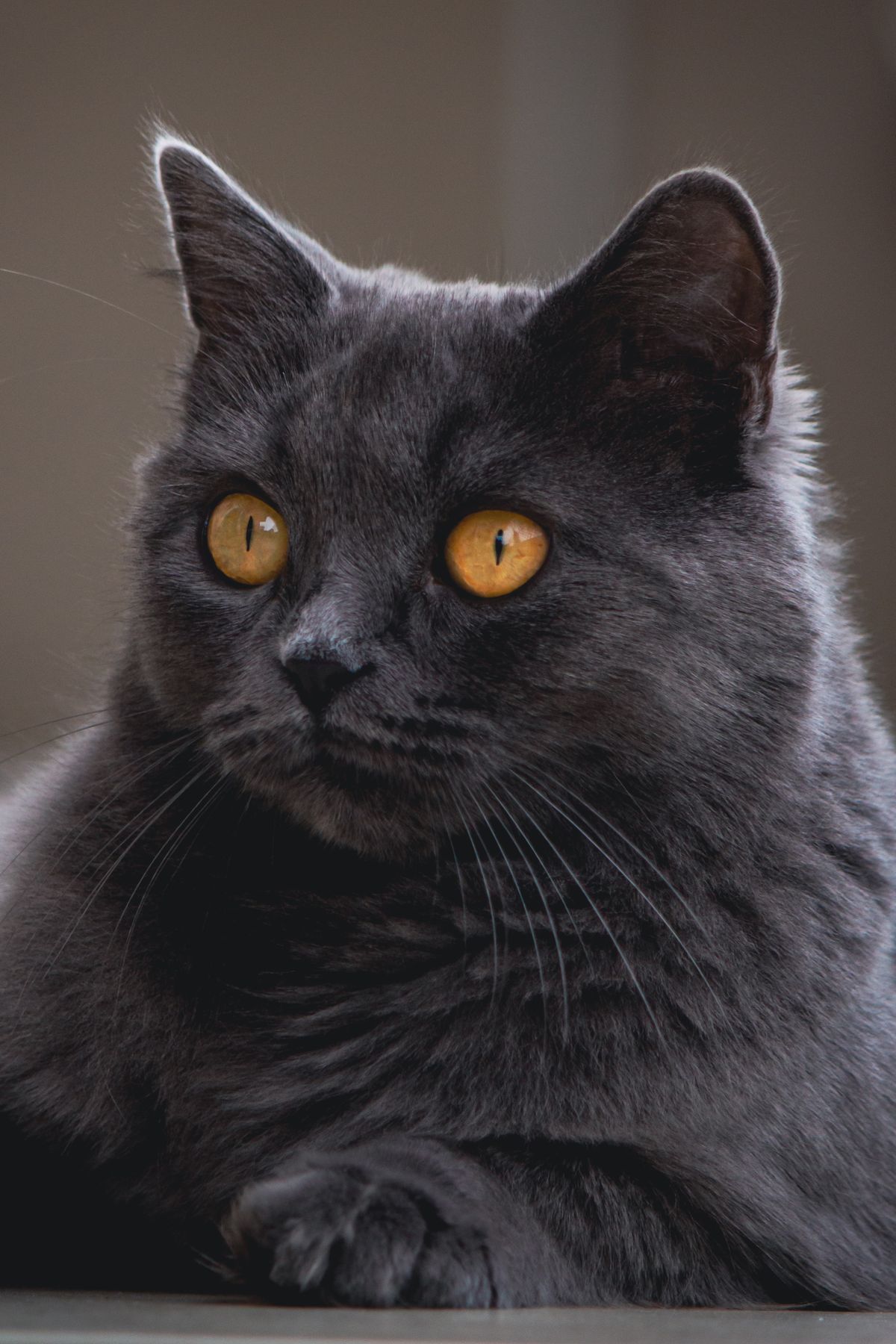
| Amber / orange | Deeper yellow-orange | Can overlap visually with copper, especially in warm light |
| Copper | Rich, saturated orange with reddish depth | CFA uses “brilliant copper” in many breed/color standards |
What about brown cat eyes? People often call very deep amber or copper “brown,” particularly in photographs. The CFA's general eye-color list uses orange and copper rather than brown as a main category. That does not make an owner's description “wrong”; it means cat-eye naming is descriptive rather than a universal laboratory scale.
How to Identify Your Cat's Eye Color More Reliably
- Use indirect natural daylight. Avoid direct sun in the eyes and avoid colored indoor bulbs.
- Turn off flash. Flash reflections and pupil constriction can change how much iris you see.
- Compare both eyes. Look for whether the hue is symmetric or one eye is genuinely different.
- Ignore the pupil. The pupil is black; identify the iris around it.
- Take several photos. Auto white balance can push green toward yellow or make copper look brown.
- Use history. “Always looked like this” is different from “this eye changed this month.”
Do not use an online color chart to diagnose disease. A cloudy cornea can make an eye look blue-gray even though the iris pigment underneath did not “turn blue.”
Blue and Aqua Cat Eyes
Blue eyes are especially familiar in Siamese-type colorpoint cats. UC Davis Veterinary Genetics Laboratory explains that variants in the TYR gene produce temperature-sensitive pigment restriction: the Siamese phenotype has darkened cooler extremities and blue eyes. The Burmese phenotype has broader pigment expression and typically yellow-gray to yellow-green eyes; cats with one Burmese and one Siamese allele produce the intermediate “mink” phenotype.
The CFA specifically describes mink-pattern Tonkinese as having aqua eyes, illustrating why “aqua” is useful breed terminology even though the CFA's broad eye-color overview groups the spectrum as blue-green.
Blue eyes can also occur in white or predominantly white cats without Siamese colorpoint genetics. Eye color alone cannot tell you which genetic mechanism is responsible.
Green and Hazel Cat Eyes

Green is not one fixed shade. Some eyes are cool gray-green; others look vivid leaf-green. Hazel sits closer to the boundary between green and gold, so the same cat may be described as hazel in one room and green-gold outdoors.
Breed standards sometimes use eye color very specifically. CFA notes that Egyptian Maus, Havana Browns and Oriental Shorthairs are examples where green is expected. That is useful for breed-show terminology, but it does not mean every green-eyed cat belongs to one of those breeds. Eye color is not a breed test.
Yellow, Gold, Amber, Orange and Copper: Where Does One End?

Think of these names as neighboring parts of a warm-color continuum:
- Yellow: clearer lemon-to-straw tones.
- Gold: richer, warmer yellow.
- Amber: orange-yellow with more depth.
- Orange: clearly orange rather than yellow-green.
- Copper: the deepest saturated orange/copper appearance.
There is no universal consumer chart that defines a precise numeric boundary between “gold” and “amber.” Formal breed standards can use much tighter wording—CFA Persian and Exotic standards, for example, repeatedly specify brilliant copper for many coat divisions—but ordinary domestic-cat descriptions are more flexible.
Odd-Eyed Cats and Heterochromia
When each eye has a different overall iris color, the cat is commonly called odd-eyed; the medical descriptive term is complete heterochromia. A familiar combination is one blue eye plus one green, yellow or copper eye.
A second pattern can occur when only part of one iris has a different color, often called sectoral heterochromia. The important question for an owner is whether the pattern has been present since youth and remained stable. A lifelong, stable color difference can be a normal trait. A new patch, progressive darkening or changing pupil shape in an adult cat should not be dismissed as “new heterochromia.”
When Do Kittens' Eyes Change Color?
Young kittens begin life with blue-gray appearing irises because mature pigment has not yet developed. Cats Protection notes that the iris generally stays blue-gray until about four to six weeks, with visible color change often beginning around five weeks. Its ageing chart describes the adult color as largely established by around seven weeks; PetMD's 2026 kitten-development chart describes eye color changing at seven weeks and transitioned by eight weeks.
| Age | Typical eye-color stage | How to interpret it |
|---|---|---|
| Eyes opening–~4 weeks | Blue/blue-gray appearance common | Too early to predict many adult colors reliably |
| ~4–6 weeks | Pigment change begins to become visible | Blue may shift toward green, yellow or warmer tones |
| ~7–8 weeks | Adult direction usually much clearer | Some cats may continue to settle in shade/intensity |
| Adult | Stable baseline expected | New unilateral color change is a health question, not normal kitten maturation |
These are developmental ranges, not a promise that every kitten changes on the same day. Genetics and individual development matter.
How Genetics and Breed Selection Influence Cat Eye Color
For most cats, coat color does not map to one guaranteed eye color. CFA notes that many coat/eye associations seen in pedigreed cats reflect generations of selective breeding. The clearest genetic link is the colorpoint system influenced by Siamese and Burmese TYR variants.
| Example | Eye-color relationship | What it tells you |
|---|---|---|
| Siamese phenotype | Blue eyes | Closely linked to the Siamese colorpoint restriction genotype |
| Burmese phenotype | Yellow-gray / yellow-green | Different TYR color-restriction phenotype |
| Tonkinese mink | Aqua in CFA terminology | Intermediate Burmese/Siamese color-restriction combination |
| White/predominantly white cats | Blue, copper/gold or odd eyes can occur | White coat does not identify one eye color or one genetic cause |
| Many other breeds/domestic cats | Breed standards may prefer specific colors | Eye color alone does not prove breed ancestry |
Use pedigree and genetic testing for genetic questions—not a photo-based eye-color guess.
Do White Cats With Blue Eyes Have Hearing Problems?
There is an association, but blue eyes do not diagnose deafness. The Merck Veterinary Manual, reviewed in February 2026, states that cats with white fur and blue eyes are sometimes—but not always—congenitally deaf. Some white blue-eyed cats hear normally, and hearing status cannot be confirmed by looking at eye color.
Also, a blue-eyed white cat is not automatically an albino. UC Davis describes true feline albinism as a separate, rare genetic condition. White coat, colorpoint pattern and albinism should not be collapsed into one category.
If hearing status matters—for example in a newly adopted white cat—ask your veterinarian about appropriate assessment rather than trying to infer hearing from the eyes.
A New Eye Color in an Adult Cat Is Different From Normal Eye Color
Stable adult iris color is usually a cosmetic trait. Change is the medical clue.
| What you notice | Why it matters | Action |
|---|---|---|
| New brown/dark freckle or spreading pigment on iris | Some pigment changes are benign, but iris melanosis can progress and tumors can present as color change | Schedule veterinary eye examination; document change with dated photos |
| One iris gradually changes color | Chronic uveitis can permanently alter iris color | Veterinary assessment |
| Sudden cloudy/blue-gray haze | Cloudiness can involve cornea/lens/anterior chamber rather than iris pigment | Prompt care, especially with pain/redness/discharge |
| Red eye + squinting / light sensitivity | Consistent with painful ocular inflammation among other causes | Urgent veterinary assessment |
| Enlarged eye or persistently dilated nonreactive pupil | Can occur with glaucoma and vision-threatening disease | Urgent veterinary assessment |
| Lifelong stable odd eyes | Can be normal congenital heterochromia | No treatment needed for color alone |
VCA notes that chronic uveitis can permanently change iris color. Cornell describes progressive cloudiness, eye enlargement, squinting and a dilated nonreactive pupil among possible glaucoma signs. PetMD's 2026 eye-tumor guidance notes that tumors may first appear as a color change, freckle or bump. None of these appearances can be diagnosed from a color chart.
If what you are seeing is discharge rather than iris pigment, use Patify's cat eye-discharge guide instead.
Patify Cat Appearance & Eye-Health Cluster
- Eye color is only one visual trait. For tabby, tortoiseshell, calico, colorpoint, smoke and other coat patterns, see Patify's cat coat-pattern guide.
- For watery, yellow, green or bloody material around the eye, use Cat Eye Discharge Color: What's Normal and What Needs a Vet.
Frequently Asked Questions About Cat Eye Colors
What are the main cat eye colors?
CFA lists orange, copper, yellow, hazel, green, blue-green and blue as the main colors. Everyday descriptions also use terms such as gold, amber and aqua.
Can cats have brown eyes?
Owners may describe very deep amber or copper eyes as brown. CFA's general eye-color categories use orange and copper rather than brown as a main category.
What is the rarest cat eye color?
There is no reliable universal population dataset that ranks every eye color across all domestic cats, so a precise “rarest” claim would be misleading. Breed-specific colors can be uncommon without being globally quantifiable.
Why are kittens born with blue eyes?
Their irises have not yet developed mature pigment. The blue-gray appearance usually begins changing around four to six weeks as pigmentation develops.
When is a kitten's final eye color visible?
The adult direction is often clear by roughly seven to eight weeks, although shade and intensity can continue to settle.
What is an odd-eyed cat?
A cat whose two irises have different overall colors, commonly one blue eye and one green, yellow or copper eye. This is complete heterochromia.
Are all white cats with blue eyes deaf?
No. Merck notes that white cats with blue eyes are sometimes, but not always, congenitally deaf. Eye color cannot confirm hearing status.
Are blue-eyed white cats albino?
Not necessarily. True feline albinism is a separate, rare genetic condition; dominant white and other white-coat mechanisms are different.
Do Siamese cats always have blue eyes?
The Siamese colorpoint phenotype is genetically associated with blue eyes. A cat merely resembling a Siamese in body shape is not enough to establish the genotype or breed.
Why did my adult cat's eye turn darker?
A new adult iris change should be examined. Benign pigment change is possible, but inflammation and pigmented eye lesions can also alter appearance.
Why does my cat's eye suddenly look blue or cloudy?
That may be cloudiness in the cornea, lens or front of the eye rather than a pigment change. Sudden cloudiness—especially with redness, discharge or squinting—needs prompt veterinary care.
Can I identify my cat's breed from eye color?
No. Eye color can be part of a breed standard, but many unrelated cats share the same eye color. Pedigree or appropriate genetic testing is needed for ancestry questions.
Sources Checked for This Guide
- Cat Fanciers' Association — Coat & Color Descriptions: main eye-color categories, odd-eye terminology and breed/color relationships.
- UC Davis Veterinary Genetics Laboratory — Colorpoint Restriction: Siamese/Burmese TYR variants and associated eye-color phenotypes.
- Cats Protection — Kitten Ageing Chart: timing of kitten eye-color development.
- PetMD — Kitten Development Stages, 2026: seven-to-eight-week eye-color transition context.
- Merck Veterinary Manual — Deafness in Cats, reviewed February 2026: cautious white-coat/blue-eye hearing association.
- VCA Animal Hospitals — Uveitis in Cats: iris-color change and painful inflammatory signs.
- Cornell Feline Health Center — Feline Glaucoma: cloudiness, enlargement, pupil and squinting signs.
- PetMD — Cat Eye Tumors, published April 16, 2026: freckles/color changes and need for veterinary evaluation.
Sources and Pexels image pages were checked October 1, 2026.