
Last verified: October 2, 2026
Maine Coon Colors: Build the Name in Layers
Quick answer: Maine Coon coat names become manageable when you read them as base pigment → solid/tabby expression → silver or smoke effect → white spotting. That is why “black smoke,” “brown classic tabby,” “blue silver mackerel tabby” and “red tabby with white” are coherent combinations rather than unrelated names.
Patify decoder: identify pigment first, pattern second, silver/smoke third and white last. This is more accurate than starting with a giant “70+ Maine Coon colors” list.
The Maine Coon Color Formula
| Layer | Question | Examples |
|---|---|---|
| 1. Base pigment | Which pigment family is present? | Black, blue, red, cream |
| 2. Pattern state | Is the coat solid/non-agouti or tabby/agouti? | Solid black; brown tabby; blue tabby |
| 3. Tabby geometry | How are tabby markings arranged? | Classic, mackerel, ticked |
| 4. Silver/smoke | Is there a depigmented/silvered undercoat? | Black smoke; silver tabby; blue smoke |
| 5. White spotting | How much white overlays the colored coat? | Black-and-white, tabby-and-white, calico |
This layered architecture explains why blue silver tabby with white is more informative than “gray and white Maine Coon.” It tells you the diluted black pigment, the silver effect, the tabby pattern and the white overlay.
Maine Coon Color Chart: The Families That Matter
| Family | What it means | Examples | Fast clue |
|---|---|---|---|
| Brown/black tabby | Black-based pigment expressed through tabby pattern | Brown classic, mackerel, ticked | Dark markings over warmer brown ground |
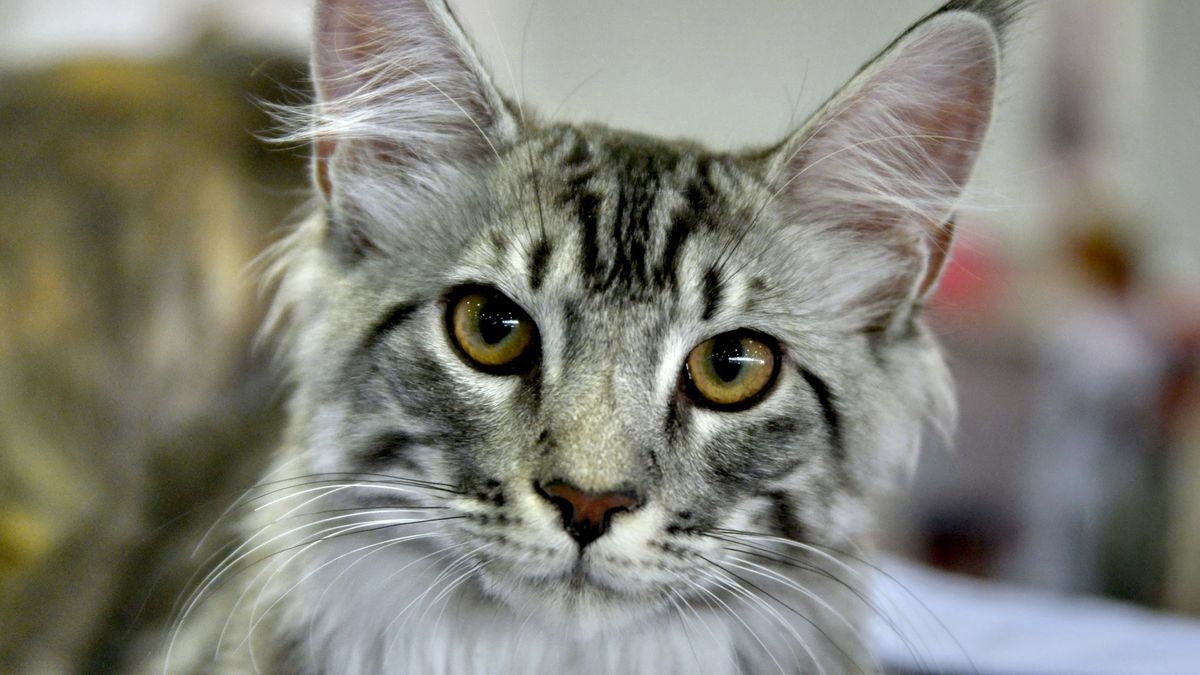
| Silver tabby | Tabby pattern plus silvered ground | Black silver, blue silver | Pattern remains obvious over pale background |
| Solid | Non-agouti/visually solid expression | Black, blue, red, cream, white | Overall uniform impression |
| Smoke | Solid-looking surface with white/silver undercoat | Black smoke, blue smoke, cameo/red smoke | Pale root appears when fur moves or is parted |
| Tortie/blue-cream | Black-or-blue pigment mixed with red-or-cream | Tortoiseshell, blue-cream | Mottled two-pigment coat |
| With white | White spotting overlays permitted color/pattern | Brown tabby-white, black-white | Identify colored areas first |
| Calico/dilute calico | Tortie family plus substantial white | Black/red/white; blue/cream/white | White separates colored patches |
Brown Tabby Is Not Genetic Chocolate
One of the most important corrections in Maine Coon color language is that brown tabby is a black-based tabby phenotype. The warm tan/brown ground between dark markings does not mean the cat is genetically chocolate.
TICA describes brown, red and silver tabbies as typical Maine Coon appearances and recognizes classic, mackerel and ticked patterns under the current Traditional category standard. CFA likewise maintains brown tabby, silver tabby, red tabby, blue tabby and related classes.
Classic tabby
Broad swirls and whorls create a marbled/bull’s-eye effect on the sides. Long coat can soften the edges, so shoulder and flank views are more useful than a face-only photo.
Mackerel tabby
Narrower vertical stripes descend from the spine. Leg, tail and chest markings can help when long flank fur blurs the pattern.
Ticked tabby
The body appears more evenly agouti/ticked with less obvious striping than classic or mackerel. Face and leg markings may still be visible.
Smoke vs Silver Maine Coon: Part the Coat
CFA defines black smoke as a white undercoat deeply tipped with black. The cat can look black while resting, yet movement or parting the fur reveals the pale base. Blue smoke uses the same architecture with blue tipping.
A silver tabby is different because the tabby pattern remains the defining surface pattern. You see dark tabby markings over a pale silver ground.
| Feature | Black smoke | Black silver tabby | Solid black |
|---|---|---|---|
| Surface at rest | Can look almost black | Visible tabby markings | Black |
| Hair base | White/silver undercoat | Silver ground with tabby architecture | Dark pigment extends much farther toward root |
| Adult body pattern | Not defined by visible tabby pattern | Tabby pattern is essential | Not defined by tabby pattern |
| Best home check | Part coat gently in daylight | Assess stripe/whorl/ticking geometry | Check roots; do not call every pale root smoke |
One photo is not perfect evidence. Kitten ghost markings, seasonal coat, grooming and exposure can change the apparent contrast. A pedigree color record is stronger than a social-media guess.
Solid Maine Coon Colors
CFA’s Maine Coon classes include white, black, blue, red and cream as solid colors. TICA’s public breed page likewise highlights black, white and blue among solid appearances.
Black
Dense black from a distance. Long guard hairs, sun exposure and warm lighting can create brownish highlights; that does not automatically make the coat smoke or “chocolate.”
Blue
Blue is cat-fancy language for diluted black pigment, producing a cool gray/blue appearance. It is not the same thing as silver.
Red and cream
Red is the orange pigment family; cream is its dilute. Red/cream coats can show visible ghost striping even in classes called solid because tabby patterning is difficult to visually suppress in the red pathway.
White
White can mask underlying color. Eye-color rules also require care: TICA permits blue and odd eyes in white cats and cats with white, while blue/odd eyes without white are not part of the championship-standard phenotype described by the breed committee.
Tortoiseshell, Blue-Cream and Calico
Tortoiseshell combines black-based and red pigment in patches or mottling. Blue-cream is the dilute counterpart. Add substantial white spotting and common registry/everyday language shifts toward calico or dilute calico.
These are color-pattern combinations, not different Maine Coon breeds. Most tortie/calico cats are female because orange pigment is X-linked; rare male exceptions occur through uncommon sex-chromosome configurations or chimerism. Color alone should never be used to make a health diagnosis.
White Is an Overlay, Not the Base-Color Answer
A Maine Coon can be tabby-and-white, black-and-white, smoke-and-white or calico. To name it logically:
- Identify the colored pigment.
- Decide whether the colored coat is solid, tabby, smoke or silver.
- Then describe the white spotting.
This prevents informal labels such as “tuxedo” or “harlequin” from replacing the underlying color information.
Chocolate, Lilac and Pointed Maine Coons: Check the Standard
The current TICA Maine Coon standard used for this guide is Traditional category only and excludes nondominant black-based modified colors such as chocolate, lilac, cinnamon, fawn and caramel. It also excludes pointed/Siamese-type coloration.
CFA similarly excludes colors indicating hybridization resulting in chocolate, lavender and Himalayan/pointed patterning, including combinations with white.
Buyer check: a seller calling a kitten a “rare chocolate Maine Coon” does not turn that label into an accepted standard color. Ask which registry is being used, verify the pedigree, and do not pay a premium solely because a marketing adjective sounds exotic.
How to Identify a Maine Coon Color From a Photo
- Confirm breed evidence separately. Color cannot prove Maine Coon ancestry.
- Use daylight and multiple angles. Long coat changes apparent tone.
- Look for tabby geometry. Classic whorls, mackerel stripes or ticking come before the color label.
- Part the coat if smoke is suspected. A pale undercoat under a solid-looking surface is the key clue.
- Do not call blue silver. Blue is diluted pigment; silver is a separate effect.
- Describe white last. First determine what the colored patches are.
- Use pedigree/registry records when precision matters.
Common Maine Coon Color Mistakes
| Mistake | Better rule |
|---|---|
| “Gray = silver” | Gray may be blue; silver requires the silver/inhibitor coat effect. |
| “Brown tabby = chocolate” | Brown tabby is normally black-based tabby terminology. |
| “Any pale root = smoke” | Use the whole coat architecture and registry definition. |
| “Black smoke is gray” | A black smoke can look nearly solid black until the coat parts. |
| “Rare color means better Maine Coon” | Color does not establish health, temperament or breeding quality. |
Related Patify Cat-Color Guides
- Patify’s cat coat-pattern guide explains tabby, tortie, calico, smoke and white spotting across cats.
- For blue, green, gold, copper and odd-eye terminology, use the cat eye-color chart.
Frequently Asked Questions About Maine Coon Colors
What colors can Maine Coons be?
Current CFA/TICA standards cover a broad traditional palette including black, blue, red, cream, white, tabbies, silvers, smokes, tortie/blue-cream combinations and versions with white.
What is the most typical Maine Coon color?
TICA describes brown classic or mackerel tabby as the most typical/common appearance, but that should not be converted into an invented population percentage.
Is a gray Maine Coon blue or silver?
It can be either. Blue is diluted black pigment; silver is a separate inhibitor effect usually named with the pattern.
What is a black smoke Maine Coon?
A smoke coat with a white undercoat deeply tipped in black. The pale root becomes obvious when the coat parts or moves.
What is the difference between smoke and silver tabby?
Smoke looks substantially solid at the surface and hides a pale undercoat; silver tabby retains visible tabby markings over silver ground.
Can Maine Coons be solid black?
Yes. Solid black is an accepted Maine Coon color.
Can Maine Coons be orange?
Yes. Cat-fancy terminology calls orange/ginger “red”; the dilute form is cream.
Are chocolate Maine Coons standard?
Not under the current CFA/TICA standards cited here.
Does color predict personality?
No reliable color-based personality rule should drive adoption. Individual genetics, socialization, health and environment matter more.
Sources Checked
- TICA — Maine Coon
- TICA — Maine Coon standard revision material
- CFA — Maine Coon Cat
- CFA — Coat & Color Descriptions
Sources reviewed October 2, 2026.