

Last verified: September 29, 2026
Cockatiel Colors: Identify the Phenotype Without Pretending You Know the Hidden Genes
Quick answer: most pet cockatiel “colors” are inherited color or pattern mutations of the same species, Nymphicus hollandicus. The wild-type foundation is normal grey. Common captive mutations include lutino, cinnamon, pearl (opaline), pied and whiteface, and breeders can combine those traits into birds such as whiteface pearl, cinnamon pied or whiteface lutino.
The hard part is that appearance does not reveal every gene. A visually normal bird can carry a recessive mutation (“split”), one mutation can mask another, males of some pearl lines lose obvious pearling after maturity, and breeder/trade names are not always genetically precise. Use photos to describe the phenotype you can see; use pedigree or breeding/DNA information when you need to know the genotype.
Patify identification rule: describe what is visible first—base tone, cheek color, eye color and pattern—then assign a mutation name only as confidently as those features allow.
Color vs Mutation vs Morph vs Trade Name
Owners often use all four words interchangeably, but keeping them separate prevents bad identification.
| Term | Useful meaning | Example |
|---|---|---|
| Wild type / normal | The species’ baseline captive phenotype without a color mutation being expressed | Normal grey |
| Mutation | An inherited genetic change affecting pigment or feather pattern | Lutino, cinnamon, pearl, pied, whiteface |
| Phenotype | What the bird visibly looks like | White body, no orange cheek, red-looking eyes |
| Genotype | The underlying genetic combination, including genes not visible | A normal-looking bird that is split to whiteface |
| Combination | Two or more expressed mutations in one bird | Whiteface pearl pied |
| Morph / color | Convenient hobby terms for visible varieties | “Lutino morph” |
| Trade/breeder name | A label that may vary between communities and may not map cleanly to one gene | Some “silver,” “emerald,” “pastel” labels |
LafeberVet describes normal grey as the foundation from which captive color variations developed. Cockatiel Genetics catalogs multiple distinct inherited mutations, including sex-linked lutino, pearl, cinnamon, recessive pied, whiteface, silver/fallow families and yellow-cheek traits.
Important: color mutations do not make these separate cockatiel species or breeds.
Cockatiel Color Chart: 10 Common Visual Categories
| Variety | Main visual clue | Orange cheek? | Eye clue | Visual-ID confidence |
|---|---|---|---|---|
| Normal grey | Grey body, white wing patch, yellow/grey face depending age/sex | Usually yes | Dark | High for phenotype; hidden splits still possible |
| Lutino | Melanin strongly removed; pale yellow/cream/white appearance | Usually yes | Red/reddish | High when classic |
| Cinnamon | Warm brown/taupe replaces normal dark grey | Usually yes | Adults dark; hatchling eye clues can differ | Moderate–high |
| Pearl / opaline | Scalloped/pearled feather pattern | Usually yes unless combined with whiteface | Typically dark | High in juvenile/female; adult males can be tricky |
| Pied | Irregular clear/yellow-white patches interrupt darker plumage | Variable with combinations | Usually dark | Moderate–high |
| Whiteface | Yellow/orange pigments absent; grey + white look | No orange cheek | Usually dark | High when pure phenotype is clear |
| Whiteface lutino | Very pale/white bird because whiteface + lutino effects combine | No | Red/reddish | High for phenotype; often mislabeled “albino” |
| Fallow family | Reduced/altered dark pigment; softer brownish or pale appearance | Depends on combination | Some fallow types have reddish eyes | Low–moderate without breeder records |
| Silver/dilution families | Grey pigment appears lightened or altered | Depends | Depends on mutation | Low from casual photo alone |
| Yellow-cheek / face variants | Cheek/face psittacin coloration altered | Altered from classic orange | Usually not primary clue | Low–moderate because names/genetics vary |
This table is intentionally conservative. Rare mutations and combinations can imitate one another, and lighting/white balance can make grey look brown or cream look white.
1. Normal Grey Cockatiel
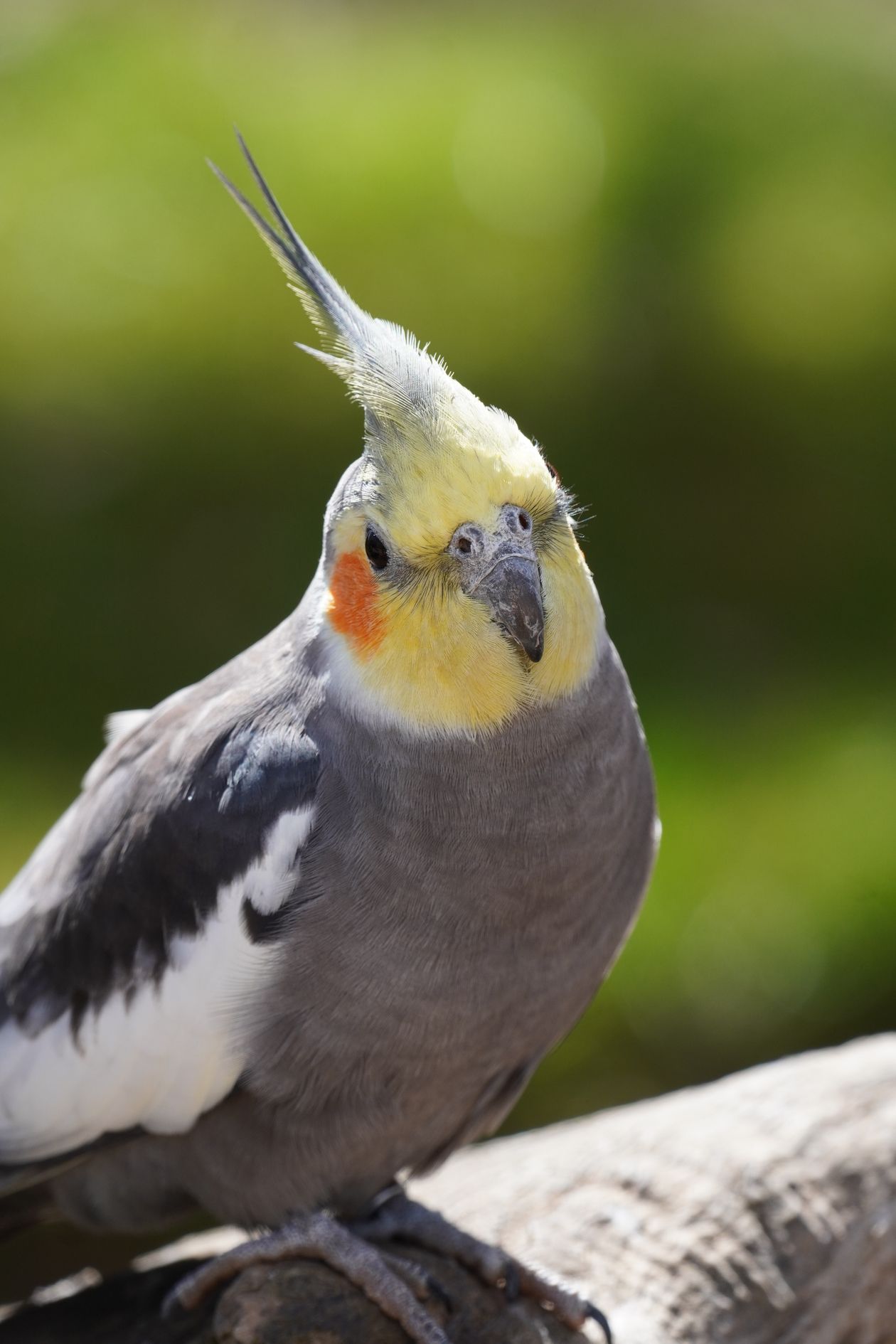
VCA describes mature wild-type cockatiels as primarily grey with white on the front portion of each wing, yellow facial coloring and orange cheek patches. Normal grey is not a “mutation” in the same sense as lutino or pearl; it is the baseline wild-type phenotype.
Typical adult male
- grey body;
- bright yellow face/crest;
- bright orange cheek patch;
- solid darker underside to tail/flight feathers after maturity.
Typical adult female
- greyer/paler face than adult normal male;
- orange cheek patch often less intense;
- fine barring on underside of tail;
- spots on underside of long wing feathers.
VCA notes that immature normal-grey males and females resemble mature females and that adult coloring becomes clearer after the first molt, around 9–12 months. This is why a bright-yellow-face rule is unreliable in young birds.
Genetic trap: a normal-looking cockatiel may still be split to a recessive mutation and pass that mutation to offspring. Appearance cannot rule out hidden genes.
2. Lutino Cockatiel
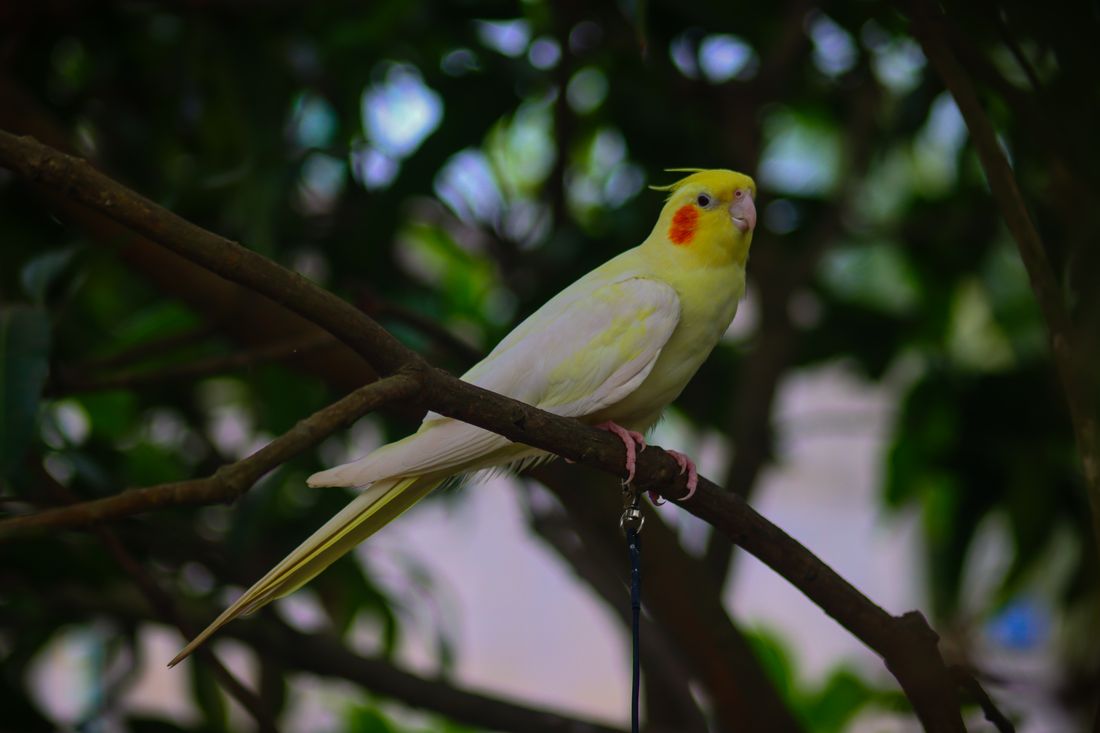
Lutino removes melanin expression through much of the bird. Cockatiel Genetics describes the common sex-linked lutino as producing pale plumage, pinkish soft tissues and red eyes from hatch. LafeberVet describes lutinos as carrying a light yellow hue and notes that pale birds are often casually mislabeled.
Look for
- cream, pale yellow to near-white plumage;
- yellow crest/face;
- orange cheek patches;
- pinkish beak/feet/nails;
- red or reddish-looking eyes, particularly obvious in certain light.
The exact shade varies. A photo exposed too brightly can make a light lutino look pure white, so preserve eye and cheek information when trying to identify one.
3. Cinnamon Cockatiel
Cinnamon alters melanin so the bird’s dark areas become warmer brown/taupe rather than the cool charcoal-grey of a normal cockatiel. Cockatiel Genetics classifies cinnamon as a sex-linked recessive mutation.
Normal grey vs cinnamon
| Feature | Normal grey | Cinnamon |
|---|---|---|
| Body tone | Cool dark grey | Warm brown-grey / taupe |
| Dark feather areas | Black-grey | Browned / softened |
| Orange cheek | Present | Usually present unless another mutation removes it |
| Lighting sensitivity | Moderate | High—warm indoor light can exaggerate brown tone |
Cinnamon is particularly easy to overcall from a warm phone photo. Compare the bird in neutral daylight and, ideally, against a known normal grey.
4. Pearl / Opaline Cockatiel
Pearl changes the distribution of pigment across individual feathers, creating repeated scalloped, spotted or “pearl” markings across the back, wings and body. Cockatiel Genetics classifies pearl/opaline as sex-linked recessive.
The maturity trap
This mutation is one of the biggest visual-ID traps. LafeberVet notes that immature pearl birds of both sexes can show obvious pearling, while mature males typically lose much of the visible pearl pattern after maturity. Cockatiel Genetics likewise notes that adult males may become difficult to distinguish visually after molt, although some combinations—especially with recessive pied—can complicate that rule.
Therefore:
- young pearl-looking bird: phenotype is easy to describe, sex may not be;
- adult female pearl: typically retains obvious pearling;
- adult male genetically pearl: may look much more normal after molt;
- combined mutations: do not rely on a single sexing shortcut.
5. Pied Cockatiel
Pied breaks up the normal melanin pattern, leaving irregular clear/yellow-white areas among darker feathers. LafeberVet describes pied as a two-color appearance with highly variable grey distribution; Cockatiel Genetics classifies the common recessive pied as autosomal recessive.
Why two pieds can look very different
The amount and location of clear feathering varies dramatically. Some birds retain large dark areas; others are heavily pied and look almost clear. That means “more yellow” does not automatically mean “more genetically pied” in a simple measurable way.
Sexing trap
Cockatiel Genetics describes recessive pied as anti-dimorphic: classic male/female visual differences can be reduced or obscured. Do not use a normal-grey sexing chart as if pied were normal grey.
6. Whiteface Cockatiel
Whiteface removes the yellow/orange/red psittacin-type pigmentation while leaving melanin. The result is a grey-and-white cockatiel without the classic orange cheek patch. Cockatiel Genetics classifies whiteface as autosomal recessive.
Key clues
- no orange cheek patch;
- no normal yellow facial pigment;
- grey/black and white dominate;
- eye color remains dark unless another mutation changes it.
This is a useful example of why “white bird” and “whiteface” are not the same concept: a whiteface can still be visibly dark grey over much of the body.
7. Whiteface Lutino: Why “Albino Cockatiel” Is a Tricky Name
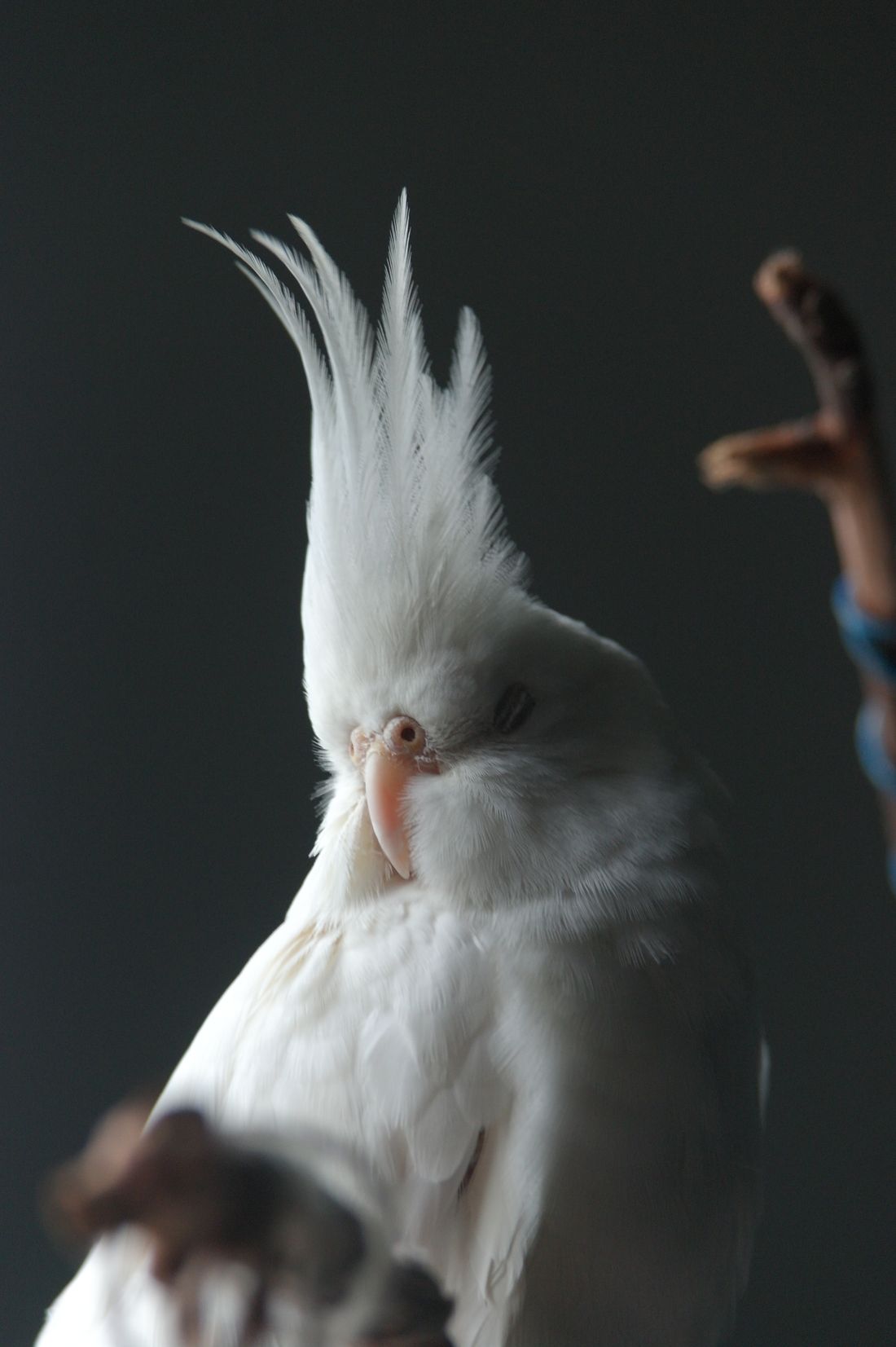
Many pet listings call an all-white red-eyed cockatiel an albino cockatiel. Current Lafeber Pet Birds guidance explains that this appearance is generally a whiteface lutino—the whiteface mutation removes yellow/orange pigments while lutino removes melanin—rather than a separate true-albino cockatiel mutation.
Older avian handouts and breeder terminology sometimes use “albino” more loosely, which is why both names remain online. For an owner guide, whiteface lutino (“commonly called albino”) is the clearest label.
Look for
- white to nearly white plumage;
- no orange cheek patch;
- no yellow face coloration;
- red/reddish eyes;
- pinkish soft tissues.
8–10. Fallow, Silver/Dilution and Yellow-Cheek Families
Once you move beyond the major five mutations, naming gets much harder because breeder communities may distinguish several genetically different pale/silver/fallow traits that look similar in ordinary photographs.
8. Fallow families
Fallow mutations reduce or alter melanin and may produce warmer, paler plumage; some are associated with red/reddish eyes. “Fallow” should not be assigned solely because a bird looks light brown.
9. Silver / dilution families
There are multiple genetically distinct lightening/dilution traits in cockatiels, including dominant and recessive forms cataloged separately by specialist genetics sources. A generic seller label of “silver” may not tell you which genetic mutation is present.
10. Yellow-cheek / face-color variants
Several mutations alter cheek/face coloration. Cockatiel Genetics separately catalogs sex-linked yellow cheek and other psittacin-altering traits. Because naming differs internationally, breeder records are especially valuable here.
Rare-color rule: when two mutations can look similar, write “phenotype consistent with…” rather than turning a photograph into a genetic certificate.
Combined Cockatiel Mutations: Why One Bird Can Have Three Names
Mutations can combine. The National Cockatiel Society’s show classifications include combinations such as cinnamon pearl, cinnamon pied, pearl pied, whiteface cinnamon, whiteface pearl, whiteface pied and more complex combinations.
| Example combination | What combines visually |
|---|---|
| Cinnamon pearl | Warm brown base + pearl/scalloped pattern |
| Pearl pied | Pearl pattern + irregular clear patches |
| Whiteface pearl | Pearling without orange/yellow face pigment |
| Whiteface pied | Grey/white whiteface palette + pied clear pattern |
| Whiteface cinnamon | No orange/yellow facial pigment + warm brown melanin tone |
| Whiteface lutino | Whiteface removes psittacin colors + lutino removes melanin |
| Cinnamon pearl pied | Three visible pattern/pigment effects can overlap |
This is why a 20-photo “cockatiel types” chart quickly breaks down. The number of visual combinations is much larger than the number of core mutations.
Cockatiel Color Genetics Without a Breeding Calculator
You do not need to breed birds to understand the three inheritance concepts that explain most identification surprises.
1. Sex-linked recessive
Cockatiel Genetics classifies several major mutations—including common lutino, cinnamon and pearl—as sex-linked recessive. Because birds use a Z/W sex-chromosome system, inheritance patterns differ between males and females.
2. Autosomal recessive
Whiteface and recessive pied are classic examples. A bird can carry one copy without visually expressing the mutation. That hidden carrier state is why two visually ordinary birds can sometimes produce a mutation offspring if the pedigree permits.
3. Dominant traits
Some rarer cockatiel color traits are dominant, meaning the visual inheritance logic differs from recessive mutations.
What does “split to” mean?
In breeder language, a bird “split to whiteface” looks non-whiteface but carries a recessive whiteface allele that can be passed to offspring. Lafeber’s breeding guidance explicitly notes that birds can carry another mutation without showing visible markings.
Phenotype does not reveal every split. Do not sell, breed or label a bird as carrying a hidden mutation merely because an online calculator says it is possible; parentage/pedigree and breeding results are what establish those hidden genetics.
Can You Tell a Cockatiel’s Sex From Its Color?
Sometimes—but mutation and age can erase the normal visual clues.
| Phenotype | Visual sexing usefulness | Main caution |
|---|---|---|
| Adult normal grey | Often useful after first molt | Juveniles resemble females |
| Pearl | Can be informative after maturity | Males often lose obvious pearling; combinations complicate rule |
| Pied | Often poor | Pied can obscure normal sexual dimorphism |
| Lutino | Variable / less reliable | Normal face-color clues do not transfer cleanly |
| Whiteface | Some age/sex clues may remain | Orange/yellow face clue is removed by definition |
| Whiteface lutino / very pale combinations | Poor from appearance alone | Very few classic plumage sex markers remain |
A 2026 Lafeber response specifically warns that many white/light mutations do not show the usual male-versus-female markings clearly and recommends DNA sexing when certainty matters. Behavior can add clues but is not guaranteed: some females vocalize strongly and some males are quiet.
Cockatiel Mutation Identification: A 7-Step Photo Checklist
Use this in order. It prevents “yellow bird = lutino” and “white bird = albino” mistakes.
- Start with the base tone. Cool grey, warm brown, pale yellow/cream, white, diluted silver?
- Look for the orange cheek patch. Present, reduced/altered, or completely absent?
- Inspect the face/crest pigment. Yellow, grey/white, pale, mixed?
- Inspect eye color. Dark brown/black appearance versus red/reddish.
- Look for a repeating feather pattern. Pearling/scalloping is different from irregular pied clearing.
- Look for irregular clear patches. Pied does not follow the regular pearl pattern.
- Add age and molt history. Juvenile plumage and adult male pearl loss can change the answer.
Photo conditions that improve identification
- neutral daylight;
- no color filter;
- full-body side view;
- face and cheek visible;
- back and wings visible;
- underside of tail/flight feathers if visual sexing is relevant;
- eye close-up without flash overexposure.
Confidence labels
| Confidence | When to use it |
|---|---|
| High | Classic phenotype with several agreeing features, e.g. whiteface with no orange/yellow pigment |
| Moderate | Likely common mutation but lighting/age or combination introduces uncertainty |
| Low | Rare pale/silver/fallow phenotype, heavy combinations or poor photo |
| Genotype unknown | Any hidden “split” status without pedigree/breeding evidence |
Does Cockatiel Color Change Care, Diet or Personality?
No color mutation turns a cockatiel into a different species with a different basic care plan. VCA describes the same core husbandry framework for cockatiels regardless of color: appropriate housing, balanced nutrition, social and behavioral care and avian veterinary attention.
Be skeptical of claims such as:
- “lutinos are always friendlier”;
- “whiteface cockatiels live longer”;
- “pearls are quieter”;
- “pieds need a special diet”;
- “rare color means healthier genetics.”
Individual health depends on breeding quality, nutrition, environment, infectious disease exposure, preventive care and many other factors. A color label is not a health certificate.
If a cockatiel suddenly becomes very quiet, weak, stops perching normally or has breathing changes, use Patify’s parrot emergency guide rather than attributing behavior to mutation. If the concern is a major new vocalization pattern, Patify’s sudden screaming guide separates health, fear, learned behavior and environmental causes.
10 Common Cockatiel Color Identification Mistakes
- Calling normal grey a mutation. It is the wild-type baseline.
- Calling every pale yellow bird “albino.” Lutino keeps yellow/orange pigment.
- Calling every white bird “whiteface.” Whiteface itself can still have dark grey plumage.
- Ignoring eye color. It can separate look-alike pale phenotypes.
- Confusing pearl with pied. Pearl is a repeated feather pattern; pied is irregular clearing.
- Calling warm lighting “cinnamon.” Check neutral daylight.
- Sexing juveniles like adult normal greys. Immature males resemble females.
- Assuming an adult male cannot carry pearl because the pearling faded.
- Claiming a hidden split from appearance. Recessive carrier status may be invisible.
- Assuming breeder names are globally standardized. Rare mutation terminology can differ.
Frequently Asked Questions About Cockatiel Colors
What is the natural color of a cockatiel?
Normal grey is the wild-type foundation: a predominantly grey bird with a white wing patch, orange cheek patches and sex/age-dependent facial coloration.
What are the most common cockatiel color mutations?
Lutino, cinnamon, pearl/opaline, pied and whiteface are among the best-known captive mutations, with many combinations of them.
Is lutino the same as albino?
No. Lutino cockatiels retain yellow/orange pigments and normally have orange cheek patches. Birds commonly sold as “albino cockatiels” are generally whiteface lutinos.
Is a whiteface cockatiel completely white?
No. Whiteface removes yellow/orange/red pigmentation, so many whiteface cockatiels are grey and white. A nearly all-white red-eyed bird is more consistent with a whiteface-lutino combination.
What is the difference between pearl and pied?
Pearl creates a repeated scalloped/pearled feather pattern. Pied creates irregular clear patches where normal dark pigment is absent.
Do male pearl cockatiels lose their pearls?
Typically, mature males lose much of the visible pearling after molt, while females retain it. Combined mutations can complicate the pattern, so it is not an absolute photo-sexing rule.
What does “split to whiteface” mean?
It means the bird carries a recessive whiteface allele without visually expressing whiteface. Hidden split status cannot generally be diagnosed from appearance alone.
Can two grey cockatiels have colored chicks?
Potentially, if their genetics include compatible hidden recessive or sex-linked mutations. The exact possibilities depend on each parent’s genotype.
Can you identify a cockatiel mutation from one photo?
Common phenotypes can often be estimated, but genotype cannot be fully established from one image. Age, lighting, eyes, pattern, parentage and combinations matter.
Are rare cockatiel colors more valuable?
Market price varies by breeder, region, age, tame/training status and mutation rarity, but rarity does not make a bird healthier or better suited as a pet.
Does cockatiel color affect personality?
There is no good basis for assigning a fixed personality to common color mutations. Socialization, handling, age, sex, individual temperament and environment matter more.
How do I tell a cinnamon cockatiel from normal grey?
Cinnamon replaces cool dark grey/black tones with warmer brown/taupe tones. Use neutral daylight because warm indoor lighting can make normal grey look brown.
Why are mutation names confusing?
Some names arose in different breeder communities before genetics terminology became standardized. A trade name can describe appearance while specialist genetics sources use a different mutation name.
Sources Checked for This Guide
- VCA Animal Hospitals — Cockatiels: General Information: wild-type appearance, common captive colors, first molt and normal-grey visual sexing.
- LafeberVet — Cockatiel Concerns: normal grey foundation, pearl, lutino, pied and mutation overview.
- Lafeber Pet Birds — Albino or Whiteface?: current clarification that “albino” appearance is whiteface lutino.
- Lafeber Pet Birds — Cockatiel Colors: hidden/split mutations and unexpected offspring colors.
- Lafeber Pet Birds — Sex of a White Bird: visual-sexing limitations in light color mutations and DNA sexing.
- Cockatiel Genetics — Mutation Index: specialist catalog of established mutations.
- Cockatiel Genetics — Sex-Linked Lutino: phenotype and inheritance.
- Cockatiel Genetics — Cinnamon: melanin effect and inheritance.
- Cockatiel Genetics — Pearl / Opaline: pattern, inheritance and adult male pearl loss.
- Cockatiel Genetics — Recessive Pied: irregular melanin clearing and anti-dimorphic effect.
- Cockatiel Genetics — Whiteface & Par-Blue: whiteface pigment effect and recessive inheritance.
- National Cockatiel Society — Show Classifications: documented combination classes including cinnamon, pearl, pied and whiteface combinations.
- Pexels — grey cockatiel cover image
- Pexels — lutino cockatiel image
- Pexels — pale/white cockatiel illustrative image
- Pexels License
Editorial note: this guide distinguishes visible phenotype from hidden genotype, treats rare trade names conservatively, and does not claim genetic certainty from photographs alone; sources were reviewed September 29, 2026.