
Last verified: October 3, 2026
How to Acclimate Fish: The Method Depends on How Long the Fish Was Bagged
Quick answer: there is no single best acclimation method for every arrival. For a fish bought locally and transported briefly, gradual mixing can reduce temperature/pH differences. For a fish that spent many hours sealed in a shipping bag, prolonged acclimation after opening can increase ammonia exposure as CO₂ escapes and pH rises. Temperature-match the sealed bag first, then use the seller/species-specific protocol and never pour shipping water into the display tank.
Patify acclimation rule: ask local or shipped? → time sealed → bag type → temperature difference → pH/salinity difference → species sensitivity → quarantine plan before choosing float, staged mixing, drip or fast transfer.
1. Acclimation Starts Before You Open the Bag
Your receiving aquarium should already be biologically ready. PetMD’s May 2026 new-tank guidance emphasizes that ammonia and nitrite must be controlled by an established biological filter; adding fish to an uncycled aquarium turns acclimation into the least important problem.
Before the fish arrives:
- test temperature, pH, ammonia and nitrite;
- prepare a quarantine tank if possible;
- dim aquarium/room lights;
- have a dedicated bucket/specimen container and net ready;
- know whether the fish came from freshwater, brackish or marine conditions;
- read the seller’s arrival/guarantee protocol before opening.
Use Patify’s fishless cycling guide if the destination tank is not already proven.
2. Fish Acclimation Method: Decision Table
| Arrival | Main problem | Reasonable method | Avoid |
|---|---|---|---|
| Local store, short trip | Temperature/pH/mineral difference | Float sealed bag ~10–15 min, then staged aquarium-water mixing in separate container | Very long unattended drip |
| Long sealed shipment | Temperature + accumulated CO₂/ammonia | Temperature-match sealed bag, then prompt transfer following shipper protocol | Leaving opened shipping water for a long acclimation |
| Sensitive freshwater fish/invertebrate | Large chemistry/osmotic difference | Controlled staged or drip acclimation when transport-water ammonia risk is low | Unmeasured rapid chemistry swing |
| Marine invertebrate | Specific-gravity sensitivity | Seller-specific measured drip procedure | Freshwater-fish shortcut |
| Breather bag | Different gas-exchange design | Follow shipper instructions; Aquarium Co-Op suggests external temp equalization rather than floating some breather bags | Assuming every bag behaves identically |
This is why apparently contradictory acclimation advice can both be legitimate: the transport scenario is different.
3. Local Fish / Short Transport: Gradual Mixing Is Reasonable
Aquarium Co-Op recommends placing small fish or shrimp from a local purchase into a specimen cup/container with transport water, then adding destination aquarium water in stages:
- Dim the lights.
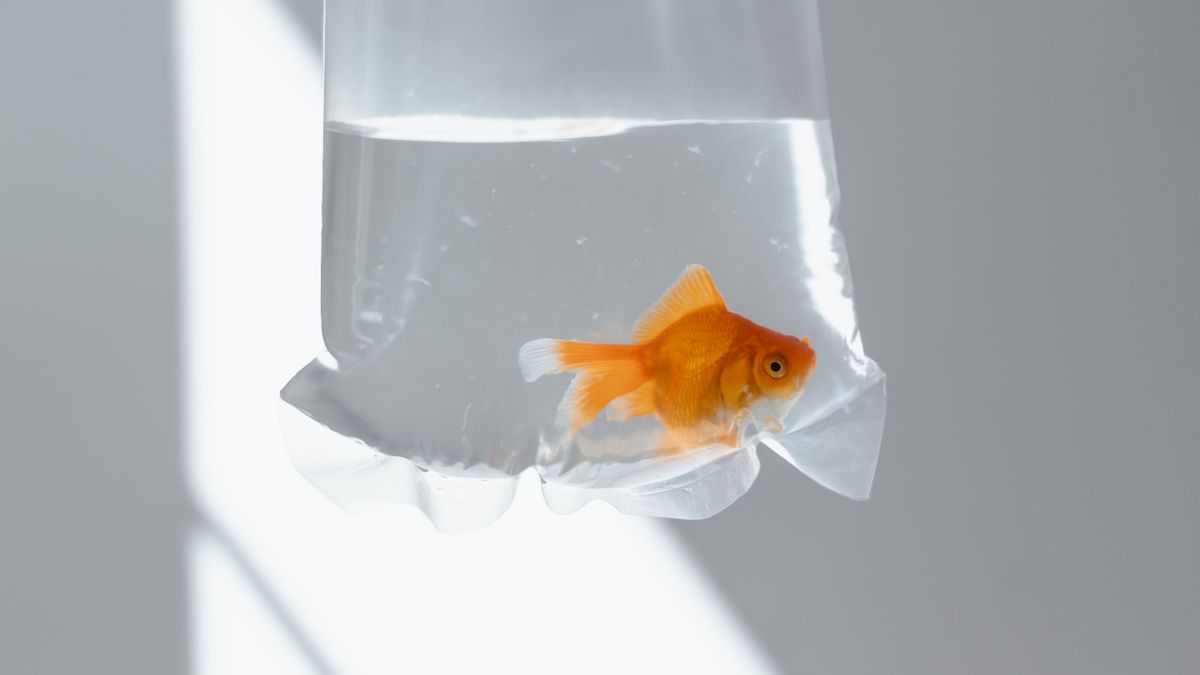
- Float the sealed transport bag for about 10–15 minutes if a temperature difference exists.
- Move fish plus enough transport water to cover them into a clean acclimation container.
- Add aquarium water until the volume roughly doubles.
- Wait about 15 minutes, then repeat gradual additions.
- After another short interval, transfer the fish with a clean net/cup.
- Discard acclimation water rather than pouring it into the aquarium.
The point is controlled chemistry change, not hitting a magic number of minutes.
4. Long Shipping Changes the Chemistry: Understand Ammonia Before You Open
Aquarium Co-Op gives different advice for fish that were shipped for many hours. While sealed, fish respiration adds carbon dioxide, which lowers pH. Waste adds ammonia/ammonium. At lower pH, a larger fraction is present as the less toxic ammonium form.
When the bag is opened, CO₂ escapes and pH can rise. That shifts the ammonia/ammonium equilibrium toward more toxic un-ionized ammonia. Aquarium Co-Op therefore recommends a “plop and drop”-style approach for many shipped fish: temperature-match the sealed bag, open it only when ready, discard shipping water, and transfer promptly.
LiveAquaria’s guidance also explicitly warns against adding an airstone to shipping water because rapid pH rise can expose animals to toxic ammonia.
This is why “drip every shipped fish for two hours” is not a universal rule. Follow the shipper’s protocol, especially when a live-arrival guarantee depends on it.
5. When Drip Acclimation Makes Sense
LiveAquaria recommends drip acclimation for sensitive animals when controlled chemistry matching is the priority, especially many invertebrates and marine animals. Its current procedure uses airline tubing at roughly 2–4 drips per second and monitored water-volume increases.
Drip acclimation is most defensible when:
- transport time was short enough that ammonia accumulation is not a major concern;
- the animal is highly sensitive to salinity/pH/hardness change;
- you can monitor the process continuously;
- temperature will not drift badly in the bucket;
- the seller recommends it for that exact species/shipping method.
Do not put an airstone into old shipping water to “help oxygen” before you understand the ammonia/pH situation.
6. Acclimate Into Quarantine, Not Straight Into the Display When Possible
Acclimation solves environmental transition. It does not detect parasites or infectious disease.
PetMD repeatedly recommends quarantining new fish before adding them to established systems; one veterinarian cited by PetMD recommends at least 30 days for new aquarium animals. The exact quarantine duration/protocol varies by species, source and disease risk, but the principle is stable: isolate new arrivals where they can be observed without exposing the display tank.
A quarantine tank should have:
- mature biological filtration or pre-seeded media;
- species-appropriate temperature and aeration;
- simple hiding structures;
- easy visual access to feces/behavior;
- dedicated nets/equipment where possible.
7. Do Not Pour Store or Shipping Water Into the Aquarium
LiveAquaria’s floating method specifically instructs keepers to net the animal and discard bag water. This reduces introduction of unknown medications, pathogens, detritus and transport-water chemistry into your display.
Use a net when appropriate, but not for animals that should remain submerged during transfer. Aquarium Co-Op, for example, recommends moving pea puffers in a cup/container rather than lifting them into air.
8. The First 24 Hours After Acclimation
- Keep lights dim/off initially.
- Do not chase the fish around for photographs.
- Offer food only when the species is settled enough; some fish skip the first meal.
- Watch respiration, balance, color, hiding and aggression.
- Test ammonia/nitrite after adding livestock, especially in smaller/quarantine systems.
- Do not medicate prophylactically unless your quarantine protocol or aquatic veterinarian calls for it.
LiveAquaria suggests keeping aquarium lights off for several hours after introduction, which reduces another abrupt sensory stressor.
9. Common Fish Acclimation Mistakes
- Acclimating into an uncycled tank. Perfect bag technique cannot overcome ammonia/nitrite toxicity.
- Opening a long-shipped bag and leaving the fish in it for hours. pH rise can increase ammonia toxicity.
- Assuming drip is always safer. Method depends on shipping duration and chemistry.
- Pouring transport water into the display.
- Matching temperature but ignoring salinity/pH for sensitive species.
- Skipping quarantine because the fish looks healthy.
- Using one protocol for fish, shrimp, snails and marine invertebrates. Osmotic sensitivity differs.
Frequently Asked Questions About Acclimating Fish
How long should I acclimate a new fish?
There is no universal time. Short local transport can justify gradual mixing; long sealed shipping may call for temperature matching followed by prompt transfer because of ammonia chemistry.
Should I float the fish bag?
For standard sealed bags, floating for roughly 10–15 minutes is a common way to reduce temperature shock. Follow special instructions for breather bags.
Is drip acclimation always best?
No. It is useful for sensitive chemistry changes, but prolonged exposure to opened long-shipping water can be risky if ammonia has accumulated.
Why can opening a shipping bag make ammonia more dangerous?
CO₂ escapes, pH rises, and more total ammonia shifts toward the toxic un-ionized form.
Can I pour fish-store water into my aquarium?
It is better to transfer the fish and discard transport water rather than adding it to the display.
Do I need to quarantine new fish?
Quarantine is strongly recommended for protecting an established aquarium because apparently healthy arrivals can carry pathogens or parasites.
Should I feed immediately after acclimation?
Not necessarily. Let the fish settle and offer a small species-appropriate meal when normal behavior resumes.
Sources Checked
- Aquarium Co-Op — How to Acclimate New Fish
- LiveAquaria — Step-by-Step Acclimation Guide
- LiveAquaria — New Arrival Acclimation
- PetMD — Fish Tank Water Testing
- PetMD — New Tank Syndrome (DVM-reviewed, 2026)
Sources reviewed October 3, 2026.