
Manitoba Cat Dental Costs 2026: Winnipeg Estimates, VOHC Products & Insurance Guide
Cat dental bills in Winnipeg vary too much to support a responsible citywide “average” from public data alone. The final cost depends on anesthesia time, full-mouth dental radiographs, the number and complexity of extractions, pre-anesthetic testing, pain control and what the veterinarian finds only after the cat is anesthetized. This guide therefore uses an evergreen budgeting approach: how to get a legally useful written estimate in Manitoba, what a complete feline dental procedure should include, which cat products currently carry a Veterinary Oral Health Council (VOHC) seal, why anesthesia-free cleaning is not equivalent to veterinary dentistry, and how Trupanion and Petsecure currently handle dental care in Canada.
Manitoba cat dental: what matters most
No verified Winnipeg average: the previous $420–$680 cleaning average, $95-per-tooth extraction figure and $2,100 full-mouth-extraction “average” were not supported by a transparent Winnipeg clinic dataset and have been removed.
Manitoba price protection: The Veterinary Medical Act requires MVMA standards that make veterinarians/veterinary corporations disclose fees and charges a client is likely to incur before services, except for reasonably necessary urgent or unexpected care.
Dental X-rays matter: a complete oral assessment in cats requires anesthesia and intraoral radiography; important disease can be hidden below the gumline.
VOHC is product- and species-specific: Feline Greenies, Purina DH Feline, Hill's t/d Feline and several other cat products are currently accepted. A brand name appearing on the dog list does not make the same product VOHC-accepted for cats.
Insurance: Trupanion covers eligible new dental illness/injury when its dental-care conditions are met but not routine cleanings. Petsecure currently includes a routine dental allowance in every plan, subject to its plan limit and six-month dental waiting period.
Why there is no responsible “average Winnipeg cat dental price” here
The old article presented precise Winnipeg low/mid/high prices and then compared them with Toronto. The sources available for this update do not provide a transparent, representative set of Winnipeg feline invoices that could justify those averages.
MVMA does maintain a current Small Animal Fee Guide, but a fee guide is not the same as a citywide transaction average, and individual veterinary practices remain responsible for their own pricing. The clinically important issue is also that a pre-procedure quote can change after anesthetized probing and radiographs reveal painful disease that was invisible during the awake examination.
What should be itemized in a Winnipeg cat dental estimate?
- Pre-dental examination and anesthesia risk assessment
- Pre-anesthetic blood/other testing if recommended for this cat
- IV catheter and fluids, if part of the protocol
- General anesthesia and physiologic monitoring
- Full-mouth intraoral dental radiographs
- Supragingival and subgingival scaling
- Polishing
- Dental charting and periodontal probing
- Local dental nerve blocks and pain control when indicated
- Simple versus surgical extraction pricing or time-based extraction charges
- Take-home medication if needed
- Recheck visit or post-operative follow-up
AAHA notes that a complete treatment plan and final cost often cannot be determined until the cat is anesthetized, the mouth is examined tooth by tooth and full-mouth radiographs are reviewed. That is why a sensible estimate usually has a low and high range rather than one guaranteed number.
Dental disease is common in cats—but the old Manitoba statistic was unsupported
The previous guide claimed that 70% of Manitoba cats over age 12 have “Grade 2+ periodontal disease.” No Manitoba-specific prevalence study supporting that figure was identified.
The broader evidence is still strong. Cornell reports that roughly 50–90% of cats older than four have some form of dental disease. Tooth resorption alone affects an estimated 20–60% of all cats and close to three-quarters of cats age five and older in one Cornell summary.
Why full-mouth dental X-rays are important for cats
Feline mouths hide disease. AAHA cites research showing that a substantial share of apparently normal cat teeth have clinically important radiographic abnormalities. Tooth resorption can begin below the gumline, and periodontal bone loss cannot be fully evaluated by looking only at visible crowns.
AAHA therefore recommends an anesthetized oral examination with intraoral radiography for comprehensive assessment. A low dental quote that excludes radiographs is not necessarily a better-value quote if it leaves major pathology undiagnosed.
Anesthesia-free dental cleaning is not equivalent dental care
AAHA's feline and dental guidelines say anesthesia-free dentistry is inappropriate because it cannot provide a complete oral examination, intraoral radiographs or effective subgingival periodontal treatment. It can also create stress, injury and aspiration risk while making the visible tooth surface look cleaner without diagnosing deeper disease.
Manitoba law is also relevant: veterinary dentistry is explicitly included in the practice of veterinary medicine under The Veterinary Medical Act. Veterinary services must be provided by people who are legally authorized to practise within the scope permitted by Manitoba law and MVMA bylaws.
Home dental care: daily brushing remains the gold-standard habit
Cornell and AAHA both emphasize regular tooth brushing to remove plaque. AAHA states that brushing needs to be done daily to provide the intended benefit. Brushing removes plaque, not established calculus, and it does not eliminate the future need for anesthetized dental exams or treatment.
Introduce brushing gradually and use only a product intended for cats. If the gums are already painful, bleeding or severely inflamed, ask the veterinarian before brushing because manipulating diseased tissue can hurt and create a strong aversion.
Best first step
Get the cat comfortable with lip lifting and brief handling before introducing a brush.
What brushing can do
Disrupt soft plaque before it mineralizes.
What brushing cannot do
Remove established calculus or diagnose root disease/tooth resorption.
When to pause
Pain, oral bleeding, marked redness, drooling, reluctance to eat or a suspected resorptive lesion deserves veterinary assessment first.
VOHC cat products: use the current cat list, not brand marketing
The VOHC Seal of Acceptance is awarded to a specific product for a specific plaque and/or tartar claim. It does not mean every oral-care item made by that company is accepted, and dog acceptance should not be copied into a cat article.
| Current VOHC cat example | VOHC claim | Availability class on VOHC | Practical role |
|---|---|---|---|
| Hill's Prescription Diet Feline t/d | Plaque & Tartar | Veterinary only | Dental diet; use only when nutritionally appropriate for the whole cat |
| Hill's Science Diet Oral Care for Cats | Plaque & Tartar | Consumer | Dental diet for appropriate cats |
| Purina Pro Plan Veterinary Diets DH Feline | Plaque & Tartar | Veterinary only | Veterinary dental diet |
| Royal Canin Feline Dental Diet | Plaque | Consumer | Dental diet; current VOHC claim is plaque |
| Feline Greenies Dental Treats | Tartar | Consumer | Accepted treat; current cat claim is tartar, not plaque+tartar |
| Purina DentaLife Daily Oral Care Cat Treats | Tartar | Consumer | Tartar-control treat |
| ProDen PlaqueOff Powder | Plaque & Tartar | Consumer | Food additive with current feline VOHC acceptance |
| HealthyMouth Toothpaste/Brush Kit for Cats | Plaque | Consumer | Brush-based home-care option with feline VOHC acceptance |
Dental diets and CKD: do not swap diets based on dental marketing
The previous article suggested that certain dental treats or a dental diet were generally appropriate by IRIS kidney stage. That is too prescriptive. A cat with CKD may need phosphorus, calorie, protein, sodium, hydration and medication decisions that take priority over dental-diet convenience.
If your cat is eating a therapeutic renal diet, do not replace a meaningful portion with a dental diet or add frequent dental treats without discussing the full nutrition plan with the veterinarian. The most appropriate oral-health strategy may instead be brushing, a different VOHC product or professional dental care.
Manitoba pet insurance: Trupanion dental coverage
Trupanion Canada currently says its policy can cover new dental illnesses and injuries, including extractions, tooth resorption/root abscess treatment and other eligible dental treatment, provided policy terms are met.
The important maintenance condition is easy to miss: Trupanion says the pet needs an annual dental examination and the owner must comply with the veterinarian's recommended dental care for dental illness/injury coverage to be available. Routine dental cleanings are treated as expected/preventive care and are not covered merely because they are recommended.
Petsecure: routine dental is not just a wellness add-on
The previous guide incorrectly said routine dental cleaning was available only through a Petsecure wellness rider. Current Petsecure materials say every plan level includes an annual amount for routine dental care.
| Petsecure plan | Current annual dental amount | Routine wellness benefit |
|---|---|---|
| Secure 1 | $200 | None |
| Secure 2 | $300 | None |
| Secure 3 | $400 | None |
| Secure 4 | $600 | $350 annual wellness coverage for cats |
Petsecure's current FAQ also states a six-month waiting period for dental coverage. Its detailed page says dental coverage is included in all plans, while the broader Secure 4 wellness benefit is a separate feature.
These amounts and plan structures are a September 2026 snapshot. Always read the current policy wording before assuming a particular extraction, stomatitis treatment or preventive service will be reimbursed.
How to compare a Manitoba dental insurance policy
- Does the plan cover routine dental care, unexpected dental illness, or both?
- Is there a separate annual dental sub-limit?
- Is there a dental waiting period?
- Does the insurer require an annual dental examination?
- Must you follow every recommended cleaning for later dental disease to remain eligible?
- How does the policy define pre-existing dental disease, gingivitis, tartar, tooth resorption or stomatitis?
- Are dental radiographs, anesthesia, extractions and oral surgery included within the same dental limit?
- Are exam fees and taxes reimbursable?
- Does the deductible apply annually or per condition?
What happened to the “University of Manitoba dental referral clinic”?
The old clinic table listed “University of Manitoba Veterinary Diagnostic Services” as though it were an owner-facing dental referral facility. Manitoba's Veterinary Diagnostic Services (VDS) is actually a provincial diagnostic laboratory. Companion-animal services are accessed through veterinarians for diagnostic testing and sample submission.
It should not be presented as a Winnipeg cat dental hospital, dental specialist clinic or academic dental-care option.
How to choose a Winnipeg clinic for a cat dental
Rather than ranking clinics by unverified prices, compare the components that determine quality and final cost.
Dental radiography
Confirm that full-mouth intraoral radiographs are available and ask whether they are included in the estimate.
Anesthesia monitoring
Ask what parameters are monitored, whether the cat is intubated and how pain is managed.
Extraction capability
Ask who performs surgical extractions and when referral is recommended for complex oral surgery.
Written estimate
Get the expected low/high range and the authorization process if unexpected disease is found.
Records
Ask for the dental chart and radiographs after the procedure; they matter for future care and insurance claims.
Follow-up
Confirm pain-control instructions, feeding recommendations and when the mouth should be rechecked.
Signs your cat needs a dental examination
- Bad breath that is new or persistent
- Drooling or blood-tinged saliva
- Dropping food or chewing on one side
- Sudden preference for soft food
- Pawing at the mouth or face rubbing
- Red/swollen gums
- Visible broken tooth or pink defect near the gumline
- Weight loss or reduced appetite without another explanation
Cats often hide oral pain. Eating does not prove the mouth is comfortable.
Frequently asked questions
What is the average cat dental cleaning price in Winnipeg in 2026?
This update did not find a transparent public Winnipeg invoice dataset strong enough to publish a defensible citywide average. Ask clinics for the same itemized service bundle—anesthesia, monitoring, full-mouth X-rays, scaling/polishing, bloodwork if recommended and extraction pricing—before comparing quotes.
Does Manitoba require a veterinarian to tell me the price before the dental?
Manitoba's Veterinary Medical Act requires MVMA standards for clear disclosure of fees and charges the client is likely to incur before professional services, except for reasonably required urgent or unexpected services. Ask for the estimate in writing.
Is anesthesia-free dental cleaning safe for cats?
It is not considered an appropriate substitute for veterinary dentistry. AAHA says it cannot provide a complete oral exam, dental radiographs or proper subgingival treatment and carries stress, injury and aspiration concerns.
Is Virbac C.E.T. toothpaste VOHC-approved for cats?
Do not assume so from brand recognition. The current VOHC cat list reviewed in September 2026 does not list the ordinary Virbac C.E.T. Enzymatic Toothpaste as a feline accepted product. Verify the exact product on VOHC before using the seal as a purchasing claim.
Are Feline Greenies VOHC accepted?
Yes. The current VOHC cat list gives Feline Greenies a tartar-control claim. That is narrower than saying the product has both plaque and tartar acceptance.
Does Petsecure cover routine cat dental cleaning in Manitoba?
Current Petsecure materials say every plan level includes a routine dental allowance: $200, $300, $400 or $600 depending on plan. A six-month dental waiting period applies under the current FAQ.
Does Trupanion cover feline tooth resorption?
Trupanion Canada currently lists treatment for new tooth resorption/root abscesses among eligible dental coverage examples, subject to policy terms, pre-existing-condition rules, annual dental examinations and compliance with recommended dental care.
Should my CKD cat eat a dental diet?
Do not replace a renal or other therapeutic diet solely for dental benefit without veterinary guidance. The cat's kidney stage, phosphorus goals, hydration, calories and total nutrition plan may be more important than a dental-food claim.
Bottom line
The most useful Manitoba dental-cost strategy is not memorizing a $520 “average.” Get a complete written estimate, compare equivalent services, insist on proper diagnostic dentistry, and understand which costs could change once radiographs reveal disease below the gumline.
At home, daily brushing is the strongest routine habit when the mouth is comfortable enough for it. When buying dental products, verify the exact cat product on the current VOHC list. And if insurance is part of your plan, read the dental-specific maintenance requirements, waiting periods and annual limits before the first claim.
AAHA/AAFP — Feline Dental Care
AAHA — Dental Care Guidelines for Dogs and Cats
AAHA — Home Oral Hygiene and Dental Products
Cornell Feline Health Center — Feline Dental Disease
Cornell Feline Health Center — Tooth Resorption
Manitoba — The Veterinary Medical Act
Manitoba Veterinary Medical Association — 2026 Small Animal Fee Guide index
Province of Manitoba — Veterinary Diagnostic Services Laboratory
Trupanion Canada — Current Dental Coverage Requirements
Petsecure Canada — Current Cat Plans and Dental Limits
Petsecure — Current Dental Waiting Period and Routine Dental FAQ
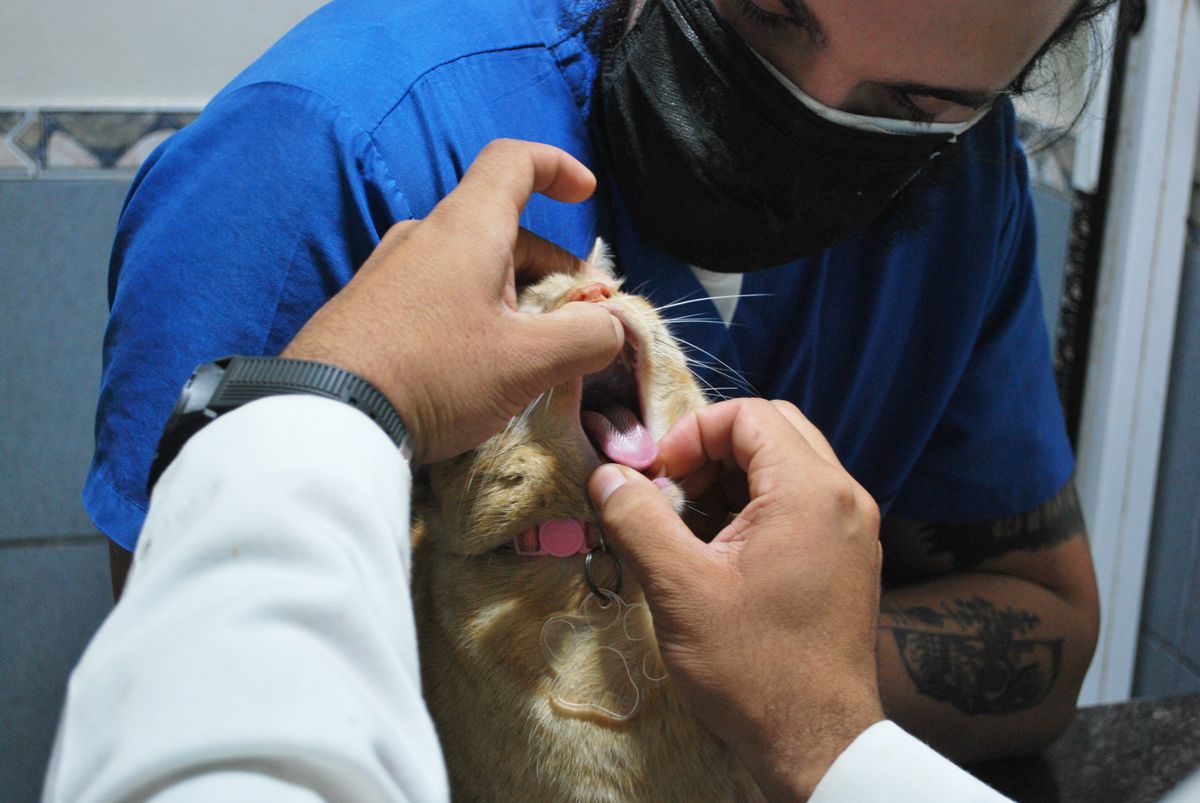
Pexels — Ermelinda Maglione, veterinarian inspecting a cat's teeth (free to use)