Last verified: October 2, 2026
Blue Tongue Skink Enclosure: Identify the Skink Before Setting Humidity
Quick answer: an adult blue-tongued skink needs a large horizontal enclosure, a strong basking/thermal gradient, UVB, deep diggable substrate, secure hides and species-appropriate humidity. The biggest setup mistake is applying one humidity target to every blue-tongue. Current ReptiFiles guidance ranges from roughly 20–40% for some Australian taxa to 60–80% for Indonesian forms, while Northern/Eastern T. scincoides are generally placed around 40–60%.
Patify setup rule: species/locality → enclosure footprint → heat gradient → UVB → humidity → substrate → hides → monitoring. If species identity is uncertain, solve that before tuning the habitat.
1. “Blue Tongue Skink” Is Not One Husbandry Profile
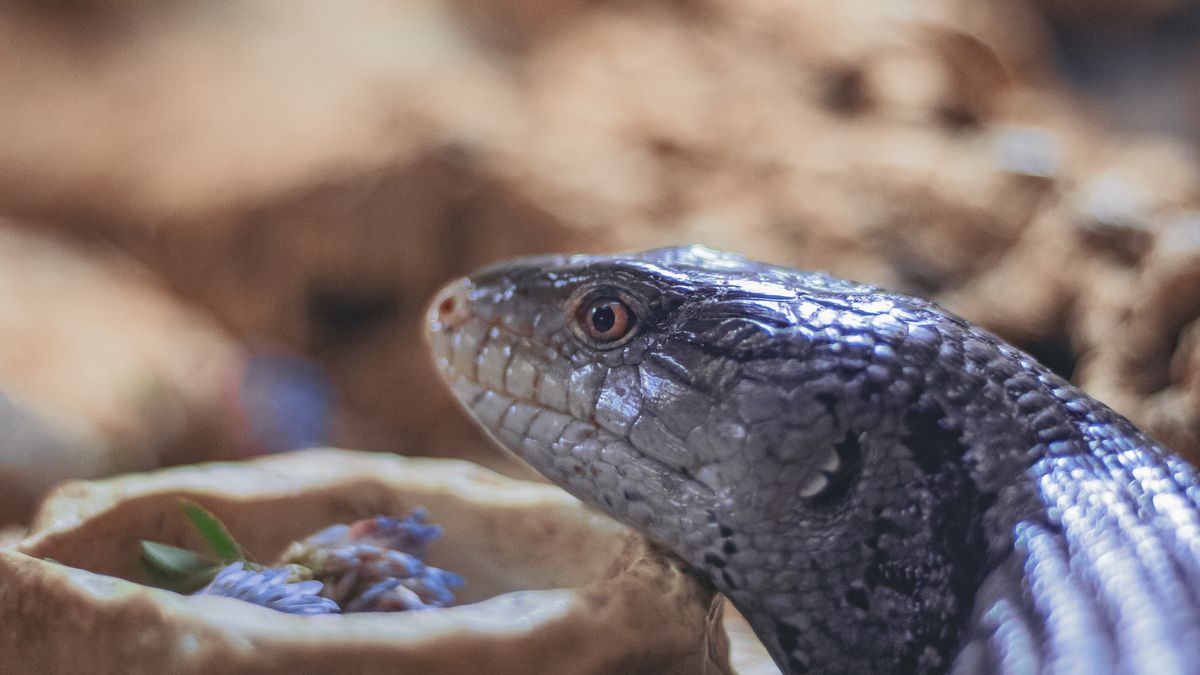
The pet trade includes several Tiliqua species, subspecies and locality labels. Australian forms such as Northern, Eastern, Centralian, Western and Blotched skinks come from different climate regimes than Indonesian-group animals such as Merauke, classic Indonesian/Halmahera, Kei Island and Irian Jaya-type skinks.
Humidity is the variable most likely to become dangerously wrong when identification is skipped. A setup optimized for a Centralian blue-tongue can be chronically too dry for an Indonesian animal; a wet tropical substrate can be inappropriate for a semi-arid taxon.
Before buying equipment: ask the breeder/rescue for the scientific name/locality, parent information and whether the animal is captive bred or imported. Do not use “blue tongue skink” on an invoice as the entire identification.
2. Adult Enclosure Size: Think Floor Area, Not Gallons
Blue-tongues are heavy-bodied terrestrial lizards. Current ReptiFiles best-practice guidance recommends at least 12 sq ft (1.1 m²) of floor space and at least 18 in (45 cm) of height, increasing to at least 24 in (60 cm) if heat/lighting equipment is mounted inside. A 6 × 2 × 2 ft enclosure is a practical way to reach that 12-sq-ft footprint.
ReptiFiles explicitly calls this a U.S.-oriented compromise; some European herpetological guidance uses even larger body-length formulas. The important lesson is that the old 36-inch tank standard is not enough room for an adult skink to thermoregulate and move well.
Juveniles can use an adult-sized enclosure when it is furnished with abundant secure cover and hides.
3. The Enclosure Blueprint
| Warm/basking third | Middle third | Cool third |
|---|---|---|
| Wide basking stone/platform under heat + UVB overlap; warm hide nearby | Open travel lane, cover, cork/low obstacles, deep substrate for digging | Cool hide, water dish, hygrometer probe, optional humid retreat depending on species |
Do not fill the entire enclosure with décor. A blue-tongue needs enough clutter to feel secure and enough continuous ground plane to walk, forage and turn normally.
House one blue-tongue per enclosure. ReptiFiles warns that forced cohabitation can lead to territorial conflict and serious injury.
4. Create a Measurable Thermal Gradient
Measure two different things:
- basking surface temperature with an infrared temperature gun;
- ambient air temperature with digital probe thermometers.
ReptiFiles' current general target is about 100–105°F (37–40°C) at the basking surface, with T. scincoides forms listed hotter at roughly 105–115°F (40–46°C). Cool-side air is generally about 70–85°F for Australian species and 75–85°F for Indonesian species.
Those values explain why a single stick-on dial thermometer in the middle of the tank cannot validate the setup. You need a surface reading under the lamp and air readings across the gradient.
Use overhead halogen/incandescent basking heat rather than an internal electric “heat rock.” ReptiFiles and veterinary sources warn against hot rocks because contact burns can occur.
5. UVB: Treat It as Core Husbandry
Blue-tongues are diurnal. ReptiFiles recommends species-appropriate UVB and targets approximately UVI 3.0–4.0 at the basking zone when measured with a Solarmeter 6.5. Exact lamp distance depends on fixture, bulb percentage and mesh obstruction.
Glass or plastic between the UVB source and the animal blocks useful UVB. Match the lamp/fixture distance to manufacturer data or measured UVI rather than copying a random “12-inch rule.”
Place the UVB tube so it overlaps the basking zone and covers roughly half the enclosure, leaving a lower-UV refuge.
6. Blue Tongue Skink Humidity by Species/Type
ReptiFiles' current humidity ranges illustrate why identification comes first:
| Type | Current reference humidity | Setup implication |
|---|---|---|
| Northern (T. s. intermedia) | 40–60% | Moderate substrate moisture, strong ventilation |
| Eastern (T. s. scincoides) | 40–60% | RSPCA Australia gives the same 40–60% ambient range |
| Blotched (T. nigrolutea) | 40–50% | Temperate/moderate setup |
| Centralian / Western | 20–40% | Drier semi-arid substrate architecture |
| Indonesian / Merauke / Kei / Halmahera group | 60–80% | Moisture-retentive substrate + ventilation |
| Irian Jaya-type | 60–80% | Tropical-style moisture management |
Humidity is a gradient, not a command to make every inch identical. Measure ambient humidity at the cool end near substrate level, and provide microclimates through substrate depth and hides.
7. Give a Burrowing Animal Real Substrate Depth
ReptiFiles recommends about 4–6 inches (10–15 cm) of soft loose substrate because blue-tongues dig and burrow. The material should match the humidity target:
- Australian/semi-arid setups: moisture-tolerant topsoil/sand-style mixes or other safe semi-arid reptile substrates;
- Indonesian setups: moisture-retentive mixes such as coconut-based substrate, appropriate bark/husk and sphagnum components.
A bare floor or thin carpet may be easy to wipe but removes a major natural behavior. Conversely, permanently swampy substrate is not the answer for tropical animals; moist does not mean stagnant.
For general ecosystem concepts, Patify's bioactive terrarium setup guide explains drainage, cleanup crew and plant establishment. The blue-tongue's species-specific heat/humidity requirements still take priority.
8. Place Sensors Where They Answer Real Questions
| Tool | Where | Question answered |
|---|---|---|
| IR temperature gun | Basking stone/surface | Is the animal's contact basking zone actually hot enough? |
| Digital probe thermometer | Warm-side air | Is ambient heat excessive away from the surface? |
| Digital thermometer/hygrometer | Cool side near substrate level | What cool refuge temperature/humidity can the skink choose? |
| UV meter if available | At skink-back height in basking zone | Is actual UV exposure in target range? |
Log readings after setup, after seasonal room-temperature changes, after changing bulbs and after major substrate/ventilation changes. “The thermostat says 90” does not describe the whole habitat.
9. Common Blue-Tongue Enclosure Mistakes
| Mistake | Why it fails |
|---|---|
| Using one humidity target for every blue-tongue | Australian and Indonesian taxa occupy different moisture regimes |
| Choosing enclosure by gallons | Terrestrial floor area and gradient length matter more than water-tank volume |
| One thermometer in the center | Cannot validate basking surface and cool-end refuge |
| Thin substrate | Prevents normal digging/burrowing |
| No UVB because “they get D3 from food” | Current best-practice reptile husbandry provides UVB to this diurnal basking genus |
| Heat rock | Creates direct contact-burn risk |
| Cohabitation | Territorial skinks may injure each other |
| Wet enclosure with poor ventilation | Humidity does not require stagnant, chronically saturated conditions |
Frequently Asked Questions About Blue Tongue Skink Enclosures
What size enclosure does an adult blue tongue skink need?
ReptiFiles' current best-practice recommendation is at least 12 sq ft of floor area and 18 inches of height, or 24 inches if fixtures are mounted inside. A 6×2×2-ft enclosure meets the floor-area target.
Is a 4×2×2 enclosure enough?
It has been a common modern baseline, but current ReptiFiles guidance has moved to at least 12 sq ft of floor area because larger adults benefit from more movement and gradient length.
What humidity does a Northern blue tongue need?
ReptiFiles lists Northern T. scincoides intermedia around 40–60% ambient humidity.
What humidity does an Indonesian blue tongue need?
Most Indonesian-group forms in current ReptiFiles guidance are around 60–80%, substantially higher than many Australian taxa.
Do blue tongue skinks need UVB?
Current best-practice guidance recommends UVB. ReptiFiles targets roughly UVI 3–4 at the basking zone when measured.
How deep should substrate be?
About 4–6 inches is the current ReptiFiles recommendation to support digging/burrowing.
Can two blue tongue skinks live together?
Routine cohabitation is not recommended. ReptiFiles advises one skink per enclosure because territorial conflict can cause serious injury.
Where should the hygrometer go?
Near substrate level on the cool side gives a useful ambient reference; pair it with temperature probes and surface-temperature measurements.
Sources Checked
- ReptiFiles — Blue Tongue Skink Enclosure Size
- ReptiFiles — Temperature, UVB & Humidity
- ReptiFiles — Substrate
- RSPCA Australia — Blue Tongue Skink Care
Sources reviewed October 2, 2026.