
Last updated: September 24, 2026
Quick answer: for one adult central bearded dragon (Pogona vitticeps), start with an enclosure around 120 × 60 × 60 cm (about 4 × 2 × 2 ft) or larger, then build the habitat around a hot bright basking end, a cooler shaded end, usable UVB exposure, secure hides, stable climbing/basking structures, and easy-to-monitor temperatures. RSPCA lists 120 × 60 × 60 cm as its minimum adult size; VCA recommends 60–100 gallons or larger as the dragon grows and says enclosure length should be at least three times the lizard's total body length.
Think in zones, not decorations. A visually attractive enclosure is only successful if your dragon can move between heat and cool, bask under useful UVB, retreat into shade, climb without falling, eat without swallowing unsafe substrate, and be monitored/cleaned reliably.
Adult Bearded Dragon Enclosure Size: What the Sources Actually Say
RSPCA recommends a 120 cm long × 60 cm high × 60 cm deep vivarium as the minimum for one adult bearded dragon. VCA gives a different framework: 60–100 gallons or larger as the animal grows, with enclosure length at least three times total body length and enough width for the lizard to turn comfortably.
| Source | Adult-space guidance | Useful interpretation |
|---|---|---|
| RSPCA | 120 × 60 × 60 cm minimum for one adult | A practical 4 × 2 × 2 ft-class baseline |
| VCA | 60–100 gal or larger; length ≥ 3× dragon's total length; width ≥ 16 in | Size the habitat to the actual animal, not only a gallon label |
| Merck | Use species-appropriate enclosure; largest practical enclosure preferred | Space must support thermal gradient, retreats and normal movement |
“Gallons” can be misleading because two tanks with the same volume can have very different floor dimensions. Bearded dragons are primarily terrestrial; usable length and depth matter for locomotion and for building a real warm-to-cool gradient.
If you are sizing the habitat around your individual animal, Patify's full-grown bearded dragon size guide explains adult total length, SVL and growth tracking.
The 6-Zone Bearded Dragon Habitat Map
Before choosing décor, sketch these six functional zones:
| Zone | Purpose | What belongs there |
|---|---|---|
| 1. Basking zone | High surface temperature + strong light/UV access | Stable stone/slate/platform beneath basking heat and useful UVB |
| 2. Warm transition | Intermediate body temperature | Branch/rock route, open floor, optional warm hide |
| 3. Cool zone | Thermoregulatory escape | Cool hide, water, shaded resting area |
| 4. UV/shade choice | Photoregulation | Bright basking area plus true shade/retreat |
| 5. Feeding zone | Clean controlled feeding | Stable shallow dish, easy-clean surface |
| 6. Enrichment/dig zone | Climb, explore, dig where appropriate | Secure branch/rock and—if suitable for the individual—dig box or naturalistic section |
A strong setup lets the dragon choose between these zones without climbing over unstable furniture or crossing a single dangerously hot point.
Layout 1: Simple Easy-Clean Adult Setup
Best for: first-time keepers, newly acquired dragons after initial health assessment, owners who need straightforward cleaning and measurement.
LEFT / HOT END → basking stone + heat lamp + UVB coverage
CENTER → secure low branch / open movement lane / food dish
RIGHT / COOL END → cool hide + water dish + shaded area
Build it
- Use a 4 × 2 × 2 ft-class adult enclosure or larger.
- Place the basking lamp over one end, not the center.
- Place a broad, stable stone/slate basking platform beneath that end.
- Position UVB so the basking zone receives useful exposure while the far end offers shade.
- Add one secure low branch or rock route through the warm-to-middle zone.
- Place a hide in the cool end; a second hide at the warmer end is useful where space allows.
- Use an easy-clean floor such as paper during initial monitoring, or another appropriate permanent surface once husbandry is stable.
- Keep food off loose particulate substrate.
Layout 2: Naturalistic Adult Setup With a Digging Zone
Best for: a healthy adult whose temperatures, UVB and sanitation are already under control.
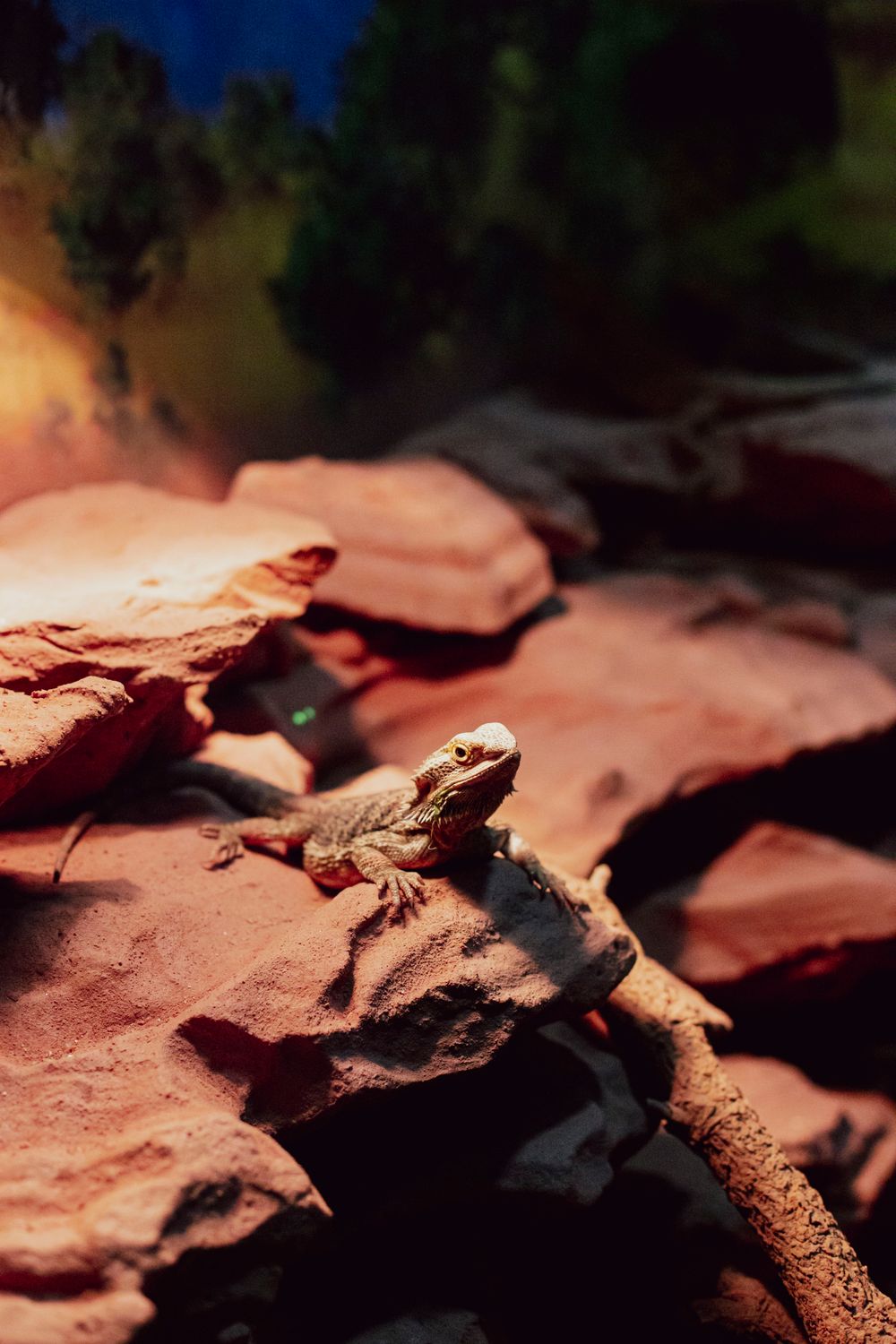
HOT END → elevated stone basking platform + bright UV/heat
MIDDLE → low branch + textured rock + open walking path
COOL END → cool hide + dig box / naturalistic substrate section + water
RSPCA specifically recommends stones and branches for climbing, hides at both ends, and—at the cool end—a digging box filled with an appropriate sand/soil mixture. It also states that healthy adults can be housed on suitable reptile-safe sand or sand/soil mixtures when the rest of the environment is correct.
Naturalistic does not mean cluttered
- Keep a clear walking corridor.
- Secure every heavy rock so digging cannot undermine it.
- Do not stack rocks loosely where they can collapse.
- Keep the basking platform broad enough for the whole body.
- Create shade that is genuinely darker/cooler rather than decorative foliage directly under the lamp.
- Keep feeding controlled so prey capture does not routinely include mouthfuls of substrate.
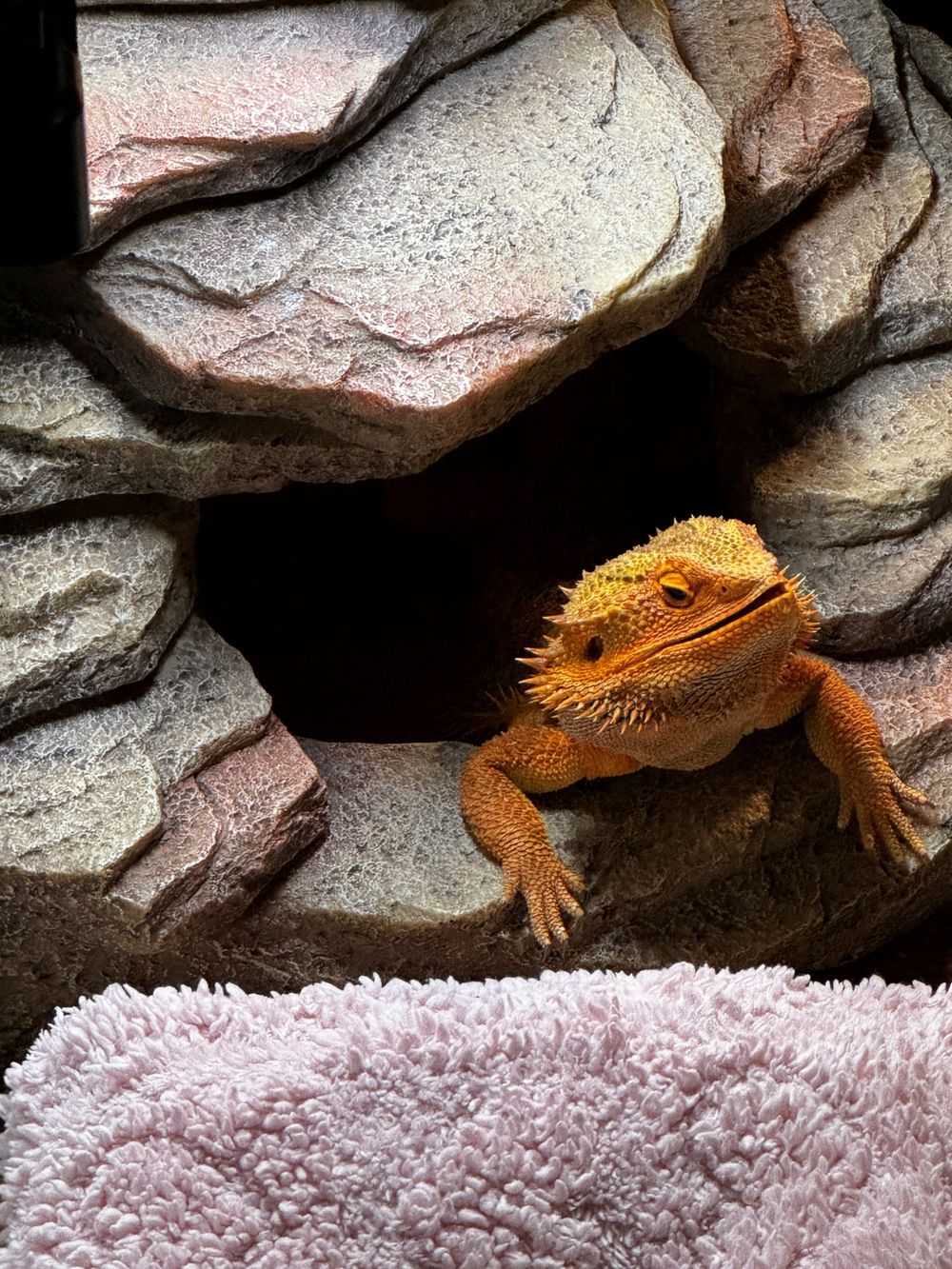
Layout 3: Quarantine or Medical-Monitoring Setup
Best for: a new animal awaiting veterinary evaluation, suspected parasites/diarrhea, recovering illness, wound monitoring, or situations where precise stool/food observation matters.
HOT END → stable washable basking platform
MIDDLE → minimal secure climb + clean food dish
COOL END → washable hide + water
FLOOR → disposable paper for easy stool/parasite monitoring
This is intentionally less decorative. The environmental essentials—correct heat gradient, UVB, hide, movement and hydration—remain, but sanitation and observation take priority.
A quarantine enclosure should not become an excuse to use a tiny tank. The dragon still needs enough space to thermoregulate.
Heat and UVB Placement: Setup-Level Rules
This article covers enclosure layout, not lamp-by-lamp calibration. Still, the habitat cannot be designed correctly without placing heat and UV deliberately.
Heat belongs at one end
RSPCA recommends a thermogradient from a hot bright end to a cooler shaded end. Its current guidance gives a 38–42°C (100–108°F) basking/hot-end target and 22–26°C (72–79°F) cooler end. VCA gives a somewhat broader 90–100°F warm-end and 75–80°F cool-end framework.
Different sources measure “basking surface,” “warm end,” and ambient air differently, so do not mix numbers from different measurement points. The practical setup rule is:
- heat source at one end;
- solid basking surface directly beneath;
- unobstructed path toward the cool end;
- thermostatic control where appropriate;
- infrared thermometer for surface checks;
- fixed digital probes for ongoing ambient monitoring.
UVB should overlap the basking opportunity
RSPCA recommends a high-output 10–12% UVB fluorescent tube positioned toward the hot end, with a basking-zone UV Index around 3.0–5.0 and shade approaching zero. Merck and VCA both stress that glass/plastic can filter UVB and that lamp distance/output decline matter.
Do not copy lamp distance from another enclosure without checking the exact lamp, reflector, mesh, mounting position and manufacturer guidance. UV intensity changes with distance and barriers. A UV meter is the most informative way to verify the result.
Where to Measure Temperature, Humidity and UV
A habitat can look perfect and still fail because measurements are taken in the wrong places.
| Measurement | Where to measure | Tool |
|---|---|---|
| Basking surface temperature | Exactly where the dragon's body rests under the basking source | Infrared thermometer / temperature gun |
| Warm-side ambient | Air near the warm zone, not touching rock/lamp | Digital probe thermometer |
| Cool-side ambient | Near the cool hide/resting level | Second digital probe thermometer |
| Humidity | RSPCA suggests monitoring toward the cool end | Digital hygrometer |
| UV Index | At the dragon's back height on the basking platform, plus shaded retreat | Appropriate UV Index meter |
RSPCA's current humidity target is around 30–40% at the cool end. Merck lists bearded dragons as an arid/desert species and emphasizes that ventilation should not be sacrificed merely to hold heat or humidity.
Daily setup log
Date: ______
Basking surface: ______
Warm ambient: ______
Cool ambient: ______
Humidity: ______
UV Index at basking height: ______
Dragon behavior: basking / hiding / glass surfing / normal roaming / other ______
Hides, Rocks and Climbing Structure
VCA recommends large climbable rocks, low horizontal natural branches and a hiding place. RSPCA goes further and recommends hides at both ends of the enclosure.
Good structure has four qualities
- stable: cannot roll, collapse or fall if climbed;
- wide enough: dragon can rest with the whole body supported;
- reachable: no forced leaps from excessive height;
- cleanable: surfaces can be disinfected or safely replaced.
Bearded dragons do climb, but an enclosure should not be built like an arboreal gecko habitat. Low, broad climbing opportunities are more useful than narrow decorative towers.
Substrate: Why Reputable Sources Disagree
This is one area where high-quality sources do not give identical advice.
| Source | Position | What that means for setup |
|---|---|---|
| VCA | Prefers paper-based substrates and advises against sand, gravel, wood shavings, corn cob, walnut shell and cat litter because of cleaning/impaction concerns | Conservative, easy-monitoring approach |
| RSPCA | Allows reptile-safe sand or sand/soil mixtures for healthy adults; also allows rough stone tile/slate, and recommends a dig box if non-loose flooring is used | Natural-behavior approach when husbandry is already sound |
| PetMD | Avoids gravel, wood chips and crushed walnut; if loose sand is used, feed separately to reduce accidental ingestion | Risk-management middle ground |
For this enclosure setup guide, the lowest-error starting point for a new, sick, underweight or unassessed dragon is an easy-clean substrate that lets you monitor stool and food intake. A healthy adult in a stable, correctly heated enclosure may be managed naturalistically by experienced keepers following appropriate guidance.
Never use calci-sand as a “safe because digestible” shortcut. RSPCA warns that it can contribute to impaction under incorrect environmental conditions, and VCA also advises against it.
The dedicated Patify substrate article will handle the full decision matrix separately so this page does not cannibalize that search intent.
Where to Put Food and Water
VCA recommends stable shallow dishes that do not tip easily. Place them where they do not sabotage the thermal gradient or become contaminated constantly.
Food
- Use a shallow washable dish.
- Keep it away from loose-substrate feeding where accidental ingestion is likely.
- Do not leave uneaten live insects roaming the enclosure; RSPCA notes they can bite the dragon.
- Remove plant leftovers before they spoil.
Patify's bearded dragon food guide covers life-stage diet, greens, feeder insects, calcium and weekly feeding structure.
Water
Use a stable shallow crock and keep fresh water available. If a large water dish pushes enclosure humidity persistently above the desired range, review dish size/location and ventilation rather than simply removing access to clean water.
Bearded Dragon Enclosure Equipment Checklist
| Item | Purpose | Setup note |
|---|---|---|
| Adult-sized secure enclosure | Usable territory | Around 4 × 2 × 2 ft class or larger for an adult |
| Basking heat source | High-temperature zone | Mounted/guarded so the dragon cannot contact it |
| Thermostatic control where appropriate | Limit overheating | Match control type to heat source |
| High-output UVB system | UVB exposure | Correct reflector, distance and unobstructed path |
| Timer | Consistent photoperiod | RSPCA commonly uses ~12 h light / 12 h dark |
| IR temperature gun | Basking-surface measurement | Measure the surface the dragon actually uses |
| Two digital thermometers | Warm/cool ambient tracking | Do not rely on one center-mounted dial |
| Digital hygrometer | Humidity monitoring | Monitor cool-end humidity |
| UV Index meter | Verify usable UV exposure | Especially useful when mesh/distance changes |
| Broad basking rock/platform | Heat/UV exposure | Stable and large enough for whole body |
| Two hides | Security across gradient | One cool, one warmer where practical |
| Secure branch/rock enrichment | Low climbing/exploration | No collapse or fall hazard |
| Stable food/water dishes | Clean feeding/hydration | Easy to wash; hard to tip |
| Appropriate substrate | Traction/sanitation/digging | Choose based on health status and husbandry experience |
The expensive-looking item is not automatically the important one. A reliable thermometer, appropriate UVB, correct enclosure dimensions and a safe basking platform matter more than themed décor.
Run the Enclosure Before the Dragon Moves In
RSPCA recommends setting up the vivarium and running it for at least one week before introducing the bearded dragon. This gives you time to identify problems without using the animal as the test instrument.
Seven-day commissioning check
- Run lights and heat on the intended timer.
- Record basking surface, warm ambient and cool ambient.
- Measure cool-end humidity.
- Check UV at the exact basking height if a meter is available.
- Verify the cool hide stays meaningfully cooler/shadier.
- Make sure rocks/branches stay stable after repeated handling.
- Test doors, locks and cable openings for escape risk.
- Confirm cleaning access: can you remove waste without dismantling the whole enclosure?
If the room temperature changes dramatically between day and night, test the setup under both conditions before the animal arrives.
12 Common Bearded Dragon Enclosure Setup Mistakes
- Using a small tank because the dragon is still young. Plan the adult enclosure early.
- Putting the heat source in the middle. This weakens the hot-to-cool gradient.
- Measuring only air temperature. The basking surface itself must be measured.
- Using one thermometer in the center. You need warm- and cool-side information.
- Letting glass/plastic block UVB. Useful UV must actually reach the animal.
- Copying lamp distance from a forum photo. Lamp output, reflector and mesh change exposure.
- Using a hot rock. VCA and Merck warn that contact heaters/hot rocks can cause burns.
- Building a vertical obstacle course. Bearded dragons benefit from secure low climbing, not unstable towers.
- Having no true cool hide. Thermoregulation requires an escape from heat/light.
- Choosing substrate only for appearance. Health status, feeding method and sanitation matter.
- Housing dragons together because the enclosure is “large enough.” RSPCA recommends separate housing because of territorial/aggressive risk.
- Putting the dragon in the same day the tank is assembled. Commission the environment first.
Frequently Asked Questions
What size enclosure does an adult bearded dragon need?
RSPCA recommends at least 120 × 60 × 60 cm for one adult. VCA uses a broader 60–100 gallon-or-larger framework and says enclosure length should be at least three times the dragon's total body length.
Is a 40-gallon tank enough for an adult bearded dragon?
It is below the current RSPCA 120 × 60 × 60 cm adult minimum and below VCA's 60–100 gallon-or-larger adult guidance. It may be useful temporarily for a smaller juvenile, but it should not be the long-term adult target.
Where should the basking spot go?
At one end of the enclosure so the dragon can move away into progressively cooler conditions. The UVB system should overlap the basking opportunity while shade remains available.
How hot should a bearded dragon basking area be?
RSPCA gives 38–42°C (100–108°F) for the hot/basking end; VCA gives 90–100°F for its warm-end framework. The difference partly reflects measurement terminology, so measure the correct surface/air point consistently rather than mixing values.
What humidity should a bearded dragon enclosure have?
RSPCA recommends around 30–40% at the cool end. Good ventilation is important; do not seal the enclosure merely to hold heat.
Can I use sand?
Guidelines differ. RSPCA permits appropriate reptile-safe sand or sand/soil mixtures for healthy adults, while VCA takes a more conservative paper-based approach and advises against sand because of impaction concerns. Health, temperature, feeding method and keeper experience all matter.
How many hides does a bearded dragon need?
RSPCA recommends hides at both ends so the dragon does not have to choose between security and thermoregulation.
Should bearded dragons live together?
Separate housing is the lower-risk default. RSPCA notes territorial/aggressive behavior and warns that captive dragons may injure one another.
Should I set up the enclosure before buying the dragon?
Yes. RSPCA recommends running the vivarium for at least a week first so heat, UVB and humidity can be adjusted before the animal arrives.
Bottom Line: Build the Physics First, Then Add the Décor
A reliable adult bearded dragon enclosure should let the animal:
- bask on a stable surface under heat and useful UVB;
- walk gradually into a cooler shaded zone;
- hide without being forced to stay hot;
- climb low, secure structures;
- eat and drink from clean stable dishes;
- use substrate appropriate to its health and husbandry;
- live alone without resource competition;
- be monitored with real instruments rather than guesswork.
Once those functions work for a full week, the enclosure is ready for aesthetic upgrades. A desert backdrop cannot rescue a setup with poor UVB, no cool zone, an unstable basking rock or measurements taken in the wrong place.