Cat Chewed the Christmas Tree Lights: Emergency Signs to Watch For

🚨 The short answer: If your cat chewed plugged-in Christmas lights, treat it like a potential electrical emergency even if the mouth looks “not too bad” at first. Mouth burns can worsen over the next few days, and breathing complications from fluid in the lungs may not appear until 12 to 36 hours later. Tonight, your job is to unplug the lights, look for mouth pain and visible oral injury, and watch closely for drooling, coughing, hard breathing, weakness, or collapse.
Cats—especially kittens—love strings, movement, and anything that dangles from a holiday tree. Unfortunately, Christmas tree lights combine two problems in one object: they behave like a toy and they can deliver electrical injury.
What makes this search intent tricky is that owners often look for obvious burn marks and assume no visible wound means no serious problem. That is not always true. Veterinary references specifically note that the full extent of an oral electrical burn may not be appreciable for at least 3 to 4 days, while one of the most dangerous internal complications—fluid in the lungs—can be delayed for 12 to 36 hours.
In this article
- What to do first
- What to check in your cat's mouth tonight
- Why burns may not look dramatic right away
- The breathing signs that mean emergency care
- The delayed 12–36 hour risk window
- What if your cat seems normal?
- What if the lights were unplugged?
- What to tell the veterinarian
- Frequently asked questions
What to do first if your cat chewed Christmas lights
- Unplug the lights before touching the cord or your cat. MSPCA-Angell specifically advises disconnecting the electricity first so you do not get injured too.
- Move your cat away from the tree and damaged wire. Prevent repeat exposure while you assess the scene.
- Check whether the cord was actually live. Plugged-in lights create the highest concern for oral electrical burns and internal complications.
- Look for immediate distress. Trouble breathing, collapse, seizures, marked weakness, or unresponsiveness are veterinary emergencies.
- Call a veterinarian promptly. Even if the injury looks mild, delayed complications are the whole reason this kind of accident deserves extra caution.
⚠️ Do not wait for a dramatic wound. A cat can have a significant electrical injury even when the lips or tongue look only mildly abnormal in the first hours after the accident.
What to check in your cat's mouth tonight
If your cat is calm enough to inspect safely, make a quick, gentle check of the visible mouth tissues. Do not force the mouth open deeply if your cat is painful, struggling, or likely to bite. In that situation, it is safer to let a veterinarian perform the exam.
| What to check | Why it matters | What may be seen |
|---|---|---|
| Lips and lip corners | Electrical contact often causes local thermal burns in the mouth region. | Pale yellow, tan, gray, ulcerated, or wounded areas. |
| Gums | Oral contact sites may involve gingiva and nearby tissues. | Discoloration, raw-looking spots, bleeding, obvious pain. |
| Tongue | MSD notes that animals that chew electrical cords often develop a linear scar on the dorsal tongue surface outlining the cord's path. | Linear lesion, discoloration, swelling, reluctance to move the tongue normally. |
| Saliva | Pain and oral inflammation commonly cause excessive drooling. | Drooling, sticky saliva, or saliva tinged with blood. |
| Behavior around the mouth | MSD says burned animals may resent handling of the mouth or face and hesitate to eat or drink. | Pulling away, pawing at the mouth, refusing food or water. |
🔎 Practical rule: If you see drooling plus obvious mouth pain, or any suspicious tongue, lip, or gum lesion after chewing live lights, assume the injury is real even if it looks small.
Why the burn may not look severe right away
This is the part many owners miss. MSD Veterinary Manual states that the full extent of the burn may not be appreciable until at least 3 to 4 days after the incident, once the demarcation between damaged and healthy tissue becomes clearer.
So if your cat only has subtle redness tonight, that does not guarantee the injury is superficial. Electrical damage can evolve. That is why these cases are more than “watch and see if the lip looks worse.” They are “watch the mouth and the breathing, because internal complications matter too.”
The worst mistake after a cat chews Christmas lights is assuming “no big burn” means “no big problem.” With electrical injuries, the clock can reveal damage that the first glance misses.
The breathing signs that mean emergency care
After electrical cord injury, one of the most dangerous complications is non-cardiogenic pulmonary edema—fluid buildup in the lungs caused by the electrical injury. MSPCA-Angell lists these warning signs:
- Coughing
- White or pink foam or fluid from the mouth or nose
- Difficulty breathing
- Blue or gray gums
- Weakness or collapse
If you see any of those signs, this is not a “wait until morning” situation. The cat needs urgent veterinary assessment.
🫁 Go now: hard breathing, open-mouth breathing, coughing, foamy fluid from the mouth or nose, blue/gray gums, collapse, seizures, or severe weakness after chewing a live cord or string lights.
The delayed 12–36 hour risk window
MSPCA-Angell notes that the onset of lung-fluid complications can be delayed up to 12 to 36 hours. That is why a cat who seems “okay for now” still deserves close monitoring through the night and into the next day.
ASPCA guidance on cats chewing cords highlights key signs that may indicate trouble: drooling, not wanting to eat, coughing, difficulty breathing, and decreased energy. Those are exactly the changes you should monitor for after a Christmas lights incident.
In other words, if your cat chewed lights at 9 PM and looks fairly normal at 10 PM, you still are not fully in the clear. Respiratory effort and energy level over the next day matter.
What if my cat seems normal?
If your cat is acting normal, that is reassuring—but not enough to dismiss the incident if the lights were plugged in and there is evidence of chewing.
- If the cord was live, call your veterinarian even if your cat seems okay.
- If you can see mouth pain or oral lesions, contact a vet promptly.
- If the cat is not eating, drooling, coughing, or unusually quiet, treat that as significant.
- If the cat chewed the plastic but the lights were definitely unplugged, the risk shifts more toward mouth trauma or swallowing wire/plastic pieces rather than electrical injury.
🟢 Lower-risk scenario: the lights were definitely unplugged, no bulb or wire pieces are missing, your cat has no mouth pain, no drooling, and is breathing normally. Even then, monitor for delayed signs and call your veterinarian if anything changes.
What if the lights were unplugged?
An unplugged string light is less likely to cause a live electrical shock, but it is still not automatically harmless. Cats can cut their mouths on broken plastic, chew through sharp wire, or swallow small pieces of bulb casing or insulation.
If you suspect your cat swallowed wire, plastic, or bulb fragments, tell your veterinarian. In that case, the problem can shift from electrical injury to foreign-body or oral-trauma risk.
Can a cat have a heart problem after chewing a live cord?
Yes. MSPCA-Angell notes that electrical injuries can also cause irregular heart rhythms. The clinic lists warning signs such as agitated behavior, inability to settle, weakness, collapse, pale or gray gums, and difficulty breathing.
Owners will not diagnose an arrhythmia at home, but if your cat seems unstable, weak, or suddenly abnormal after the incident, that is another reason not to delay veterinary care.
Should I force food or water tonight?
MSD says animals with mouth burns may hesitate to eat or drink and resent handling of the mouth or face. If your cat seems painful, do not force food, oral medications, or repeated mouth manipulation. Focus first on safety, breathing, and veterinary guidance.
If your veterinarian tells you home observation is appropriate, follow the feeding and hydration instructions they provide based on the severity of the mouth injury.
What to tell the veterinarian
Be ready with the details that make triage easier:
- Was the light string plugged in?
- When did the chewing happen?
- What symptoms are you seeing? Drooling, coughing, trouble breathing, refusing food, low energy, visible mouth lesions.
- Is anything missing? Wire, plastic, bulbs, or a section of cord coating.
- Did your cat collapse or seem shocked?
- Your cat's age and weight.
If you can do it safely, take a picture of the damaged cord and any visible mouth lesion. That can help document what happened.
How to prevent a repeat
Christmas lights are the perfect storm for cats: dangling strings, visual stimulation, and accessible cords. Hide or secure wires behind furniture, use cord covers where possible, unplug lights when you are not supervising, and keep the lowest strands out of reach of curious kittens.
Holiday décor safety is not just about plants and ornaments. For cats, electrical cords are one of the fastest ways a festive room becomes an emergency room visit.
Frequently asked questions
My cat chewed Christmas lights but seems fine. Should I still worry?
What mouth signs should I look for tonight?
How long can electrical-burn damage take to show up?
What are the emergency breathing signs after a cat chews a live cord?
Could this just be a mouth burn, or can the lungs be affected too?
What if the string lights were unplugged?
Are kittens at higher risk?
- MSD Veterinary Manual — Soft Tissue Trauma of the Mouth in Small Animals
- MSD Veterinary Manual — Oral Inflammatory and Ulcerative Disease in Small Animals
- MSPCA-Angell — Electrical Cord Injury
- ASPCA Animal Poison Control Center guidance via “Keeping Your Foster Cats Out of Trouble”
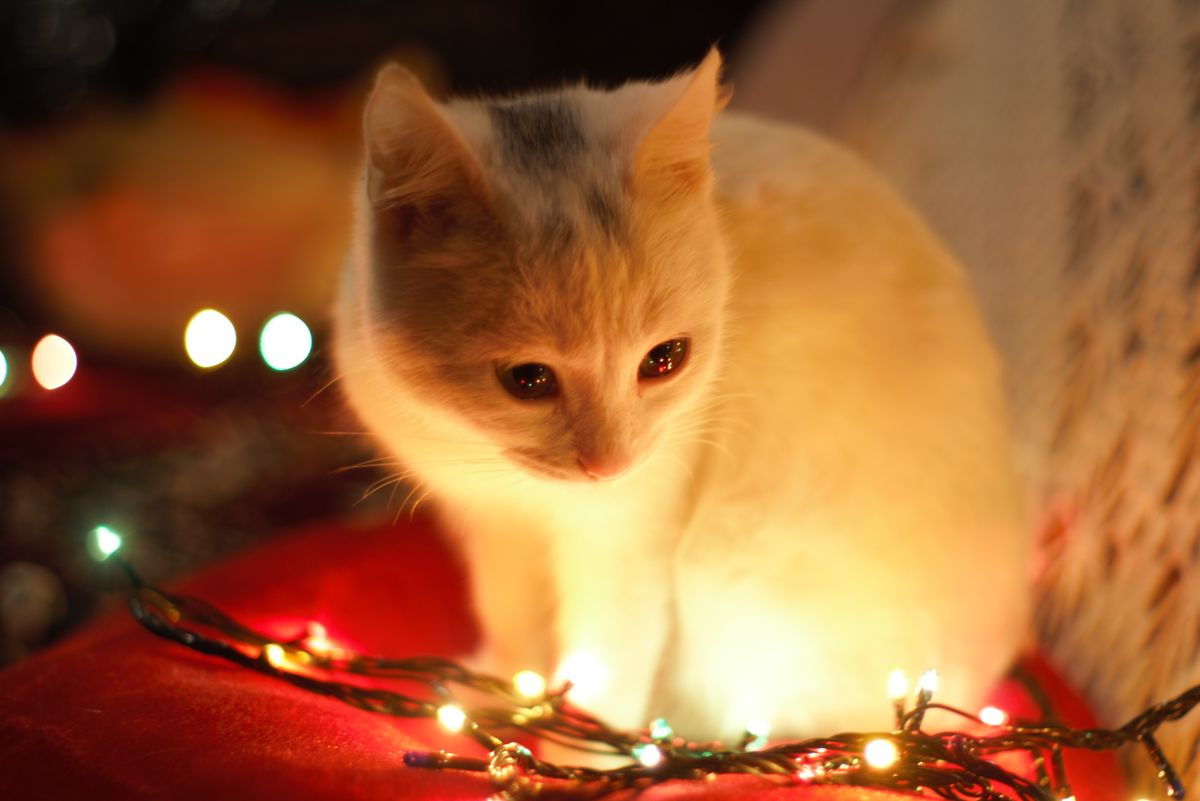
- Pexels — “Charming white kitten surrounded by colorful Christmas lights,” free-to-use stock photo