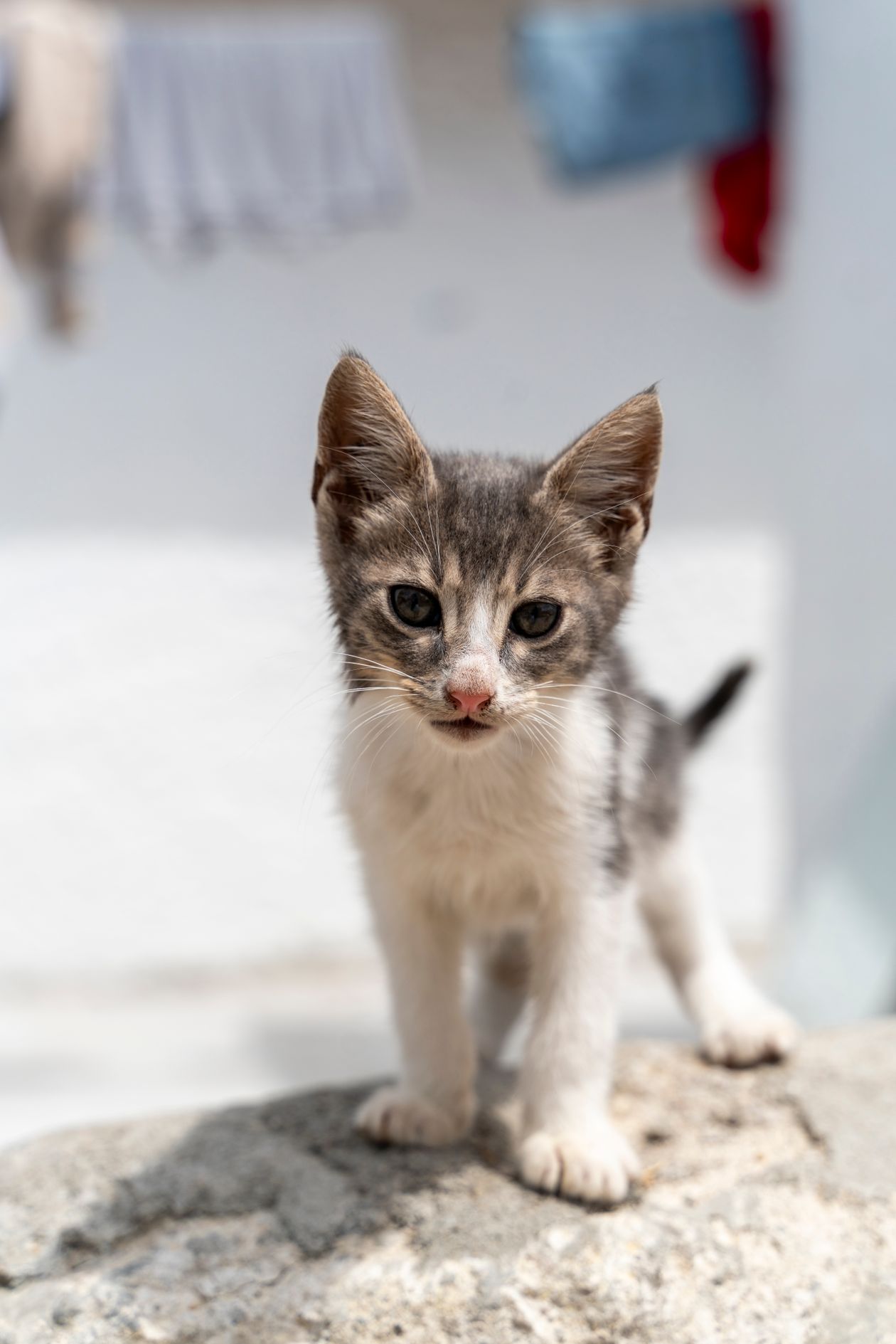

Last verified: September 29, 2026
Cat Tail Language: Read Position, Movement and Context Together
Quick answer: a cat’s tail can tell you a lot, but it does not work like a one-word dictionary. Read three things together: where the tail is held, how it is moving, and what the rest of the cat is doing. A tail held straight up usually supports a friendly, confident approach. A puffed tail usually signals high arousal or threat. A fast side-to-side thrash often means irritation or agitation. But a tiny tail-tip twitch can mean hunting focus, play or annoyance depending on the ears, eyes, posture and situation.
Patify’s 3-part decoder: Position × Motion × Context. Never translate the tail alone if the ears, eyes, whiskers, body tension or environment tell a different story.
This guide explains the common tail positions and movements, the combinations that matter most, when “wagging” is not friendly, how to tell a greeting quiver from possible urine marking, and when a sudden tail change may be a medical problem rather than communication.
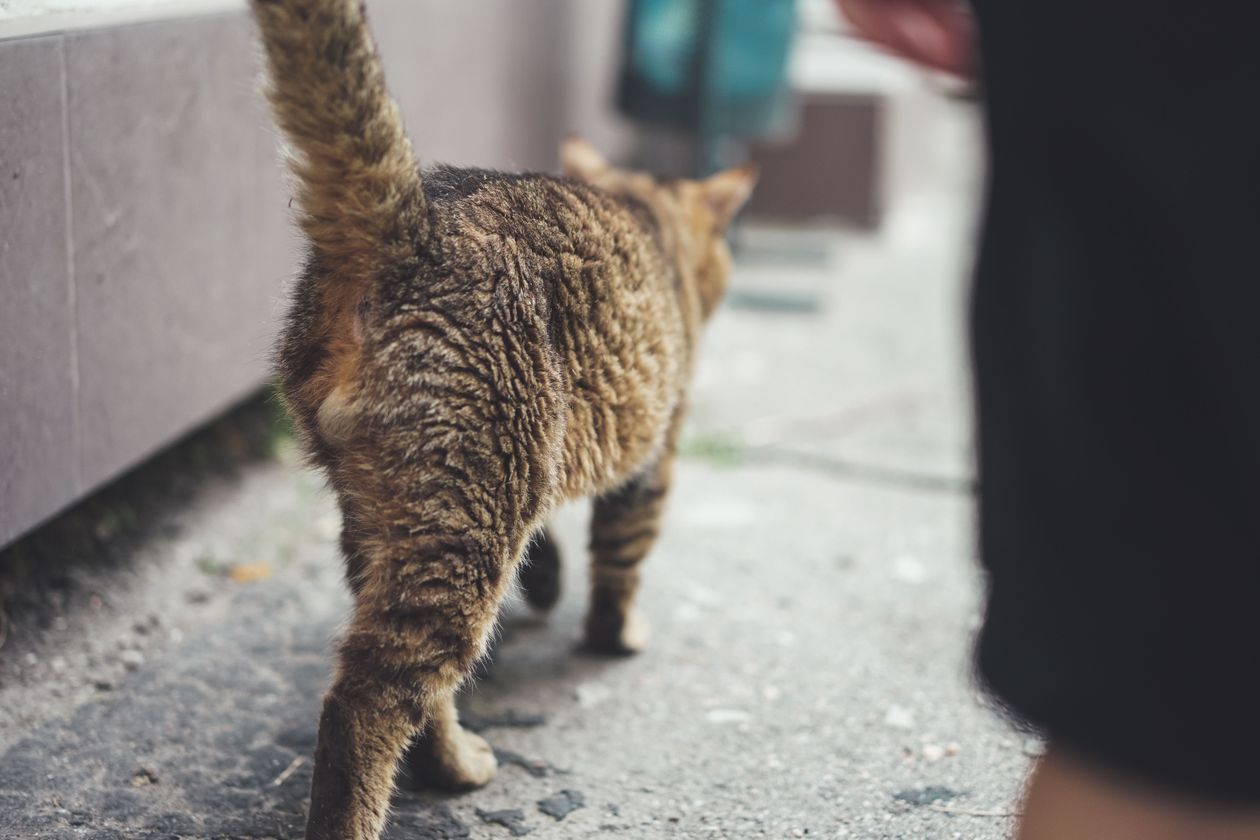
The 3-Part Cat Tail Language Decoder
Veterinary and feline-behavior sources repeatedly make the same point: the tail is expressive, but it should be interpreted alongside the rest of the body. PetMD specifically advises considering the cat’s eyes, ears, posture and environmental context, and Cats Protection likewise emphasizes reading small changes across the whole cat.
| Layer | Question to ask | Examples |
|---|---|---|
| 1. Position | Where is the tail held? | Upright, low, tucked, horizontal, wrapped, puffed |
| 2. Motion | How is it moving? | Still, slow swish, fast thrash, tip twitch, quiver |
| 3. Context | What is the rest of the cat doing? | Approaching, stalking a toy, being petted, backing to a wall, crouching, hissing |
Example 1: upright + still + relaxed approach
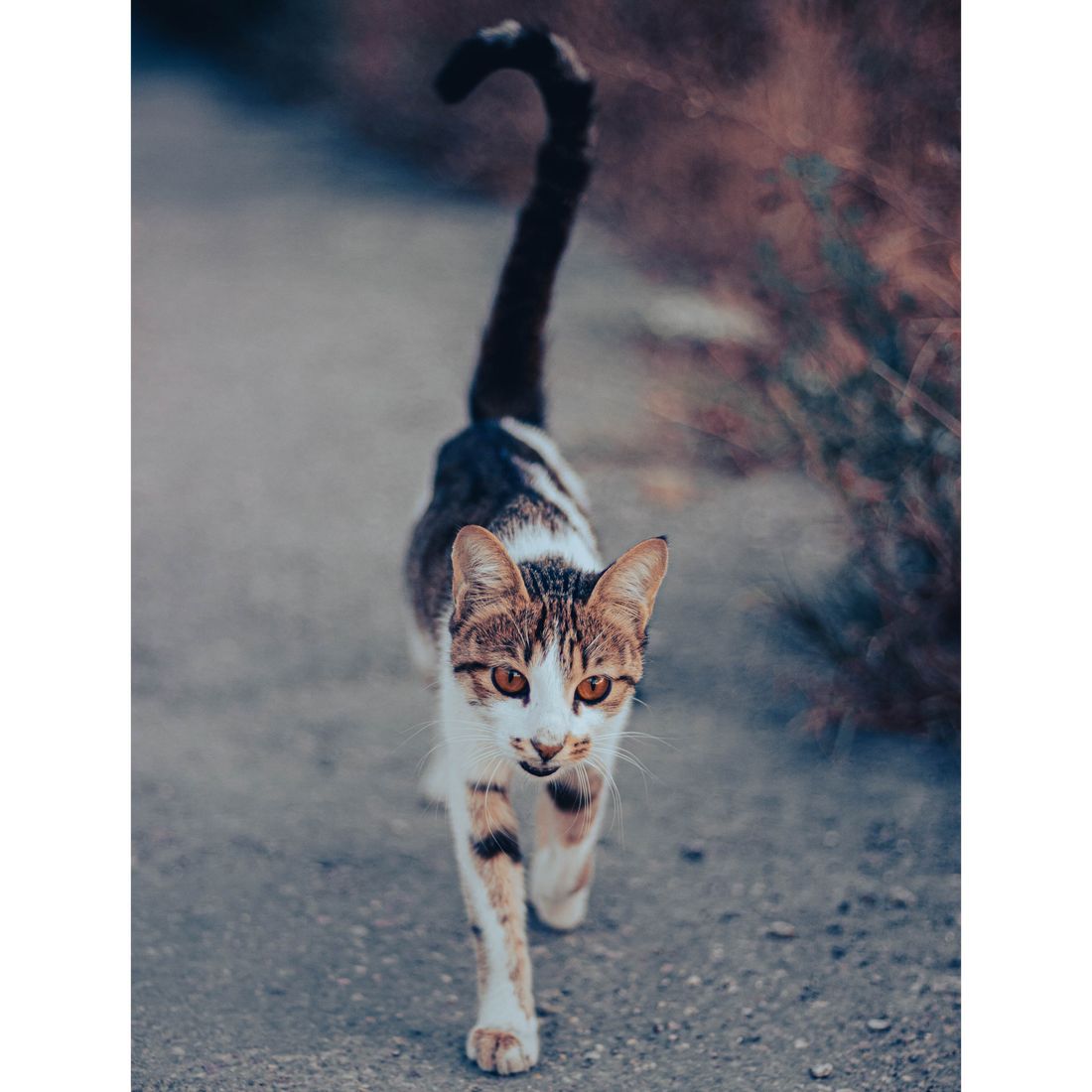
Tail vertical, ears forward, body loose, cat walking toward you: this strongly supports a friendly, confident greeting.
Example 2: upright + quivering + walking toward you
This can be an excited greeting. Cats Protection and PetMD both describe upright tail quivering in friendly/social contexts.
Example 3: upright + quivering + backing against a vertical surface
Now the context changes. PetMD and Cats Protection note that tail quivering can accompany urine marking or “pseudo-spraying.” Do not label every quiver “happiness.”
Example 4: tail-tip twitch + crouched focus on toy
Likely hunting/play concentration.
Example 5: tail-tip twitch + ears back + body tense during petting
Now the same tail motion fits irritation or overstimulation much better.
Cat Tail Positions and Their Common Meanings
| Tail position | Common interpretation | Check the rest of the body for... |
|---|---|---|
| Straight up | Friendly, confident, socially open | Loose body, forward/neutral ears, voluntary approach |
| Up with curved tip | Friendly greeting / relaxed interest | Soft posture, approach, rubbing |
| Horizontal / neutral | Context-dependent; exploration, focus or neutral movement | Body tension, speed, target of attention |
| Held low | Fear, anxiety, uncertainty or discomfort can be involved | Crouching, ears back, wide pupils, avoidance |
| Tucked beneath body | Stronger fear/stress; pain can also contribute | Defensive posture, hiding, reduced movement |
| Puffed | High arousal, fear/threat, startle | Arched back, sideways stance, flattened ears, hissing |
| Wrapped around own body | Can be normal resting/heat conservation; persistent tight wrapping with tension may indicate fear, pain or illness | Whether the cat is relaxed versus crouched and withdrawn |
| Wrapped around you/another cat | Often affiliative/friendly contact | Loose posture, rubbing, social approach |
The table gives you probabilities, not guarantees. Breed, tail length, previous injury and individual habits can change how a cat physically carries the tail.
Cat Tail Movements: What Wagging, Swishing and Twitching Usually Mean
| Movement | Common context | What to do |
|---|---|---|
| Slow side-to-side swish | Focused attention, indecision, stalking/pre-pounce concentration | Watch ears, eyes and target |
| Fast thrash / thump | Irritation, frustration, high arousal | Reduce interaction; give space |
| Tail-tip twitch | Hunting/play focus or mild irritation | Read the scene |
| Small rhythmic flick during petting | May be an early “I’m getting done” signal | Pause petting and see whether cat re-initiates |
| Whole-tail quiver upright | Excited greeting or marking-related behavior | Look at direction, body position and nearby surface |
| Sudden unusual/erratic movement | May reflect frustration; persistent change can accompany discomfort | Compare with normal baseline and other signs |
Unlike the popular shorthand around dogs, a moving cat tail is not automatically a “happy wag.” Cats Protection says fast side-to-side movement is commonly associated with anger/upset, while slow movement can reflect indecision or pre-pounce focus.
What Does It Mean When a Cat’s Tail Is Straight Up?
This is one of the more reliable positive tail signals when it occurs during a relaxed social approach. PetMD describes an upright tail as friendly and confident, and Cats Protection uses an upright tail as a classic happy/friendly greeting sign.
Researchers have also studied the social significance of the tail-up posture in cat-to-cat communication. The useful practical point is simple: if your cat walks toward you with an upright tail, relaxed shoulders and forward/neutral ears, they are usually comfortable with the interaction.
Do not confuse “upright” with “stiff and highly aroused”
A rigid upright tail with puffed fur, enlarged body profile or sudden tension means something different. Always ask whether the body is loose or braced.
What Does a Question-Mark Cat Tail Mean?
An upright tail with a soft curve or hook at the tip is commonly associated with friendly, relaxed approach behavior. PetMD and Cats Protection both describe this shape as a positive social signal.
It is reasonable to offer interaction—but not to assume consent for unlimited petting. Let the cat sniff, rub or approach, and watch whether the posture stays loose.
Friendly signal ≠ permanent consent. A cat can begin an interaction with a question-mark tail and later start flicking or thrashing the tail when they have had enough.
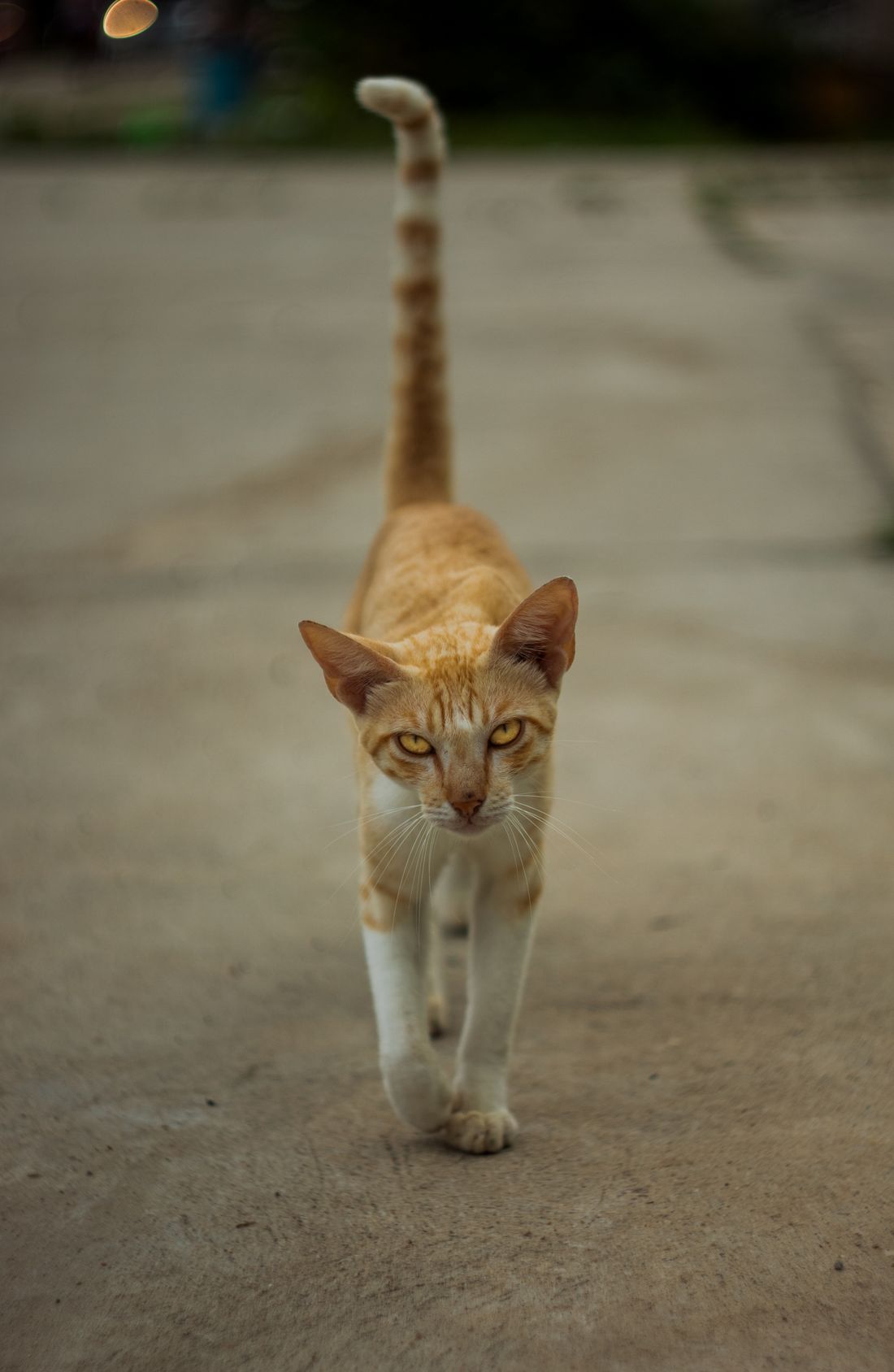
Low Tail vs Tucked Tail
Tail held low
PetMD and VCA both associate a low tail with possible fear, anxiety or pain. The important word is possible. Some cats naturally carry their tails lower while moving, and body conformation can affect posture.
Tail tucked under the body
A tucked tail combined with crouching, flattened/sideways ears, wide pupils or hiding strongly supports fear or defensive discomfort. VCA also notes that pain can be part of the picture.
What to do
Do not move closer simply to “test” whether the cat is afraid. Increase choice and distance. If a low/tucked tail is new and appears alongside hiding, appetite changes, reduced jumping, vocalization, gait change or sensitivity to touch, consider a medical cause.
Puffed-Up Cat Tail: Fear, Threat or High Arousal
A fully puffed tail is caused by piloerection—hair standing up. PetMD, VCA and Cats Protection all describe this as a common high-arousal response to feeling threatened, frightened or startled.
In the classic “Halloween cat” posture, the puffed tail may accompany:
- arched back;
- side-on body orientation;
- raised fur along the back;
- flattened ears;
- wide pupils;
- hissing, growling or defensive swatting.
The body is trying to look larger. Give the cat room to escape or decompress rather than reaching toward them.
Can a cat puff its tail during play?
Yes, especially during high-arousal kitten play or sudden excitement. This is exactly why “puffed = aggressive” is too crude. If the cat is bouncing sideways, taking breaks, re-engaging voluntarily and showing otherwise playful behavior, the context can be different from a cornered defensive cat.
Cat Swishing, Thumping and Tail-Tip Twitching
Fast side-to-side thrashing
PetMD describes fast thrashing or thumping as a strong sign of irritation, annoyance or anger. Cats Protection similarly treats rapidly wagging or swishing tails as an “upset” signal.
If you are petting the cat, stop or pause before the cat needs to escalate to ears-back, growling, swatting or biting.
Slow side-to-side swish
This often appears during intense visual focus—watching a toy, bird, insect or another moving target. PetMD notes that cats may swish slowly when preparing to pounce. Cats Protection also describes a mid-tail wag as potentially reflecting indecision.
Just the tip is twitching
This is one of the most context-sensitive signals. It can appear during hunting/play concentration and also during irritation. Use the ears and body:
- ears forward + crouched toward toy + pupils focused: hunting/play is likely;
- ears rotating back + body stiff + petting continuing: irritation/overstimulation becomes more likely;
- resting cat + sudden persistent twitch + skin rippling/biting at back: stop treating it as a mood clue and consider discomfort.
Why Is My Cat’s Tail Quivering?
This is where simple tail charts often fail.
Upright quiver while approaching you
Cats Protection says an upright shaking/quivering tail can occur when a cat is excited to see you. PetMD also describes an excited social quiver.
Upright quiver while backing toward a wall or vertical object
Now watch the rear body and environment. PetMD notes that tail quivering while the cat backs toward a vertical surface can occur during urine marking. Cats Protection also distinguishes greeting quivers from spraying or pseudo-spraying contexts.
| Clue | Greeting quiver | Possible spraying/marking |
|---|---|---|
| Direction | Approaches you/another cat | Backs toward vertical surface |
| Body | Loose, social, often rubbing | Rear positioned close to wall/object |
| Feet | May show excited little steps | May tread/paddle while tail quivers |
| Urine | None | May release a small amount; pseudo-spraying may occur without urine |
| Interpretation | Excited social signal | Marking behavior context |
Why Do Cats Wrap Their Tails Around Themselves, People or Other Cats?
Around another cat or person
PetMD describes tail wrapping around a familiar person or another cat as affiliative social behavior. Think of it as part of a friendly contact sequence rather than a literal human-style “hug” with one fixed emotional meaning.
Around their own body
This needs context. A relaxed sleeping cat may curl the tail around the body for comfort or warmth. But PetMD and VCA note that a cat tightly wrapping the tail while crouched or withdrawn can also be defensive, fearful, painful or unwell.
Ask: is the whole cat soft and resting—or tense and trying to disappear?
Use the Tail to Know When Petting Should Stop
Cats Protection specifically advises stopping stroking when you see signs such as tail swishing, sudden tensing, ears turning backward or dilated pupils. These can appear before hissing, swatting or biting.
A practical consent check
- Pet briefly around areas your cat usually enjoys.
- Pause.
- If the cat leans back in, rubs you or re-initiates, continue briefly.
- If the tail begins flicking faster, the body tightens or the head turns sharply toward your hand, stop.
Patify’s safe cat-handling guide uses the same principle: respond to early “I’m done” signals rather than waiting for the cat to bite.
Cat Tail Language During Hunting and Play
Predatory-style play naturally changes tail movement. PetMD notes that a focused cat may flick or slowly swish the tail while stalking or preparing to pounce.
Likely play/hunt context
- attention fixed on a toy or moving target;
- body crouched in stalking posture;
- ears forward or rotating toward target;
- rear-end wiggle before pounce;
- tail tip flicking or slow swish;
- normal recovery after the pounce.
This is not the same as a cat thrashing the tail while being restrained or petted.
For sounds that often accompany friendly or prey-focused behavior, Patify’s cat trilling guide explains why vocalizations also need body-language context.
How Cats Use Their Tails With Other Cats
Tail language matters in cat-to-cat relationships because subtle tension can exist without obvious fighting.
Friendly/affiliative patterns
- upright approach;
- tails gently contacting or intertwining;
- loose body posture;
- rubbing;
- resting near each other without blocking movement.
Tension patterns
- puffed tail;
- rapid swishing paired with flattened ears;
- crouched low tail posture;
- fixated stare;
- body blocking or stalking;
- hissing/growling/chasing.
Cat Friendly Homes lists swishing/puffed tails alongside tense body posture, staring and flattened ears as possible intercat-tension signs. A tail signal becomes more meaningful when several of these appear together.
If you are trying to decide whether rough interaction is reciprocal play or real conflict, Patify’s cats playing vs fighting guide uses role reversal, chasing, vocalization, body language and recovery rather than one frozen tail position.
When a Tail Change May Be Medical, Not “Mood”
Behavior guides should not turn every tail posture into emotion. Pain, trauma and neurologic injury can alter how a cat holds or moves the tail.
Call a veterinarian promptly if the tail suddenly:
- hangs limp and the cat cannot lift or move it;
- develops swelling, bleeding or a wound;
- appears painful when touched;
- is held differently after being caught in a door, pulled, stepped on or hit;
- is accompanied by hind-limb weakness;
- is accompanied by difficulty urinating or defecating.
VCA’s tail-injury guidance notes that nerve damage can make a cat unable to flick or lift the tail and, in serious cases, can affect bladder or bowel control. A suddenly limp tail is therefore not a body-language puzzle to monitor for days.
Repeated back/tail twitching with self-attack
Persistent skin rippling, frantic tail/back biting or episodes where the cat seems impossible to distract can have medical or behavioral causes. Do not diagnose “feline hyperesthesia” from social media clips; veterinary evaluation is needed because pain, skin disease and neurologic problems can overlap with those signs.
10 Common Cat Tail Language Mistakes
- “Wagging means happy.” Cat tail movement is not dog-tail shorthand.
- “Puffed tail means aggressive.” Fear, startle and high arousal are common reasons.
- “Tail tip twitch = angry.” It can also occur during hunting/play focus.
- “Tail up always means pet me.” Friendly approach is not unlimited handling consent.
- “Quivering tail always means love.” Marking context matters.
- “Low tail always means fear.” Individual carriage and pain can change posture.
- “Wrapped tail always means anxiety.” Relaxed resting cats may simply be comfortable or conserving warmth.
- Ignoring ears and eyes. Tail interpretation becomes much stronger when signals agree.
- Reading a frozen photo as a diagnosis. Movement before and after the image matters.
- Calling a new limp tail a mood. Sudden loss of tail movement needs medical attention.
Fast Cat Tail Context Matrix
| Tail | Ears / body | Situation | Most useful interpretation |
|---|---|---|---|
| Up | Loose, ears forward | Approaching you | Friendly/confident greeting |
| Up + curved tip | Loose | Approach/rub | Relaxed social interest |
| Up + quiver | Loose | Approaches you | Excited greeting possible |
| Up + quiver | Rear to wall | Vertical surface | Urine marking/pseudo-spraying context |
| Tip twitch | Forward focus | Watching toy/bird | Hunting/play concentration |
| Tip twitch | Ears back, tense | Being petted | Irritation/overstimulation likely |
| Fast thrash | Tense | Handling/conflict | Back off / reduce interaction |
| Puffed | Arched/stiff | Sudden threat | Fear/high arousal |
| Tucked | Crouched | Trying to hide | Fear/stress; consider pain if new |
| Limp, unmoving | Abnormal gait/pain | After trauma or suddenly new | Medical concern, not mood |
Frequently Asked Questions About Cat Tail Language
What does it mean when a cat holds its tail straight up?
During a relaxed approach, an upright tail commonly signals friendliness and confidence. Confirm with loose posture and neutral/forward ears.
What does a question-mark cat tail mean?
An upright tail with a softly curved tip is commonly associated with a relaxed, friendly greeting and openness to social interaction.
Why does my cat wag its tail while lying down?
It depends on speed and context. Slow movements can reflect focus or mild stimulation; strong repeated thumping can signal irritation. Watch the ears, eyes and what is happening around the cat.
Why does my cat flick the tip of its tail?
Tail-tip flicking can occur during hunting/play focus or mild irritation. If your cat is staring at a toy, hunting is likely. If you are petting them and the body is becoming tense, stop and give space.
Why does my cat’s tail puff up?
Piloerection usually means high arousal, often fear, threat or startle. During playful kitten bursts it can also happen with excitement, so use the rest of the posture to interpret it.
Why does my cat wrap its tail around me?
This commonly occurs as friendly affiliative contact, especially when paired with rubbing and relaxed body language.
Why does my cat wrap its tail around itself?
A relaxed cat may do it for comfort or warmth. A tense crouched cat with a tightly wrapped tail may be fearful, defensive, painful or unwell.
What does a low cat tail mean?
Fear, anxiety or discomfort may be involved, especially when the cat is crouched or avoiding interaction. Some cats naturally carry the tail low, so compare with that cat’s normal posture.
What does a quivering cat tail mean?
An upright quiver during a friendly approach may reflect excitement. A quivering tail while backing against a vertical surface can be part of urine marking or pseudo-spraying behavior.
Does tail swishing mean a cat is angry?
Fast forceful swishing often signals irritation or high arousal. Slower swishing can reflect hunting focus or indecision, so speed and context matter.
Can a cat’s tail show pain?
Yes. A low/tucked posture can occur with pain, and a sudden limp tail or inability to move the tail can indicate injury or nerve damage. New persistent changes deserve veterinary attention.
Can I tell exactly how my cat feels from its tail?
No. Tail language is one channel. The most accurate interpretation combines the tail with ears, eyes, whiskers, body tension, movement and the current situation.
Sources Checked for This Guide
- PetMD — How to Read Your Cat’s Tail Language: tail positions, movements, quivering and context.
- PetMD — Cat Body Language: interpreting tail signals alongside ears, eyes and posture.
- VCA Animal Hospitals — Kitten Tail Meanings: upright, curved, puffed, low/tucked, wrapped and moving-tail patterns.
- Cats Protection — Cat Tail Meanings: upright greeting, quiver, puffing, swishing, twitching and health context.
- Cats Protection — Cat Body Language: whole-body interpretation and relaxed/stressed signals.
- Cats Protection — When Cats Attack: stopping interaction at early tail/ear/body warning signs.
- Cat Friendly Homes / FelineVMA — Intercat Tension: tail signals in broader social-tension context.
- VCA Animal Hospitals — Tail Injuries in Cats: limp tail, nerve injury and bladder/bowel warning signs.
- Pexels — upright-tail cat cover image
- Pexels — walking cat support image
- Pexels — tabby tail-position support image
- Pexels License
Editorial note: tail signals are presented as context-dependent behavioral clues rather than fixed emotional diagnoses; sudden loss of tail movement, pain or post-trauma changes are treated as veterinary concerns. Sources were reviewed September 29, 2026.