Congo Tetra Care: Adult Swimming Length, Group Behaviour and Male Fin Safety
Plan Congo tetras around a 120 cm aquarium length, mature group behaviour, feeding access, flowing-fin safety and stable water conditions. Read the adult-size and same-species group notes before purchasing fish for a community tank.
Is a Congo tetra school right for your aquarium?
The Congo tetra, Phenacogrammus interruptus, is not a scaled-up neon tetra or a colourful finishing touch for a cramped community tank. This African schooling species needs a long, open swimming area, a social group and relatively peaceful surroundings. Adult males develop striking iridescence and flowing fins; juveniles at stores often look silver and ordinary. For someone choosing between a small tetra and Congo tetras, tank length should settle the question before colour or price does. Never buy a few juveniles on the assumption that their current store size is the size they will keep.
Seriously Fish lists an adult standard length of around 8 cm and a minimum aquarium base of about 120 by 30 cm. This is a dimensional planning reference for adult swimming and group behaviour, not a stocking promise for every tank with the same litres. A fully stocked display needs additional room for other species and hardscape. If an aquarium is under that length, the appropriate alternative may be a genuinely smaller schooling fish rather than reducing the Congo tetra group to fit a decorative tank.
Confirm the species and account for mature males
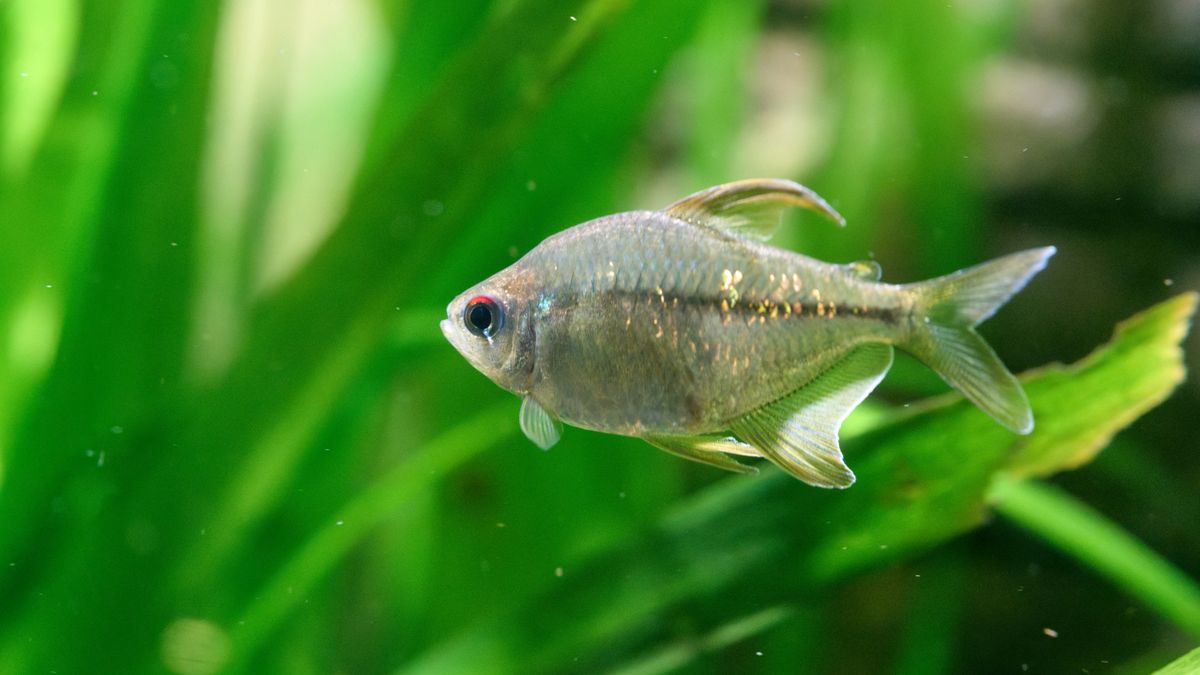
The Congo tetra belongs to the African characin family Alestidae, and its distribution is associated with parts of the Congo drainage in the Democratic Republic of Congo. Ask for the scientific name Phenacogrammus interruptus because “African tetra” can refer to multiple species with different requirements. The classic adult male shows iridescent bands and elongated caudal and dorsal fin structures. Females are typically smaller and less showy. An illustration of an adult male does not describe every juvenile in a shipment.
Male fins are one reason community selection matters. A fast fin-nipping tank mate can spoil fins and create prolonged stress without being a true predator. Conversely a shy fish may feel overwhelmed by a school of larger active characins even when no biting occurs. When checking fish at a retailer, observe movement for several minutes; good condition is not established by an attractive photograph. Ask about how recently the batch arrived and whether fish are feeding reliably.
Measure usable swimming length, not just tank capacity
The 120 cm base-length reference from Seriously Fish is a useful screening test. It gives adult fish a direction to swim rather than endlessly turning around a central ornament. The suggested base dimensions of 120 by 30 cm describe a minimum physical footprint, and the profile's approximate volume figure is not a universal answer to stocking. A long, shallow tank and a short, deep column can have similar volumes and very different usable corridors.
Sketch your layout at scale before adding fish. Mark the position of the filter outlet, wood branches, tall plants and any place where one dominant fish might block the school. Leave a continuous midwater lane across the aquarium, with dense plant islands at either end for retreat. Measure after hardscape is in place rather than making plans from the empty glass. If a centrepiece driftwood tangle interrupts every movement, rethink the arrangement even if it looks spectacular from the sofa.
For a genuinely smaller alternative, compare adult dimensions in the lemon tetra guide.
Group structure, confidence and swimming behaviour
Congo tetras are schooling fish and become noticeably less secure when kept in inadequate numbers. Detailed profiles recommend a mixed-sex shoal; Aquarium Co-Op also advises keeping males and females together to see normal social displays. Plan a meaningful same-species group from the outset, subject to your tank's adult stocking capacity. Some keepers use six as a floor, but a larger group often gives more natural interaction if adequate length, filtration and maintenance capacity remain. A group is not a justification to overcrowd.
Watch for a loose, travelling school rather than demanding that every fish form a single synchronized line all day. Temporary separation to investigate food or retreat into plant cover is ordinary. Constant hiding, frantic dashing at every movement, or an animal remaining isolated from the rest deserves a review of disturbance, water quality and compatibility. School size can improve confidence, but adding more fish to an uncycled aquarium or one suffering repeated ammonia spikes would make a bad situation worse.
| Decision gate | Adult Congo tetra requirement | Do not substitute |
|---|---|---|
| Footprint | At least approximately 120 cm of tank length | Juvenile store-tank volume |
| Grouping | Meaningful same-species mixed-sex shoal | One showy male as an ornament |
| Water | Stable conditions within source range | Sudden pH manipulation |
| Tank mates | Peaceful species, no persistent fin nipping | Any fish sharing temperature |
| Layout | Open lane with plants/wood on sides | Hardscape blocking midwater |
Temperature, pH and hardness: use measured values
Seriously Fish lists 23–28°C, pH approximately 6.0–7.5 and general hardness around 3–18 dGH. A broad species range should be treated as a guide for planning stable aquarium water, not instructions to swing between its endpoints. Record the temperature over several days, including nights when a Canadian room may be cooler. Verify your water source, dechlorination routine and heater accuracy with instruments rather than relying exclusively on a preset dial or app forecast.
If your treated tap water falls well outside the appropriate range, seek advice on a dependable long-term strategy rather than improvising with acids or salts the night before fish arrive. Dilution, mineralisation and buffering each have consequences for stability and other residents. Do not apply a water-adjustment recipe written for a different aquarium. The fish need consistent conditions and functioning gas exchange just as much as they need parameters that overlap the species profile.
Establish biological filtration before purchase
A beautiful Congo tetra will still suffer in a new tank with no mature nitrogen cycle. Biological filtration converts fish-produced ammonia through nitrite to nitrate, and monitoring these compounds matters more than the apparent clarity of the water. A filter running for a few hours or an unopened bottle of bacteria is not proof that the aquarium can process the intended waste load. Confirm the cycle with appropriate tests before a full school arrives.
Allow for the fact that Congo tetras are comparatively substantial fish with a meaningful feeding and waste load. Plan filtration to maintain stable water without turning the whole aquarium into a relentless jet. Test after stocking changes, especially if a whole group is introduced together. Be ready to reduce feeding and perform appropriately conditioned partial water changes if tests reveal a problem. Avoid destroying mature filter media through unnecessary deep cleaning on the same day you add livestock.
Build an African-inspired aquascape without pretending it is a biotope
Seriously Fish suggests driftwood, plants including Anubias and floating vegetation as useful elements for a Congo tetra display. These features can frame the school and give refuge from direct light. However, a cluster of store-bought plants does not create a scientifically verified reconstruction of a particular Congo river site. Call the layout inspired by habitat rather than claiming authentic water chemistry or wild collection provenance without evidence.
Keep the centre open. Use aquarium-safe wood and secure stones so a startling group cannot knock over unstable elements. Put broad-leaved plants around the back and boundaries, with broken sightlines for resting fish. Consider the strength and direction of current: gentle to moderate circulation and oxygenation should reach the whole tank while leaving less exposed places to rest. Watch whether the group can swim against the flow normally or spends its day pinned to one corner.
Our planted aquarium setup guide explains the equipment and planting fundamentals separately from Congo tetra space requirements.
Light, iridescence and why shop fish often look grey
Congo tetra colours change with maturation and viewing angle. Aquarium Co-Op describes adult males with vivid blue and reddish-orange bands and characteristic flowing fins; the same individual can look less dramatic under flat lighting. A juvenile's dullness should not be mistaken for poor genetic quality or treated as a disease in the absence of other symptoms. Lighting can improve visibility, but it cannot compensate for dirty water or relentless competition.
A predictable lighting schedule supports both fish behaviour and plant health. Provide shaded places using broad leaves or floating cover while preserving open surface exchange. To track condition, photograph from the same angle and under similar illumination rather than comparing a phone picture in an aquarium shop with a heavily processed advertising image. Sudden collective colour loss, rapid respiration or clamped fins warrants water testing and health assessment, not stronger blue LEDs.
Feed a sizeable school without polluting the tank
Congo tetras are omnivorous and accept suitably sized prepared food, with live and frozen options contributing diet variety according to detailed species profiles. Offer a reputable staple suited to their mouths and supplement with appropriately handled small aquatic invertebrates. Variety is not permission to pour large cubes of frozen food into the tank. Thaw and portion carefully, observe consumption and remove food that travels unnoticed into a plant thicket.
In an active school, faster fish can intercept nearly all floating food. Distribute portions across two or three points along the swimming lane when you observe uneven access, and look at whether quieter females and younger fish get their share. Test whether sinking particles remain available long enough to be eaten. A fish that is slowly losing condition while the rest become rounded may face competition or illness; increasing food for everyone without diagnosing the disparity increases waste and risk.
Adult male fin care and the nipping problem
An attractive male's extended fins are vulnerable to tank mates that repeatedly target long or moving appendages. A peaceful species in a shop label may still behave poorly in a confined social arrangement. Avoid notorious nippers, boisterous species that chase continuously and predatory fish capable of swallowing smaller residents. Congo tetras are not generally classified as aggressive fin nippers themselves, but they can alarm very timid fish through size and movement.
Inspect fins at feeding and during calm periods without chasing the fish with a net. Are frayed edges appearing on several animals, or only after a new tank mate was introduced? Does damage coincide with chasing, poor water measurements or a sharp plastic ornament? Those patterns direct very different responses. Separating an identified aggressor and improving water conditions can help; dosing broad-spectrum remedies before ruling out physical or behavioural causes is not a sound first reaction.
| Observed issue | Review first | Avoid |
|---|---|---|
| Repeated fin damage | Nipping or sharp hardscape; water quality | Blind medication |
| Frantic darting | School confidence, disturbance, water tests | Adding more fish to a crisis |
| Weak feeding in some fish | Food placement and competition | Feeding excess indiscriminately |
| Male still juvenile-coloured | Age and lighting context | Claims of defective genetics |
Community choices: a bigger fish is not always a tougher fish
Potential companions mentioned by Seriously Fish include appropriate peaceful rainbowfish, larger characins, some Corydoras, loricariid catfishes and certain non-aggressive cichlids. This is not a guaranteed shopping bundle. An individual species' adult size, water requirements, temperament and ability to obtain food must all be checked. A fish that reaches twenty centimetres or claims a large territory may not be suitable just because it shares a temperature range.
Do not use a numerical “compatibility score” as an override for the actual aquarium footprint. Likewise, an aquarium full of small tetras will not automatically become harmonious if Congo tetras are added as a visual focal point. The larger school's fast feeding and movement can unsettle existing fish. Use a written community plan and an observation period after any addition, preferably with quarantine and a clear way to separate animals if an incompatible interaction becomes evident.
Congo tetra versus lemon tetra: choose by the bottleneck
A lemon tetra and a Congo tetra have different origins, adult footprints and presentation despite sharing the tetra label. Lemon tetras remain comparatively small and can be appropriate for an approximately 80 cm base under other suitable conditions; Congos require substantially more length. It is therefore dangerous to move a stocking rule between them. If you only know the aquarium's litre rating, measure the actual length before deciding which species fits.
Their behaviour also differs in scale. A larger Congo group can be active enough to outcompete a more delicate school around food, even where pH and temperature overlap. Combining the two may be possible in a generously planned aquarium, but it does not mean using the smaller species' minimum as a joint stocking prescription. If your priority is subtle yellow colour in a medium planted tank, start with lemon tetra research. If your priority is the Congo's adult fin display, design for the larger species first.
Shopping and provenance questions for Canadians
Ask the seller to confirm the scientific name, approximate juvenile size, current feeding pattern and whether the fish were recently transported. Commercially bred Congo tetras are common in the trade, according to species references, but a generic “tank-bred” label at one retailer does not prove the origin of every specimen in its tanks. Ask whether the fish have been in observation and what water parameters they were held in. Avoid a shop with recurring unexplained losses in the same system.
Before paying, calculate a complete same-species group and the equipment required to keep them, not just an individual sale price. Prices vary across provinces, stores, shipping methods and seasons; a reliable Canada-wide average cannot be inferred from one online listing. Large aquariums also entail floor-support, safe stand, filtration, heater and water-testing expenses. A genuinely economical plan may be delaying the purchase until you already own a suitable established display.
Transport and acclimation with less guesswork
Transport bags create a small, changing water environment. The acclimation method should reflect travel time, whether fish have been shipped for many hours and differences between bag water and the receiving tank. Aquarium Co-Op cautions that opening long-shipped bags can alter pH and make accumulated ammonia more hazardous, so a slow improvised drip is not always the best solution. Ask the supplier how the fish travelled and use a justified protocol suited to that situation.
Keep handling quiet and short, protect the fish from Canadian seasonal extremes on the journey home and avoid placing a bag on a freezing car floor or in direct sun. Move fish gently with suitable equipment, and do not routinely introduce transport water into the established community aquarium. If any individual arrives in poor condition, seek qualified guidance; do not assume that prolonged acclimation will correct physical injury, severe distress or an uncycled destination aquarium.
Quarantine without compromising school welfare
A properly prepared observation aquarium can prevent newly purchased animals from bringing a disease into the main display. It must still have biological filtration, heat, water movement, hiding places and enough temporary space for the fish being held. Quarantine is not an excuse to house a whole Congo tetra group in a tiny unfiltered bucket for weeks. Plan the quarantine equipment and water testing before collecting fish, particularly if the display already holds valuable or sensitive species.
Observe respiration, feeding, skin and fins daily, taking note of trends rather than diagnosing every colour change as infection. The Aquarium Co-Op quarantine guide describes methods, but medication choices must account for the actual symptoms and individual species; do not automatically apply a multiproduct regimen to healthy fish without professional advice. If serious signs appear, consult a veterinarian with aquatic experience. A cautious observation period is part of responsible stocking, not a guarantee that every possible pathogen will be excluded.
The first month: track behaviour and water together
During the first week, log basic readings, food taken and whether the school explores the tank calmly once people step away. In weeks two and three, pay attention to repeated chases, damage to flowing fins and whether fish stay thin despite regular meals. As fish settle, the group should be able to traverse the length of the tank without repeated startled collisions. The timing of adaptation varies, so avoid a fixed countdown promising colour improvement on a particular day.
After a month, compare the current observations with the baseline photographs and notes. If the fish are calmer but still unusually pale, examine your lighting and the age of the fish, while not overlooking water quality. If they dart at night or crowd the surface, check aeration and equipment operation, especially around lights-out. An apparently healthy, colourful male does not prove every quieter individual is eating properly.
| Fish comparison | Lemon tetra | Congo tetra |
|---|---|---|
| Approx. SL | 4 cm | 8 cm |
| Base length reference | 80 cm | 120 cm |
| Key activity | Compact group in planted middle water | Larger active school in open midwater |
| Risk in mixed display | Outcompeted or crowded | Fins exposed to nippers |
| Planning rule | Do not use for Congos | Design for larger species first |
Maintenance priorities in a long community aquarium
A long tank develops maintenance zones: quieter corners collect debris while the strongest current may carry food toward an intake. Check these patterns when feeding and during water changes. Remove visible trapped waste as needed, but do not strip established surfaces or filter material all at once. Dechlorinate replacement water as appropriate for your municipal source, align temperature and test water on a schedule that matches stocking and feeding.
Prune plants that block the swimming corridor and make sure a full school can turn without catching fragile male fins on hardscape. Inspect heater placement and cords; an aquarium this length may have temperature gradients if circulation is poorly arranged. Test values tell only part of the story: fin condition, appetite, normal shoaling and ease of breathing all contribute to a responsible welfare picture.
Breeding, eggs and expectations in the display
Congo tetras are egg-scattering characins. Breeding accounts usually describe a more controlled approach than ordinary community-tank care, and eggs or very small fry are vulnerable to adults and other fish. Maintaining a striking mixed-sex school is not a promise that young will survive in a planted display. If you want to breed the species, first establish reliable adult care and research the separate tank, water, egg protection and food cultures required for early fry.
Do not keep adding males simply to intensify competition or stage photographs. The same delicate extended fins that make the species attractive can become liabilities in a crowded setting. Never advertise a guaranteed hatch rate or a precise developmental schedule without closely matched evidence and actual observations. An aquarium that supports healthy adults over time is a valid goal even when no breeding programme is attempted.
Troubleshooting shy fish, fin damage or disrupted shoaling
Start with changes you can verify: an added tank mate, rearranged wood, a loud nearby appliance, a new light schedule, a missed filter cleaning or a sudden temperature change. Test ammonia and nitrite before adding “calming” chemicals. Look for whether all fish are affected or one animal is repeatedly chased. If only the largest males have torn fin edges, investigate nipping and contact with hardscape; if several fish breathe fast, prioritise environmental and medical assessment.
Never assume that a clear photograph identifies fin rot, parasites or a nutritional deficiency. Some conditions appear similar even when the correct treatments differ. Isolate appropriately when needed and seek aquatic-veterinary advice for unexplained injuries or losses. Record symptoms and water measurements to provide the professional with a usable case history. Avoid the tempting but counterproductive cycle of changing temperature, pH, lighting and diet simultaneously.
Final plan before buying Congo tetras
Write the usable tank length, the intended group size, measured water values, quarantine plan, list of tank mates and where food will reach every part of the group. Then compare the adult species figures against the actual aquascape. If the aquarium is not long enough, stop there. No decorative enhancement or premium food will replace swimming room for mature fish. If a shop suggests that a few juvenile Congos can remain forever in a short display, ask for evidence or decline.
The species figures here are sourced principally from Seriously Fish and the comparative husbandry discussions from Aquarium Co-Op. They are general references rather than measurements of your tank or claims of hands-on experiments by Patify. Review our lemon tetra and cherry barb species pages for different adult footprints, and the fishless cycling and planted-tank guides for the shared setup fundamentals. Those pages complement this guide; they do not soften the Congo tetra's space requirement.
Compare species and core aquarium steps
Use these additional guides to compare a different species or to solve a setup question. The size and group requirements in this article still apply to the exact species discussed here.
Related species: Lemon Tetra Care Guide, Cherry Barb Care Guide.
Existing practical resources: Tetra Types, Planted Aquarium Setup, How To Cycle A Fish Tank, How To Acclimate Fish.
Sources and evidence limits
Species figures and behavioural notes were checked against the references below on 15 October 2026. They are care-planning sources, not measurements of your own tank. When advice differs, prioritise adult swimming space, a healthy group and stable, measurable water conditions; verify local availability and prices with your retailer.
- Seriously Fish — Congo tetra
- Aquarium Co-Op — Top ten tetras
- Aquarium Co-Op — Planted tank fish
- Aquarium Co-Op — Quarantine
- Aquarium Co-Op — Acclimation
Animal welfare: persistent abnormal breathing, wounds, loss of balance, refusal to feed or repeated deaths warrant timely review of water quality and advice from a qualified aquatic veterinarian. This editorial guide does not diagnose or prescribe treatment.