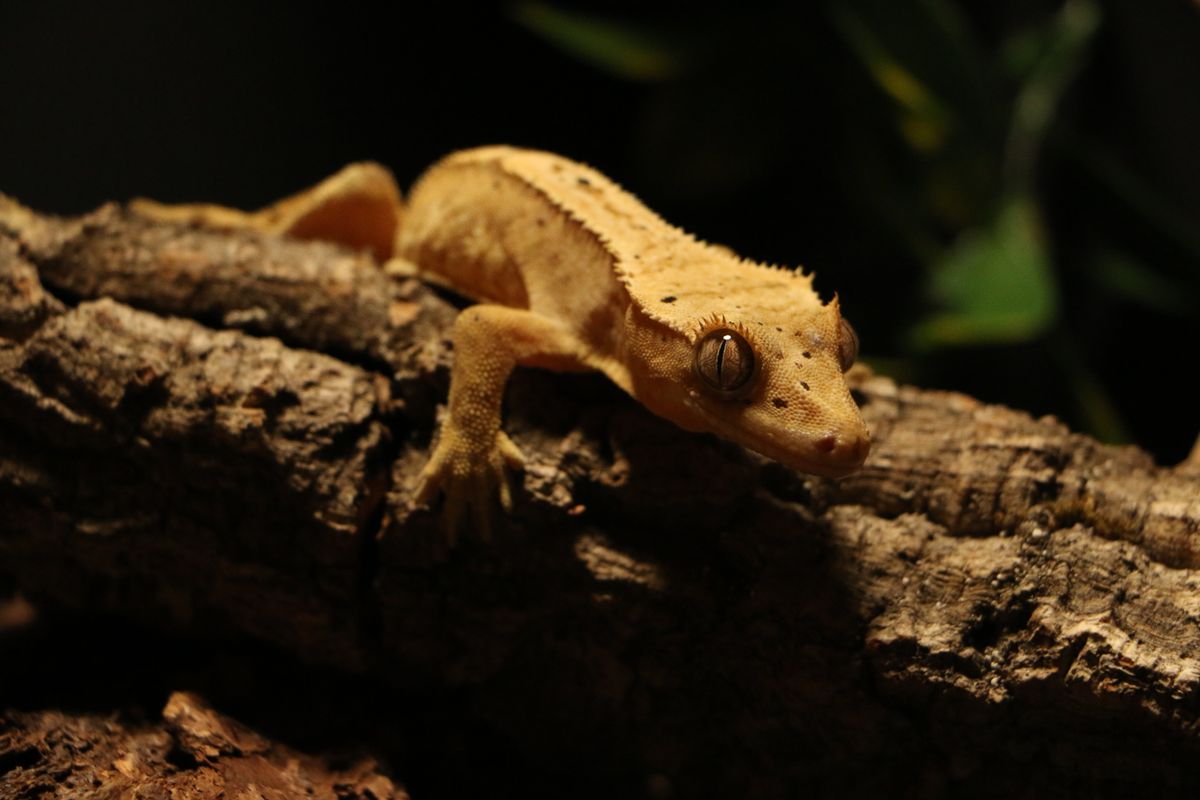

Last verified: September 29, 2026
Crested Gecko Morphs: First Separate Color, Pattern and Proven Genetics
Quick answer: a crested gecko can be described with several labels at the same time because base color, pattern, visual traits and proven genetic morphs are different layers. A gecko might be described as a red-base extreme harlequin partial pinstripe with Dalmatian spots, while a genetically established trait such as Lilly White or Axanthic adds another layer. That is why “What morph is my crested gecko?” rarely has a one-word answer.
The second complication is firing up and firing down. Crested geckos naturally shift between darker/more saturated and paler/duller appearances. Lighting, age and development can also change what you see. A single filtered phone photo is therefore a weak basis for assigning rare genetics.
Patify ID rule: describe the visible phenotype first. Claim a lineage-dependent genetic morph only when parentage or reliable breeder records support it.

Morph, Color, Pattern and Trait Are Not Interchangeable
Crested-gecko terminology grew out of breeder descriptions long before every visible feature had a mapped inheritance mechanism. That history matters. A hobby label can describe a useful visual phenotype without being a single-gene morph.
| Layer | What it describes | Examples |
|---|---|---|
| Base color | The underlying body-color family | Dark/brown, red, yellow; hobby shades such as lavender or olive may sit within those families |
| Pattern | Where contrasting color appears | Flame, harlequin, extreme harlequin, tiger/brindle |
| Structural/visual trait | A specific repeated feature | Pinstripe, portholes, white wall, Dalmatian spotting |
| Established genetic morph | A trait with demonstrated inheritance | Lilly White, Axanthic, Cappuccino and other proven projects |
| Combination | Multiple layers expressed together | Red Lilly White harlequin; Axanthic pinstripe; Frappuccino |
Zen Habitats’ morph guide, last reviewed in May 2026, makes the same practical distinction by separating genetic morphs, traits and colors. Current MorphMarket community discussions also show why visual terms should not automatically be converted into single-gene claims: many classic crested-gecko patterns remain polygenic or incompletely understood.
Fired Up vs Fired Down: The Same Gecko Can Look Like Two Different Animals
Crested geckos naturally change color intensity. Hobbyists call the darker, richer state fired up and the paler state fired down. Zen Habitats notes that base-color identification should account for this shift rather than treating every temporary shade as a separate morph.
| Photo condition | What can happen | ID consequence |
|---|---|---|
| Fired up | Base becomes darker/more saturated; pattern contrast may increase | Best for documenting mature base-color family |
| Fired down | Animal appears pale, muted or greyed | Can falsely suggest lavender/silver/axanthic-type appearance |
| Warm indoor light | Brown/red/yellow tones intensify | Can exaggerate red or orange labels |
| Cool LED / phone processing | Warm pigment can be suppressed | Can make ordinary animals look unusually grey |
| Juvenile | Pattern and white coverage may still develop | Adult phenotype may differ substantially |
For identification, photograph the gecko in neutral daylight or neutral-white lighting, without filters, and save both fired-up and fired-down images when possible.
The Patify 5-Layer Crested Gecko Morph Decoder
- Base color: What color family is visible when fired up?
- Dorsal pattern: Is the back plain, flame-like, harlequin, striped or strongly contrasting?
- Lateral/limb pattern: How far does contrasting pattern extend onto sides and legs?
- Named traits: Are pinstripes, Dalmatian spots, portholes, white wall or other repeatable features present?
- Proven genetics: Is Lilly White, Axanthic, Cappuccino or another genetic claim supported by lineage?
This order prevents a common error: seeing one feature—such as lots of white—and jumping directly to a high-value genetic label.
Crested Gecko Base Colors
Zen Habitats organizes base colors broadly into dark, red and yellow families, each with substantial variation. Hobby labels such as lavender, olive, black, cream, orange and pink often describe shades within or interacting with those broader categories.
Dark base
Can range from light tan and brown through olive/lavender-looking shades to very dark brown or near-black when fired up.
Red base
Can range from softer brick/pinkish red to highly saturated deep red. Age and firing state strongly affect intensity.
Yellow base
Can range from cream/yellow through gold and orange. Some animals become less intensely yellow with age or photograph differently under warm light.
Color is not automatically a gene. “Red,” “lavender” or “black” on a sales listing can be a phenotype description, line-bred tendency or marketing term rather than a single proven mutation.

Patternless and Bicolor Crested Geckos
Patternless
A patternless crested gecko lacks substantial contrasting pattern over the body. The animal can still have natural shading and minor variation; “patternless” does not mean mathematically identical color on every scale.
Bicolor
Bicolor animals are visually close to patternless but the dorsal is a noticeably different shade from the sides/body. Zen Habitats treats bicolor as a visual trait rather than automatically assigning a separate simple gene.
These labels are useful phenotype descriptions even when the precise genetics behind the overall pattern are more complex.
Flame vs Harlequin vs Extreme Harlequin
These labels describe a continuum of contrasting pattern coverage, not three completely unrelated animals.
| Pattern | Dorsal | Sides | Legs |
|---|---|---|---|
| Flame | Contrasting dorsal pattern | Little lateral pattern | Little or no patterned coverage |
| Harlequin | Broken/contrasting dorsal | Moderate side pattern | Visible patterned coverage |
| Extreme harlequin | Strong dorsal contrast | Pattern pushes high into laterals | Heavy pattern, often visually connected to side coverage |
Zen Habitats describes flame as a lower-expression version of the same broad harlequin pattern concept and extreme harlequin as high lateral/limb expression. Breeders may draw the exact boundary differently, so treat the labels as descriptive zones rather than laboratory cutoffs.
Pinstripe and Partial Pinstripe
Pinstripe refers to highlighted raised scales running along the edges of the dorsal. A full pinstripe has continuous highlighted lines; a partial pinstripe has breaks.
Pinstripe can coexist with flame, harlequin, Lilly White and many other appearances. It is therefore usually appended to another phenotype description rather than replacing it.
Phantom pinstripe
Zen Habitats describes phantom pinstripe animals as having the raised pinstripe structure without the same obvious contrasting highlight seen in conventional pinstripes. This is another example of why a top-down and side photo both matter.
Tiger and Brindle
Brindle describes irregular darker striping or banding; tiger generally describes a stronger, more organized striped expression that may extend into the dorsal. These are visual pattern terms and can appear alongside other traits.
Do not confuse a striped fired-down animal with Axanthic simply because the photo looks grey. Axanthic is a genetic pigment-reduction claim; tiger/brindle describes pattern geometry.
Dalmatian Spots
Dalmatian crested geckos display discrete dark spots over the body. Spot count, size and distribution vary, and spots may become more apparent as the gecko grows.
“Super Dalmatian” is commonly used by breeders for heavily spotted animals, but it is a descriptive hobby threshold rather than a universally standardized count.
Spot-color nuance
Spots can vary in shade and size. Do not turn every unusual spot color into a separate proven gene unless the lineage project demonstrates inheritance.
White Wall, Portholes and High-White Traits
Portholes
Portholes are small light/white spots along the laterals. Zen Habitats notes that they can expand or “bloom” as an animal matures.
White wall
White wall describes substantial white/cream coloration rising from the lower lateral area. It can visually resemble Lilly White, especially in a high-expression animal.
Important: lots of white does not automatically equal Lilly White. Parentage is extremely useful because a true Lilly White must come from a pairing in which the Lilly White gene is present.
Lilly White Crested Gecko
Lilly White is one of the best-known proven genetic crested-gecko morphs. Pangea describes it as an incomplete-dominant trait, and Zen Habitats describes characteristic white/cream coverage that can expand or intensify with age.
Common visual clues
- strong white/cream pattern, particularly laterally;
- white or pale tail features in many individuals;
- lightened areas around feet/ventral/lateral regions;
- raised/thickened-looking pale scales in characteristic regions;
- expression can range from subtle to extremely high white.
Low-expression Lilly Whites can be harder to identify visually, while high-white non-Lilly traits can imitate part of the look. Reliable lineage is therefore more important than a single photograph.
Breeding safety
Zen Habitats’ May 2026 review states that Lilly White is incomplete dominant and warns against Lilly White × Lilly White pairing because offspring inheriting two copies are considered nonviable/fatal. This is a breeding-welfare issue, not a reason to avoid keeping a healthy single-copy Lilly White as a pet.
Axanthic Crested Gecko
Axanthic reduces yellow pigment, creating a greyer/black/white overall palette. Zen Habitats describes Axanthic as a recessive genetic morph, meaning a visual Axanthic needs the relevant inheritance from both sides.
Why “grey-looking” is not enough
A fired-down brown gecko, cool lighting, camera processing, lavender-type phenotype or juvenile coloration can all look grey. Current MorphMarket discussions repeatedly show that lineage remains important when sellers or owners suspect a recessive genetic morph from photos.
A gecko described as het Axanthic is a carrier, not a visual Axanthic simply because it looks pale.
Cappuccino, Frappuccino and Super Cappuccino
Cappuccino is a newer genetic project than classic visual labels such as flame or harlequin. Pangea and MorphMarket genetics discussions document Cappuccino inheritance and its combination with Lilly White.
Cappuccino
Expression can be subtle and may overlap visually with ordinary dark/brown phenotypes. Zen Habitats notes that Cappuccino can be difficult to identify confidently when lineage is unknown.
Frappuccino
Frappuccino is the combination of Cappuccino + Lilly White. Pangea actively lists lineage-documented Frappuccino animals and identifies both component traits.
Super Cappuccino
Zen Habitats warns that inheriting the Cappuccino gene from both parents produces a super form associated with significant abnormalities, including reduced nostril size, spinal problems and poor quality of life. Therefore this is not simply a “rarer dark morph” breeding goal.
This is exactly why lineage-sensitive morphs should not be assigned to a pet-store gecko solely from appearance and then “proved out” through experimental breeding.

How Crested Gecko Combination Names Work
Most sales names are built by stacking layers. Read them from broad appearance toward specific traits.
| Example label | How to decode it |
|---|---|
| Red harlequin | Red base + harlequin pattern |
| Dark extreme harlequin partial pinstripe | Dark base + heavy harlequin coverage + broken pinstripe |
| Tricolor Lilly White | Three-color visual appearance + proven Lilly White gene |
| Axanthic pinstripe | Proven recessive Axanthic + pinstripe trait |
| Frappuccino harlequin | Cappuccino + Lilly White combination with harlequin-pattern expression |
| Red Dalmatian | Red base + Dalmatian spotting |
Long names are not necessarily marketing nonsense; they can accurately describe several independent visible/genetic layers. The problem begins when an unproven genetic label is inserted merely because the animal resembles a photo online.
How to Photograph a Crested Gecko for Morph Identification
Use a consistent photo set rather than one close-up portrait.
| Photo | What it reveals |
|---|---|
| Full side, fired up | Base color + lateral/leg pattern |
| Full side, fired down | How much appearance changes with firing |
| Top-down | Dorsal structure, pinstripe continuity, tail pattern |
| Opposite side | Asymmetry and true pattern coverage |
| Neutral eye/head close-up | Headstamp, scale details; useful supportive information |
| Hatch/juvenile photo | Developmental comparison for Lilly/white traits and other changing phenotypes |
Include this information with the photos
- age or hatch date if known;
- current weight;
- parents and breeder lineage;
- known genetic claims from the breeder;
- whether image is fired up or fired down;
- lighting conditions;
- older photos showing developmental change.
A recent September 2026 MorphMarket identification discussion illustrates the limitation well: experienced keepers declined to confirm Cappuccino in an unknown-lineage pet-store animal because several non-Cappuccino traits can mimic the appearance. That is the correct level of caution.
Age Can Change the Morph You Think You See
Juvenile crested geckos are not finished photographs. White coverage, portholes, spots, contrast and base shades can change as the animal grows.
Therefore:
- do not overpay for an adult color prediction from a tiny hatchling without understanding the lineage;
- keep dated photos under similar lighting;
- compare both fired states;
- expect phenotype descriptions to become more precise with maturity;
- do not confuse normal development with illness-related color change.
Why Morph Identification and Breeding Are Different Questions
If you only want to describe your pet, “dark-base harlequin partial pinstripe with spots” may be perfectly useful even without pedigree.
If you plan to breed, the standard should be much higher because:
- recessive carrier status can be invisible;
- some genetic combinations carry serious welfare consequences;
- unknown lineage can hide relatedness or undocumented genetic projects;
- visual look-alikes can be genetically different;
- experimental pairings should not be used as a casual identity test.
For a pet-store gecko with unknown ancestry, the safe conclusion may simply be “phenotype identified; genotype unconfirmed.”
If handling stress causes a tail-drop incident, Patify’s crested gecko tail-drop guide covers clean recovery setup, infection red flags and the fact that crested gecko tails do not regenerate.
Does Morph Change Crested Gecko Care?
Most color/pattern morphs do not create a separate husbandry species. A Lilly White, harlequin and normal-looking crested gecko are all Correlophus ciliatus and require the same core species-appropriate environment, nutrition, hydration, climbing structure and veterinary care unless a veterinarian identifies an individual medical need.
The important exceptions are not “rare color needs rare food”; they are genetic-welfare issues in certain breeding combinations. Do not invent special supplements, temperatures or diets simply because a gecko is expensive or visually unusual.
12 Common Crested Gecko Morph Identification Mistakes
- Calling every visible label a single gene.
- Ignoring fired-up vs fired-down color.
- Calling a grey fired-down gecko Axanthic.
- Calling every high-white animal Lilly White.
- Confusing flame, harlequin and extreme harlequin as unrelated morphs.
- Using only a face photo.
- Ignoring the opposite side of the animal.
- Assigning Cappuccino without lineage because the gecko is dark.
- Assuming “het” should be visible.
- Treating breeder marketing names as globally standardized genetics.
- Ignoring age-related phenotype change.
- Breeding an unknown-lineage animal to “see what comes out.”
Frequently Asked Questions About Crested Gecko Morphs
What is a crested gecko morph?
In hobby use, “morph” can refer broadly to a recognizable color/pattern variety. For precise genetics, separate proven inherited morphs from visual pattern labels and base colors.
What are the most common crested gecko patterns?
Common phenotype terms include patternless, bicolor, flame, harlequin, extreme harlequin, pinstripe, tiger/brindle and Dalmatian.
What colors do crested geckos come in?
They occur in dark/brown, red and yellow base families with many hobby-described shades such as cream, orange, olive, lavender and near-black.
What does fired up mean?
Fired up is the darker or more saturated color state. Fired down is the paler/more muted state. The same gecko can look dramatically different between them.
Is harlequin a genetic morph?
Harlequin is most safely treated as a visual pattern description. Crested-gecko pattern genetics are complex and not every classic hobby label maps to one simple gene.
What is the difference between flame and harlequin?
Flame has much less lateral/leg pattern; harlequin has more. Extreme harlequin pushes pattern heavily into the sides and limbs.
What is a pinstripe crested gecko?
Pinstripe refers to highlighted raised scales running along both edges of the dorsal. Continuous lines are called full pinstripe; broken lines are partial pinstripe.
What is Lilly White?
Lilly White is an established incomplete-dominant genetic trait associated with characteristic high white/cream patterning. Expression varies, so lineage is important in low-expression or look-alike animals.
Can two Lilly White crested geckos be bred together?
Current breeder/genetics guidance warns against Lilly White × Lilly White because the homozygous form is considered lethal/nonviable.
What is Axanthic?
Axanthic is a recessive genetic morph that reduces yellow pigment and produces a grey/black/white palette. Looking grey in a photo is not enough to prove Axanthic.
What is a Cappuccino crested gecko?
Cappuccino is a documented genetic project with variable visual expression. It can be difficult to identify confidently without known lineage because ordinary traits can imitate aspects of the look.
What is a Frappuccino crested gecko?
Frappuccino is the combination of Cappuccino and Lilly White.
What does het Axanthic mean?
“Het” means heterozygous carrier in this context. A het Axanthic carries a recessive Axanthic allele but is not automatically visually Axanthic.
Can I identify my crested gecko from a photo?
You can often describe its visible base color, pattern and traits from good photos. Rare or lineage-dependent genetic claims may remain unconfirmed without breeder records.
Do morphs need different care?
Most morphs use the same core crested-gecko husbandry. Do not change diet, temperature or supplementation merely because the animal has a rare color label.
Sources Checked for This Guide
- Zen Habitats — Crested Gecko Morphs, Colors and Traits: reviewed May 19, 2026; morph/trait/color framework, firing, Lilly White, Axanthic, Cappuccino, Sable and visual traits.
- Pangea Reptile — Lilly White: incomplete-dominant inheritance and current breeder examples.
- Pangea Reptile — Cappuccino / Frappuccino Genetics: Cappuccino project history and combination terminology.
- Pangea Reptile — Lineage-documented Frappuccino example: current example showing Cappuccino + Lilly White parentage and stacked phenotype labels.
- MorphMarket Community — Morph/Trait Guide: hobby terminology and visual examples.
- MorphMarket Community — 2026 genetics discussion: current breeder discussion of polygenic visual traits and why simple gene-rendering models can mislead.
- MorphMarket Community — September 2026 unknown-lineage ID discussion: current example of refusing to confirm Cappuccino from phenotype alone.
- Pexels — crested gecko cover image
- Pexels — side-pattern image
- Pexels — scale/pattern image
- Pexels License
Editorial note: this guide separates phenotype descriptions from lineage-dependent genetic claims, treats newer genetic projects conservatively and uses responsive image dimensions so visual examples remain usable on both mobile and desktop; sources were reviewed September 29, 2026.