
Last verified: September 29, 2026
Crested Gecko vs Leopard Gecko: Choose by Habitat and Daily Routine, Not Just Looks
Quick answer: crested geckos and leopard geckos are both popular first reptiles, but they ask you to manage almost opposite environments. A crested gecko is arboreal, tropical and humidity-dependent, uses vertical space, and can eat a nutritionally complete crested-gecko diet alongside insects. A leopard gecko is terrestrial, arid-adapted, depends heavily on a warm-to-cool ground-level gradient, needs a localized humid hide, and eats live insect prey as the dietary foundation.
If your home and routine make it easier to maintain a tall planted enclosure, regular misting/humidity cycles and prepared gecko diet, a crested-gecko setup may fit more naturally. If you prefer a terrestrial habitat, are comfortable keeping live feeder insects and enjoy building a precise warm/cool/humid-hide system, leopard-gecko husbandry may fit better.
Patify decision rule: compare the recurring husbandry task you must perform every week—not the purchase price or how calm a baby looks at a reptile expo.

Crested Gecko vs Leopard Gecko: Quick Comparison
| Factor | Crested gecko | Leopard gecko |
|---|---|---|
| Scientific name | Correlophus ciliatus | Eublepharis macularius |
| Primary lifestyle | Arboreal | Terrestrial |
| Enclosure emphasis | Vertical height + branches/foliage | Floor area + hides/rock structure |
| Humidity | Moderate-high cycle with drying period | Dry ambient enclosure + localized humid hide |
| Heat | Mild basking area; overheating is a major risk | Stronger warm/basking zone with cool retreat |
| Diet | Complete crested-gecko diet + insects | Live insects as primary diet |
| Climbing ability | Adhesive toe pads; excellent vertical climber/jumper | No adhesive toe pads; ground-dwelling with low climbing |
| Eyelids | No movable eyelids; licks eyes | Movable eyelids |
| Tail after autotomy | Does not regenerate | Regenerates, but replacement differs from original |
| Adult length | About 8 in in ReptiFiles care guide | About 5–10 in in VCA; ~25 cm in RSPCA |
| Typical commitment | Often 15–20 years with good care | Often 10–20 years depending source/care |
Neither column means “easy pet.” Merck’s 2026 reptile-selection guidance stresses that proper reptile housing can require as much commitment as more visibly demanding pets because temperature, humidity, lighting and diet must be engineered rather than left to room conditions.
1. Habitat: Arboreal Forest Gecko vs Ground-Dwelling Arid Gecko
Crested gecko
ReptiFiles describes crested geckos as arboreal New Caledonian geckos. Their enclosure must provide usable vertical and horizontal branches, foliage and elevated feeding/resting sites. A tall empty glass box is not an arboreal habitat; the gecko needs multiple routes between levels.
Leopard gecko
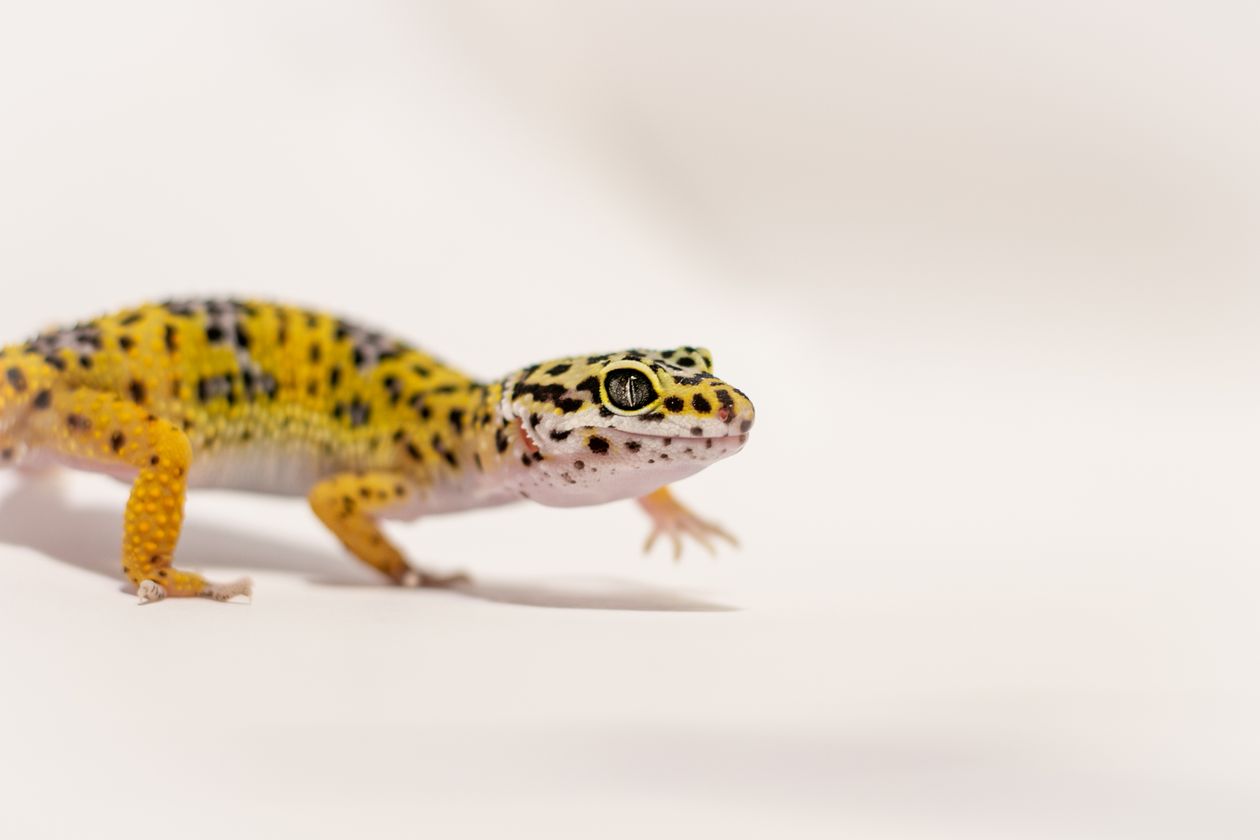
RSPCA describes leopard geckos as terrestrial animals adapted to dry scrubland and rocky/clay environments. Their functional map is horizontal: warm zone, cool zone, multiple secure hides and a humid microclimate for shedding.
| Design question | Crested | Leopard |
|---|---|---|
| Where is the valuable space? | Height + connected climbing routes | Ground footprint + protected thermal zones |
| Main cover | Leaves, cork, branches, elevated hides | Ground hides, rocks, low branches, tunnels |
| Main movement | Climbing, jumping, vertical travel | Walking, low climbing, moving between hides |
| Feeding position | Often elevated ledge | Ground-level feeding area / insect hunting |
2. Enclosure Size: Vertical Volume vs Floor Area
Care standards have moved beyond the old idea that a gecko should be kept in the smallest container it can survive in. ReptiFiles currently recommends at least 18 × 18 × 36 in for a juvenile/adult crested gecko above its hatchling threshold and at least 36 × 18 × 18 in for an adult leopard gecko, while larger enriched habitats are encouraged.
RSPCA gives smaller minimums in its UK care sheets, which demonstrates why you will see different numbers online. For a U.S. long-term setup, Patify uses the larger modern ReptiFiles targets because they provide more usable space for enrichment and environmental gradients.
Furniture test: a crested enclosure may take less floor length but more vertical wall/stand clearance; a leopard enclosure is lower but spreads across more horizontal surface. Measure the actual stand and lighting clearance before buying the animal.
For the leopard-gecko side, Patify’s leopard gecko tank setup guide maps the warm, cool and humid-hide zones in detail.

3. Temperature: The Two Enclosures Fail in Different Directions
Crested gecko
ReptiFiles’ current guide uses a mild warm zone around 82–85°F (28–29°C), a cooler lower zone around 70–75°F (21–24°C), and cooler nights. It specifically warns that prolonged temperatures above about 85°F can become dangerous.
The practical risk is overheating: a room that becomes hot in summer can push a crested enclosure beyond its comfortable range surprisingly quickly.
Leopard gecko
Leopard geckos need a substantially warmer ground-level thermogradient. ReptiFiles currently targets a basking surface around 94–97°F (34–36°C), a warm hide around 90–92°F, and a cooler end around 70–77°F. RSPCA uses a somewhat cooler 28–30°C basking-zone target, illustrating a real source difference in husbandry recommendations.
The common ground matters more than the exact number: leopard geckos require a protected warm zone and a real cool retreat. One uniform enclosure temperature is poor husbandry.
Thermostat rule
Any powered reptile heat source needs appropriate regulation and independent measurement. VCA notes that incorrect temperature and humidity gradients are common contributors to captive-reptile health problems.
4. Humidity: Whole-Enclosure Cycle vs Localized Humid Hide
Crested gecko
ReptiFiles currently recommends roughly 60–80% humidity after misting, followed by a drying cycle down toward about 40–50% before the next mist. Constantly wet conditions are not the goal; ventilation and drying reduce mold/mildew risk.
Leopard gecko
RSPCA uses roughly 30–40% ambient humidity for the enclosure while still requiring a separate humid hide. ReptiFiles similarly recommends dry ambient air with a high-humidity microclimate for shedding.
| Task | Crested | Leopard |
|---|---|---|
| Whole enclosure misting | Routine, monitored | Usually not used to keep entire enclosure humid |
| Dry-out period | Important | Ambient enclosure already relatively dry |
| Humid microclimate | Provided through enclosure humidity/cover | Dedicated humid hide is essential |
| Main beginner error | Keeping everything permanently wet or overheating during humid conditions | Running whole enclosure too damp or forgetting humid hide |
5. Diet: This Is Often the Lifestyle-Deciding Difference
Crested gecko: complete prepared diet can carry the nutritional foundation
ReptiFiles treats established nutritionally complete crested-gecko diets (CGD) as the staple feeding tool and adds appropriately sized live insects for enrichment, exercise and nutritional variety. This makes crested geckos unusual among reptiles: you can provide much of the nutritional foundation from a prepared powdered diet mixed with water.
RSPCA’s crested-gecko guidance is more whole-food oriented and does not recommend relying exclusively on CGD. That is a source difference worth acknowledging. For a U.S. owner, Patify follows the modern specialist approach of using a reputable complete CGD as the foundation while still incorporating suitable live insects and monitoring body condition.
Leopard gecko: insects are the job
VCA and ReptiFiles describe leopard geckos as insectivorous. Appropriate captive feeding uses live feeder insects such as crickets, roaches and other suitable species, with gut-loading and calcium/supplement management.
| Daily-life issue | Crested | Leopard |
|---|---|---|
| Can a complete prepared diet be foundational? | Yes, with reputable CGD | No equivalent powdered staple replaces appropriate insect feeding |
| Need to keep feeder insects? | Useful/strongly recommended, but lower routine dependence | Yes; central to feeding |
| Food spoilage issue | Mixed CGD must be removed/replaced appropriately | Uneaten insects should not remain indefinitely |
| Gut-loading/dusting | Applies to insects offered | Core routine for feeder insects |
If you strongly dislike keeping live insects in the home, that should weigh heavily against choosing a leopard gecko.
6. UVB and Lighting: “They Can Survive Without It” Is Not the Best Planning Standard
ReptiFiles recommends appropriate low-level UVB for both species as part of modern husbandry. VCA describes UVB as recommended for leopard geckos even though older care traditions often treated it as unnecessary.
Good setup design includes:
- a predictable day/night photoperiod;
- species-appropriate UVB strength and distance;
- shade and hides so the gecko can self-select exposure;
- no glass/plastic barrier blocking the UVB path;
- heat and UVB positioned to create a coherent usable basking zone.
Do not copy bulb wattage or UVB percentage without considering fixture, mesh obstruction and distance to the animal.
7. Handling: Both Can Be Handleable, but They Move Differently
Crested gecko
Crested geckos can be calm with patient handling but are built to jump between branches. Their adhesive toe pads let them climb vertical surfaces, and a startled animal can leap unexpectedly. Handling is therefore more about controlled hand-to-hand movement than holding the animal still.
Leopard gecko
Leopard geckos are ground-oriented and cannot stick to vertical glass. Many become steady, manageable reptiles with calm repeated handling, but they can still bolt, tail-drop or bite when frightened.
Handling rules for both
- support the body rather than restraining tightly;
- handle low over a safe surface at first;
- never grab the tail;
- let the animal walk between hands;
- end sessions before obvious escape behavior escalates;
- wash hands after reptile contact and enclosure cleaning.
8. Tail Drop: One Regrows, One Does Not
This is a surprisingly important difference.
Crested gecko
ReptiFiles states that crested geckos can drop the tail as a defense response and the tail does not grow back. A tailless adult can live normally, but the original semi-prehensile climbing tail is permanently gone.
Patify’s crested gecko tail-drop guide covers recovery and infection red flags.
Leopard gecko
Leopard geckos can also autotomize the tail, but ReptiFiles notes that it regrows. The regenerated tail is usually shorter, smoother or differently shaped/colored than the original.
Because a leopard gecko stores meaningful energy reserves in the tail, tail loss still matters; regeneration does not make careless handling acceptable.
9. Cleaning and Maintenance: Different Chores, Similar Need for Consistency
Crested enclosure
Expect regular misting/humidity checks, wiping glass, removing old CGD, managing plant/substrate moisture, cleaning elevated feeding ledges and watching for mold in dense décor.
Leopard enclosure
Expect spot-cleaning feces, maintaining the humid hide, removing uneaten feeders, checking dry substrate, monitoring multiple hides and maintaining thermal surfaces.
Crested workload feels like: managing a small humid vertical ecosystem.
Leopard workload feels like: managing a dry terrestrial thermal map plus a live-insect pantry.
Neither is “set it and forget it.”

10. Lifespan: Both Are Long-Term Pets
ReptiFiles lists crested geckos at roughly 15–20 years. RSPCA also gives up to around 15–20 years in captivity. Leopard-gecko estimates vary: VCA gives roughly 10–15 years with good care, while RSPCA notes they can live up to about 20 years.
The practical conclusion is the same: either animal can remain with you through moves, school/work changes and major life transitions. Do not buy one as a short-lived “starter pet.”
11. Cost: Do Not Compare Only the Gecko Price
There is no useful universal U.S. annual dollar figure because enclosure brands, electricity rates, feeder-insect prices, bioactive materials and veterinary fees vary. Compare the recurring cost pattern instead.
| Cost category | Crested | Leopard |
|---|---|---|
| Enclosure | Tall front-opening enclosure | Long terrestrial enclosure |
| Heat | Usually lower-output but may still require controlled heat | Stronger basking/ground thermal system |
| Humidity equipment | Sprayer/misting + hygrometer; more moisture-tolerant décor/substrate | Humid hide materials + dry ambient monitoring |
| Food | Complete CGD + some insects | Ongoing live-feeder colony/purchases + supplements |
| Décor | Heavy vertical branch/foliage investment | Multiple hides + stable rock/low-climb structure |
| Veterinary | Reptile/exotics veterinarian | Reptile/exotics veterinarian |
12. Lifestyle-Fit Matrix
| Your constraint | More natural fit | Why |
|---|---|---|
| You dislike keeping many live feeder insects | Crested gecko | Complete CGD can form the nutritional foundation |
| You want a terrestrial display with rocks/hides | Leopard gecko | Ground-dwelling ecology |
| You have more vertical than horizontal furniture space | Crested gecko | Tall enclosure uses vertical volume |
| Your room regularly becomes very hot in summer | Neither without climate control | Crested geckos are especially heat-sensitive; leopard geckos still need controlled gradient |
| You enjoy live feeding and hunting behavior | Leopard gecko | Insect feeding is central to routine |
| You prefer planted/tropical-style habitat maintenance | Crested gecko | Humidity and arboreal clutter suit that design |
| You prefer a dry enclosure with a local humid zone | Leopard gecko | Matches arid husbandry pattern |
| You are anxious about permanent tail loss | Leopard gecko | Tail can regenerate, although loss is still stressful and significant |
This matrix describes husbandry fit, not which animal is “better.” A poorly matched easy species becomes difficult; a well-researched species becomes predictable.
13. Minimum Planning Checklist Before You Buy Either Gecko
Crested gecko checklist
- tall adult enclosure planned before purchase;
- thermostat-controlled heat if room temperature does not provide safe gradient;
- digital temperature/humidity monitoring;
- low-level UVB setup with correct distance;
- dense horizontal + vertical branches and foliage;
- elevated feeding ledge;
- reputable complete CGD;
- appropriate feeder-insect source;
- reptile-vet contact;
- summer overheating plan.
Leopard gecko checklist
- at least modern adult floor-space target planned;
- thermostat-controlled basking/warm zone;
- independent surface/air temperature measurement;
- low-level UVB and shade;
- warm hide + cool hide + humid hide;
- safe substrate plan;
- multiple feeder-insect species/source;
- gut-load + supplement system;
- reptile-vet contact;
- backup plan when feeder insects are unavailable.
For flooring decisions, use Patify’s leopard gecko substrate guide; it separates quarantine/health-monitoring floors from naturalistic soil-sand setups rather than declaring one material universally correct.
Health Errors Often Start as Husbandry Errors
Merck and VCA both emphasize that reptile health is tightly connected to enclosure temperature, humidity, lighting, sanitation and nutrition. This is why choosing the species whose routine you will actually maintain matters more than choosing the species with the prettier morph.
Crested-gecko warning patterns
- persistent overheating;
- constant saturation with poor ventilation;
- chronic low appetite/weight loss;
- calcium/UVB imbalance;
- unsafe falls or tail trauma.
Leopard-gecko warning patterns
- inadequate basking temperatures;
- no humid hide / repeated retained shed;
- poorly gut-loaded or unsupplemented insects;
- obesity from energy-dense feeders;
- unsafe loose substrate combined with poor husbandry.
Any persistent appetite loss, progressive weight loss, marked lethargy, abnormal gait, swelling, severe shedding problem or breathing change deserves evaluation by a reptile/exotics veterinarian.
14 Common Crested-vs-Leopard Gecko Comparison Mistakes
- “Both are geckos, so their tanks are basically the same.”
- Using tank gallons instead of usable dimensions.
- Calling crested geckos room-temperature pets without checking actual room temperatures.
- Running a crested enclosure permanently wet.
- Running a leopard enclosure uniformly dry with no humid hide.
- Assuming leopard geckos can live on mealworms alone.
- Assuming crested geckos never need insects because CGD exists.
- Using identical UVB/heating hardware for both species without measuring output.
- Buying a vertical enclosure for a leopard gecko because it has more gallons.
- Buying a long low aquarium for a crested gecko and wasting its arboreal behavior.
- Grabbing either gecko by the tail.
- Assuming a regenerated leopard-gecko tail will look original.
- Assuming a crested-gecko tail will regenerate.
- Choosing by morph price before pricing the complete habitat.
Frequently Asked Questions About Crested and Leopard Geckos
Which is easier to care for, a crested gecko or leopard gecko?
Both can be manageable for a well-prepared keeper, but the work is different. Crested geckos demand vertical habitat and humidity-cycle management; leopard geckos demand precise terrestrial heating and routine live-insect feeding.
Which needs a bigger enclosure?
They need differently shaped space. ReptiFiles currently uses about 18 × 18 × 36 in as an adult crested-gecko minimum and 36 × 18 × 18 in as an adult leopard-gecko minimum. One is vertical; the other prioritizes floor area.
Which needs higher humidity?
Crested geckos. Leopard geckos generally need dry ambient air plus a localized humid hide rather than a humid whole enclosure.
Which needs more heat?
Leopard geckos require a substantially hotter basking/warm area. Crested geckos need a milder gradient and are more vulnerable to dangerous overheating.
Which eats fewer insects?
Crested geckos can use a reputable complete crested-gecko diet as the nutritional foundation, with insects added. Leopard geckos are insectivores and live insects are central to the diet.
Can crested geckos eat only powdered diet?
Some complete commercial diets are formulated as nutritional staples, but current specialist care still values appropriate insects for enrichment and dietary variety. Follow the exact product instructions and monitor body condition.
Can leopard geckos eat fruit?
No routine fruit-based diet is appropriate. Leopard geckos are insectivorous and should be fed suitable live prey with correct gut-loading and supplementation.
Which is better for handling?
Both can become handleable. Crested geckos are more likely to jump/climb vertically; leopard geckos tend to move across hands and surfaces. Individual temperament matters.
Do crested geckos bite?
They can bite when frightened or defensive, although handling problems more commonly involve jumping/escape. Any reptile can resist handling.
Do leopard geckos bite?
They can, particularly if frightened, food-excited or restrained. Calm voluntary handling reduces risk.
Do crested gecko tails grow back?
No. Once a crested gecko drops its tail, it remains tailless.
Do leopard gecko tails grow back?
Yes, but the replacement tail is usually different in shape, texture and/or coloration from the original.
Which is better for an apartment?
Both are quiet compared with many mammals/birds, but enclosure footprint, feeder-insect storage, humidity and room temperature matter more than noise. Check landlord rules for reptiles as well.
Can either gecko live with another gecko?
Solo housing is the safer default. Cohabitation can create competition, mating pressure, bullying and injury that owners may miss until weight loss or tail damage occurs.
Which lives longer?
Both are long-lived. Crested geckos are commonly cited around 15–20 years; leopard gecko sources commonly cite about 10–20 years depending care and source.
Which is cheaper?
There is no universal winner. Crested setups spend more on vertical habitat/humidity structure and prepared diet; leopard setups carry ongoing live-feeder and heating costs. Veterinary and enclosure quality dominate lifetime cost more than the gecko’s purchase price.
Sources Checked for This Guide
- ReptiFiles — Crested Gecko Care Manual: updated May 12, 2026; biology, size, lifespan, climbing and tail regeneration.
- ReptiFiles — Crested Gecko Terrarium Size: current adult enclosure target and arboreal space use.
- ReptiFiles — Crested Gecko Temperature & Humidity: heat gradient, overheating risk and humidity cycling.
- ReptiFiles — Crested Gecko Food: complete CGD and live-insect feeding framework.
- ReptiFiles — Crested Gecko Tail Loss: autotomy and non-regeneration.
- ReptiFiles — Leopard Gecko Care Manual: terrestrial ecology, insectivory, eyelids and tail regeneration.
- ReptiFiles — Leopard Gecko Enclosure Size: modern adult floor-space target.
- ReptiFiles — Leopard Gecko Temperature & Humidity: current basking, cool-end and humid-hide guidance.
- RSPCA — Leopard Gecko Care: terrestrial habitat, humidity, live feeding and husbandry.
- RSPCA — Crested Gecko Care: arboreal housing, lifespan, humidity and diet.
- VCA Animal Hospitals — Leopard Geckos: Care and Feeding: adult size, lifespan, insect diet, calcium and UVB recommendation.
- Merck Veterinary Manual — Selecting a Reptile: updated June 2026; long-term care and housing commitment.
- Merck Veterinary Manual — Reptile Husbandry: environmental gradients, humidity and reptile management principles.
- Pexels — crested gecko cover image
- Pexels — leopard gecko support image
- Pexels — crested gecko support image
- Pexels License
Editorial note: this comparison uses current species-specific husbandry sources and deliberately highlights source differences where enclosure or temperature recommendations vary; images are constrained with responsive max-width, clamp-based height and object-fit rules for both mobile and desktop. Sources were reviewed September 29, 2026.