
Last updated: September 24, 2026
Use this page as an identification atlas, not a DNA test. Leopard gecko appearance comes from several different kinds of inheritance: simple recessive traits, incomplete-dominant traits, eye traits, pattern traits and long-running line-bred color projects. Two geckos can look similar for completely different genetic reasons, and a gecko can carry hidden recessive traits that are invisible in every photograph.
Rule 1 — phenotype: describe what you can actually see.
Rule 2 — genotype: confirm hidden genetics from parentage/breeder records, not color alone.
Rule 3 — strain: never guess Tremper vs Bell vs Rainwater Albino solely from one photo.
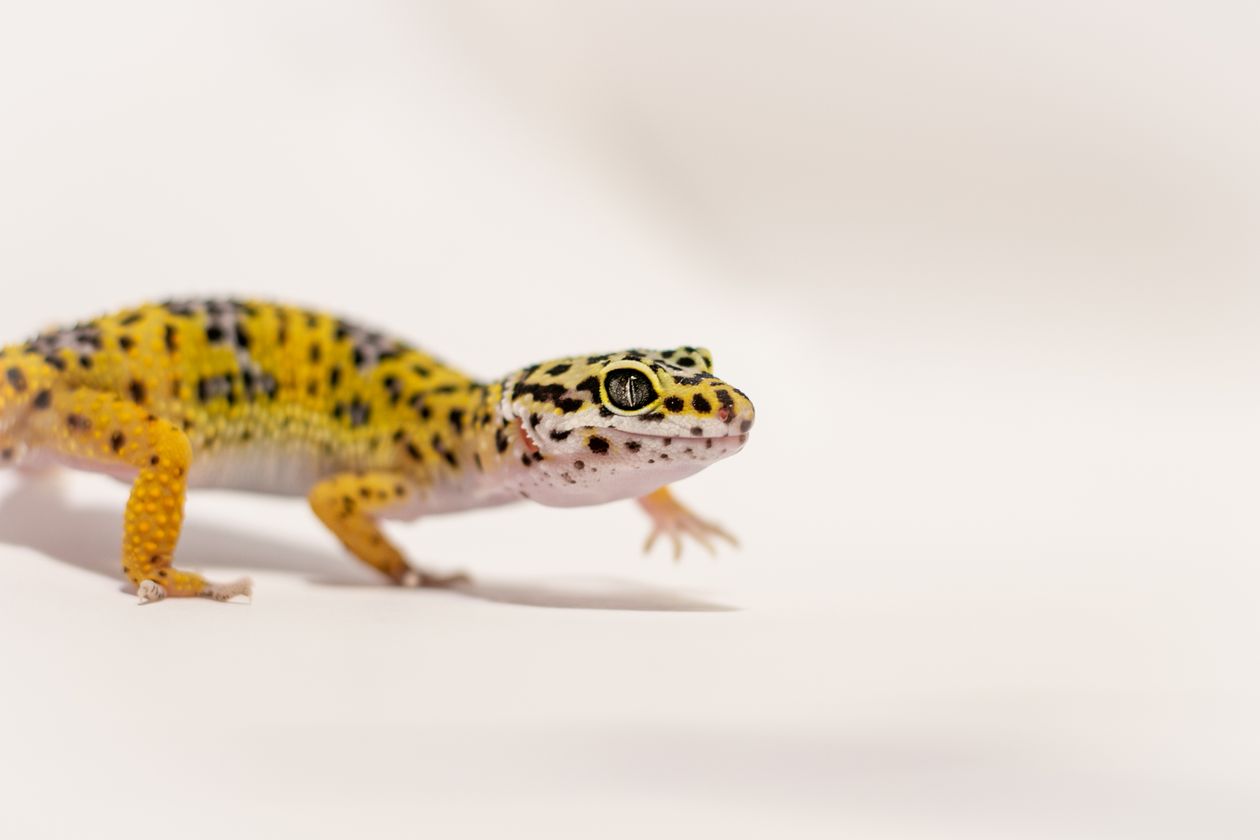
Morph Family Map: First Decide What Kind of Trait You Are Looking At
| Family | Examples | Main visual change | Photo confidence |
|---|---|---|---|
| Albino strains | Tremper, Bell, Rainwater | Reduced/altered melanin; brown/lavender rather than normal black pigment | Medium for “albino,” low for exact strain |
| Snow system | Mack Snow, Mack Super Snow | Reduced yellow / high-contrast hatchling pattern; Super Snow develops characteristic spotting and often dark eyes | Medium–high with age/history |
| Patternless traits | Blizzard, Murphy Patternless | Greatly reduced or absent normal body pattern | Medium; combinations blur the distinction |
| Eye traits | Eclipse, snake-eye expression | Solid or partially pigmented eyes; pied feet can accompany Eclipse | Medium; look-alikes exist |
| Line-bred color/pattern | Tangerine, Black Night, Super Hypo, Carrot Tail, Baldy, Bold projects | Intensity of orange, darkness, spot reduction, tail color or pattern quality | High for description, low for exact bloodline |
| Combination names | RAPTOR, Radar, Typhoon, Diablo Blanco | Multiple inherited traits stacked into one project name | Low without lineage |
| Welfare-linked morphs | Lemon Frost, Enigma | Distinct appearance plus known/reported health concerns | Identification is secondary to welfare history |
Confidence key: “High” means appearance can strongly support a phenotype label; it still does not reveal hidden hets or prove a named breeder line. “Low” means lineage is essential.
Look-Alike Lab #1: Tremper vs Bell vs Rainwater Albino
Leopard geckos have three widely recognized captive albino strains: Tremper, Bell and Rainwater. Current specialist breeder inventories still list all three as separate categories, and GeckoBoa's genetics overview likewise treats them as distinct albino strains.
Tremper Albino
Common in the hobby and used in many combination projects such as RAPTOR, Blazing Blizzard and Diablo Blanco. Pigment that would normally be black is typically brown, lavender or tan.
Bell Albino
Another independently maintained albino strain. Current breeder catalogs separate Bell projects from Tremper and Rainwater projects rather than treating “albino” as one interchangeable gene.
Rainwater Albino
Also called Las Vegas Albino in older hobby literature. Current breeder inventories still maintain Rainwater projects separately, including Typhoon and Rainwater Patternless combinations.
Do not identify the strain from eye shade or “this one looks pinker.” Experienced current MorphMarket discussions explicitly note that the three albino strains cannot be reliably separated by appearance alone. If the breeder record is missing, the defensible label may simply be albino, strain unknown.
That distinction matters most if breeding is ever considered. A pet owner does not need to “prove” the strain to provide correct daily husbandry.
Look-Alike Lab #2: Mack Snow vs Mack Super Snow
Mack Snow is one of the cleaner examples of an incomplete-dominant leopard gecko trait in current breeder practice. A single-copy Snow bred to a non-Snow animal is expected to produce a mix of Snow and non-Snow offspring; Snow × Snow can produce normal, Snow and double-copy Super Snow offspring.
Classic Snow × Snow expectation: approximately 25% non-Snow, 50% Mack Snow, 25% Mack Super Snow under the simple single-trait model.
| Feature | Mack Snow | Mack Super Snow |
|---|---|---|
| Genetic state | Single-copy Snow phenotype | Double-copy / “super” phenotype |
| Hatchling look | Often reduced yellow and strong black/white contrast | Very high-contrast black/white pattern |
| Adult pattern | Variable; yellow can increase with age | Frequently dense spotting over pale ground color |
| Eyes | Not defined by solid black eyes | Often solid dark/black eyes |
| Major ID trap | Can overlap with other “snowy” or pale projects | Solid dark eyes can be confused with Eclipse expression |
That last point is important: current breeder discussions specifically warn that Super Snow can show solid dark eyes even when Eclipse is not present. “Black eye = Eclipse” is therefore not a safe one-step rule.
Look-Alike Lab #3: Blizzard vs Murphy Patternless
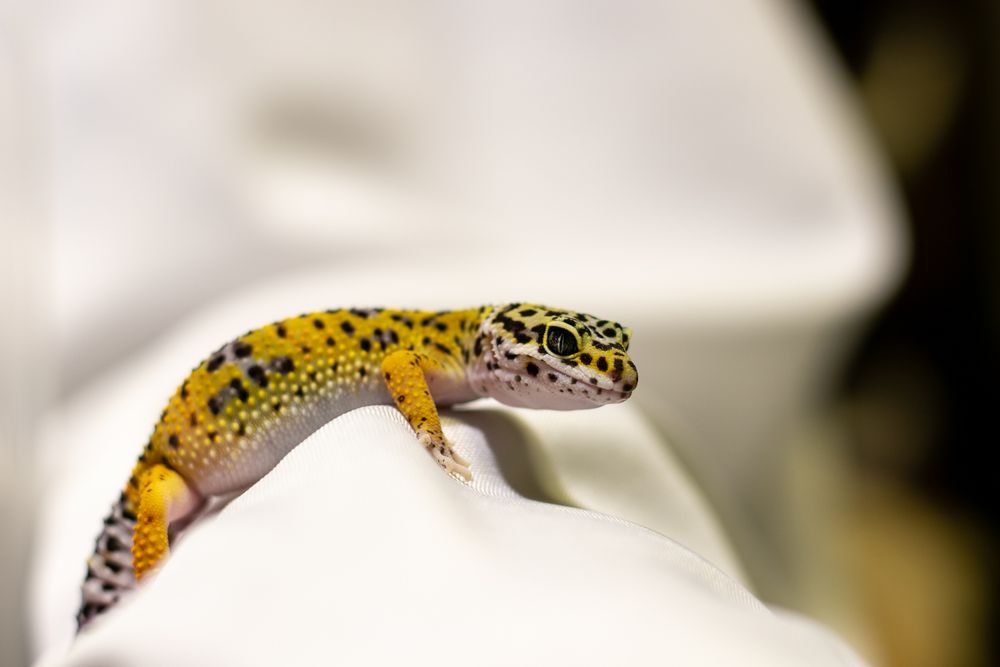
Blizzard and Murphy Patternless are both established pattern-reducing morph categories in current breeder catalogs, but they are genetically distinct projects.
| Question | Blizzard | Murphy Patternless |
|---|---|---|
| Adult impression | Typically very uniform, often gray, lavender, white or pale yellow depending on combinations | Patternless adult appearance that can carry more tan/yellow/brown tone |
| Hatchling clues | Already strongly reduced pattern | Young animals can show pattern that fades substantially as they mature |
| Common combinations | Blazing Blizzard, Diablo Blanco, Mack Snow Blizzard | Patternless Albino, various Patternless combinations |
| Can one adult photo prove it? | No. Lineage and hatchling/history photos are far more useful when appearance overlaps. | |
The Eclipse Eye Trait: Strong Clues, but Not a One-Photo Genotype Test
Eclipse is widely treated in leopard gecko breeder genetics as a recessive eye/pigmentation trait. Visual expression can include solid eyes or partial “snake eye” pigmentation, and hobby identification often also uses pied/white feet as a supporting clue.
Three reasons to stay cautious:
- Super Snow can create very dark eyes without Eclipse;
- eye photographs change with pupil size, angle and lighting;
- a gecko can be het Eclipse with no visible Eclipse eye phenotype.
If the listing says “100% het Eclipse,” that information must come from the pairing/parentage—not from the eye photo.
Line-Bred Traits: Tangerine, Black Night, Super Hypo, Carrot Tail and Baldy
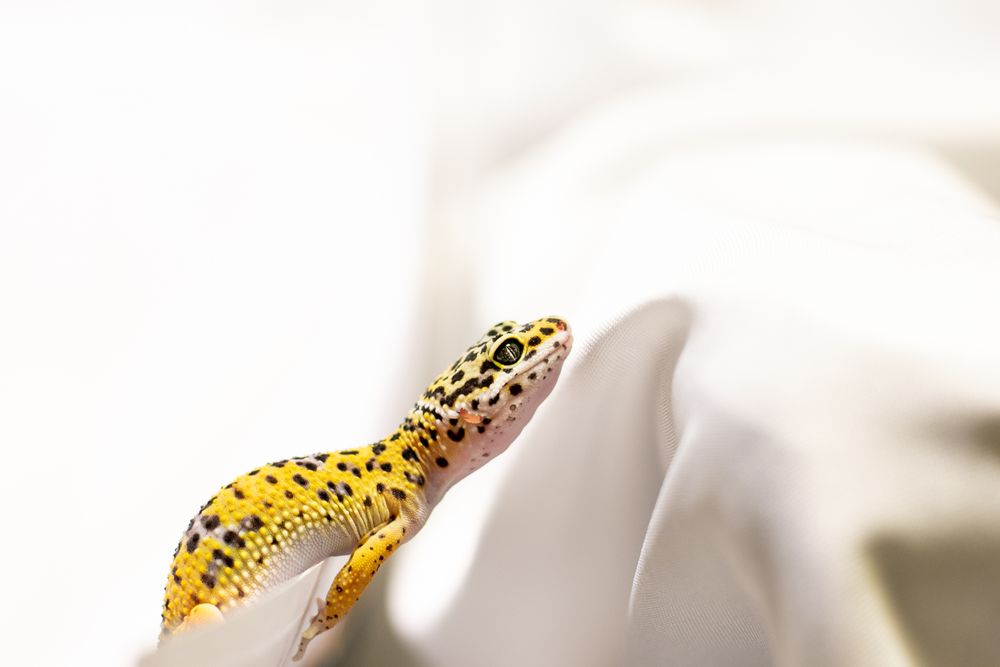
Not every familiar morph name follows a neat Punnett-square ratio. Current breeder discussions repeatedly distinguish line-bred / polygenic traits from simple Mendelian traits.
| Descriptor | What it usually means visually | Genetics caution |
|---|---|---|
| Tangerine | Selected orange body coloration | Intensity is line-bred; different breeder lines can be crossed and vary widely |
| Super Hypo | Strong reduction of dorsal body spotting | Phenotypic/line-bred threshold rather than a simple hidden recessive test |
| Baldy | Reduced/absent head spotting | Line-bred appearance descriptor |
| Carrot Tail | Strong contiguous orange pigment on part of the tail | Line-bred; quality/intensity varies |
| Black Night | Very dark/melanistic selected line | Current breeder discussions describe inheritance as polygenic/polymorphic rather than a predictable single-gene ratio |
This is why a “Black Night × normal” calculator cannot honestly promise a simple percentage of jet-black babies. Current 2026 MorphMarket community discussion explicitly notes that Black Night appearance depends heavily on the line and ancestry.
Combination-Name Decoder: What RAPTOR, Radar, Typhoon and Diablo Blanco Are Trying to Tell You
Combination names compress several traits into a single marketplace label. They are useful shorthand only if you know the components.
RAPTOR
Traditionally built around Tremper Albino + Eclipse with selected orange/pattern traits; current marketplace usage is not perfectly uniform.
Radar
Common breeder shorthand for a Bell Albino + Eclipse project.
Typhoon
Common breeder shorthand for a Rainwater Albino + Eclipse project.
Diablo Blanco
Commonly described as Tremper Albino + Blizzard + Eclipse, often producing extremely pale pattern-reduced animals with striking eyes.
Current Geckos Etc. inventory still separates Bell, Rainwater, Tremper, Blizzard, Eclipse and combination animals into distinct active categories, which is useful for seeing how these names are used in today's market.
Morphs With Welfare Flags: Appearance Is Not the Whole Story
Lemon Frost: strong modern evidence of tumor risk
Lemon Frost is the clearest welfare warning in this atlas because the evidence goes far beyond breeder anecdotes. Genetic work identified the Lemon Frost color mutation as a semi-dominant trait associated with iridophoroma. In a breeding colony of more than 900 animals, published research reported that more than 80% of animals carrying the Lemon Frost allele developed white tumors, with severe disease and metastasis documented in some animals.
Follow-up research published in 2025–2026 has continued to document iridophoroma clinical complications and genomic changes in Lemon Frost tumors. A buyer should therefore treat Lemon Frost history as a health issue, not merely an unusual white-color project.
Patify position for this guide: do not recommend or normalize Lemon Frost breeding as an aesthetic project; the documented tumor predisposition is too important to hide behind morph photography.
Enigma: neurologic concern, but the evidence base is less complete
Enigma-line leopard geckos have long been associated with neurologic signs described as Enigma Syndrome, including circling, head tilt, abnormal upward head posture, incoordination and difficulty catching prey. Veterinary-facing sources and a 2023 descriptive welfare assessment discuss the syndrome, while a 2025 German veterinary review identifies Enigma Syndrome as a breeding-associated disorder.
The evidence is not equivalent to the Lemon Frost genetics literature: the molecular basis, penetrance and full natural history are not established by comparable large modern genetic studies. That uncertainty is a reason to be more careful—not a reason to dismiss affected animals.
Any leopard gecko showing circling, seizures, persistent head tilt, inability to aim at prey or other neurologic signs should be evaluated by a reptile veterinarian because infection, trauma, metabolic disease and other conditions can mimic parts of the picture.
The 6-Photo Morph ID Protocol
If you want useful help identifying a pet-store or rescue leopard gecko, one filtered phone picture is not enough. Take:
- Top-down full body — shows stripe, band, spot and hypo pattern.
- Left side in neutral daylight — shows body color and tail pigment.
- Right side — catches asymmetric pattern and pied-foot clues.
- Both eyes close-up — needed for Eclipse/snake-eye questions and to document eye color.
- Feet and toes — useful for Eclipse-supporting pied-foot observations and general health.
- Hatchling photo or breeder record if available — crucial for patternless traits and strain identification.
Use neutral white balance and avoid saturation filters. A gecko's shed stage and lighting can make orange, lavender and gray look dramatically different.
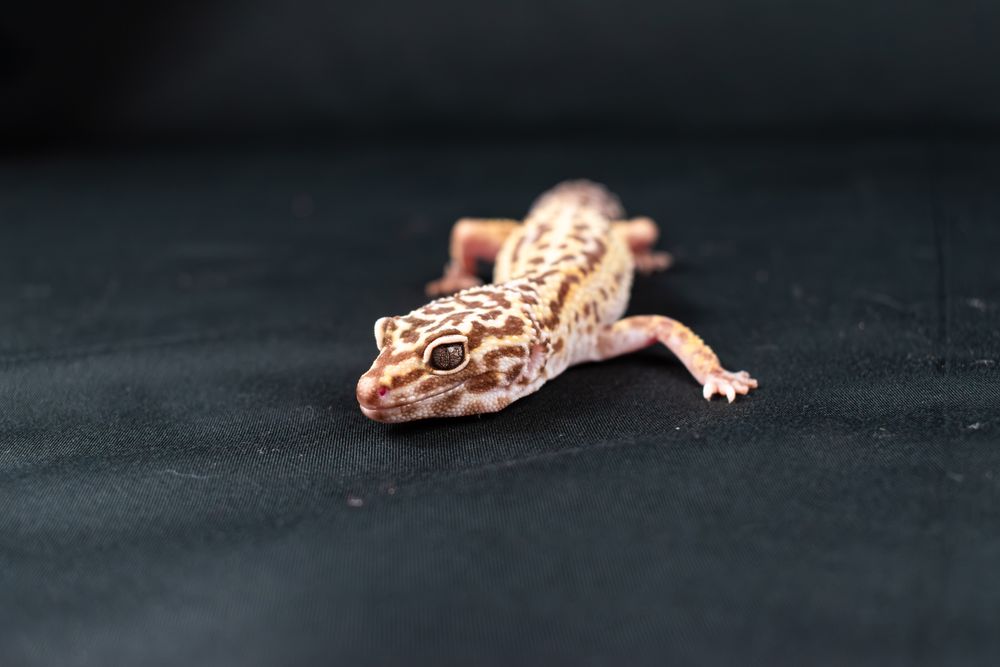
Labeled Visual Atlas: Current Examples Without Rehosting Breeder Photos
Pexels images are excellent for licensed general leopard-gecko photography, but they do not come with reliable genotype records. For morph comparison, use current breeder/market pages as labeled examples and remember that the labels are supplied by the breeder/seller rather than independently DNA-tested by Patify.
| Trait / family | Current labeled reference | What to study |
|---|---|---|
| Tremper Albino | Geckos Etc. — Tremper Albino inventory | Range of pigment and combination effects |
| Bell Albino | Geckos Etc. — Bell Albino | Why “albino” appearance overlaps across strains |
| Rainwater Albino | Geckos Etc. — Rainwater Albino | Rainwater projects and Typhoon-type combinations |
| Blizzard | Geckos Etc. — Blizzard | Pattern reduction across combinations |
| Tangerine | Geckos Etc. — Tangerine | How broad line-bred orange intensity can be |
| White & Yellow | Geckos Etc. — White & Yellow | Trait combined with Bell, Eclipse, Snow and pattern projects |
Listing Decoder: Turn a Long Morph Name Into Separate Claims
Example listing: “Tangerine Tremper Albino Eclipse, 100% het Blizzard”
Tangerine → line-bred orange color.
Tremper Albino → visually expressed albino strain claimed from lineage.
Eclipse → visually expressed eye/pigmentation trait.
100% het Blizzard → hidden carrier claim based on parentage; not visible in the photo.
Five questions to ask before trusting the label
- Which traits are visual?
- Which traits are het / possible het?
- What were the sire and dam?
- Is the name a simple genetic trait, a line-bred color project or a combination nickname?
- Is there any welfare-linked ancestry such as Lemon Frost or Enigma?
Does Morph Change Normal Leopard Gecko Care?
For most common morphs, the core care system is the same: adequate terrestrial floor area, warm/cool gradient, humid hide, low-level UVB with shade, appropriate livefood and supplements, safe substrate and solitary housing.
Use Patify's leopard gecko tank setup for the environment and the leopard gecko substrate guide for floor choice.
Pale or red-eyed animals may appear more light-sensitive individually, so the answer is not “remove UVB.” Provide the normal low-UVI gradient, abundant shade and hides, then adjust with reptile-veterinary guidance if an individual shows genuine light intolerance or ocular disease.
Atlas Summary: What You Can Safely Name From a Photo
| Observation | Reasonable description | What you should not claim |
|---|---|---|
| Reduced black pigment, brown/lavender markings | “Albino phenotype likely” | Exact Tremper/Bell/Rainwater strain without records |
| Dense black spotting, pale ground, very dark eyes | “Super Snow-like phenotype” | Eclipse solely because eyes are dark |
| Uniform pale/lavender body | “Patternless phenotype” | Blizzard vs Murphy Patternless without history |
| Very orange body | “Strong tangerine/orange phenotype” | Exact Tangerine bloodline |
| Solid/partial dark eye | “Eclipse-like ocular pigmentation” | Hidden hets or complete genotype |
| Very dark body | “Melanistic / Black Night-like appearance” | Black Night bloodline without pedigree |
The safest morph ID is sometimes intentionally incomplete. “Albino, strain unknown” is better information than confidently inventing Tremper ancestry from a pet-store photograph.