Dog Food Protein: How to Compare Labels, Dry Matter, and Calories
An evidence-led U.S. guide to protein quality, amino acids, wet-versus-dry calculations, and choosing a complete diet — without treating the biggest percentage as the best food.
By Patify Editorial Research Team · Updated October 16, 2026 · United States

A bag promising 32% protein can seem like a better choice than one promising 25%. Then you pick up a can that says 9% and wonder whether it contains hardly any protein at all. Those numbers look straightforward, but they are describing products with different amounts of water, different calorie densities, and different formulations. None of them tells you by itself whether the food will meet your dog's needs.
Protein matters enormously. Dogs use amino acids from dietary protein to maintain muscle, make enzymes, support tissues and carry out countless other functions. Yet buying dog food by choosing the largest crude-protein number can lead you in the wrong direction. The more useful questions are whether the diet is complete for your dog's life stage, whether its protein is appropriately supplied and digestible, and how much protein the dog actually receives in relation to energy intake.
This guide gives you a repeatable method. We will translate the label, compare three completely fictional foods on two different bases, show which information a food manufacturer can provide beyond the package, and explain when a veterinarian should take over the decision. There is no brand ranking or invented feeding trial here. If you have a package in hand, you can follow the same process while reading.
The short answer: Start with the nutritional adequacy statement, not the crude-protein number. Use dry-matter conversion to account for water and grams per 100 kcal to account for energy. Treat guaranteed-analysis calculations as estimates, since the stated protein figure is normally a minimum rather than a typical value. A higher number is not proof of better protein quality or a healthier food.
What protein actually does for a dog
A dog's body is constantly breaking down and rebuilding proteins. Muscle tissue is a familiar example, but proteins also form enzymes involved in metabolism, transport molecules, parts of immune defenses, and components of skin and other tissues. A growing puppy needs protein to build new tissue; an adult dog needs an ongoing supply to maintain and repair it. The relevance of protein does not end when a dog reaches adulthood.
The body does not simply absorb a whole piece of chicken or a percentage printed on a package and turn it directly into muscle. During digestion, dietary proteins are broken into smaller peptides and amino acids, which can then be absorbed and used according to the dog's needs. Some amino acids are considered essential because the dog cannot synthesize adequate amounts and must receive them through food. This is why the pattern of amino acids in a formulated food matters in addition to the total amount of protein.
Protein is also an energy-containing nutrient. But the goal of feeding a complete diet is not to deliver the greatest amount of any one nutrient in isolation. It is to supply essential nutrients in useful proportions while providing an appropriate amount of energy. A highly concentrated food fed in generous portions can contribute to weight gain even if its front label emphasizes lean muscle or athletic performance. Conversely, a diet that provides too few calories may also provide too little total protein because the dog is eating an insufficient quantity of the food.
The Pet Food Institute's protein overview describes both animal and plant protein ingredients, although it is an industry organization rather than an independent veterinary regulator. For a consumer, its most useful takeaway is the distinction between protein sources and the essential amino acids the finished food must provide. Assess the whole formula before assigning virtue or blame to one ingredient.
Protein requirements are not one percentage for every dog
Puppies, adult dogs, pregnant or nursing dogs, and dogs under veterinary treatment do not all have identical nutritional requirements. Life-stage nutrient profiles account for some of those differences. A food labeled for adult maintenance is not automatically suitable for growth, and a product designed for intermittent or supplemental feeding is not an everyday replacement for a complete diet.
You may see reference numbers from AAFCO nutrient profiles quoted online. Those are formulation benchmarks under specified assumptions, not a personalized target printed for your dog and not a command to buy the product with the highest guaranteed-analysis percentage. Feeding-trial substantiation and nutrient-profile formulation are distinct methods of supporting nutritional adequacy claims. If you want to understand which method a product uses, the statement on the package provides the starting point.
Start here: read the nutritional adequacy statement
Before comparing protein, turn the bag, tray or can around and look for its nutritional adequacy statement. In the United States, this statement helps answer the question that matters before all the others: is this product intended to serve as a complete diet for a particular life stage? The AAFCO label-reading guide explains where to find the statement and what its standard language means.
A diet described as formulated to meet the AAFCO Dog Food Nutrient Profiles for adult maintenance has a different purpose from one substantiated for growth, reproduction or all life stages. An all-life-stages claim also needs careful reading where large-size puppies are concerned: check the exact wording about growth of large-size dogs rather than deciding from the word puppy on the front panel. Diets for veterinary management may also have specific instructions that cannot be replaced by a general consumer checklist.
What if the food says only "for supplemental feeding"? That phrase signals that it is not intended to provide complete everyday nutrition on its own. A protein-rich meat topper, jerky treat or single-ingredient pouch can still be useful in its intended role, but its protein percentage should not be compared with a complete meal as though they were interchangeable products.
The FDA's explanation of complete and balanced foods is particularly helpful here: a label's feeding-trial or nutrient-profile wording is more meaningful evidence of adequacy than a marketing endorsement on the front. AAFCO does not itself certify or individually approve a bag of food. The label represents the responsible manufacturer's claim under applicable rules.
| What the label says | What it helps establish | What it does not establish |
|---|---|---|
| Complete and balanced for adult maintenance | The product is intended as a complete adult diet | Ideal for every puppy or a dog with medical needs |
| Complete and balanced for growth or all life stages | The product's claimed nutritional purpose includes growth, subject to precise wording | Automatic suitability for every large-size growing dog |
| Intermittent or supplemental feeding only | The product is meant to accompany, not replace, a complete diet | A safe sole ration because its crude protein is high |
| High protein, real meat first, performance blend | A marketing or product-characteristic claim worth examining | Independent proof of quality, digestibility or clinical benefit |
What does “crude protein” mean on a dog food label?
Most U.S. pet food packages display a guaranteed analysis with minimum crude protein and crude fat, plus maximum crude fiber and moisture. The word crude refers to the analytical method used to estimate protein from nitrogen content, not to a judgment that the ingredient is rough, unrefined or low quality. AAFCO's nutritional-labeling information also emphasizes that the guarantee is set to account for real variation between batches.
A label that says crude protein (minimum) 26% promises a minimum under the relevant regulatory framework; it does not say the average nutrient content of every bag is precisely 26%. A second food labeled 28% minimum might actually have a fairly similar typical protein level to the first. One minimum cannot reveal digestibility, individual amino acid amounts, or manufacturing consistency. Think of the number as a regulated floor, not a full nutritional portrait.
Ingredients and nutrient guarantees also describe different things. The ingredient statement lists ingredients in descending order by weight at formulation, with moisture in raw ingredients affecting that order. The guaranteed analysis expresses selected nutrient quantities for the finished product. A meat-first recipe can contain plant protein too; a food using poultry meal can still be formulated to provide adequate nutrition. Neither of those truths makes a particular food good or bad without evaluating its full nutrient profile.
Why a wet food's 9% protein can be misleading
Imagine a canned diet with 9% protein and 76% moisture, and a dry diet with 25% protein and 10% moisture. If you compare 9 against 25, you are mainly comparing products with strikingly different water content. Removing water mathematically gives you a fairer common basis. It does not magically reveal how much protein is absorbed, but it fixes the most obvious comparison problem.
The FDA dry-matter explanation makes precisely this point about different-moisture foods. For products with similar moisture levels, comparing guarantees may be a useful initial screen. For wet against dry, conversion is more informative. And for feeding decisions affected by calories, there is still another step after dry-matter calculation.
Calculate dry-matter protein: a practical example
The arithmetic is simple enough for a phone calculator. Subtract the label's moisture percentage from 100 to estimate the percentage that is dry matter. Divide the protein percentage by that dry-matter percentage, then multiply by 100. Use percentages as numbers here, not as decimals: for example, 25 divided by 90 times 100.
Dry matter (%) = 100 − moisture (%).
Protein on a dry-matter basis (%) = labeled crude protein (%) ÷ dry matter (%) × 100.
Consider three invented dog foods. These are teaching examples, not named products, laboratory measurements or buying recommendations. They deliberately use round numbers and a single hypothetical package for each format so you can check every step yourself.
| Fictional example | Crude protein minimum, as-fed | Moisture maximum | Calculated dry matter | Calculated protein on dry-matter basis |
|---|---|---|---|---|
| A: Everyday dry kibble | 25% | 10% | 90% | 27.8% |
| B: Complete canned meal | 9% | 76% | 24% | 37.5% |
| C: Soft-moist complete food | 15% | 30% | 70% | 21.4% |
For food A, the calculation is 25 ÷ (100 − 10) × 100 = 27.8%. For food B, it is 9 ÷ (100 − 76) × 100 = 37.5%. Food C gives 15 ÷ (100 − 30) × 100 = 21.4%. The canned food appears lowest by its printed 9% number and highest after a simple moisture adjustment. That reversal is why comparing wet and dry guarantees directly can be deceptive.
Important limitation: The guaranteed analysis usually combines a minimum protein percentage with a maximum moisture percentage. The true protein and water content of any batch may differ from those limits. This exercise is a standardized estimate using declared guarantees, not a certified dry-matter analysis and not a way to determine exact intake. To compare more precisely, request the manufacturer's typical nutrient analysis on a consistent basis.
Dry matter is also not a complete quality score. Two foods with nearly identical calculated dry-matter protein could differ in amino acid balance, calorie density, fiber, fat, mineral content and how well a particular dog tolerates them. After making the moisture correction, take the next step rather than selecting the biggest percentage.
Compare protein per 100 calories: the energy question
Dogs generally receive a food in portions designed to supply energy, not in equal one-pound servings of every possible formula. That is why a comparison per 100 kilocalories can give a different perspective from dry-matter percentage. If one food is especially calorie dense, a dog may eat less of it to meet an energy target. The amount of protein consumed then depends on how much food that calorie target represents.
The Tufts Petfoodology article Nutrition Math 101 provides a method to estimate grams of protein per 100 kcal from the protein guarantee and kcal/kg of food. Convert the printed percentage into grams per kilogram: a 25% food contains a guaranteed minimum of 250 g protein per kilogram under the label convention. Divide that number by the calories per kilogram and multiply by 100.
Estimated protein (g per 100 kcal) = labeled protein (%) × 1,000 ÷ kcal/kg.
The number is an estimate using the guaranteed minimum, not a typical analyzed amount. It is most useful for preliminary comparisons when a reliable energy figure is available for the exact product. Do not substitute kcal per cup into a formula requiring kcal per kilogram; the units will be wrong.
Let's extend the same fictional examples by assigning expressly hypothetical energy densities. The energy numbers are chosen to demonstrate the formula, not to claim that a real dog food has those exact values.
| Fictional example | Minimum protein | Hypothetical energy | Estimated g/100 kcal | Estimated g/1,000 kcal |
|---|---|---|---|---|
| A: Dry kibble | 25% | 3,500 kcal/kg | 7.14 g | 71.4 g |
| B: Canned meal | 9% | 1,100 kcal/kg | 8.18 g | 81.8 g |
| C: Soft-moist | 15% | 2,600 kcal/kg | 5.77 g | 57.7 g |
For example B: 9 × 1,000 ÷ 1,100 = 8.18 g/100 kcal. Example A: 25 × 1,000 ÷ 3,500 = 7.14 g/100 kcal. The canned example delivers more labeled-minimum protein per unit of energy despite the smaller as-fed percentage. But even that comparison is not enough to say which product is more appropriate for an individual dog. The life-stage statement, complete nutrient formulation and animal's health still govern the choice.
When to use dry matter versus protein per calorie
Use dry matter when your immediate question is, "How different are the protein concentrations once I remove the water effect?" Use grams per 100 or 1,000 kcal when you need to compare nutrient delivery relative to the energy a dog eats. In a veterinary diet discussion, nutrients per 1,000 kcal can be especially useful because the calories consumed influence how much of each nutrient arrives in a day's ration.
Neither calculation establishes real digestibility or is a substitute for a complete formulation analysis. And if two products publish typical values rather than minimum guarantees, do not quietly mix those typical values with another product's minimums and call the ranking precise. State which kind of number each calculation uses. Methodological honesty matters more than a third decimal place.
How to find trustworthy numbers for a real product
You do not need a laboratory to make an initial comparison, but you do need the right label. Match the food's exact name, format, flavor, life-stage claim and current package. A manufacturer may sell similarly named formulas with different nutrient guarantees or update a recipe without your saved spreadsheet updating automatically. The most current physical label remains central.
Look for crude protein, moisture and the calorie statement on the package. Calories may be expressed as kcal/kg and as kcal/cup or kcal/can. For the per-calorie formula, kcal/kg is the convenient number. If you can find only kcal per cup, ask for kcal/kg rather than guessing the weight of a cup from another food. Different kibble shapes and densities make cup weights differ.
Then contact the manufacturer and request the typical or average nutrient analysis: dry-matter protein, grams per 1,000 kcal, full essential amino acid information where available, and digestibility data. Ask whether the available numbers describe the exact current formula. A transparent company should explain whether the data come from laboratory analyses, formulation estimates, or testing and what the numbers mean. A vague screenshot of a front-of-bag claim is not the same kind of evidence.
The WSAVA nutrition toolkit and the published WSAVA nutritional-assessment guidelines describe the value of asking manufacturers about formulation expertise, complete nutrient analysis, quality controls and research. WSAVA does not issue a product-level approval stamp; it provides questions and resources for making a better-informed choice.
A copyable manufacturer inquiry
If a customer service agent responds that their food has "premium protein," try a more specific request: "I am comparing the exact [formula and size] for my adult dog. Could you provide the typical protein content as grams per 1,000 kcal, its dry-matter protein percentage, the nutritional adequacy statement, and whether you have digestibility or essential amino acid analysis for this formula? I would also appreciate knowing who formulates the food and what finished-product quality checks are performed." This question is practical because each answer can be put side by side rather than interpreted as advertising.
You may not receive every piece of data. That is useful information about transparency, but lack of a publicly posted value is not by itself proof a food is unsafe or deficient. Keep a record of what you asked and whether the reply concerned the correct recipe. Avoid conflating a helpful representative with independently audited evidence about the entire manufacturer.
Protein quality is more than the first ingredient
It is appealing to assume that the first ingredient is the best shorthand for protein quality. That assumption misses several steps. Ingredients are ordered by weight when the recipe is formulated; moisture in fresh meat can affect position, and multiple ingredients can contribute nitrogen or amino acids to the final product. Conversely, an ingredient called a "meal" has already had much of its water removed. The name alone does not tell you whether the finished diet is deficient or appropriate.
For the same reason, crude protein can be a blunt tool when comparing formulations with different sources. Dogs need useful amino acids from digested and absorbed food, not simply a large nitrogen-derived figure. A diet can contain ample crude protein while falling short in a relevant amino acid if it is poorly formulated. Formulation, processing and digestibility all influence whether protein supplies what the animal needs.
Digestibility is not ordinarily printed on a retail label, so it would be dishonest for this guide to assign a universal digestibility percentage to chicken, beef, fish, peas, insect meal or other ingredients. Such values depend on the ingredient, processing and finished diet. Research on a single protein material cannot automatically be applied to all brands that mention it. When a medical decision hinges on the difference, a veterinarian or board-certified veterinary nutritionist can ask for product-specific data.
Animal and plant proteins: avoid the simple good-versus-bad script
Beef, lamb, poultry, fish, eggs and some plant-derived ingredients can all contribute protein or amino acids. Plant ingredients are not automatically nutritionally empty, and an animal-derived ingredient is not automatically a complete diet. The question is whether the formulation as a whole supplies the essential amino acids and other required nutrients for the life stage for which the food is sold.
A dog is not a cat, and claims about feline nutritional requirements should not be imported into a dog food recommendation. Similarly, the existence of a vegetarian-formulated complete dog food is not proof that every homemade vegetarian recipe is adequate. If you are considering unusual formulations, home preparation or a diet for a dog with a clinical condition, seek individualized veterinary guidance rather than assembling an amino-acid plan from marketing descriptions.
Is high-protein dog food better?
Not as a universal rule. An active dog, a growing puppy and a less active mature dog might all do well on different complete diets. The ratio between protein and energy can matter during changes in energy needs, but "high protein" does not specify how much protein the dog receives daily, whether the food is balanced, or what the correct total calorie intake should be.
Some owners shop for more protein because they are concerned about muscle condition. Muscle loss can accompany illness, inadequate intake, aging or other factors that require different responses. A food switch made from a crude-protein percentage alone can miss the underlying issue. Ask your veterinarian to check body condition, muscle condition, weight trend and diet history if you notice a change. An appropriate calorie plan and suitable activity may also matter.
A high-protein food is not inherently a high-quality food, and a modestly lower-protein food is not necessarily low quality. If two complete adult diets are both suitable and the dog maintains good body condition, comfort and stool quality, there may be no meaningful benefit to chasing a larger front-of-bag percentage. A medical diagnosis, however, can change what should be evaluated. Protein is not the only nutrient that might need attention.
Can too much protein damage healthy kidneys?
Broad social-media claims are not a good basis for diagnosing or managing kidney disease. The question of protein intake differs in a healthy dog and a dog with documented kidney disease or another medical condition. Veterinary renal diets are designed around more than a single crude-protein number; phosphorus, energy, other nutrients, clinical stage and appetite may enter the plan. Do not attempt to "treat the kidneys" by choosing the lowest protein percentage on a supermarket shelf.
Likewise, do not assume that every older dog needs protein restriction. An aging dog's muscle condition and health status deserve individual assessment. A geriatric dog losing muscle and a dog with a diagnosed condition may need very different strategies. If a clinician recommends a specific diet, ask which target values and follow-up measurements actually matter in that case.
Protein choices by life stage and situation
Think of life stage as a gate that must be passed before product preference. The table below does not prescribe grams or percentages. It identifies which question should be answered first for a particular dog, because those questions cannot be solved from the same number on a package.
| Dog or household situation | First useful question | What not to assume |
|---|---|---|
| Healthy adult | Is this complete for adult maintenance, with appropriate calories and quality control? | More protein automatically means better health |
| Growing puppy | Does the adequacy statement cover the relevant growth needs, including large-size wording if applicable? | Every adult "high-protein" kibble is safe for growth |
| Sporting or highly active dog | How do calories, body condition, workload and nutrient delivery fit together? | Athletic branding is a personalized fueling plan |
| Senior with weight or muscle changes | Has a veterinarian assessed muscle condition, dental comfort and disease? | Older dogs universally need low protein |
| Dog with suspected food reaction | Has the cause been evaluated and is a proper diet trial warranted? | Novel or beef-free food alone diagnoses an allergy |
| Dog on a prescribed medical diet | What has the treating clinician specified and why? | A store-bought number can substitute for the therapeutic plan |
For a dog with no special medical needs, the practical goal is less dramatic: identify a complete diet, feed an appropriate amount, monitor the dog's condition, and ask competent questions of the company. For a dog with special needs, the goal is to coordinate those questions with the veterinary team rather than choosing the highest or lowest crude-protein guarantee.
Does a different protein source mean a better protein level?
"Chicken dog food," "lamb dog food" and "fish dog food" are ingredient or recipe descriptions. They are not standardized rankings of protein amount or nutritional adequacy. Two foods using the same animal source can have different energy densities, supporting ingredients, amino acid profiles and target life stages. A formula with more than one named protein may still be completely appropriate for a healthy dog, while it may be unsuitable for a carefully controlled food-allergy trial.
This is why we've kept detailed ingredient questions in separate Patify articles rather than repeating a list of purported protein winners here. Our grain-free dog food guide examines grain exclusions and the evidence around diet-associated DCM; our limited-ingredient dog food guide covers ingredient exclusions and the difference between retail labels and a veterinary diagnostic diet. The BSFL protein guide considers one less-common ingredient and its particular evidence limitations. Those are different decisions from simply computing protein concentration.
If you are deciding between protein sources because of a suspected allergy, keep the entire diet history and the veterinary diagnostic plan in view. Merely alternating among chicken, salmon and lamb recipes bought at a store may introduce new exposures without producing a reliable answer. Diagnostic food trials require stricter choices and follow-through than a routine change for taste.
Common mistakes when comparing dog food protein
The first error is ranking a dry food against a canned food by comparing the printed guaranteed-analysis numbers directly. The second is treating a calculated dry-matter percentage as an exact laboratory result even though you used a minimum protein and maximum moisture. The third is forgetting calories: food concentration is not always the same as nutrient delivery at the energy level your dog consumes. The fourth is taking an ingredient claim as evidence of amino acid adequacy or digestibility.
A fifth mistake is comparing product listings from different formula revisions. If an online retailer lists a protein value from an old bag and the manufacturer's current product page differs, you need to resolve the discrepancy. A sixth is comparing a complete food with a treat or topper that is not nutritionally complete. A seventh is treating a larger protein number as a way to self-manage illness without a diagnosis.
Finally, do not use a calculator as a scoreboard for brand quality. It produces useful arithmetic, not a verdict on microbiological safety, manufacturer expertise, digestibility, palatability or a dog's clinical needs. An honest uncertainty note makes a nutrition comparison more trustworthy, not less useful.
A 10-minute label comparison you can do at home
Take photos of both products' full labels rather than relying on short online listings. First, check that both are complete and balanced for your dog's actual life stage. Second, note whether either is intended for supplementary feeding or prescribed for a condition. Third, record the crude protein minimum, moisture maximum, and kcal/kg exactly as stated. Keep the units with the numbers; doing that prevents many calculator errors.
Fourth, compute dry-matter protein for each and mark it "guarantee-based estimate." Fifth, calculate protein per 100 kcal where kcal/kg is available. Sixth, note which source provided the numbers and the date you viewed it. Seventh, ask for typical analysis if the comparison still matters. Eighth, compare the other parts of the diets: calories, fat, the suitability statement, ingredients you need to avoid for a documented reason, and manufacturer transparency.
Ninth, review the dog rather than the spreadsheet. Has weight remained stable? Does the dog eat comfortably? Is there a medical issue requiring a tailored plan? A food that looks superior by one column could be inconvenient to measure, inappropriate for a life stage or rejected by the dog. Tenth, take your notes to a veterinary appointment if the change is intended to address weight loss, chronic gastrointestinal signs, allergies, muscle loss or a diagnosed condition.
The accompanying offline comparison worksheet included with this editorial package performs the two formulas while keeping the important caveats visible. It is an educational aid, not an automated diet recommendation. If its result conflicts with the manufacturer's typical nutrient data, prefer the better-characterized data and document the distinction.
A practical decision log: two foods that look very different
Suppose you are choosing between fictional kibble A and fictional canned food B from our earlier table for a healthy adult dog. On the bag, A says 25% minimum protein and B says 9%. First you reject the instinct to call A nearly three times richer. Their water contents differ too much. Converting the guarantees gives 27.8% and 37.5% on a dry-matter basis. That answers the moisture question but not the whole decision.
Next you check energy: hypothetical A has 3,500 kcal/kg; hypothetical B has 1,100 kcal/kg. Their guarantee-based protein-per-energy values become 7.14 g and 8.18 g per 100 kcal. The difference is smaller than the as-fed percentages suggested and points in the opposite direction. Still, you do not buy B merely because its result is larger. You verify both foods' nutritional adequacy statements, match the actual life stage and consider the dog's current calorie needs.
Then imagine the manufacturer of A provides its current typical amino-acid analysis and digestibility studies, while B provides only public label minimums. You now possess different amounts of quality information. That asymmetry may influence how confidently you interpret the numbers, though it does not by itself certify A as superior. A careful comparison is a log of answered questions and unresolved questions, not an invented medal table.
Questions to ask before switching foods
Ask why you want a different protein level. Is your dog's weight changing, are you concerned about muscle condition, or do you simply see a bold marketing claim? The answer determines whether a calculation, a normal product comparison, or a medical assessment comes first. A balanced adult diet that is already working well does not need replacing simply because another bag says 34% instead of 26%.
If you switch for an ordinary preference rather than a veterinarian-directed medical reason, do it with attention to tolerance and portion differences. Exact transition schedules vary with the dog and circumstance. A dog with persistent vomiting, diarrhea, poor appetite, weakness or other concerning symptoms needs veterinary advice rather than an internet promise that a new protein will resolve everything. Do not delay care for serious signs while experimenting with formulas.
If you are comparing a medical diet, bring the current brand and formula, complete ingredient list, medication list and relevant records to the clinical discussion. A diet advertised as "kidney support" or "sensitive stomach" may not have the same purpose or controls as a therapeutic product your veterinarian selected. Ingredient and protein percentages are only part of the case.
Frequently asked questions
What percentage of protein should dog food have?
There is no single best front-label number for every dog. The proper starting point is a diet with a nutritional adequacy statement matching the dog's life stage. AAFCO profiles include nutrient minimums used to substantiate certain claims, but a guaranteed-analysis minimum is not an individually prescribed daily requirement. If the dog has a diagnosed medical condition, ask the veterinarian for the relevant nutrient targets and the form in which they should be compared.
Is 30% protein dog food better than 24%?
Not automatically. If two products have the same moisture and comparable energy density, the guarantees provide a rough comparison of protein concentration. But they do not describe digestibility, amino acid balance, formulation expertise or whether the additional protein is necessary. If the moisture and calories differ, convert to a common basis before drawing even a preliminary comparison.
Is 8% protein in canned dog food too low?
Not on that number alone. Canned foods commonly contain much more water than kibble. A canned product with 8% protein and 78% moisture calculates to about 36.4% on a dry-matter basis using its declared limits. You still need the nutritional adequacy statement and better data if an exact comparison is important. The low-looking printed number is not enough to reject the food.
Is crude protein the same as digestible protein?
No. Crude protein is an analytical estimate primarily derived from nitrogen measurement. Digestibility describes how much of a nutrient can be digested and used, and it is influenced by the ingredient and finished diet. A higher crude-protein guarantee does not establish higher digestible protein, better essential amino acid balance or improved clinical outcomes.
How can I calculate protein per 1,000 kcal?
Multiply the crude-protein percentage by 10,000 and divide by the food's kcal/kg. For a fictional 25%-protein food with 3,500 kcal/kg, the result is approximately 71.4 grams per 1,000 kcal, based on the guaranteed minimum. Keep the caveat: it is a label-based estimate and can differ from a typical or analyzed value. If the package states only kcal/cup, ask the manufacturer for kcal/kg.
Should senior dogs eat low-protein food?
Age alone does not establish a need for protein restriction. A senior dog's muscle condition, appetite, weight trend, underlying disease and overall energy intake all matter. A veterinarian can help distinguish a healthy older dog needing an appropriate complete diet from one needing a tailored medical nutrition plan. Do not use a general age label to self-prescribe a restricted diet.
Does meat listed first mean more usable protein?
It tells you where that ingredient falls by weight in the formulation, not how much digestible, balanced protein the finished product delivers. Moisture in fresh meat and the contribution from other ingredients make a simple ranking unreliable. Read the full nutritional adequacy statement and ask about the complete formulation instead of treating the first ingredient as a final quality grade.
Can I use a high-protein topper as the main food?
Not unless it is actually labeled complete and balanced for the dog's life stage and is being used according to its intended feeding instructions. Many toppers and treats are for intermittent or supplemental feeding. A high crude-protein percentage cannot replace the necessary balance of other nutrients when a product is not formulated as a complete meal.
Sources, editorial method, and limits
This guide draws primarily on AAFCO's U.S. label-reading guidance, its explanation of nutritional guarantees, the FDA's complete-and-balanced and dry-matter comparison guidance, Tufts' protein-and-calorie calculations, and WSAVA nutrition resources. The peer-reviewed WSAVA nutritional-assessment guidelines inform the manufacturer-question section. The Pet Food Institute is cited as an industry educational source, not an independent product certifier. Sources were checked for this U.S. guide on October 16, 2026.
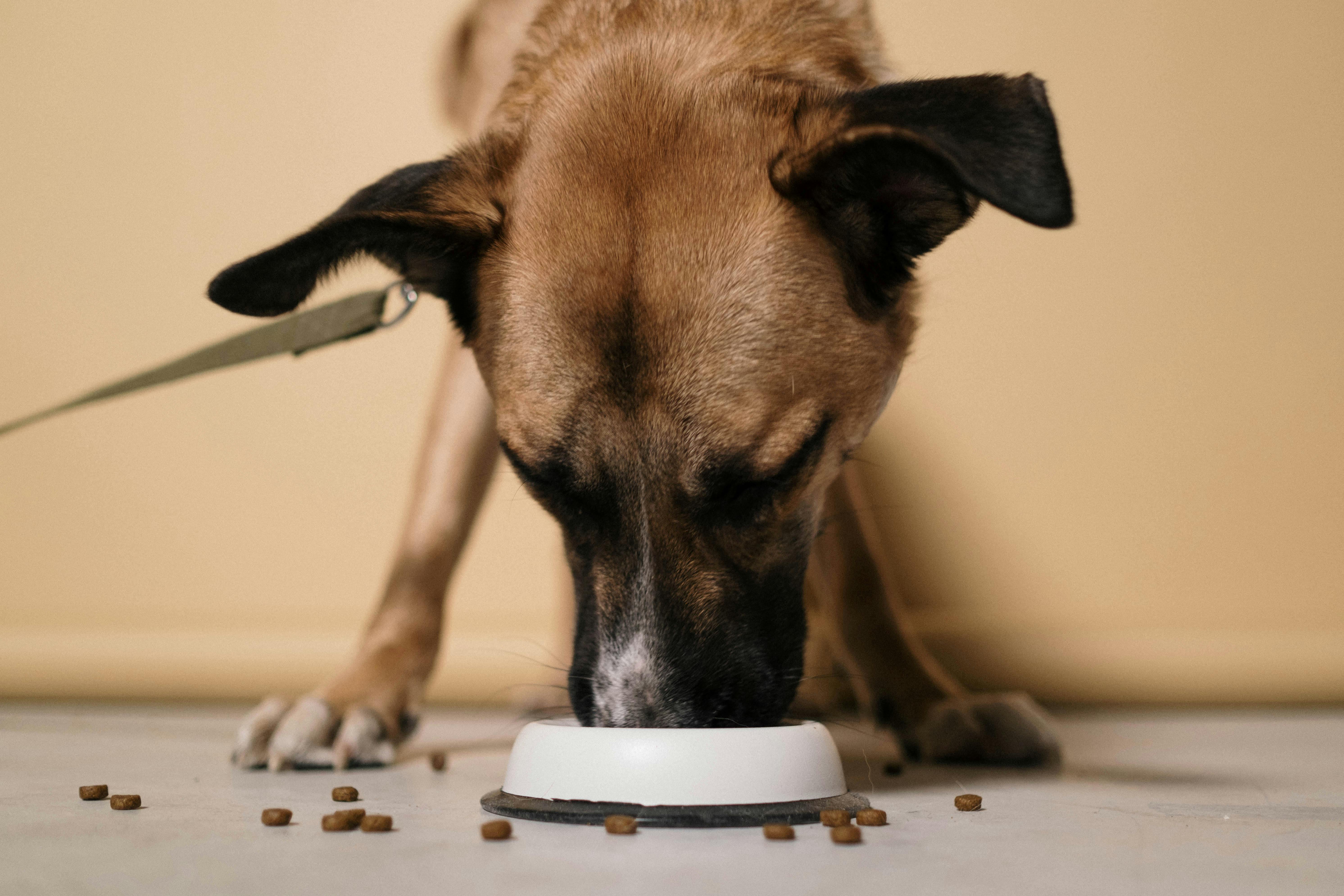
What Patify did and did not do: We designed and checked the arithmetic for three transparent fictional examples. We did not purchase or test dog foods, perform laboratory amino acid or digestibility assays, conduct a feeding trial, compare manufacturer records privately, or obtain independent veterinary review. The examples are not product recommendations, and the educational calculator cannot establish clinical nutrient needs or food safety. The cover is an illustrative stock photograph, not evidence about any pictured food's formulation or protein level. This article is informational and does not replace individualized veterinary care.
The bottom line: Read the adequacy statement first. Put protein on a comparable moisture and calorie basis when numbers differ. Ask about typical analysis, amino acids, digestibility and quality control if the decision demands more precision. The winner is not the largest percentage on the bag; it is a complete, appropriately formulated diet that fits the actual dog and can be evaluated with credible information.