Grain-Free Dog Food: What the Label Means, the Heart-Health Questions, and How to Choose
Editorial note: This is a source-based consumer guide, not a veterinary examination, feeding trial, sponsored product review, or endorsement of a specific food. No veterinarian has reviewed or approved this article for Patify. If your dog has heart disease, persistent digestive trouble, suspected food allergies, or a medical diet, ask your veterinarian before changing the food.
“Grain-free” sounds reassuring on a dog food bag. It may sit next to pictures of meat, vegetables, and a happy-looking dog, leaving you with an easy impression: fewer grains must mean more meat and better nutrition. But a grain-free label tells you something narrow. It says the recipe is marketed without grains such as wheat, rice, corn, or oats. It does not tell you whether the food is complete for your dog, who formulated it, how the company tests it, or whether it addresses a genuine dietary need.
There is also a serious question worth understanding before you buy. The U.S. Food and Drug Administration (FDA) has investigated reports of canine dilated cardiomyopathy (DCM) associated with certain diets, many—but not all—marketed as grain-free. That investigation deserves attention without turning an unresolved scientific question into a blanket claim that every grain-free food is dangerous. This guide explains what the evidence says, what it does not say, and how to assess a specific formula rather than shopping by a front-of-bag slogan.
What does grain-free dog food actually mean?
A grain-free recipe generally excludes cereal grains including wheat, corn, rice, barley, and oats. Depending on the product, a manufacturer may supply carbohydrate, fiber, or other functional ingredients through potatoes, sweet potatoes, peas, lentils, chickpeas, or additional plant sources. Some diets use several of these ingredients; others use different combinations. The presence or absence of a particular ingredient does not establish the overall quality of the finished food.
Grain-free is not the same as low carbohydrate. Kibble needs a workable formulation, and removing rice does not automatically remove starch. Nor does the term promise that a recipe contains mostly meat. A product could have a large animal-protein component, a substantial quantity of pulses or tubers, or a blend of both. The ingredient list helps you identify components, but it does not disclose their exact percentages unless the manufacturer voluntarily supplies additional information.
Do not confuse grain-free with gluten-free, limited-ingredient, novel-protein, or prescription hydrolyzed foods. Those terms describe different characteristics, and some are marketing descriptions rather than stand-alone guarantees of allergy control. Grain-free also does not mean raw; those are separate feeding choices. If you are exploring that distinction, read our separate guide to raw meat diets, where handling and pathogen risks need their own attention. A rice-containing food may be appropriate for one dog, while a grain-free veterinary-recommended formula may be appropriate for another. The right decision starts with the animal, not a broad category name.
Grain-free vs. grain-inclusive: a useful comparison
It is tempting to compare two bags by their main claim. A more informative comparison asks what question each diet answers. For a healthy adult dog eating a nutritionally adequate food comfortably, there is usually no reason to assume that excluding grains creates a benefit. If a veterinarian has identified a specific adverse response or medical concern, a carefully selected diet may be part of a management plan—but the words “grain-free” alone are not a diagnosis or treatment.
| Question | Grain-free food | Grain-inclusive food | What matters more |
|---|---|---|---|
| Contains wheat, rice, oats or corn? | Typically excluded by the recipe claim | May contain one or several grains | Read the full ingredient statement |
| Automatically lower in carbohydrates? | No | No | Ask about the full nutrient profile and calories |
| Automatically better for allergies? | No | No | Identify the specific trigger with a veterinarian |
| Complete and balanced? | Possible, not automatic | Possible, not automatic | Check the nutritional adequacy statement and life stage |
| Free from DCM-related uncertainty? | Cannot be determined from label category | Cannot be determined from label category | Review complete diet history with your veterinarian |
| Appropriate for a growing large-breed puppy? | Only if the adequacy statement covers the relevant growth needs | Same rule | Read the large-size-dog growth wording |
Think of this table as a correction to the sales pitch, not a verdict for or against an entire category. A dog food's suitability is affected by life stage, health, energy intake, formulation, manufacturing controls, and the ability of the person feeding it to follow a consistent plan. Ingredients still matter, particularly when there is a known adverse reaction, but the overall finished diet matters more than any single desirable-sounding ingredient.
Grain-free dog food and DCM: what the FDA actually says
Dilated cardiomyopathy is a disease of heart muscle in which the heart enlarges and pumps blood less effectively. Some dogs are predisposed through their genetics; non-hereditary forms may involve several interacting factors. The FDA began examining reports involving dogs with DCM that had been eating certain commercial foods, including many diets labeled grain-free. In the earlier case reports, foods featuring peas, lentils, other pulse ingredients, or potatoes prominently in their formulations drew particular attention.
The critical distinction is between an investigative signal and a proven single cause. The FDA's public questions and answers state that many reported diets contained non-soy pulses high in ingredient lists and that both grain-free and grain-containing diets appeared in reports. The agency says it does not know the specific connection and is examining diet formulation alongside genetics, underlying illness, nutrient availability, ingredient sourcing, processing, and feeding practices. It does not say that every diet containing peas is inherently unsafe.
FDA report totals also need careful interpretation. An adverse-event report is not a controlled study with a known denominator, and the agency cannot independently verify every submission. Reports can increase after public attention to an issue. They cannot be converted into a reliable risk percentage for a particular food or a claim about how many dogs eating that product will develop heart disease. The FDA's December 2022 notice said it did not plan further routine public updates until meaningful new scientific information became available; the absence of a recent routine bulletin should not be presented as proof that the concern is settled.
Another common oversimplification is to call this merely a “taurine deficiency problem.” Taurine and its precursors have been investigated, but the FDA describes a broader and unresolved question. Taurine supplementation, replacing peas with another carbohydrate, or switching between two products with similar marketing language is not a proven do-it-yourself answer to a suspected heart disorder. In a dog with symptoms or an existing diagnosis, the choice of diet belongs in a veterinary treatment discussion.
What owners can do without jumping to conclusions
First, keep the complete label or a clear photograph of the food your dog eats, including its exact product name, flavor, life-stage statement, ingredient list, and lot information. Include treats, toppers, supplements, and any home-prepared food when discussing the diet. A veterinarian reviewing possible cardiac concerns needs a real dietary history, not simply the answer “grain-free.” If you are unsure about a recipe dominated by multiple pulse ingredients, that is a sensible question for the veterinary team and manufacturer.
Second, take potential symptoms seriously rather than trying to diagnose DCM from the food bag. New exercise intolerance, unusual fatigue, coughing, weakness, or a change in breathing deserve a veterinary assessment; collapse or difficulty breathing requires urgent veterinary care. These signs have many possible causes and are not proof of diet-associated DCM. A veterinarian may decide whether physical examination, imaging, or cardiac testing is appropriate. Do not wait for a website checklist to confirm a serious problem.
Third, avoid making claims about brands based on an old FDA list. Product formulas can change, and the FDA explicitly says it is not updating the brand names previously reported because manufacturers have modified products. An archived brand mention is not a current safety rating. The practical focus should remain the current recipe, the company behind it, and your dog's clinical situation. Read the FDA's current explanatory Q&A for the agency's exact language.
How to read a U.S. grain-free dog food label, step by step
For most people, the first meaningful label information is not on the front. Turn the package over. The Association of American Feed Control Officials (AAFCO) consumer guide explains several standard parts of a U.S. pet food label: the ingredient statement, guaranteed analysis, nutritional adequacy statement, feeding instructions, and responsible company details. Federal and state labeling rules govern different aspects of what appears on the package.
1. Match the nutritional adequacy statement to your dog
Look for an explicit statement that the food is formulated to meet AAFCO Dog Food Nutrient Profiles for a named life stage or that feeding tests using AAFCO procedures substantiate complete and balanced nutrition for that stage. These are distinct ways a product may support an adequacy claim. The statement can appear in small type on the back or side of the bag. A slogan such as “whole food,” “ancestral,” or “premium” cannot replace it.
Adult maintenance is not the same as growth or reproduction. A food labeled for all life stages has to cover requirements that differ from those of a typical adult pet. Growing large-size dogs deserve special attention: review the statement about growth of large-size dogs rather than assuming “puppy” on the front is sufficient. Your veterinarian can help interpret that language for a particular puppy. An item labeled for intermittent or supplemental feeding only should not quietly become the sole everyday ration.
2. Read ingredients without treating the first ingredient as a grade
Ingredients are generally listed by weight before processing, from greatest to least. Moisture changes how fresh meat, meat meals, grains, or legumes appear in that order, so the first-listed ingredient does not reveal final protein quality or a precise ingredient percentage. Multiple pea-derived ingredients, for example, may appear separately on a list; that deserves a question about formulation, but the label alone does not provide their combined share of the finished recipe.
Look for which ingredients appear, not a simplistic good-versus-bad ranking. If your veterinarian has instructed you to avoid an identified ingredient, the complete statement matters. If you need information about the nutrient composition or actual inclusion of pulse ingredients, contact the manufacturer rather than guessing from order. An attractive ingredient list is not a substitute for evidence that the complete recipe satisfies canine nutritional requirements.
3. Interpret guaranteed analysis in context
The guaranteed analysis commonly lists minimum crude protein and fat and maximum fiber and moisture. A minimum is not an exact laboratory measurement of the bag you bought, and two values on different-moisture products cannot always be compared directly. An 8% protein canned food is not inherently less protein-rich than a 24% protein dry kibble; moisture may explain much of the difference. In the FDA's comparison guide, dry-matter conversion is described as a way to compare nutrient percentages at similar moisture levels.
The arithmetic is straightforward but has limitations: dry matter percentage equals 100 minus moisture percentage; nutrient percentage on a dry-matter basis equals the listed nutrient percentage divided by dry matter percentage, multiplied by 100. Because guaranteed minimums and maximums are not a typical nutrient analysis, the result is an approximate label-based comparison, not a precise formulation report. Ask the manufacturer for typical analysis or nutrient amounts per 1,000 kilocalories if you need a clinical or more rigorous comparison.
4. Check calories and feeding amounts
Grain-free foods can vary substantially in caloric density. A dog that eats an equal volume of two kibbles may receive different amounts of energy. Check the kcal-per-cup and kcal-per-kilogram information and any feeding guide. If your dog needs a measured daily energy plan, ask your veterinary team to define a starting target and monitor body condition and weight. Measuring by weight can be more repeatable than filling a scoop with inconsistent kibble shapes, but the food's calorie information still matters.
Use the package directions as a starting reference, not as a requirement to feed the maximum suggested serving. Training rewards, chews, and table scraps contribute to the day's calories too. A food that looks nutritionally excellent on paper may still be the wrong fit if portions are consistently too large or your dog's weight changes unexpectedly. A modest, monitored adjustment based on veterinary guidance often matters more than the difference between a trendy grain-free and an ordinary grain-inclusive label.
5. Identify the accountable company
Find a customer service contact and the name of the manufacturer or distributor. “Distributed by” does not necessarily mean that company physically makes the food. Ask who develops the formula, where it is produced, what finished-product testing is conducted, and how quality issues are addressed. The World Small Animal Veterinary Association's (WSAVA) pet-food selection guide offers a useful framework for these questions. WSAVA does not approve or certify brands; references to “WSAVA approved” food should be treated skeptically.
Two fictional label examples: what would you actually choose?
The following examples are illustrative label-reading exercises, not real commercial products. The recipe details are invented solely to demonstrate which questions a buyer should ask. No nutritional adequacy, testing, ingredient percentage, or medical outcome is being asserted for a purchasable food. This matters because an imagined formula should never be mistaken for product research.
| Label clue | Illustration A: Grain-Free (fictional) | Illustration B: Grain-Inclusive (fictional) |
|---|---|---|
| Front claim | Grain-free; meat-forward | With whole grains |
| Selected ingredients | Chicken, peas, chickpeas, potatoes | Chicken meal, rice, oats |
| Adequacy statement | Not shown in this hypothetical photo | States complete and balanced for adult maintenance in this hypothetical example |
| Manufacturer information | Needs verification | Needs verification |
| Reasonable next step | Get the full label and ask about formulation and adequacy | Confirm the exact statement, calories and manufacturer practices |
Example A is not automatically an inferior food simply because it includes pulses, and Example B is not automatically excellent because it lists rice. Still, based on the information displayed here, you cannot make an informed everyday-feeding choice for Example A: critical information is missing. Example B offers one useful piece of evidence—its hypothetical life-stage adequacy statement—but you would still evaluate its formulation and the dog receiving it.
Notice what a careful consumer does not do: claim Example A causes heart disease, assume Example B treats allergies, or assign quality points based on the first ingredient. Instead, you ask for the missing facts. This is the kind of comparison that can travel with you to the grocery aisle, pet store, or online product page without pretending a label is a clinical study.
Will grain-free food help itching, ear infections, or an upset stomach?
Sometimes changing diets improves symptoms. That does not mean the absence of grains caused the improvement. Food allergies can involve proteins from many different sources, including animal ingredients and occasionally plant ingredients. Dogs can also itch because of fleas, environmental allergies, or other medical problems, and diarrhea may have causes unrelated to food. A grain-free purchase is therefore not a reliable test for a grain allergy.
Food allergy diagnosis generally involves a structured elimination diet followed by a challenge, planned with a veterinarian. Depending on the dog's history, that might mean a hydrolyzed-protein diet or a carefully selected novel-protein veterinary diet for a defined period, while avoiding unapproved treats, flavored medications, and other exposures. VCA Animal Hospitals explains the importance of a strict elimination-challenge process in its clinical client guide. Feeding a random store-bought grain-free bag for a week does not establish what the dog is allergic to.
If symptoms improve after a switch, record what changed: the main protein, total fat, calories, treats, feeding quantity, and medication exposure may all differ between formulas. That history helps your veterinarian decide whether a formal trial is appropriate. It also prevents you from attributing success to the grain-free claim when several other variables changed simultaneously. Do not independently restrict a young, pregnant, underweight, or medically fragile dog to a diet of uncertain adequacy.
“My dog seems allergic to chicken—should I choose grain-free?”
Not necessarily. A grain-free product may still contain chicken, chicken meal, poultry fat, or other ingredients relevant to a veterinarian-designed diet trial. Meanwhile, a grain-inclusive recipe could use a different primary protein. If your veterinarian suspects a food-triggered condition, choose based on the prescribed diagnostic plan, not on whether the bag says grain-free. The planned Patify article on limited-ingredient foods will examine retail label limitations separately; the issue here is that ingredient avoidance and nutritional adequacy are two different jobs.
Seven questions to ask before buying a specific grain-free food
A producer should be able to answer questions about its own formula without asking you to trust influencer endorsements. The WSAVA framework emphasizes qualified formulation, quality control, research, nutritional adequacy, and accessible contact information. These are not pass-fail certificates that magically make one brand perfect. They are ways to replace vague marketing claims with information you can assess, save, and discuss with your veterinarian.
| Ask the manufacturer | What a useful response includes | Why it matters |
|---|---|---|
| Who formulates this exact recipe? | Relevant qualifications and responsibility | Identifies nutrition expertise rather than just branding |
| What does its AAFCO adequacy statement say? | Exact life stage and method of substantiation | Confirms intended dietary role |
| What finished-product tests are conducted? | Quality-control program and nutrient verification | Helps assess consistency and safety practices |
| Can you share typical nutrient analysis? | Values in a comparable format, ideally per calorie | Provides more than guaranteed minima/maxima |
| Why are these pulse ingredients included? | Formulation rationale and an accountable explanation | Addresses questions not settled by the word grain-free |
| Who manufactures and packs the food? | Plant responsibility and contact process | Clarifies accountability |
| How can I identify a change in recipe or recall? | Lot tracking and current notification channels | Supports ongoing product monitoring |
Ask for the exact formula, not a corporate answer that applies to an unrelated product line. The name on a retailer's page may be an abbreviated label, and a recipe with the same brand name can vary across flavors or life stages. If a company cannot answer a question, that is a reason to seek further information or alternatives rather than proof that the food causes disease. Retain an email response or screenshot so that later decisions are grounded in what the company actually said at the time.
How to choose based on your dog's situation
The decision can be simplified without turning it into a blanket ban. If your healthy dog eats a complete and balanced grain-inclusive formula, maintains an appropriate body condition, and has no veterinary reason to avoid ingredients in it, the grain-free aisle offers no demonstrated automatic upgrade. You do not need to manufacture a dietary problem because another bag sounds more natural.
If your dog is already doing well on a grain-free recipe, don't panic. Photograph the current label and discuss your questions with your veterinary team at the next appropriate opportunity; seek care sooner for concerning symptoms. Because the FDA has not established a simple one-ingredient cause, abrupt unsupervised switching and supplementing based solely on fear are not useful substitutes for an individualized assessment. The relevant details include your dog's age, breed, current health, diet duration, and medical history.
For dogs with ongoing itching, digestive signs, or suspected food reactions, make the veterinary appointment about the symptom, not your favorite marketing claim. Bring a diary, stool or symptom history as requested, and a list of everything fed. The veterinarian can decide whether a diagnostic diet, parasite control, testing, or other assessment makes sense. For dogs with established cardiac disease, use the heart-care team's diet recommendation rather than a generic online ranking.
| Your starting point | Practical next move | Avoid assuming |
|---|---|---|
| Healthy adult; thriving on current food | Verify adequacy, calories and body condition | Grain-free must be an improvement |
| Healthy dog already eating grain-free | Review exact formula and discuss any concerns with the vet | The label alone confirms harm |
| Itching or recurring ear problems | Ask about diagnosis and an appropriate elimination plan | Removing grains diagnoses allergy |
| Large-breed puppy | Check large-size growth adequacy and discuss growth plan | All puppy foods fit every growth pattern |
| Cardiac symptoms or prior DCM diagnosis | Prompt veterinary assessment or the cardiologist's plan | Changing kibble or adding taurine is treatment |
| Dog on a therapeutic prescription diet | Follow the treating clinician's instructions | A retail grain-free alternative is interchangeable |
How to compare value without inventing price rankings
The most expensive bag does not have a monopoly on balanced nutrition, and a lower sticker price does not automatically make a product economical. Compare foods by how long a package lasts at the appropriate calorie allowance for your dog. For instance, two hypothetical foods with equal bag weights may have different kcal-per-cup and scoop weights. One could require a larger daily serving to meet the same energy target, while the other might cost more per bag but last longer. Without real product prices and nutrient labels, a universal “cheapest grain-free brand” ranking would be misleading.
A useful shopping worksheet records the pack price, net weight, labeled kilocalories per kilogram, daily calorie target supplied by your veterinary team, and calculated daily food cost. If the price is $P for a bag holding K total kilocalories and the planned daily food allotment is D kilocalories, the simplified food-only daily cost is P multiplied by D, divided by K. This calculation compares the cost of energy, not the adequacy or quality of nutrient intake; it assumes the selected formula is otherwise appropriate. Treats, waste, delivery, and actual feeding adjustments can change spending.
For online purchases, confirm you are comparing the same formula, bag size, and life stage. Coupons and subscriptions change, and a displayed sale price may come with conditions. The formula for comparison is reproducible; a fictional current market price is not. If the manufacturer has materially changed the recipe, recalculate instead of copying a value from last year's shopping spreadsheet.
If you and your veterinarian decide to change foods
Ask your veterinarian whether there is any medical reason to move faster or more cautiously before changing the diet. For a healthy dog without special dietary instructions, a gradual transition is commonly used to make digestive changes easier to observe. That does not guarantee the absence of vomiting or diarrhea, and it is not suitable as a universal schedule for every animal. If your veterinarian prescribes a diagnostic elimination trial, follow that protocol exactly rather than adding unauthorized mixers or treats.
For a routine transition, start with the current food and introduce modest amounts of the new food while monitoring appetite and stool. Increase the new food over several days as tolerated according to the feeding instructions and your clinician's advice. Use calories or weights rather than assuming equal-sized scoops contain equal energy. Keep the feeding routine otherwise stable so that a change in stool or appetite is easier to interpret. If persistent gastrointestinal signs appear, contact your veterinary team rather than repeatedly cycling through new bags.
A practical written record can be surprisingly useful. Note the date, product and flavor, portion, any treats, stool consistency in ordinary language, appetite, and relevant symptoms. Take a photo of the current bag before recycling it. Keep packaging long enough to find the lot and best-by details if a safety issue arises. Our dog food recall guide provides additional context; for current official recall status, consult the FDA directly. Seek prompt veterinary advice for repeated vomiting, severe diarrhea, marked lethargy, refusal to eat, or other concerning changes; difficulty breathing or collapse warrants emergency care.
Seven common mistakes that make grain-free shopping harder
Choosing by the first ingredient
“Chicken first” might be helpful context, but it does not measure the finished diet's nutrient balance, digestibility, or manufacturing consistency. Read beyond the first line, especially the adequacy statement and caloric content.
Assuming grain-free means carbohydrate-free
Starch can come from several non-grain plants. If your dog needs a particular carbohydrate or energy plan, use actual nutrient information and professional guidance rather than a category word.
Treating all peas and lentils as toxic
The FDA has not declared pulses inherently dangerous. Its investigation concerns complex patterns in certain reported diets and unresolved mechanisms. Claims that a single pea in any recipe is harmful go beyond the agency's findings.
Believing every food labeled “all life stages” suits every puppy equally
Growth needs differ from adult maintenance. Large-size puppy growth wording and veterinary recommendations matter, regardless of grain status. Check the exact nutritional adequacy statement.
Using grain-free food as an allergy test
A different product changes many dietary variables at once. It cannot identify a particular allergen. Formal elimination-challenge trials are designed to answer a narrower clinical question.
Relying on a decade-old brand list
Manufacturers reformulate products. A historical adverse-event mention is not an updated product safety score, and an absent brand name is not a guarantee. Investigate the current recipe and manufacturer response.
Copying another dog's diet
A friend's dog might have a different age, body condition, genetic risk, activity level, or medical diagnosis. A formula that fits their feeding plan does not automatically belong in yours, even if both dogs enjoy it.
Frequently asked questions
Is grain-free dog food bad for dogs?
Not as a universal category judgment. The FDA is investigating a possible association between certain diets and non-hereditary DCM, with complex factors and no established simple causal rule. Assess your dog's health and the exact current recipe with your veterinarian rather than declaring every grain-free product either safe or unsafe.
Is grain-free dog food healthier than food with grains?
There is no automatic nutritional advantage to removing grains from a complete, appropriate diet. The relevant measures are suitability for the dog's life stage, actual nutrient profile, formulation expertise, quality controls, caloric intake, and medical needs. Both categories contain products that require individual evaluation.
Do dogs need grains to survive?
Dogs need an adequate supply and balance of nutrients, not necessarily a particular named grain ingredient. That does not mean all grain-free formulas are equivalent or that cereal grains lack useful nutritional roles. The complete food's composition is what must meet the dog's nutritional needs.
Is rice better than peas in dog food?
There is no universal winner between individual ingredients. Rice and peas serve different nutritional and functional roles depending on formulation. Because reported DCM diets frequently included pulses high in ingredient lists, ask sensible questions about a pulse-heavy recipe; do not infer a diagnosis or a guaranteed outcome from one ingredient.
Does grain-free mean gluten-free?
The terms overlap but are not interchangeable guarantees. Wheat, barley, and rye contain gluten; other grains do not necessarily have the same gluten proteins. Manufacturing and cross-contact questions also matter when avoidance is medically necessary. Confirm exact labeling and talk with your veterinarian about the condition being managed.
Can grain-free food cause a taurine deficiency?
The diet-and-DCM research has examined taurine and multiple other mechanisms. A bag's grain-free label cannot tell you an individual dog's taurine status, and the FDA has not reduced the investigation to a simple proven taurine-deficiency explanation. Do not begin supplements as a substitute for veterinary assessment.
Should I switch my dog off a grain-free food today?
If your dog seems healthy, do not interpret an article as an instruction for an emergency food change. Discuss concerns, the current recipe, and your dog's risks with your veterinarian. If your dog has difficulty breathing, collapses, or shows other urgent symptoms, seek immediate veterinary care rather than waiting for a dietary discussion.
How can I tell whether a grain-free formula is complete and balanced?
Find the AAFCO nutritional adequacy statement on the package. It should identify the species, intended life stage, and method supporting the claim. If the item is labeled for intermittent or supplemental feeding only, do not use it as the sole diet unless your veterinarian has directed otherwise.
The bottom line
Grain-free can describe a recipe choice, but it is not a quality certification, an allergy diagnosis, or a health outcome. The best starting point is the right nutritional adequacy statement for your dog, a manufacturer that can explain its formulation and testing, and a feeding plan that fits your dog's health. Take the FDA's diet-associated DCM findings seriously while also respecting the scientific uncertainty: neither panic nor a blanket dismissal helps you choose well.
Before checking out, save the full label, confirm your dog's life stage and calories, and write down any unanswered questions. If your dog has symptoms or a medical condition, make that conversation with the veterinarian the priority. An evidence-informed decision may be less dramatic than the marketing on a pet food bag, but it is more useful to the dog eating from the bowl.
Sources and editorial method
This guide uses primary U.S. regulatory and international veterinary nutrition resources for the core label and DCM information, with veterinary clinical material for food-allergy trial context. The examples, worksheets, and decision tables are illustrative editorial tools—not original laboratory studies, product testing, reported patient outcomes, or estimates of product safety. Primary references were reviewed on October 15, 2026; source pages may be updated by their publishers after that date.
- FDA — Questions and answers on potential causes of non-hereditary DCM in dogs
- FDA — Investigation update and limitations of adverse-event reports
- AAFCO — Reading pet food labels
- FDA — Complete and balanced pet food and dry-matter comparisons
- WSAVA Global Nutrition Committee — Selecting a pet food
- VCA Animal Hospitals — Elimination-challenge diet trial for dogs
- FDA — Animal food labeling and pet food claims
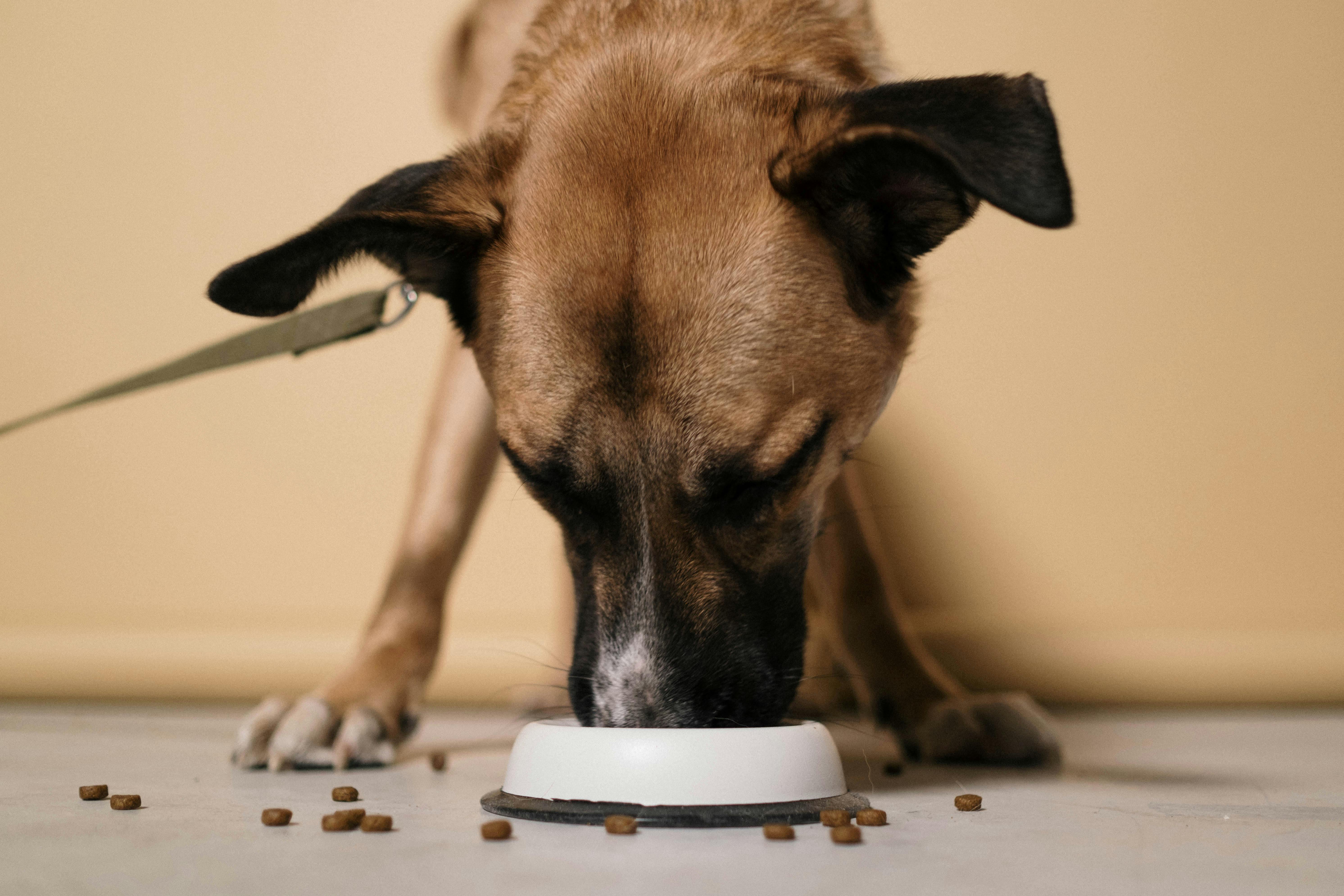
Cover photo: cottonbro studio / Pexels, used under the Pexels License. The photographed food is illustrative; its ingredients and grain status are unknown.