
Last updated: September 25, 2026
Guinea Pig Breed ID: Start With the Coat, Not the Color
Quick answer: in the United States, the American Rabbit Breeders Association (ARBA) currently recognizes 13 cavy breeds: Abyssinian, Abyssinian Satin, American, American Satin, Coronet, Peruvian, Peruvian Satin, Silkie, Silkie Satin, Teddy, Teddy Satin, Texel and White Crested. The American Cavy Breeders Association (ACBA) shows the same 13-breed lineup.
That list is narrower than the names you will see on pet websites. Skinny pigs, Baldwins, Rex, Lunkarya, Alpaca and other coat/type names may be real and useful descriptions, but they are not all separate ARBA-recognized breeds in the U.S. A pet can also be a crossbreed that does not fit a show standard cleanly.
The fastest identification rule: ignore color first. Look at hair direction, rosettes/crests, coat length, curl and texture. Color patterns such as tortoiseshell, roan or broken color do not by themselves tell you the breed.
The 60-Second Guinea Pig Breed Identification Flow
1. Is the coat mostly hairless?
If yes, you are likely looking at a hairless type such as a Skinny or Baldwin, not one of the 13 ARBA-recognized U.S. breeds. Skinny pigs usually retain some hair around the nose/feet; Baldwins are born coated and become hairless as they mature.
2. Is the coat short and smooth?
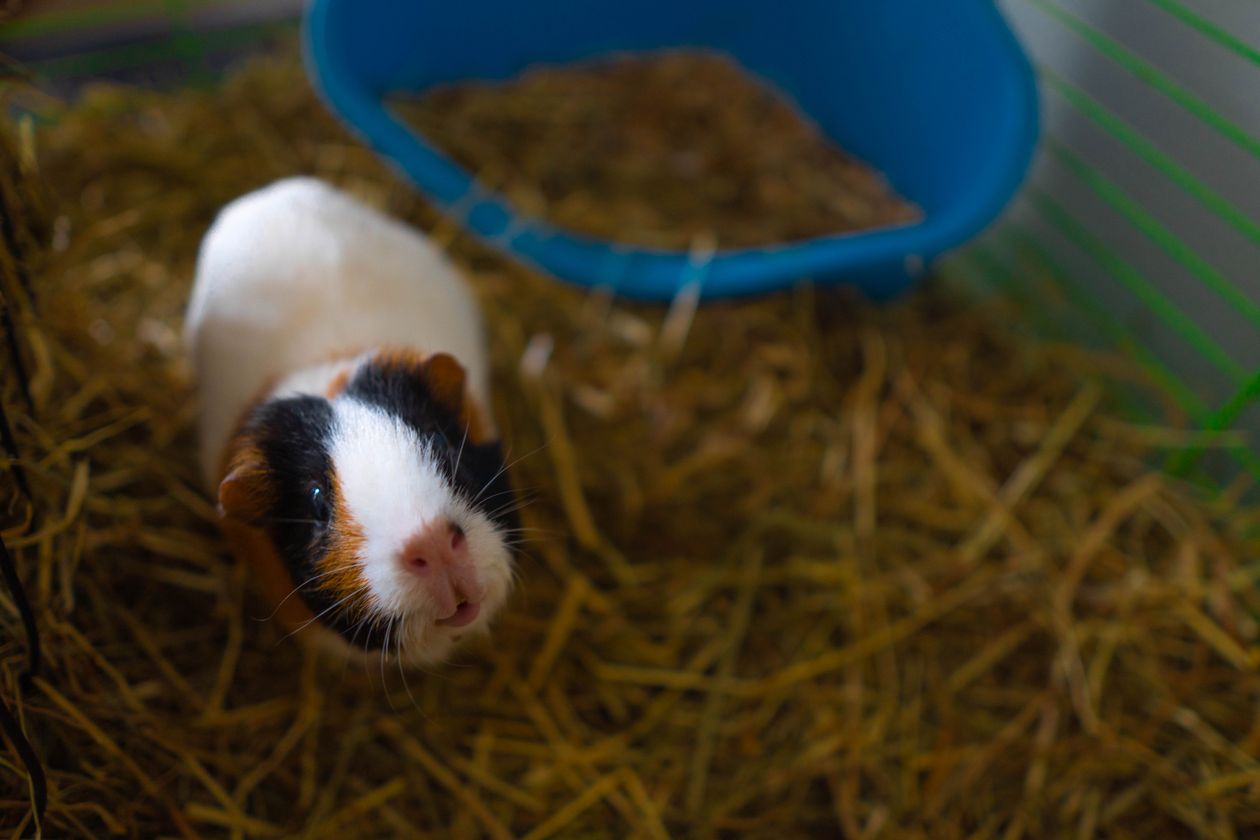
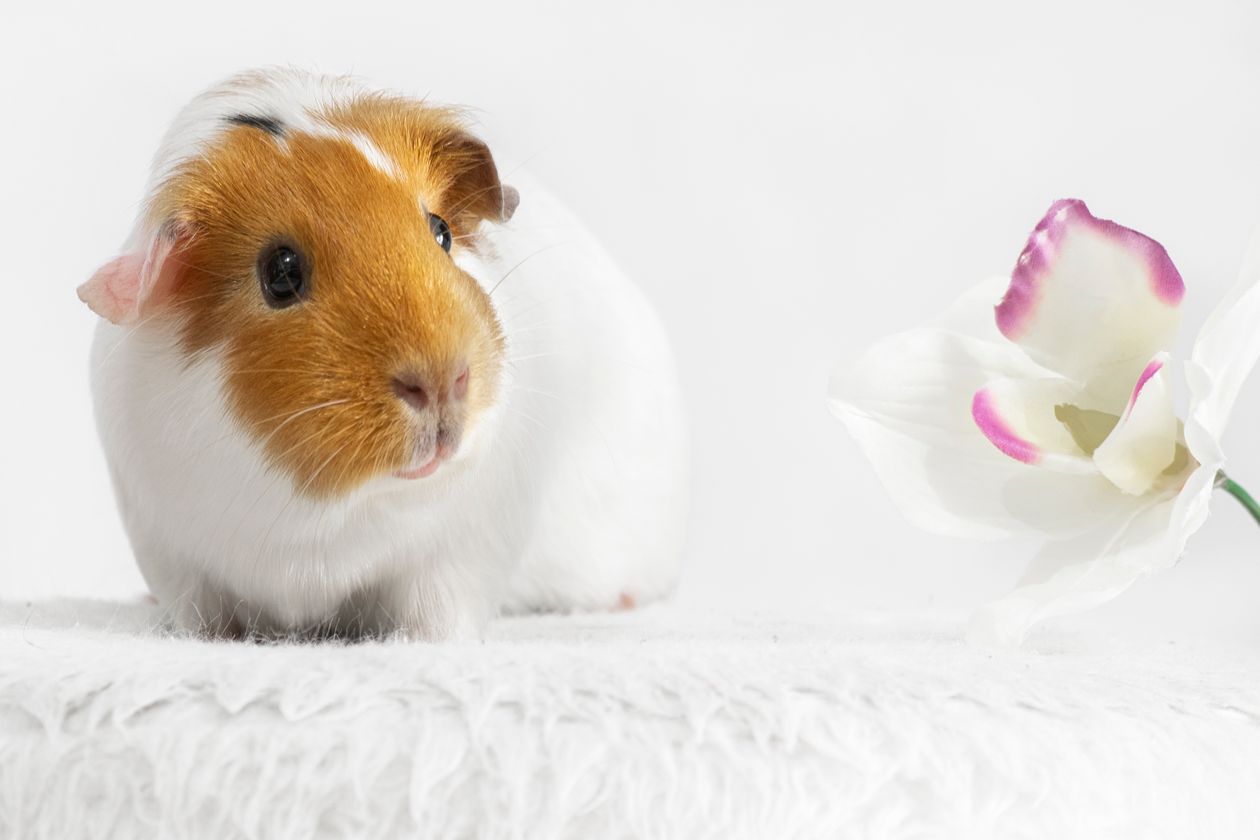
Think American first. If there is a single white crest centered on the forehead, compare with White Crested. A strong glossy sheen may suggest a Satin form, but sheen in a photograph is not enough to prove Satin.
3. Is the coat short but rough, springy or full of swirls?
Rosettes/cowlicks across the body point toward Abyssinian-type coat structure. A dense, plush coat that stands up without multiple body rosettes points more toward Teddy.
4. Is the coat long?
Now look at direction and curl: Peruvian hair grows forward over the head; Silkie hair sweeps backward away from the face; Coronet resembles a Silkie but adds a forehead crest; Texel is long and curly.
All 13 ARBA-Recognized Guinea Pig Breeds
| Breed | Fast visual cue | Coat-care load | Easy confusion |
|---|---|---|---|
| American | Short, smooth coat lying close to body | Low | Any smooth-coated crossbreed |
| American Satin | American-type short coat with satin sheen | Low coat care; see Satin health note below | Glossy lighting on a normal American |
| Abyssinian | Short-to-medium rough coat broken into visible rosettes/ridges | Low–moderate | Rosetted crossbreed |
| Abyssinian Satin | Abyssinian rosette structure plus satin sheen | Low–moderate; see Satin health note | Abyssinian photographed under strong light |
| White Crested | Short smooth coat with a distinct white forehead crest | Low | Crested cross with imperfect marking |
| Teddy | Short, dense, resilient coat that stands away from body | Low–moderate | Rex-type or rough-coated cross |
| Teddy Satin | Teddy texture plus satin sheen | Low–moderate; see Satin health note | Normal Teddy with reflective coat |
| Silkie | Long smooth hair swept backward from the head; face remains visible | High | Peruvian, Coronet |
| Silkie Satin | Silkie architecture plus satin sheen | High; see Satin health note | Silkie under bright lighting |
| Coronet | Long Silkie-like coat plus one crest on the forehead | High | Silkie, long-haired crested crosses |
| Peruvian | Very long coat with hair growing forward over the head/face | Very high | Silkie when hair is trimmed or pushed back |
| Peruvian Satin | Peruvian coat architecture plus satin sheen | Very high; see Satin health note | Peruvian with naturally shiny hair |
| Texel | Long, dense curls/ringlets over much of the body | Very high | Other curly long-haired pet types |
Important: this table is a practical pet-owner identification guide, not a substitute for the current ARBA Standard of Perfection. Show classification includes details that cannot be verified reliably from one casual photo.
Photo Atlas: Learn the Coat Families Visually
American — Smooth and Close-Coated

ID clue: if your guinea pig is short-haired and the coat lies flat from nose to rump, American-type coat is the first comparison to make. Color does not determine the breed.
Abyssinian — Rosettes Create Ridges and Cowlicks

ID clue: rosettes matter more than hair color. A tricolor smooth-coated pig is not automatically Abyssinian; the swirl/ridge structure is the useful clue.
Teddy — Plush, Upright Texture

ID clue: think “plush and resilient,” not “rosettes everywhere.” A rough short coat with obvious swirls is more Abyssinian-like; an even stand-up coat is more Teddy-like.
Peruvian — Long Hair Comes Forward

ID clue: if long hair naturally falls forward over the face, Peruvian becomes much more plausible. A Silkie's long hair is swept backward, leaving the face clearer.
Coronet — Long Coat + Forehead Crest

Texel — Long and Curly

Silkie vs Peruvian vs Coronet: The Long-Hair Test
| Question | Silkie | Peruvian | Coronet |
|---|---|---|---|
| Does hair naturally fall over the face? | Usually no; sweeps backward | Yes — key clue | Usually no; sweeps backward |
| Forehead crest? | No | Not the defining feature | Yes — key clue |
| Long straight coat? | Yes | Yes | Yes |
| Home grooming | High | Very high | High |
PetMD's veterinarian-authored long-hair overview makes the same practical distinctions: Peruvian hair can fall forward over the face, Silkie hair sweeps backward, and Coronet combines the backward-flowing coat with a head crest.
What Does “Satin” Mean — and Why It Deserves a Health Note?
In U.S. show classification, Satin is not simply a color. ARBA/ACBA recognize Satin forms of American, Abyssinian, Peruvian, Silkie and Teddy as separate breeds. The coat has a distinctive reflective sheen related to hair-shaft structure.
There is also a genuine veterinary concern associated with satin guinea pigs: fibrous osteodystrophy, often called Satin Syndrome. A published veterinary case report describes a satin guinea pig with bone demineralization, dental disease and lameness, and reviews earlier reports of similar disease in satins. Veterinary Partner's 2025 overview likewise notes that satin guinea pigs may be at increased risk.
Do not diagnose Satin Syndrome from shininess in a photo. If a satin or suspected satin guinea pig develops reluctance to move, persistent lameness, painful chewing, weight loss or recurrent dental problems, discuss the history with an exotics veterinarian. Diagnosis depends on veterinary assessment and may include radiographs and laboratory work.
Popular Guinea Pig “Breeds” That Are Not on the Current ARBA 13-Breed List
This is where most online breed lists become confusing. A name can describe a real, established coat type or line without being an ARBA-recognized breed in the United States.
| Name you may see | What it describes | ARBA-recognized U.S. breed? |
|---|---|---|
| Skinny pig | Hairless type with limited hair, commonly around nose/feet | No |
| Baldwin | Hairless type born coated and progressively losing hair | No |
| Rex | Short rough/plush coat type recognized in some other systems | No |
| Lunkarya | Long, dense, curly Swedish-developed coat type | No |
| Alpaca | Long curly coat type used in pet/breed communities | No |
| Merino | Long curly/crested type name used outside ARBA's 13-breed lineup | No |
PetMD's newly updated September 2026 hairless-guinea-pig guide distinguishes Skinny pigs and Baldwins and emphasizes their extra skin/environmental needs. Their absence from the ARBA list does not make them “fake”; it simply means pet-type terminology and U.S. show recognition are not the same system.
Choose by Grooming Workload, Not Just Looks
A breed guide becomes useful when it changes the care decision. RSPCA states that long-haired guinea pigs need grooming every day. PetMD similarly recommends frequent/daily attention for long coats because mats, debris and moisture can become trapped in the hair.
Lowest coat workload
American, White Crested
Short coat; routine checks and occasional brushing are usually straightforward.
Moderate coat workload
Abyssinian, Teddy
Shorter coats but texture can hide debris, skin flakes or small tangles. Run your hands through the coat rather than judging only the surface.
High coat workload
Silkie, Coronet
Long straight hair needs frequent combing, trimming around soiled areas when appropriate and daily checks for mats.
Very high coat workload
Peruvian, Texel
Length plus forward growth or curls creates more opportunities for tangles, urine contamination and bedding debris.
Coat maintenance also interacts with the cage floor. A long-haired pig living on persistently damp substrate becomes a grooming problem fast. Patify's guinea pig bedding comparison covers moisture, dust and cleaning workload for fleece, recycled paper and aspen.
Can You Identify a Guinea Pig Breed From One Photo?
Sometimes you can identify the coat type; often you cannot prove the pedigree. A clear side-and-top photo may strongly suggest American, Abyssinian, Teddy, Peruvian, Silkie, Coronet or Texel architecture. But several things reduce confidence:
- mixed-breed guinea pigs can combine coat traits;
- long coats may have been trimmed;
- young guinea pigs may not show their final coat fully;
- lighting can make a normal coat look “satin”;
- a hidden forehead or rump can conceal the crest/rosette that changes the ID;
- pet-store labels may describe appearance rather than documented pedigree.
For a better breed-ID photo, capture:
✓ full left or right side
✓ top-down view showing hair direction and rosettes
✓ clear forehead/crest
✓ rump and shoulders
✓ natural dry coat, not freshly wet or brushed flat
✓ neutral lighting without flash glare
Breed, Color and Pattern Are Different Questions
An American can be many colors. So can an Abyssinian, Peruvian or Teddy. Terms such as agouti, roan, tortoiseshell, brindle, broken, Himalayan and other markings describe color/pattern genetics or show varieties; they do not automatically name the coat breed.
This matters because searches such as “black and white guinea pig breed” often start with the wrong clue. Two black-and-white guinea pigs can belong to completely different coat breeds if one is smooth-coated and the other is rosetted.
Do Guinea Pig Breeds Have Different Personalities?
Be careful with confident personality charts. You will find claims that one breed is “more playful,” another “calmer,” and another “better for children,” but those labels are usually anecdotal and can be overwhelmed by individual temperament, age, social history, handling, housing and health.
Use breed mainly to predict coat/grooming requirements and show phenotype. Choose an individual guinea pig based on health, compatibility and behavior rather than assuming its hairstyle predicts its personality.
If you are trying to understand vocal or social behavior after adoption, Patify's guinea pig sound decoder pairs wheeks, purrs, warning calls and teeth chattering with body-language context.
What to Ask Before Adopting a Long-Haired or Hairless Guinea Pig
- How often is the coat currently combed or trimmed?
- Does urine or bedding collect around the rear coat?
- Are there mats hidden underneath the belly or behind the legs?
- For a satin/suspected satin: any history of lameness, dental disease or painful movement?
- For a Skinny/Baldwin: how is room temperature and skin protection managed?
- Is the “breed” documented by a breeder/pedigree, or simply an appearance-based shelter/pet-store label?
None of those questions make one coat type inherently “better.” They tell you whether the daily care fits your household before appearance makes the decision for you.
Breed ID Cheat Sheet
Smooth + short: compare American.
Smooth + short + white forehead crest: compare White Crested.
Multiple body rosettes: compare Abyssinian.
Short, dense, upright/plush: compare Teddy.
Long + swept backward: compare Silkie.
Long + swept backward + forehead crest: compare Coronet.
Long + grows forward over face: compare Peruvian.
Long + curly: compare Texel.
Hairless: Skinny/Baldwin type — real guinea pigs, but not on ARBA's current 13-breed list.
Reflective satin sheen: possible Satin form; appearance alone is not a diagnosis or pedigree proof.