

Last verified: September 29, 2026
How to Introduce a Cat to a Dog Without Rushing the Hard Part
Quick answer: do not begin with a face-to-face meeting. Start with complete separation and a cat-safe room, then move through scent exposure → visual contact through a secure barrier → controlled leash sessions → short supervised shared space → longer calm coexistence. Advance only when both animals can notice each other and then disengage without escalating.
The goal is not instant friendship. A successful household may look like a cat and dog cuddling—or simply two animals who can move through the home, rest, eat and access their resources without chasing, blocking, fixation or fear.
Patify’s progression rule: calendar time does not unlock the next stage; behavior does. If the dog is staring, stiffening, stalking, whining intensely, lunging or trying to chase, or if the cat is repeatedly hiding, flattening, fleeing or refusing normal activities, increase distance or return to the previous stage.
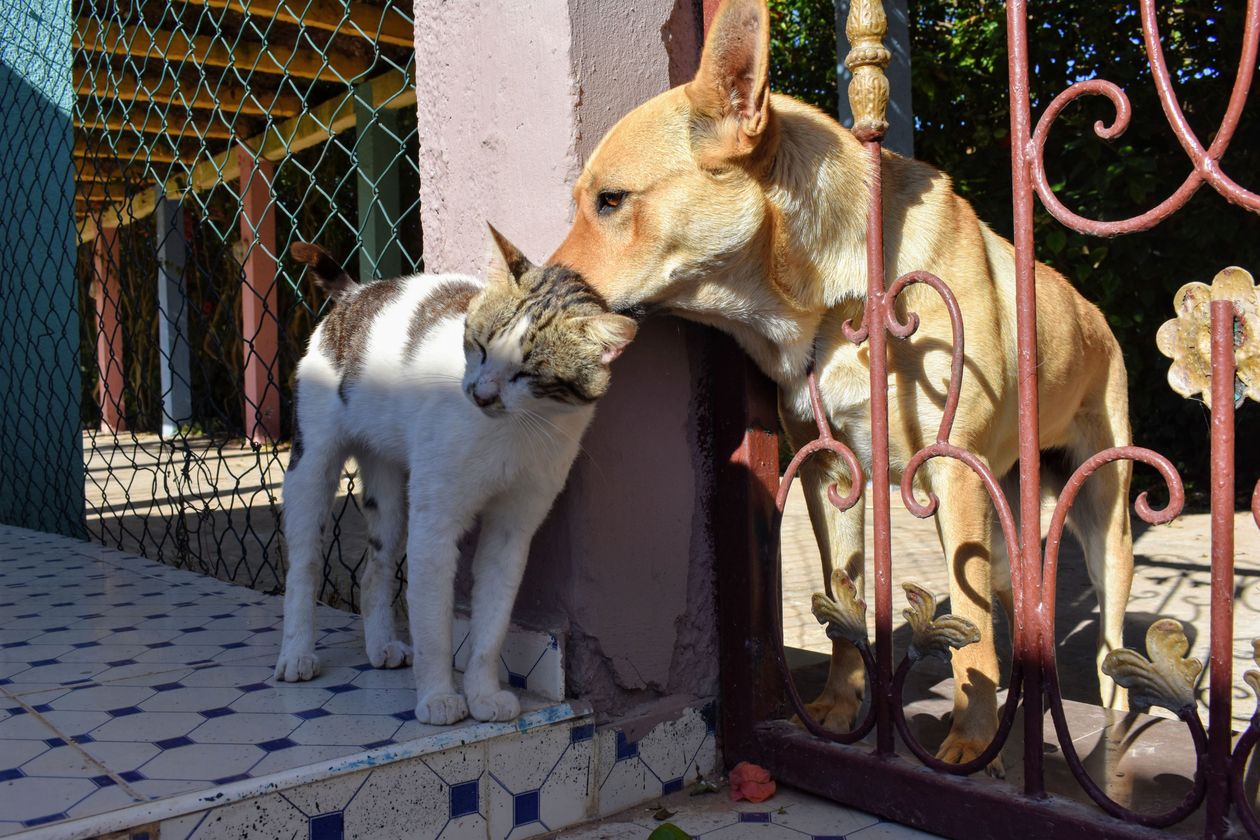
Before You Begin: Decide Whether This Is a Normal Introduction or a High-Risk One
Best Friends Animal Society emphasizes that individual animals matter more than species stereotypes. Some dogs live safely with cats; some do not. A history of living with one cat also does not prove a dog will be safe with every cat, and a cat that tolerated a previous dog may be frightened by a new one.
| Lower-risk starting signs | Higher-risk signs |
|---|---|
| Dog can notice cats outdoors and disengage | Dog stalks, freezes, hard-stares or explosively chases cats/small animals |
| Dog responds to name/cues around mild distractions | Dog cannot respond to handler once the cat is visible |
| Cat has safe retreat behavior and recovers after mild novelty | Cat has severe fear, panic or no escape strategy around dogs |
| No known bite/chase incident involving cats | Dog has injured, grabbed or killed a cat/small animal |
| Both animals are medically comfortable | New pain, illness or mobility limits make escape/handling harder |
If the dog has a history of catching or injuring cats, or shows intense predatory fixation, do not use a DIY “let them meet and see what happens” plan. Best Friends notes that some dogs may never be safe living freely with a cat. In that situation, permanent management or guidance from a qualified behavior professional may be the appropriate outcome.
Likewise, if either animal is newly ill, painful, recovering from surgery or showing sudden behavior change, address the medical issue before making the introduction harder.
Set Up the House Before the Cat and Dog Ever Share a Room
Dogs Trust and Cats Protection both recommend creating separate core areas first. For the cat, that means more than closing a bedroom door.
The cat-safe room should contain
- food and water;
- litter box positioned away from food/water;
- comfortable resting places;
- hiding options;
- scratching surface;
- vertical space such as a sturdy cat tree, shelf or furniture perch;
- a door the dog cannot push open.
The dog also needs a normal routine
Do not turn the dog’s life into constant confinement while the cat gets the house. Maintain normal walks, rest, meals, play and training. Dogs Trust recommends separate core areas for both animals so neither has to continually compete for access to essential resources.
Build a two-barrier option if needed
Best Friends recommends a double barrier for initial visual contact in some setups. One practical version is a secure tall gate plus several feet of buffer space, or a gate with an exercise pen on the dog side. The point is not architectural perfection; it is preventing one equipment failure from becoming a chase.
Protect escape routes
The cat must be able to move away and get high. Cats Protection specifically advises against restraining the cat or forcing an approach. Do not put the cat in a carrier in the middle of the room while the dog investigates; that removes the cat’s ability to retreat.
Stage 1: Complete Separation and Decompression
Bring the new animal into its prepared area without arranging an immediate meeting. Best Friends recommends allowing a new pet to settle in a separate part of the home before progressing.
This stage is complete when the newcomer is doing ordinary species-appropriate things in the safe area rather than remaining continuously overwhelmed.
Cat readiness examples
- eating and drinking normally;
- using the litter box;
- exploring the room;
- resting in exposed as well as hidden spots;
- playing or interacting with the owner;
- recovering after hearing the dog move outside the door.
Dog readiness examples
- can pass the closed door without camping there for long periods;
- can eat, sleep or train elsewhere in the home;
- does not repeatedly scratch, slam or lunge at the door;
- can respond to their name near—but not pressed against—the cat’s room.
If either animal is obsessed with the closed door, increase distance and reduce opportunities to rehearse that behavior.
Stage 2: Scent and Sound Before Sight
Cats Protection, Dogs Trust and Best Friends all use scent exposure as an early step. Swap bedding or scent-bearing cloths between the animals while they remain physically separated.
Scent exchange
- Use a clean cloth for each animal.
- Collect scent gently from areas the animal tolerates being touched.
- Place the other animal’s scented cloth in open space rather than directly under the nose.
- Let each animal investigate or ignore it.
- Pair calm investigation with something the animal likes if appropriate.
Do not use scent as a test the pet must “pass.” If the cat avoids the item or the dog becomes intensely aroused, move it farther away and reduce intensity.
Closed-door routines
You can offer meals, treats, play or calm activities on opposite sides of a closed door, but start at whatever distance allows normal behavior. Bowls do not need to be pushed against the door. The goal is a positive, low-pressure association—not forced eating beside a trigger.
Space swapping
When practical, let each animal investigate areas the other has occupied while the other pet is safely secured elsewhere. This exposes them to household scent without direct contact.

Stage 3: Visual Contact Through a Secure Barrier
Move to visual access only after scent and closed-door exposure are becoming ordinary. Dogs Trust recommends short, calm barrier sessions where both pets can approach or move away by choice.
Your first visual session
- Use a secure tall gate, screen or pen setup.
- Keep enough distance that the dog can think and the cat does not feel trapped.
- If needed, keep the dog on a loose leash as a backup.
- Allow the cat access to height and an exit route away from the barrier.
- Reward the dog for noticing the cat and then orienting back to the handler.
- Reward the cat for calm voluntary presence if they will comfortably eat or play.
- End while both animals are still successful.
Best Friends describes a useful concept: find the dog’s threshold—the distance where the dog notices the cat but can still respond to you. If the dog starts barking, lunging, slowing into a stalk, staring rigidly or cannot respond to their name, you are too close.
What success looks like
A quick look at the other animal followed by looking away is often more useful than intense “interest.” Calm animals do not have to greet through the gate. Boring is progress.
Stage 4: Controlled Face-to-Face Sessions With the Dog on Leash
Only remove the physical barrier after repeated visual sessions have become calm. Best Friends recommends two people when possible—one responsible for each animal.
Setup
- use a well-fitted harness or other suitable walking equipment;
- keep the dog on a loose leash;
- let the cat move freely and leave;
- keep escape routes and high surfaces available;
- remove food bowls, favorite chews and other conflict-prone items from the shared space;
- choose a room large enough to create distance.
If you need help checking leash equipment before this stage, Patify’s dog harness fitting guide covers orientation, girth, movement and back-out security.
What to reinforce in the dog
Reward behaviors incompatible with chasing: looking back at you, relaxing on a mat, sniffing the ground, responding to name, settling, or calmly watching and disengaging. You are not trying to force the dog to ignore the cat completely; you are teaching that the cat can exist without triggering pursuit.
Patify’s reward-based dog cues guide covers settle, stay and recall foundations—but cues do not replace barriers or supervision.
What not to do
- do not carry the cat toward the dog;
- do not hold the cat in your lap for the dog to sniff;
- do not tighten the leash and force nose-to-nose contact;
- do not punish hissing, growling or distance-increasing signals;
- do not let the dog “chase once to get it out of the system.”
Stage 5: Short Shared-Space Sessions
The next step is not “take the leash off and hope.” First create controlled sessions where the dog has more freedom but the humans can still intervene early.
Possible progression
- Dog on normal leash.
- Dog on a longer lightweight line that can be picked up if needed.
- Dog dragging a lightweight line in a secure room, if safe for the environment.
- Dog off leash for brief supervised sessions.
Do not use a drag line where it can catch on furniture or create a strangulation/entanglement risk. Equipment is a temporary safety layer, not a substitute for reading the animals.
Shared-space readiness
- dog sees cat move quickly and remains controllable;
- dog can disengage from the cat without repeated commands;
- cat voluntarily enters the shared space;
- cat can reach food, water, litter and resting areas without being followed or blocked;
- both animals can rest in the same room;
- no chasing episodes are being rehearsed.
If the cat only appears when the dog is asleep or refuses to cross a hallway because the dog controls it, the home is not yet truly integrated.
Stage 6: Longer Coexistence—But Do Not Rush Unsupervised Time
Best Friends is explicit that a dog can injure or kill a cat very quickly and that animals should remain separated when you cannot supervise if you do not trust the dog around the cat. Cats Protection similarly advises ongoing supervision even after gradual introduction.
This means “they slept in the same room once” is not an unsupervised credential.
Before reducing supervision, ask:
- Has the dog seen the cat run without chasing?
- Can the dog disengage when the cat jumps onto furniture?
- Can the cat walk past the resting dog without detouring in fear?
- Can both animals access resources without guarding/blocking?
- Have calm interactions been repeated across different times of day?
- Is there a reliable way to separate them when nobody is home?
Some households should maintain separation whenever people are away indefinitely. That is not a failed introduction if both animals otherwise have good quality of life.
Cat–Dog Introduction Readiness Scorecard
| Observation | Green: progress | Yellow: hold stage | Red: increase safety |
|---|---|---|---|
| Dog looks at cat | Looks, then disengages | Needs repeated cue to look away | Hard stare, stalk, lunge, chase |
| Dog body | Loose, normal movement | Overexcited, whining, pacing | Stiff, frozen, predatory crouch |
| Cat movement | Walks/explores normally | Moves cautiously, stays high | Panic-running, trapped, persistent hiding |
| Cat resources | Normal eating/litter/resting | Uses them only when dog absent | Stops eating/litter use or cannot access them |
| Recovery | Both settle quickly after session | One remains aroused for a while | Prolonged distress or renewed barrier rushing |
| Handler control | Dog responds easily | Response deteriorates near cat | Dog cannot respond once cat is visible |
Move forward only when green dominates repeatedly. One calm minute does not erase repeated red behavior.
Body Language That Should Change the Plan
Dog warning signs
Best Friends highlights fixation, stiffening, staring, barking and whining as signs that can accompany strong prey interest or overarousal. Also watch for stalking posture, sudden silence after high arousal, weight shifted forward, repeated attempts to get around the barrier, and inability to respond to familiar cues.
Not every bark means predation, and not every quiet dog is relaxed. Look at the whole pattern.
Cat warning signs
- ears flattened or rotated sharply;
- tail lashing;
- crouching low;
- piloerection;
- hissing/growling;
- repeated retreat to inaccessible hiding;
- refusal to cross rooms/hallways;
- reduced eating, play or litter-box access around the dog.
The cat does not need to “stand up for itself.” Cats Protection advises against letting the cat “put the dog in its place.” A swat may stop one approach, but a frightening chase or conflict can make future introductions harder.

What If the Dog Chases the Cat?
Do not let repeated chasing become the training plan. Best Friends specifically warns that puppies and dogs can learn that chasing the cat is a fun game, which makes the problem harder.
If a chase attempt happens
- Separate calmly and safely.
- Do not punish either animal after the event.
- Return to a barrier or greater distance.
- Ask why the setup failed: too close, cat ran, leash removed too early, barrier inadequate, session too long?
- Rebuild calm dog disengagement at a lower intensity.
If fixation persists
If the dog repeatedly hard-stares, stalks, lunges or becomes unreachable around the cat, seek qualified behavior help before advancing. A positively conditioned basket muzzle can be one layer of safety in some professional plans, but a muzzle does not make an unsafe dog safe to chase or corner a cat. The cat still needs barriers, distance and escape routes.
Introducing a Kitten to a Dog—or a Puppy to a Cat
Kitten + adult dog
Best Friends notes that kittens may be fearless around dogs despite being physically fragile. Fast kitten movement can also trigger chasing in a dog. Do not use the kitten’s willingness to approach as proof that the dog is safe.
Puppy + adult cat
A social adult cat may tolerate puppy behavior, but the puppy can still rehearse chasing, body-slamming or relentless play. Use barriers and a leash/house line as appropriate, teach calm behavior, and give the cat dog-free vertical and room-level retreats.
Puppy + kitten
“They will grow up together” is not a safety protocol. Their play styles and body sizes can differ dramatically. Supervise, provide frequent breaks and prevent chase games from becoming the default relationship.
If You Have Multiple Dogs or Multiple Cats
Introduce one dog to the cat at a time. Best Friends recommends this because group arousal changes behavior and makes it harder to know which dog is escalating.
If the newcomer is a cat joining a multi-cat home as well as a dog, do not collapse both introductions into one event. The new cat needs a stable safe area first. Patify’s cat-to-cat introduction plan covers transition rooms, scent exchange, resource mapping and feline-to-feline readiness separately.
Resource rule
Keep feeding stations separate and make sure the dog cannot trap the cat near litter boxes, food, water or narrow exits. A “safe room” is not truly safe if the cat has to pass the dog to reach it.
How Long Does It Take for a Cat and Dog to Get Used to Each Other?
There is no reliable fixed timeline. Best Friends notes that desensitization may take hours in some cases and days, weeks or months in others. Dogs Trust likewise recommends repeating barrier exposure over days until both animals are relaxed.
So avoid rules such as:
- “keep them separated exactly three days”;
- “after one week remove the gate”;
- “after two calm meetings they can be left alone.”
Your timeline is the readiness scorecard. If both animals are relaxed and recovering well, the process can move. If one remains frightened or fixated, more calendar days do not automatically make the next stage safe.
10 Introduction Mistakes That Create Setbacks
- Starting face-to-face on day one.
- Holding the cat so the dog can sniff them.
- Letting the dog chase “just once.”
- Using a barrier the cat or dog can easily defeat.
- Advancing because a certain number of days passed.
- Interpreting stillness as calm when the dog is actually fixating.
- Forcing the cat to come down from a high retreat.
- Using obedience cues as a substitute for physical management.
- Introducing all household dogs at the same time.
- Leaving them alone because one supervised session went well.
Frequently Asked Questions About Introducing a Cat to a Dog
What is the first step when introducing a cat and dog?
Start with complete separation. Give the cat a secure dog-free room with food, water, litter, hiding and vertical space. Let both animals settle before scent or visual introductions.
Should I let my cat and dog sniff each other immediately?
No. Use scent exchange and controlled visual contact first. Direct greeting is safer after both can remain relaxed and disengage through a barrier.
Should the cat be in a carrier for the first meeting?
Usually no. Cats Protection advises preserving the cat’s ability to retreat, climb and hide. A carrier can trap the cat while the dog approaches and increase stress.
Should I keep the dog on a leash?
Yes during early face-to-face stages. Keep it loose enough to avoid constant tension, but short enough to prevent a rush or chase. A barrier remains useful before that stage.
How do I know if my dog is too interested in the cat?
Concern rises when interest becomes fixation: hard staring, stiff posture, stalking, lunging, intense whining/barking, or inability to respond to the handler. Increase distance and do not allow direct access.
What if my cat hisses at the dog?
Hissing communicates discomfort or a request for distance. Do not punish it. Increase space, keep the cat’s escape route open and return to an easier stage if needed.
What if my dog chases the cat?
Separate and reduce difficulty. Prevent more chase practice, restore barriers/leash management and rebuild calm disengagement. Persistent stalking/chasing warrants professional behavior help.
Can a dog with high prey drive live with a cat?
Sometimes individual dogs can, but some cannot safely share free space with cats. Best Friends explicitly notes this possibility. A history of predatory chasing or injury requires a much more conservative professional assessment.
How long should a cat and dog be separated?
Until both are ready for the next stage—not for a fixed number of days. Some introductions progress quickly; others take weeks or months.
When can I leave my cat and dog alone together?
Only after a long history of calm supervised coexistence and confidence that the dog does not chase, stalk, block or fixate on the cat. Some households should continue separating the animals whenever no one is home.
Can I introduce a kitten faster because it is young?
No. Kittens are physically vulnerable and may approach dogs without appropriate caution. Fast kitten movement can also trigger chase behavior in dogs.
Do my cat and dog need to become friends?
No. Calm coexistence and free access to resources are enough. Many successful cat-dog households involve animals that mostly ignore each other.
Sources Checked for This Guide
- Best Friends Animal Society — How to Introduce a Dog to a Cat: desensitization, threshold, prey-drive warning signs, kitten/puppy considerations and supervision.
- Best Friends Animal Society — Introducing Cats to Dogs: staged separation, barrier contact and professional-help thresholds.
- Dogs Trust — Helping Dogs and Cats Live Happily Together: separate core spaces, scent swapping, barriers and short calm sessions.
- Cats Protection — Cats and Dogs/Other Pets: cat safe spaces, vertical escape, dog preparation and controlled introductions.
- Cats Protection — Bringing a Cat Home: scent exchange, leash control and no forced approach.
- Blue Cross — Introducing Dogs and Cats: gradual introduction and cat-safe-area preparation.
- RSPCA — Introducing Cats to Other Animals: early scent swapping and gradual exposure.
- Pexels — cat and dog by gate cover image
- Pexels — cat and dog indoor supporting image
- Pexels — cat and dog interaction supporting image
- Pexels License
Editorial note: this guide uses milestone-based progression instead of fixed-day promises. It does not assume every dog can safely live with every cat. Persistent predatory fixation, chasing, injury history or severe fear changes the goal from “keep progressing” to higher-level management or qualified behavior support. Sources were reviewed September 29, 2026.