Dog Hides When You Pick Up the Leash: Fear, Pain or Handling Sensitivity? (2026)

If your dog runs under the bed, backs away or freezes when you pick up the leash, do not assume stubbornness. Leash avoidance can reflect a learned fear association, discomfort with handling or clipping equipment on, fear of what comes after the leash appears, poor equipment fit, pain, or — in some dogs — a learned chase game. The safest plan is to identify the trigger first, rule out pain when appropriate, then use gradual desensitization and counterconditioning at an intensity your dog can handle without becoming frightened.
Start with these four questions
Did this begin suddenly? New avoidance in a dog that previously enjoyed being leashed raises the importance of pain, skin/ear/neck discomfort, orthopedic problems or a new frightening experience. A veterinary check may come before training.
What exactly triggers the retreat? Seeing the leash, hearing the clip, a hand reaching toward the head/neck, wearing the collar/harness, walking outside, or a specific destination can each be a different trigger.
Is your dog below or over threshold? A dog who can look at the equipment, take food and choose to stay nearby is very different from a dog hiding, freezing, trembling, refusing food or trying to escape.
Is this actually play? A play bow and loose movement can occur in a chase game, but tail wagging alone does not prove happiness. Read the whole body and context.
Do not chase, corner or force the equipment on. Merck notes that repeated unpleasant exposure can condition more fear, and AVSAB recommends reward-based methods rather than leash corrections, prong collars, choke chains or other aversive techniques.
Last evidence review: September 1, 2026. Behavior plans should progress by the dog's response, not by a fixed calendar.
First: What Pattern Are You Actually Seeing?
Creates distance
Dog retreats, hides, crouches, freezes, trembles, turns away or avoids touch when equipment appears or approaches.
Trigger is fitting the gear
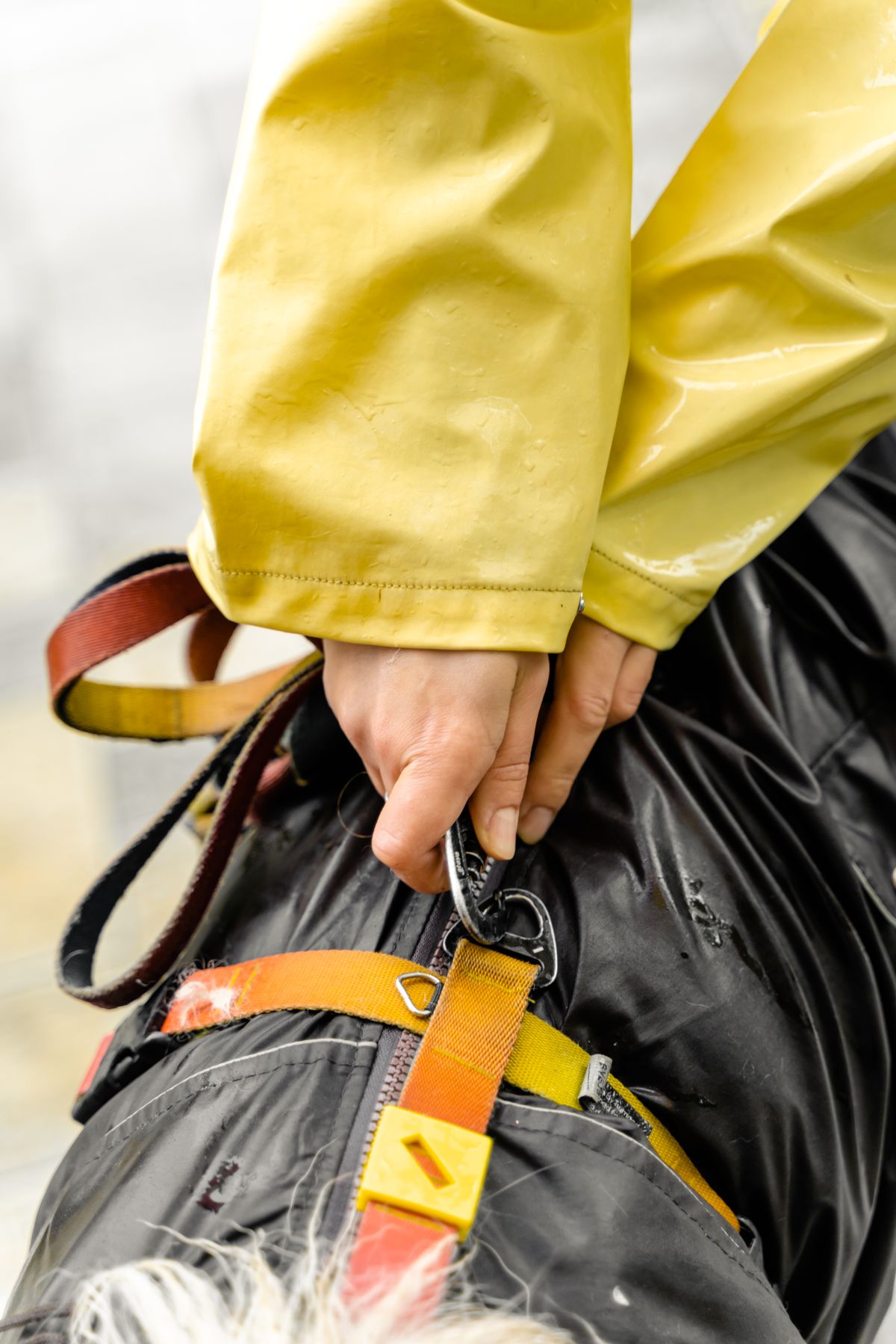
The leash itself may be fine on the floor, but reaching toward the head/neck, lifting a harness or clipping hardware triggers avoidance.
New or worsening reluctance
Sudden onset, stiffness, limping, touch sensitivity, scratching, skin irritation or reluctance to walk shifts priority toward a medical exam.
Loose, bouncy interaction
Dog repeatedly re-engages, shows loose play movements and appears to invite interaction. Still avoid turning every leash attempt into a chase game.
One signal is not enough. Dogs Trust lists yawning, lip licking, freezing, hiding, lowered posture and body tension among possible stress signs, but these need context. A yawn may simply mean tiredness; a wagging tail may occur with arousal or uncertainty. Read the pattern, not one body part.
Why Does My Dog Hide From the Leash?
1. The leash predicts something the dog finds unpleasant
Classical conditioning is a plausible mechanism: a neutral cue can start predicting an unpleasant event. If the leash repeatedly comes before a frightening street, painful handling, a stressful destination or leash corrections, the leash itself may begin to trigger avoidance. This is not evidence that the amygdala has a permanent “threat code,” and behavior modification does not literally erase a memory. The practical goal is to create new, safer associations and reduce fear responses.
2. The dog dislikes the handling sequence
Some dogs tolerate a leash lying nearby but retreat when a person reaches over them, touches the neck, guides the head through a harness opening or uses a noisy buckle. That does not prove a dominance problem. Dogs Trust specifically recommends breaking harness fitting into small steps and going back a stage if the dog retreats.
3. A previous painful or frightening experience became associated with the equipment
Leash jerks, an ill-fitting collar/harness, entanglement or a frightening event during a walk can contribute to fear learning. AVSAB recommends avoiding aversive tools and methods because of welfare and fear/anxiety risks. That does not mean every leash-avoidant dog has a punishment history; learning history must be assessed individually.
4. Early socialization or later life experience may contribute
AVSAB identifies the first three months as the most important socialization period, with positive, non-overwhelming exposure to people, handling, environments and stimuli. But adult dogs can still learn. A rescue dog with an unknown history should not automatically be labeled “poorly socialized” or “traumatized.”
5. The dog may be avoiding the walk because movement hurts
Merck emphasizes ruling out medical causes of behavior change, especially pain. Neck pain, orthopedic disease, paw injury, skin irritation, ear pain or other discomfort may make fitting equipment or walking unpleasant. Fear learning can then persist even after the physical problem improves.
6. The dog may have learned that running away starts a game
If every leash attempt becomes a chase around the house, the chase itself can be reinforced. This is a learning problem, not “defiance.” Prevent rehearsal by changing the setup: prepare equipment before calling the dog, work in a calm area and reward approaching/stationing instead of pursuing the dog.
Vet First? Signs That Make Pain or Medical Discomfort More Important
| Observation | Why it matters | What to do |
|---|---|---|
| Abrupt change in a previously comfortable dog | Behavior change can be an early sign of pain or illness. | Arrange a veterinary assessment before pushing training. |
| Yelp, growl, snap or flinch when neck/back/shoulders are touched | Handling may hurt. | Stop provoking the response and have the dog examined. |
| Limping, stiffness, slow walking, difficulty rising | Orthopedic or neurologic discomfort may make the walk itself aversive. | Veterinary assessment. |
| Skin redness, rubbing, hair loss under collar/harness | Equipment may be irritating the skin or fitting poorly. | Remove/adjust equipment and seek veterinary advice if inflamed. |
| Sudden head-shyness plus ear scratching/head shaking | Ear discomfort can make head/neck handling unpleasant. | Vet check rather than desensitizing through pain. |
Behavior and medicine can overlap. Treating pain may not instantly remove a learned fear association. Merck notes that fear learning acquired during painful handling can persist, so some dogs need both medical treatment and careful behavior modification.
How to Read Your Dog Without Turning Body Language Into a Diagnosis
Look for clusters of changes. Dogs Trust lists signs such as turning away, lip licking unrelated to food, yawning unrelated to tiredness, freezing, hiding, trembling, tucked/lowered tail and facial/body tension as possible worry or stress signals.
- Does the dog increase distance from the equipment?
- Does the body become lower, tighter or still?
- Can the dog take food normally?
- Can the dog disengage and recover quickly when the equipment moves away?
- Is the response specific to the leash, or does it happen with touch, grooming or other equipment?
- Does the response change when the environment is quieter or the stimulus is farther away?
Do not diagnose from a sigh, yawn or tail wag alone. Those signals can appear in many contexts. The useful information is the entire sequence before, during and after the leash appears.
Collar, Harness and Leash: Equipment Matters, but There Is No Universal “Best” Setup
A well-fitted body harness can reduce neck pressure
VCA notes that a well-fitted body harness places minimal pressure on delicate neck tissue and can be particularly useful for dogs with tracheal disease or neck pain. However, some dogs need conditioning to tolerate a harness, and an improperly fitted harness can cause discomfort or allow escape.
Avoid harness designs that restrict shoulder movement
Dogs Trust advises choosing a harness that does not cross and restrict the front of the shoulders. VCA similarly notes that some front-clip designs can rest over the shoulder joints and restrict movement.
Prong, choke and electronic collars are not recommended behavior solutions
AVSAB's current humane-training position recommends reward-based methods only and explicitly includes prong collars, choke chains, leash corrections and electronic collars among aversive methods to avoid. VCA likewise advises against equipment designed to create discomfort.
Head halters require gradual conditioning
Some dogs tolerate a head halter well; others do not. VCA recommends gradual conditioning and warns never to jerk the leash while a head halter is on because of injury risk.
The correct equipment is the one that is physically appropriate, escape-resistant, well fitted and emotionally tolerated by your individual dog. Switching gear can help, but it is not a diagnostic test and not a guaranteed same-day cure.
A 6-Step Leash Desensitization + Counterconditioning Plan
Merck describes desensitization as presenting the trigger at a low enough intensity that it does not evoke the fear response, then increasing intensity gradually. Counterconditioning pairs that manageable trigger with something emotionally positive. The plan below follows that principle — not a fixed day-by-day calendar.
1. Find the easiest version of the trigger
This might be the leash placed across the room, the harness on the floor, or simply the soundless sight of the clip. Start far enough away or at a low enough intensity that your dog can remain relaxed and eat normally.
2. Pair the sight of the equipment with something your dog values
Leash appears → food, play or another valued outcome begins. Leash disappears → that extra reward pauses. Keep the dog free to move away. Do not place the leash beside the food bowl if proximity itself makes the dog too worried to eat.
3. Separate the handling pieces
If reaching toward the neck is difficult, train comfortable hand approach/touch separately from the leash. If the buckle sound is difficult, condition the sound at a distance before clipping anything onto the dog.
4. Practice voluntary interaction with the gear
Reward the dog for choosing to approach, sniff, place the nose through a harness opening or stand calmly for brief handling. Dogs Trust recommends retreating to the previous stage if the dog backs away.
5. Build wearing duration gradually
Once clipping/fitting is comfortable, start with whatever duration your dog can handle without worry — that could be seconds for one dog and longer for another. Pair wearing the gear with calm enjoyable activity, then remove it before the dog becomes distressed.
6. Add movement and the real walk in small layers
Practice a few relaxed indoor steps, then a quiet doorway, then a low-stress outdoor environment. Increase distance, duration and environmental difficulty only while your dog stays comfortable. If the dog reacts, reduce the difficulty rather than forcing completion.
Progress criterion: relaxed body, voluntary participation, normal food-taking and quick recovery. Step-back criterion: retreating, freezing, refusing food, trembling, repeated avoidance or escalating tension.
How Long Does It Take to Fix Leash Fear?
There is no evidence-based timetable such as “mild cases need 2–3 weeks and severe cases need 8–12 weeks.” Merck specifically describes desensitization and counterconditioning as potentially time-consuming, and speed depends on the dog's history, trigger intensity, pain/medical factors, environment and how consistently training stays below threshold.
Dog remains comfortable
Repeatedly relaxed at the current step, approaches voluntarily and can take rewards normally.
Mixed comfort
Some hesitation but no escalation. Make the exercise easier or repeat at the same level.
Dog is over threshold
Hiding, freezing, escape attempts, refusal of food, trembling or escalating distress means the setup is too hard.
There is also no universal rule that sessions become useless after 10 minutes or that a failed session requires exactly 24 hours of “cortisol clearance.” End while the dog is still coping well, and tailor frequency/duration to the individual.
Common Mistakes That Can Make Leash Avoidance Worse
- Chasing the dog around the house. This can reinforce a game or intensify fear depending on the dog.
- Cornering and clipping the leash on by force. Repeated unpleasant exposure can strengthen fear learning.
- Increasing difficulty because “he did it yesterday.” Learning is not perfectly linear; reduce criteria when the dog struggles.
- Using a harness without conditioning it. A new harness can become another feared object if introduced too quickly.
- Assuming a tail wag means the dog is happy. Look at posture, movement, facial tension, approach/avoidance and recovery.
- Giving only rich human food as training rewards. Use safe rewards suited to the dog's diet; WSAVA recommends treats stay within about 10% of daily calories.
- Ignoring pain because the dog still completes the walk. Dogs may continue an activity despite discomfort.
- Using prong/choke/e-collar corrections. AVSAB recommends reward-based methods and advises against aversive techniques.
When to Bring in a Vet or Behavior Professional
| Situation | Best next step |
|---|---|
| Sudden new leash avoidance, pain signs or handling sensitivity | Veterinary exam first. |
| Growling/snapping when equipment is applied | Stop provoking the situation; veterinary assessment and qualified reward-based behavior help. |
| Dog panics, cannot eat, or repeatedly tries to escape | Use management and professional behavior guidance rather than increasing exposure. |
| No meaningful progress despite careful below-threshold work | Reassess trigger, pain, equipment fit and training plan with a veterinarian/qualified behavior professional. |
| Fear extends beyond the leash to handling, outdoors, people or noises | A broader behavioral assessment is more useful than a leash-only protocol. |
Medication is not a DIY “shortcut.” Merck notes that medication can sometimes reduce the emotional intensity of fear/anxiety enough to support learning, but suitability and prescribing belong to a veterinarian and should be paired with management/behavior modification when indicated.
Frequently Asked Questions
My dog loves walks but hides when I pick up the leash. How can both be true?
The dog may enjoy the walk but dislike one part of the sequence — seeing the equipment, being approached, the clip sound, neck/head handling, or a learned prediction about what happens before the enjoyable part. Observe each step separately.
If my dog will sniff the leash on the floor, does that prove the fitting process is the problem?
No. It is useful information, but not a definitive test. A dog may tolerate the leash at low intensity on the floor and still fear it when it moves, gets closer or predicts a walk.
Should I switch from a collar to a harness?
A well-fitted harness can reduce neck pressure and may help dogs with neck discomfort or collar sensitivity. But the harness itself must fit properly, avoid restricting shoulder movement and be introduced gradually.
Is a Martingale collar always safe?
No equipment is automatically safe. VCA notes that a properly fitted Martingale can reduce escape risk without choking, but poor fit can cause discomfort or entanglement. It should not be used as an aversive training tool.
Is a retractable leash causing my dog's fear?
Not necessarily. The equipment can contribute if it creates sudden tension, frightening sounds or an unpleasant event, but leash avoidance cannot be diagnosed from leash type alone.
My dog yawns or sighs when I clip the leash. Is that stress?
Yawning unrelated to tiredness can occur with stress, but a yawn or sigh alone is not diagnostic. Look for multiple signs such as turning away, freezing, lowered posture, tension or escape attempts.
My dog is fine for the dog walker but hides from me. Does that prove the problem is behavioral?
No. Different people use different movements, equipment, routes and timing, so the contrast can help identify triggers — but it does not rule out pain or other medical factors.
How many days should each desensitization step take?
There is no fixed number. Move forward when your dog is consistently relaxed at the current level; step back when the dog shows fear or avoidance.
Do I have to reward within exactly one second?
No universal one-second rule applies to this emotional-conditioning plan. Timing should be close enough that the positive outcome is clearly paired with the manageable trigger, but the bigger priority is keeping the dog below threshold.
Should I comfort my dog if the leash scares them?
You do not need to withhold calm reassurance out of fear that you will “reinforce fear.” Avoid forcing contact, give the dog space and pair manageable exposure with positive outcomes.
Track the Pattern, Not Just the Outcome
Which step triggers the avoidance?
Record whether the reaction starts at the sight of the leash, your approach, neck touch, clip sound, wearing the equipment or the first steps outside. A clear timeline helps a veterinarian or behavior professional distinguish pain, handling sensitivity and conditioned fear.
Explore PatifyBottom Line: Don't Force the Leash — Change the Dog's Experience
A dog who hides when the leash appears is not giving you a reliable diagnosis of “stubbornness,” “trauma” or “Pavlovian coding.” The same behavior can arise from fear learning, handling sensitivity, equipment discomfort, pain, anticipation of the walk or a learned chase game.
Start by identifying the smallest trigger, rule out pain when the history points that way, then work at a level where your dog can remain comfortable. Desensitization and counterconditioning are gradual by design. Progress should be measured by the dog's emotional response — not by whether a calendar says it is time for the next step.