

Quick answer: If you saw a big white fluffy dog, the most likely possibilities depend on a few visual clues. A very large dog with drop ears, a broad guardian build, and a plumed tail may be a Great Pyrenees. A smaller, more compact white dog with upright ears and a tail curled over the back points more toward a Samoyed. A leaner, long-legged guardian can resemble an Akbash; an all-white Great-Pyrenees look-alike may be a Kuvasz, Maremma Sheepdog, or Polish Tatra Sheepdog; erect ears and a shepherd outline suggest a White Shepherd; and mature rope-like white cords are the giveaway for a Komondor.
Do not use appearance as proof of ancestry. Coat, ears, body shape, and size can narrow the possibilities, but mixed-breed dogs can combine traits in ways that are difficult to identify visually. A 2018 study of 919 shelter dogs found that staff could match at least one genetically detected breed in many dogs, but matching multiple breeds was far less reliable. Treat this guide as a visual comparison—not a DNA result.
Fast Visual ID: Start With the Ears, Tail, and Coat
Color alone is a weak clue. Several unrelated livestock-guardian breeds were developed with white coats, and a thick double coat can make a dog look much larger than its frame really is. Instead, look at the dog's ear carriage, tail carriage, proportions, coat texture, and apparent height.
| If the dog looks like... | First breeds to compare | Clue to check next |
|---|---|---|
| Huge, white, drop-eared, very fluffy | Great Pyrenees, Kuvasz, Maremma, Polish Tatra | Markings, coat wave, head shape, dewclaws, overall proportions |
| White, fluffy, upright ears, curled tail | Samoyed | Medium-large frame, wedge-shaped spitz face, tail carried over the back |
| White, upright ears, shepherd-shaped body | White Shepherd | Longer athletic outline and saber-like tail rather than a tight curl |
| Very tall, white, leaner guardian | Akbash | Long legs, wedge-shaped head, pendant ears, less massive silhouette |
| White coat forming heavy cords | Komondor | Adult tassel-like cords rather than a normally brushed fluffy coat |
For an unknown rescue or stray, stop at “resembles” unless you have pedigree records or genetic information. Even experienced shelter staff can misidentify mixed ancestry from appearance alone.
Big White Fluffy Dog Breeds: Side-by-Side Comparison
The measurements below come from current AKC or UKC breed standards and breed guidance where available. They describe purebred adults, not guaranteed outcomes for individual dogs or mixes.
| Breed | Approx. adult size | Ears | Coat / color clue | Typical visual impression |
|---|---|---|---|---|
| Great Pyrenees | 25–32 in; roughly 85 lb and up depending on sex/size | Drop | White or mostly white; gray/tan/badger-type markings allowed | Massive-looking, plumed tail, heavy ruff |
| Samoyed | 19–23 in; about 35–65 lb | Upright | Dense white double coat | Spitz outline, smiling expression, tail over back |
| Kuvasz | Large guardian; males around 28–30 in in AKC comparison guidance | Drop | White; coat can be straight to very wavy | Athletic white guardian, less color variation than a Pyr |
| Maremma Sheepdog | Males 25.5–28.75 in / 77–100 lb; females 23.5–26.5 in / 66–88 lb | Drop | Solid white; limited pale ivory/orange/lemon shades tolerated | Strong, substantial livestock guardian |
| Akbash | Males 30–34 in, avg. 120 lb; females 28–32 in, avg. 90 lb | Drop | Always white; medium or long double coat | Tall, long-legged, leaner guardian |
| Polish Tatra Sheepdog | Males 25.5–27.5 in; females 23.5–25.5 in | Drop | Uniform white, long thick coat, profuse ruff | Compact, powerful white mountain guardian |
| White Shepherd | Ideal about 25 in / 75–85 lb males; 23 in / 60–70 lb females | Upright | Pure white preferred; dense straight double coat | Clearly shepherd-like, athletic, saber tail |
| Komondor | Very large guardian | Drop beneath coat | White coat develops dense felt-like cords | Distinctive corded “mop” appearance in mature coat |
“Approx.” matters: standards describe an ideal or accepted range, while real dogs vary. Coat volume can also exaggerate perceived body size.

1. Great Pyrenees: The Classic “Huge White Fluffy Dog”
For many U.S. searchers, the dog they are trying to identify is a Great Pyrenees. The breed combines a large frame with a weather-resistant double coat, which makes the silhouette look especially substantial. AKC guidance places adults around 25–32 inches at the shoulder; the official standard describes males starting around 27 inches and roughly 100 pounds at that size, with females starting around 25 inches and roughly 85 pounds.
Visual clues
- Triangular drop ears, not upright spitz ears.
- A thick ruff around the neck and shoulders, especially noticeable on males.
- A long, heavily feathered tail.
- A coat that can be all white or principally white with gray, tan, reddish-brown, or “badger” markings.
- Rear double dewclaws are a useful purebred clue in comparisons with the Kuvasz, although paws alone should never be used to identify an unknown dog.
What the fluffy appearance does not tell you
Great Pyrenees were developed as independent livestock guardians. That history matters more to ownership than the “polar bear” look. Breed guidance consistently emphasizes independent decision-making and the need for early training and socialization. A calm-looking adult is not the same thing as an automatically easy dog: size, guarding behavior, fencing, barking, grooming, and leash handling all need to fit the household.
2. Samoyed: Fluffy and White, but Usually Much Smaller Than a Great Pyrenees
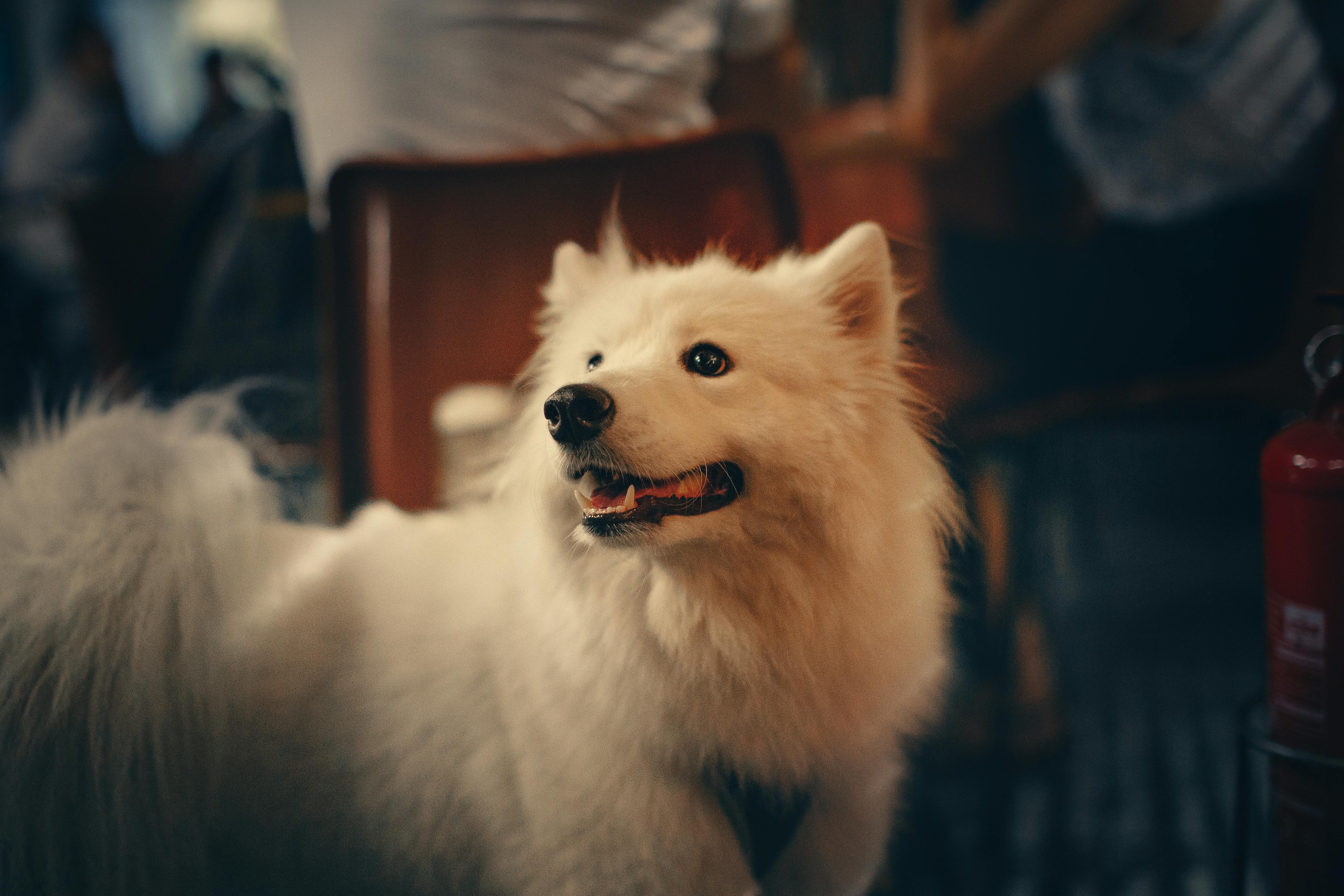
The Samoyed is one of the most recognizable white fluffy breeds, but it belongs to a different visual category. AKC guidance puts Samoyeds at about 19–23 inches and 35–65 pounds. Their upright ears, wedge-shaped spitz head, dense coat, and tail carried over the back make them comparatively easy to separate from the drop-eared livestock guardians once you know what to look for.
Visual clues
- Upright triangular ears.
- A distinctly spitz-like head and expression.
- Tail usually carried up and over the back rather than hanging like a guardian dog's plumed tail.
- Dense white double coat that adds considerable visual volume.
Do not choose a Samoyed because you want a “low-energy fluffy dog.” AKC describes the breed as social and active, with regular exercise and mental stimulation important for welfare. The coat is also a genuine maintenance commitment: frequent brushing is necessary, and shedding can be substantial.
3. Kuvasz: The Great Pyrenees Look-Alike That Even Dog People Confuse
The Hungarian Kuvasz is one of the most important breeds to include in a serious “big white dog” comparison because it can genuinely resemble a Great Pyrenees. AKC specifically notes that the public commonly confuses the two.
Great Pyrenees vs. Kuvasz: the useful differences
- Color: a Great Pyrenees may carry allowed gray, tan, reddish-brown, or badger markings; the Kuvasz is visually associated with a white coat.
- Coat texture: AKC's comparison describes the Kuvasz coat as straight to very wavy, while the Great Pyrenees coat is straight to slightly undulating.
- Rear dewclaws: the Great Pyrenees standard's rear double dewclaws are a classic distinction; the Kuvasz does not share that feature.
- Head: the stop and head planes differ, although this is easier to appreciate after comparing known examples side by side.
Both are large livestock guardians, so the ownership question is not simply “which one is fluffier?” Independent guardian behavior, secure management, socialization, and realistic expectations are central to either breed.
4. Maremma Sheepdog: A Powerful White Italian Livestock Guardian
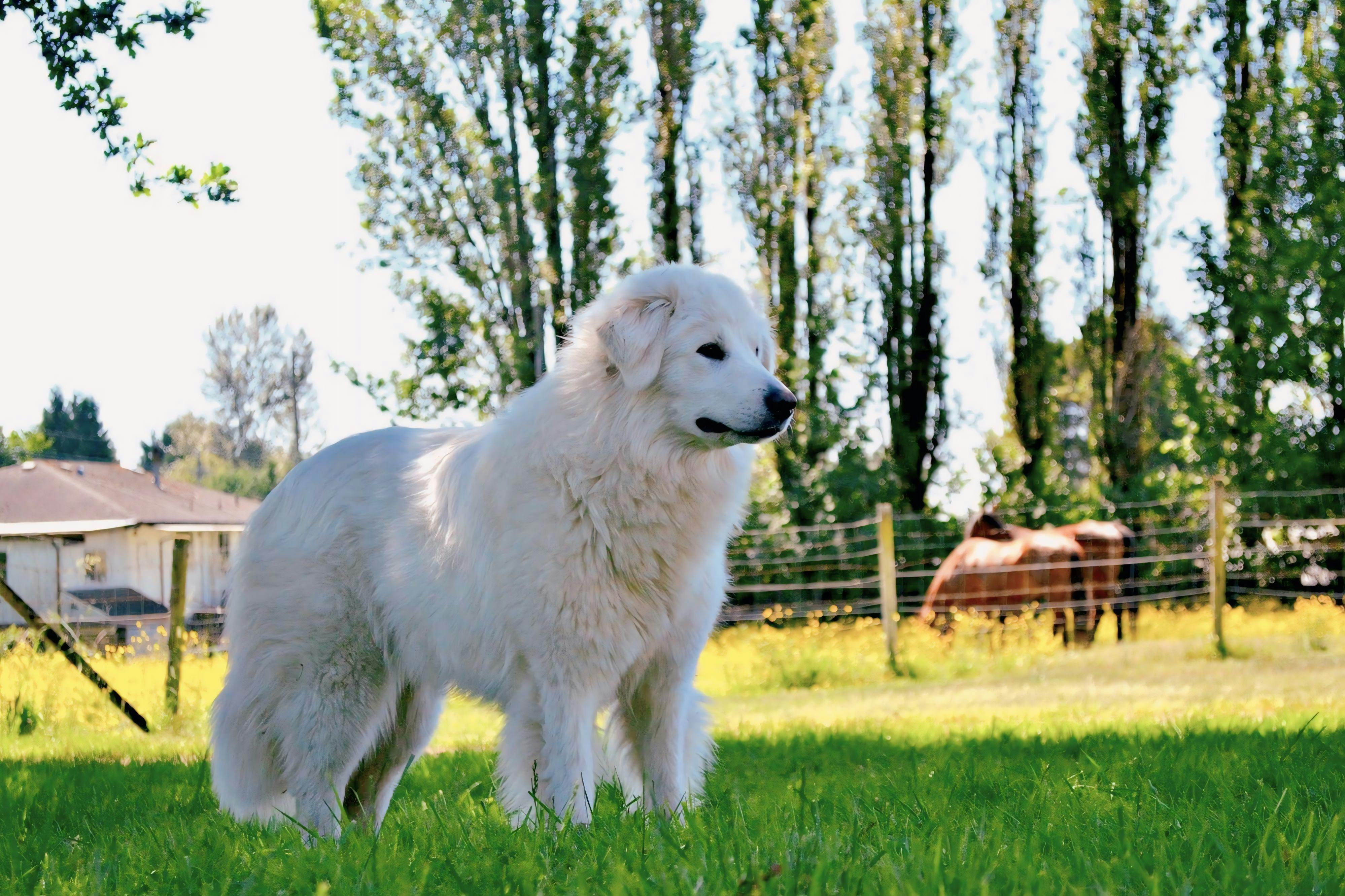
The Maremma Sheepdog (Maremmano-Abruzzese Sheepdog) is another convincing Great-Pyrenees look-alike. The UKC standard describes a strongly built dog with a somewhat long, harsh, straight coat, a seasonal undercoat, and solid white color, with limited pale ivory, orange, or lemon shades tolerated.
Visual clues
- Drop ears and a substantial guardian outline.
- White coat with a pronounced neck collar/ruff.
- Adult males roughly 25.5–28.75 inches and 77–100 pounds under the UKC standard; females are somewhat smaller.
- Less of the spitz outline seen in a Samoyed and no corded coat like a mature Komondor.
The Maremma is a working guardian breed, not simply a decorative white giant. If you are considering one as a companion, investigate the breeder or rescue's dogs as individuals and ask how their lines have been raised, socialized, housed, and worked.
5. Akbash: Taller, Leaner, and More Long-Legged
The Akbash, a livestock guardian originating in western Turkey, can solve the mystery when the dog you saw looked like a very tall white guardian but seemed more athletic or racy than a heavily built mountain dog. The UKC standard describes the Akbash as long-legged, lean, muscular, imposing, and always white.
Visual clues
- Very tall proportions: the UKC desirable range is 30–34 inches for males and 28–32 inches for females.
- Average standard weights are about 120 pounds for males and 90 pounds for females, but weight should remain proportional to the dog's lean working structure.
- Pendant, V-shaped ears.
- A wedge-shaped head.
- Either a medium or long double coat, so not every Akbash looks equally fluffy.
- A tail that may curl over the back when the dog is moving or excited.
This variability in coat length is especially important for photo identification. A long-coated Akbash can look dramatically fluffier than a medium-coated dog of the same breed.
6. Polish Tatra Sheepdog: White, Heavily Coated, and Compactly Powerful
The Polish Tatra Sheepdog, or Owczarek Podhalanski, is uncommon enough in the United States that it may not be the first name people suggest—but visually it belongs in this comparison. UKC describes it as strong and compactly built, with a long, thick, straight or slightly wavy coat, a profuse undercoat and ruff, and uniform white color.
Visual clues
- Drop ears that lie close to the head.
- A profuse mane/ruff around the neck.
- Long, thick white hair on the body, thighs, and tail.
- Males about 25.5–27.5 inches; females about 23.5–25.5 inches under the UKC standard.
- A powerful, rectangular body rather than the lighter spitz silhouette of a Samoyed.
As with the Great Pyrenees, Kuvasz, Maremma, and Akbash, the guardian heritage should be part of any ownership decision. “Calm” and “independent” can coexist; calm behavior does not mean a dog will automatically obey like a highly handler-focused breed.
7. White Shepherd: The Upright-Eared Option With a Shepherd Silhouette
If the dog was white and fluffy but had upright ears, a longer shepherd-shaped body, and a lower saber-like tail, compare it with a White Shepherd. UKC describes the breed as a medium-sized, muscular working dog with a pure white medium-length coat, erect ears, and a low-set natural tail.

UKC's ideal size is about 25 inches and 75–85 pounds for males and 23 inches and 60–70 pounds for females. Compared with a Samoyed, the outline is more recognizably shepherd-like: less compact spitz, more elongated working-dog silhouette, and a tail that normally hangs in a gentle curve rather than curling tightly over the back.
8. Komondor: White, Giant, and Unmistakably Corded as an Adult
A mature Komondor is the outlier in this list. It is a large Hungarian livestock guardian, but its adult coat does not remain a conventional brushed “fluff.” The AKC standard describes a mature coat made of dense, heavy, tassel-like cords formed as coarse outer hair traps the softer undercoat.
Young Komondors can be trickier because the puppy coat is softer and the corded structure develops with age. Owners of corded dogs do not maintain the coat by simply brushing it like a Samoyed or Great Pyrenees; developing mats are deliberately separated into cords. That makes coat-care research essential before considering the breed.
Fast rule: if the adult dog's white coat looks like long ropes or felted tassels, Komondor moves to the top of the list. If the coat is a normal brushed plume, look elsewhere.
Which Big White Fluffy Dog Fits Your Lifestyle?
The visual match is only the first question. These breeds were developed for different jobs, and two dogs that look similar can create very different daily routines.
| Your priority | Breeds worth researching first | What to verify before choosing |
|---|---|---|
| Classic giant white guardian look | Great Pyrenees, Kuvasz, Maremma, Akbash, Polish Tatra | Guardian instincts, barking, fencing, stranger/dog management, local housing rules |
| Social spitz look with upright ears | Samoyed | Exercise, companionship needs, shedding and frequent grooming |
| Trainable shepherd silhouette | White Shepherd | Activity, training, socialization, individual temperament and breeder/rescue history |
| Distinctive corded coat | Komondor | Specialized coat maintenance, guardian temperament, drying/cleanliness logistics |
Do not mistake “calm” for “low maintenance”
Several livestock guardian breeds can appear composed and less frantic than an adolescent sporting dog, but that does not erase the work created by their size, coat, independence, territorial instincts, fencing needs, or nighttime alert barking. Conversely, the smaller Samoyed in this comparison generally has a more active, socially demanding profile.
Apartment living is more than square footage
A large dog can sometimes settle well indoors, while a smaller dog can be difficult in an apartment if vocal, under-stimulated, or poorly managed. For these breeds, evaluate elevator/stair access, heat control, toileting logistics, barking tolerance, leash handling, neighbors, secure outdoor access, and whether your housing or insurer has breed/size restrictions. Never choose solely from a “good apartment dog” label.
Children and giant dogs
No breed should be treated as automatically safe with children. Size alone can cause accidental knockdowns, while food, toys, resting spaces, and rough play can create conflict in any dog. Use barriers and active adult supervision, teach children how to leave a resting dog alone, and read Patify's kids-and-dogs safety guide before bringing a large dog into a busy household.
Puppies change dramatically
A white fluffy puppy may not show its adult proportions, coat texture, or guardian behavior clearly. If you are bringing home a puppy, build your decision around the actual parents, health testing, rearing environment, temperament, and long-term care—not a cute eight-week-old silhouette. Patify's first 30 days with a new puppy guide can help with the transition after the breed decision is made.
How to Identify a Big White Fluffy Dog From a Photo
If all you have is a picture, use this order instead of guessing from coat color.
- Check the ears. Upright ears immediately shift the shortlist toward Samoyed or a white shepherd-type dog. Drop ears keep the livestock guardians in play.
- Check the tail. A tight spitz-style curl over the back supports Samoyed; a lower plumed tail supports several guardian breeds; an Akbash may carry its tail curled when alert or moving.
- Check leg length and body shape. Akbash tends toward a taller, leaner outline; Polish Tatra and Maremma look more substantial; White Shepherd looks distinctly shepherd-like.
- Check coat structure. Conventional long double coat, wavy guardian coat, and mature Komondor cords are very different visual textures.
- Look for markings. Great Pyrenees can legally have certain head/body markings in addition to white, which can help separate a marked dog from breeds expected to present as uniformly white.
- Estimate scale carefully. Use a known object or adult person in the same plane. Fur can make a 50-pound dog look enormous.
- Keep mixed ancestry on the table. If several clues conflict—Samoyed ears but a guardian body, for example—the dog may simply be a mix rather than a poor example of one breed.
Best practice for a rescue dog: describe what you can observe—adult weight, coat, ears, sociability, handling response, activity, guarding behavior—before leaning on a breed label. Those traits are more useful for matching a real dog to a home than an uncertain visual ancestry guess.
Grooming Reality: White and Fluffy Usually Means Work
Most breeds in this guide carry substantial double coats. The exact routine differs by breed and individual, but prospective owners should budget for brushing tools, coat checks, nail care, bathing/drying logistics, and seasonal shedding. A very large wet double-coated dog also takes far longer to dry than a small companion dog.
Do not copy a generic “shave it for summer” rule from social media. Coat decisions should account for the breed's coat type, skin condition, matting, climate, medical needs, and professional grooming advice. The Komondor is a particularly obvious exception to normal brushing advice because a mature corded coat is maintained differently.
Before You Buy or Adopt: Five Questions That Matter More Than Color
- What was this dog bred to do? Livestock guarding, sled/working companionship, and herding produce different default behaviors.
- Can I physically manage the adult? Think about a 70–120+ pound dog pulling, resisting a car load, needing emergency transport, or recovering after surgery.
- Can I live with the coat? White hair on clothing is a lifestyle, not a seasonal surprise.
- What do the actual parents or foster notes tell me? Individual family history and observed behavior are more useful than internet stereotypes.
- What health screening was done? Ask the relevant national breed club what tests are recommended and verify results rather than accepting “vet checked” as a substitute.
Frequently Asked Questions
What breed is the huge white fluffy dog that looks like a polar bear?
In the United States, Great Pyrenees is one of the most common answers, especially if the dog has drop ears, a giant guardian build, and a plumed tail. Kuvasz, Maremma Sheepdog, Akbash, and Polish Tatra Sheepdog can produce a similar impression, so one photo is not enough for certainty.
What is the difference between a Great Pyrenees and a Samoyed?
A Great Pyrenees is substantially larger and has drop ears and a livestock-guardian outline. A Samoyed is generally about 35–65 pounds, has upright ears, a spitz-type face, and a tail carried over the back. Their working histories and day-to-day behavior profiles also differ.
What white dog looks almost exactly like a Great Pyrenees?
Kuvasz is a classic look-alike, and AKC specifically discusses how often the two are confused. Maremma Sheepdog and Polish Tatra Sheepdog can also resemble a Great Pyrenees at a glance.
Are big white fluffy dogs hypoallergenic?
Do not assume so. Most breeds in this guide have significant coats and can shed heavily. “White” and “fluffy” describe appearance, not allergen production. Anyone with dog allergies should discuss risk with an allergist and spend time around the individual dog before making a commitment.
Which big white fluffy breed has pointy ears?
Samoyed and White Shepherd are two important comparisons. Samoyeds have a compact spitz outline and curled tail; White Shepherds have a more elongated shepherd outline and a lower saber-like tail.
Can I identify a dog's breed from a photo?
You can build a shortlist from visible traits, but you cannot reliably certify mixed ancestry from appearance alone. Research comparing shelter visual labels with genetic testing shows why photo-based identification should be treated as an estimate.
Which of these dogs has the easiest coat?
There is no universally “easy” option here. Coat length, undercoat density, shedding, matting risk, environment, and whether the coat is corded all change the workload. The Akbash even has accepted medium- and long-coated forms, while the Komondor requires specialized cord care.
Bottom Line
If someone says “I saw a big white fluffy dog,” start with anatomy rather than guessing from whiteness. Drop ears + giant guardian build makes Great Pyrenees, Kuvasz, Maremma, Akbash, and Polish Tatra worth comparing. Upright ears + curled spitz tail strongly favors Samoyed. Upright ears + shepherd outline points toward White Shepherd-type dogs. Heavy adult cords point toward Komondor.
Then stop where the evidence stops. A visual match can tell you what breeds to research; it cannot turn an unknown dog into a documented purebred. If you are choosing a companion, the dog's observed temperament, adult size, health, training history, and daily-care needs matter more than getting the label exactly right.


