
Corn-Free Dog Food: What Changes, What Doesn't, and How to Read the Label
Quick answer: Corn-free dog food is food formulated without corn ingredients, but it can still contain rice, oats, barley, wheat or other grains. Some corn-free recipes use sweet potato or peas instead; those swaps do not automatically improve nutritional quality, digestion, skin health or heart health. For most dogs, the more useful questions are whether the finished diet meets the appropriate life-stage nutritional standards, what replaced the corn, which proteins and fats are present, and why corn is being avoided in the first place. Tufts veterinary nutrition and AAFCO's label guide are better starting points than front-of-bag slogans.
Editorial disclosure: This is an independent, source-based consumer guide, not a clinical examination, feeding trial, laboratory ingredient test or sponsored brand ranking. The manufacturers cited here describe their own products, and recipes can change. No veterinarian has reviewed or approved this article for Patify. If avoiding corn is part of a suspected allergy, a diagnosed gastrointestinal condition or a medically prescribed diet, arrange an individual veterinary assessment rather than interpreting this comparison as a treatment plan.
 The real difference is in the complete label, not the front-of-bag promise.
Corn-free is a precise shopping filter, not a nutritional grade
A label promising no corn answers one limited question about formulation. It does not identify the nutrient balance, explain what the food was tested for, reveal whether the same manufacturing facilities process corn, or establish that the food will agree with an individual dog. A food may contain none of the ingredients you have decided to avoid and still be an inappropriate choice for a puppy or a dog with a medical condition. Conversely, a corn-containing formula may be complete, highly digestible and well suited to a healthy adult dog.
For a dog owner browsing U.S. pet-store filters, the challenge is that several terms sit beside one another as if they are equivalent: no corn, no corn/wheat/soy, grain-free, limited ingredient, sensitive stomach and hypoallergenic. They refer to different issues. Corn-free is about a specific excluded crop. Grain-free generally excludes multiple cereal grains. Limited ingredient may describe a recipe's marketing approach but is not a guarantee against cross-contact or a diagnostic allergy protocol. Sensitive-stomach language says nothing conclusive about the dog's actual digestive diagnosis.
The first productive question is therefore not “Which corn-free brand wins?” It is “What am I trying to solve?” If you simply prefer a corn-free complete adult food, a grain-inclusive recipe containing rice or oats could fit. If you suspect an adverse food reaction, a random store-bought switch introduces too many variables to identify the trigger. If your veterinarian already controls a therapeutic diet, do not replace it to satisfy an ingredient preference. An informed choice begins with the reason for the exclusion, not the label aesthetic.
Corn-free versus grain-free versus no corn, wheat or soy
A product can be corn-free and grain-inclusive without contradiction. Consider Purina Pro Plan Adult Sensitive Skin & Stomach Salmon & Rice dry dog food: Purina says it is made without corn, wheat or soy while listing rice, barley and oatmeal. The grains are not secretly violating the promise; corn and all grains are different categories. Blue Buffalo's Life Protection Chicken & Brown Rice adult recipe offers another grain-inclusive illustration, with the company's no-corn/wheat/soy claim and its emphasis on brown rice. In both cases the brand describes the current named recipe, not every product it sells.
A different product may exclude corn because it is grain-free. Natural Balance Limited Ingredient Salmon & Sweet Potato is an example: the manufacturer's U.S. page identifies it as grain-free and formulated without corn, wheat or soy ingredients. Those two claims can coexist, but the second does not explain why every grain was excluded. More important, none of these labels alone establishes a food allergy diagnosis or proves superior health outcomes. These are case studies in reading descriptions accurately, not winners and losers.
| Label expression | What it ordinarily signals | What it does not establish | Next check |
|---|---|---|---|
| Corn-free | Corn is omitted from the stated formulation | Other grains are absent | Inspect rice, oats, barley and wheat |
| No corn, wheat or soy | Three specified ingredients are omitted | Grain-free, allergy-tested or cross-contact free | Inspect all remaining grains and proteins |
| Grain-free | Cereal grains are generally excluded | Low carbohydrate, more meat, or better heart health | Identify replacement starches and pulses |
| Limited ingredient | A manufacturer uses a relatively restricted ingredient concept | A controlled clinical elimination diet | Ask about unexpected proteins and production controls |
| Complete and balanced for adult maintenance | An adequacy claim covers an adult life stage | Suitability for growth or every medical condition | Read the exact AAFCO statement |
These distinctions are especially important for people who combine kibble, canned food and toppers. A no-corn claim on a dry recipe is not transferable to its similarly named wet companion. One real-world illustration appears later: Purina's dry salmon-and-rice product is marketed without corn, while its separately formulated salmon-and-rice wet recipe lists corn oil. The meaningful unit of comparison is an exact formula in an exact format, not the brand or flavor family.
Is corn really a filler, and can dogs digest it?
The short answer is that “filler” is not a useful substitute for a nutritional evaluation. Corn can supply digestible carbohydrate, some protein, linoleic acid and other nutrients within a complete formulation. Whether those nutrients are useful depends partly on processing, the amount included, and the rest of the recipe. Veterinary nutritionist Cailin Heinze explains for Tufts that grinding and cooking materially improve corn starch digestibility, and cites studies indicating that the processed starch component can be highly digestible. Seeing an intact whole kernel in stool after a dog ate table scraps is not evidence that a properly manufactured kibble's ground corn is useless.
Neither should corn be elevated into a miracle ingredient. It is one possible ingredient that formulators can use to achieve an overall nutrient target. If a particular dog has a veterinarian-confirmed reaction to a component of corn, its otherwise useful nutritional contribution does not outweigh the need for an individualized diet. But the opposite claim—that every dog benefits when corn disappears from food—is not supported by Tufts' analysis. Food quality is determined at the diet level, including total energy, essential fatty acids, amino acids, mineral balance and the manufacturer's process controls.
Corn also provides a helpful illustration of why single-ingredient judgments can mislead. Its linoleic acid contributes an essential omega-6 fatty acid, yet evaluating skin-health claims still requires considering fatty acid balance across all fats in the formula. A food without corn oil might contain sunflower oil or other ingredients providing the same essential nutrient. A food with corn might contain fish oil and other sources of omega-3. Declaring one bag “anti-inflammatory” from its absence of corn is a leap the label cannot support.
Does corn cause inflammation or make itching worse?
Inflammation is a clinical concept, not a simple yes-or-no property of one ingredient. In Tufts' discussion, the context for corn oil's linoleic acid is the total fatty acid profile; it is not an instruction to eliminate every omega-6 source. Dogs can itch because of environmental allergens, parasites, infections and a range of other issues unrelated to their cereal grains. A dietary food reaction is possible in some cases, but a corn-free switch is not a controlled diagnostic test. Keep a symptom history and ask your veterinarian what the pattern suggests before changing multiple factors at once.
Does visible corn in stool prove poor digestibility?
Not if the observation follows whole sweetcorn from the kitchen or another unprocessed source. An undigested husk and a processed pet-food ingredient are not the same substrate. Tufts also warns against letting dogs chew or swallow corn cobs: a cob can lodge in the gastrointestinal tract and may require urgent surgery. The safety advice about corn on the cob must not be confused with a claim that properly formulated commercial dog food containing ground corn causes obstruction.
What replaces corn? A practical ingredient substitution map
The user's original question usually becomes more useful when reframed: if corn is out, what is in? A manufacturer may use another cereal grain, a root or tuber ingredient, a pulse, or a combination. Those ingredients contribute different mixes of starch, fiber, protein and micronutrients; they are not interchangeable simply because they all appear somewhere below the animal protein on a package. Nor does an ingredient list reveal the complete nutrient composition of the finished food.
Rice can supply readily usable starch and is common in grain-inclusive sensitive-stomach formulations. Oats and barley add different fibers and can influence how a recipe behaves during processing. Brown rice may contribute additional grain-associated nutrients relative to certain refined forms. Sorghum and millet can be useful grain alternatives, but their mere presence offers no guarantee that a specific food has been sufficiently evaluated. Potato, sweet potato and tapioca are non-grain carbohydrate sources; “grain-free” does not necessarily mean “starch-free.”
Peas, lentils and chickpeas differ from simple starch replacements because they can also contribute meaningful plant protein and fiber. Their place in a diet's formulation matters, particularly given ongoing research into diet-associated dilated cardiomyopathy (DCM). The FDA has observed that pulses often appeared high in ingredient lists among reported diets, including some that contain grains. A 2026 Tufts research update emphasizes that high-pulse diets, rather than the absence of grain alone, are an important focus of investigation; the specific biological cause is still being studied. This is a reason to ask thoughtful manufacturer questions, not a scientific basis for claiming one pea on an ingredient list will harm a dog.
| Corn alternative | Grain or non-grain? | What it can contribute | Why the whole formula still matters |
|---|---|---|---|
| Rice or brown rice | Grain | Starch, some grain-associated nutrients | Protein, fat and total calories may vary widely |
| Oatmeal and barley | Grains | Starch and fiber fractions | Not appropriate if the dog must avoid that exact ingredient |
| Sorghum or millet | Grains | Starch and varied nutrients | Their name doesn't prove superior nutrient bioavailability |
| Sweet potato or potato | Non-grain tubers | Starch, selected fiber and micronutrients | Replacing grain doesn't necessarily reduce carbohydrate |
| Tapioca or cassava | Non-grain starch | Concentrated starch for processing | No automatic higher meat content or nutritional benefit |
| Peas, lentils, chickpeas | Non-grain pulses | Plant protein, starch and fiber | Ask about inclusion levels and current DCM research |
This matrix is an ingredient-function comparison, not an independent digestibility experiment. A starch source can be helpful in one recipe and unsuitable in another depending on amounts and companion ingredients. There is no universally “cleaner” starch that you can identify without looking at the finished diet, its adequacy statement and the manufacturer's quality-control evidence. For dogs eating veterinary diets, substitution is a medical decision rather than a personal preference exercise.
Real U.S. labels: four examples and one easy-to-miss difference
To test whether “corn-free” helps a shopper make a decision, consider four current U.S. product pages. The purpose here is not to rank them by quality. Two are corn-free and grain-inclusive dry foods; one is both corn-free and grain-free; and one is a wet food whose name resembles a corn-free dry product but contains corn oil. Each manufacturer's current product page is the source for its own ingredient and nutrition claims. Packaging, lots and formulations can change, so compare the bag or can you intend to purchase.
| Exact U.S. product or format | Manufacturer-listed grain/starch examples | Corn finding from source | Label lesson |
|---|---|---|---|
| Purina Pro Plan Adult Sensitive Skin & Stomach Salmon & Rice dry | Rice, barley, oat meal | Purina explicitly says made without corn, wheat or soy | Corn-free and grain-inclusive; check the precise dry formula |
| Blue Buffalo Life Protection Adult Chicken & Brown Rice dry | Brown rice, other whole-grain ingredients | Blue Buffalo displays a “no corn, wheat or soy” promise for the recipe | Corn exclusion doesn't mean avoiding chicken or rice |
| Natural Balance Limited Ingredient Salmon & Sweet Potato dry | Sweet potato; grain-free formulation | Manufacturer explicitly says formulated without corn and grains | Corn-free may also be grain-free, but read the complete label |
| Purina Pro Plan Sensitive Skin & Stomach Salmon & Rice wet | Rice, oat meal and potato protein among listed ingredients | Manufacturer ingredient list includes corn oil | A similarly named dry formula's claim does not cover the can |
The last row is unusually instructive. Someone searching “corn-free salmon Purina” may find the dry formula's no-corn marketing and assume the canned companion follows suit. The current Purina page for the wet product actually lists corn oil. Corn oil is a corn-derived fat, not a grain kernel or a significant protein source; nevertheless, a person attempting complete ingredient avoidance should not overlook it. For a veterinary elimination trial, whether refined oils matter depends on the individual protocol and product details, so the veterinarian and manufacturer should be consulted rather than assuming either guaranteed safety or guaranteed reactivity.
The brands in the table are not clinical recommendations or controlled comparative trials. In fact, the most important observation has nothing to do with which company is “best”: an ingredient restriction applies to a specific SKU and recipe, not a product-family name. The table also demonstrates how changing from rice and barley to sweet potato can alter multiple nutrient sources at once. If a dog improves after switching between those foods, you cannot know that corn absence caused the change because meat protein, fatty acids, fiber, calories and manufacturing processes also differ.
The grain-inclusive example: Purina dry salmon and rice
Purina's U.S. dry adult product page lists salmon first, followed by rice, barley, canola meal and oat meal, and publishes the manufacturer's claim that no corn, wheat or soy is used. The formula contains fish meal, salmon meal and beef fat as well; those are worth noticing if the shopper's actual concern is a specific animal protein rather than corn. Its page provides a calculated energy density of 3,903 kcal/kg and 449 kcal/cup at approximately 115 grams per cup. The numbers help explain why portion questions belong in ingredient-focused comparisons: a label exclusion does not independently determine caloric intake.
Purina also makes a separate puppy salmon-and-rice sensitive-stomach product. Even when ingredient lists look similar, life-stage requirements are not interchangeable. Reading the exact adult adequacy statement on the current package is more useful than assuming that a puppy, an active adult and an older pet can all eat the same formula because it lacks corn. The manufacturer is the appropriate source for current formulation, nutrient analysis and lot-specific questions.
The rice-based example: Blue Buffalo chicken and brown rice
Blue Buffalo's adult Life Protection Formula Chicken & Brown Rice page emphasizes deboned chicken, brown rice and whole grains, while showing a no-corn/wheat/soy claim for that formula. That makes it a second valid illustration of corn-free, grain-inclusive marketing. It does not make the formula equivalent to Purina's fish-based example: its leading animal proteins differ, and the consumer would still need to inspect the full guaranteed analysis, life-stage statement, energy information and manufacturing answers before deciding between them.
Notice how the marketing narrative can distract in two different directions. Someone avoiding corn may over-credit the no-corn promise as a quality certificate. Someone avoiding chicken may reject the salmon-and-rice recipe without checking its additional fish and beef ingredients but then mistakenly choose the chicken-and-rice recipe because of the “grain” category. A deliberate, ingredient-by-ingredient comparison works better than a positive or negative reaction to an attractive front panel.
The grain-free example: Natural Balance salmon and sweet potato
Natural Balance states that its Limited Ingredient Salmon & Sweet Potato dry recipe is grain-free and formulated without corn, wheat or soy ingredients. The U.S. page provides an adult-maintenance AAFCO formulation statement and a calculated 3,360 kcal/kg, 365 kcal/cup. These are manufacturer-reported numbers, not Patify laboratory results. The product demonstrates that excluding corn can be accomplished by choosing a grain-free formula—but a buyer still has to ask why excluding rice, oats and barley is necessary for this particular dog.
The calorie contrast between 449 kcal/cup on Purina's dry salmon recipe and 365 kcal/cup on this Natural Balance recipe should not be treated as a weight-management ranking. Cup weight can differ among foods, and the ingredients, nutrient concentrations and intended uses are not identical. A dog eats calories and nutrients, not marketing categories. If portion control matters, use the product-specific energy density and a suitable feeding plan; do not guess equivalent quantities from a measuring cup without weighing them.
How to verify a corn-free claim ingredient by ingredient
Begin with the exact bag, can or manufacturer PDF, not a shopping site's filter alone. Search the ingredient list for plainly named corn components such as corn, ground yellow corn, whole grain corn, corn gluten meal, corn meal, corn flour and corn oil. These ingredients are not nutritionally identical, but they are all related to corn. A blanket search for the three letters “corn” can generate false alarms if it matches an unrelated string, while visual scanning can miss an item hidden far down the list. Use the exact ingredient words and context, then check the actual package when the web page is ambiguous.
A second pass should identify what you are not avoiding. Rice, oatmeal and barley are grains, but they are not corn. Beef, chicken, fish and egg are proteins that could be relevant to a different dietary concern; their presence does not contradict a simple corn-free claim. Pea flour, pea protein, lentil flour, potato starch or tapioca are different substitutions and should prompt questions about the recipe as a whole, especially if several pulse components appear high in the list. Avoid treating a long ingredient list as automatically bad or a short one as automatically good.
Finally, separate ingredients from assurances about manufacturing. The printed list describes the declared recipe; it does not independently establish the absence of unintended ingredient carryover, and no common retail phrase means a product was produced in a fully segregated facility. If avoiding traces is medically important, ask the manufacturer about shared lines, allergen controls, incoming-ingredient verification, changeovers, testing and how recently the information was confirmed. A general customer-service response saying “our food is premium” is not a substitute for information about the exact product.
| Label question | Useful evidence | Misleading shortcut |
|---|---|---|
| Does this exact recipe intentionally include corn? | Current complete ingredient list, bag and manufacturer confirmation | “No corn” badge on a different flavor |
| Is it grain-free? | Check rice, barley, wheat, oats and other cereals | Assuming no corn means no grains |
| Can this feed my dog every day? | Exact AAFCO nutritional adequacy and life stage | Assuming the ingredient claim implies completeness |
| What replaced the corn? | Specific grain, tuber and pulse ingredients | Assuming any replacement is automatically healthier |
| Is this suitable for an elimination trial? | Veterinarian-designed protocol and manufacturing information | A retail limited-ingredient or corn-free logo |
| Will it supply comparable daily energy? | kcal/kg and weighed daily portions | Comparing cup volume or bag price alone |
Use these questions as a repeatable audit, not a numeric “health score.” The answers are not additive points, and there is no evidence-based reason to assign a universal grade for excluding corn. A formula can pass a chosen ingredient filter while failing the more fundamental test of meeting a growing dog's nutritional needs. Another formula may meet the life-stage requirements yet remain inappropriate in an individually confirmed food allergy.
Does avoiding corn help a dog with allergies?
Sometimes removing a specific ingredient is justified, but suspicion and diagnosis are different. Tufts explains that true food allergies are less common than many shoppers assume and that animal proteins appear more often in confirmed reactions than grains. The fact that a dog scratches, has intermittent loose stools or experiences ear inflammation does not isolate corn as the problem. Changing to a formula that simultaneously removes corn, changes animal protein and changes fat and fiber levels introduces several possible explanations for any subsequent improvement.
A veterinary elimination diet usually requires a carefully chosen food and rigorous control of other exposures, followed by an intentional challenge to clarify whether the suspected food-related problem returns. The appropriate diet and trial duration depend on the dog's condition and medical history. Over-the-counter restricted-ingredient foods can be formulated for everyday feeding but may not provide the degree of ingredient control necessary for diagnosis. Don't treat the word “hypoallergenic” as proof of zero allergen exposure, and don't assume a diet marketed without corn meets the protocol your veterinarian prescribed.
If a clinician has advised avoiding a confirmed specific ingredient, ask whether the restriction concerns the source protein, any corn-derived ingredient, or manufacturing cross-contact. Corn oil, corn starch and corn gluten meal do not have identical protein compositions; that distinction can matter clinically, but it must not be used by a website to approve one derivative for a sensitized dog. For owners who simply prefer no corn, it is fine to state that preference without converting it into a medical claim. For owners pursuing allergy diagnosis, consistency and a professional plan take priority over product variety.
Four questions worth taking to the veterinary appointment
Ask what diagnosis is actually suspected, what evidence would confirm it, which other causes must be ruled out, and how a dietary trial would be interpreted if symptoms change. Bring photos of the entire current bag—including the guaranteed analysis and adequacy statement—not only the front logo. Record every treat, chew, supplement and flavored medication as relevant to the veterinarian's instructions. If your dog is a puppy, pregnant, underweight or managing another illness, mention those facts before restricting the diet. A well-prepared history is more useful than a list of previously tried brands with no dates or outcomes.
What about diet-associated DCM and grain-free substitutes?
This question deserves precision rather than fear. The FDA has reviewed reports of non-hereditary dilated cardiomyopathy in dogs consuming certain diets and observed that many reported foods featured pulses such as peas or lentils prominently. These formulas included grain-free diets and some grain-containing ones. The FDA says it has not established the specific causal link, and reports do not mean every product containing lentils is dangerous. Nonetheless, a corn-free shopper who chooses a pulse-heavy grain-free formula has changed more than the corn ingredient—and should understand the unresolved research.
A June 2026 Tufts veterinary nutrition research update says that current findings continue to connect diet-associated DCM with high-pulse diets and notes that the disease is not simply caused by a lack of grains. The update discusses possible mechanisms under ongoing study, without presenting a finished explanation for every case. This is a stronger and more current description than old slogans claiming that “grain-free always causes heart disease” or “adding taurine fixes the issue.” Neither sweeping statement follows from the evidence provided.
The practical response is to look for the pattern of ingredients and the manufacturer's ability to explain the finished formula. If a corn-free food uses rice and oats rather than a prominent mix of multiple pulse fractions, its ingredient pattern is different from that of a pulse-heavy grain-free diet. But that contrast alone cannot certify one food as safe or diagnose a heart problem. Discuss diet history with your veterinarian, especially in dogs with known heart disease or concerning signs. Trouble breathing or collapse requires urgent veterinary care regardless of what is printed on the food bag.
Check nutritional adequacy before comparing “clean” ingredient lists
A U.S. pet food label's nutritional adequacy statement tells you much more about its intended dietary role than a no-corn slogan. AAFCO's consumer guidance describes statements based on meeting nutrient profiles or on feeding tests using AAFCO procedures, and it explains that the named life stage matters. Food intended for adult maintenance is not necessarily appropriate for a growing puppy, pregnancy, nursing or a medically managed dog. Carefully distinguish complete everyday food from treats and products intended for intermittent or supplemental feeding.
For a large-breed puppy, check whether the growth statement specifically includes or excludes growth of large-size dogs. For a senior dog, assess body condition and medical circumstances instead of assuming it needs a generic “senior” food. For a dog receiving a prescription diet, dietary composition often serves a precise clinical purpose. A corn-free alternative cannot simply be substituted because it appears similar on an online shopping page. The energy and nutrient needs are individual even when the ingredient preference is simple.
Look beyond crude protein and fat minimums in the guaranteed analysis. These are legally defined label values, not necessarily the actual average composition of a production lot. If the reason for switching includes weight change, exercise level or a medical issue, you may need typical nutrient analyses, calcium/phosphorus information, kcal/kg and other data. Ask the manufacturer how its team formulates the diet, confirms nutrient levels and controls ingredient suppliers. The AAFCO statement is essential evidence, but it is not the complete quality-control history of a product.
How to compare protein and calories without misreading the bag
Removing corn does not automatically raise animal protein. Some formulas replace it with rice; others add legumes that contribute plant protein. An ingredient list cannot quantify the final share of animal-sourced versus plant-sourced protein merely by counting the first few items. Nor can “salmon first” guarantee the absence of beef fat, egg or another animal component later on the list. If your actual priority is a particular protein source or a suspected allergy, examine every animal-derived ingredient and obtain the relevant manufacturer information.
Daily energy offers a second comparison that is easy to miss. Imagine a dog whose veterinarian-established plan specifies 680 kcal per day from its complete food. Using the real manufacturer figures above, a food at 3,903 kcal/kg would require roughly 174 grams per day, while a food at 3,360 kcal/kg would require roughly 202 grams. This is arithmetic for an explicitly hypothetical dog, not a recommendation that any dog should receive 680 kcal. Weighed portions matter because a measuring cup may contain different numbers of grams for different kibble shapes and densities.
It would also be a mistake to declare the second food better merely because the bowl looks fuller. Appetite, satiety, digestibility, dietary fiber, total caloric intake and the dog's response require a complete assessment. If one recipe costs more per pound, it may or may not cost more per day depending on energy density and true feeding quantity. A diet selected to avoid corn should still fit the animal's body condition, activity and household budget rather than encouraging inappropriate overfeeding or cutting back so much that nutrient intake becomes inadequate.
| Illustration using manufacturer-published energy density | Energy density | Portion at hypothetical 680 kcal/day | Interpretation |
|---|---|---|---|
| Purina Pro Plan Adult Sensitive Skin & Stomach Salmon & Rice dry | 3,903 kcal/kg | 174 g/day | Corn-free, grain-inclusive example |
| Natural Balance Salmon & Sweet Potato grain-free dry | 3,360 kcal/kg | 202 g/day | Corn-free, grain-free example |
The two numeric portions were computed from kcal/kg and rounded to whole grams. They do not account for treats, mixed feeding, medical restrictions, individual energy needs, or different nutritional priorities. The use of a real manufacturer energy number does not imply that either company recommends 680 kcal to your dog. Your veterinarian or established individualized feeding plan must supply the daily calorie target before a calculator can convert that target into food grams.
A better five-step decision process at the pet store
Start with your purpose. Is corn avoidance a personal buying preference, a vague worry raised by marketing, or a confirmed veterinary restriction? If it is a preference, choose among complete foods suitable for the dog; there is no need to manufacture an allergy concern. If a health issue is present, resolve the clinical question before replacing a prescribed diet with a retail bag. This first step prevents unnecessary switching and gives every later comparison a clearer meaning.
Next, identify the precise SKU, format and life stage. The Purina dry-versus-wet example illustrates why names alone are unreliable. Read the full ingredient list, including oils and minor ingredients, and check the nutritional adequacy statement. Third, map the substitutions: are they rice and barley, sweet potato or tapioca, or prominently placed peas and lentils? These details affect the questions you ask, not a fixed algorithm that declares one recipe superior. Fourth, request missing evidence from the manufacturer, especially about formulation expertise, testing and cross-contact if medically relevant.
Finally, plan the transition and follow-up. For a healthy dog changing foods for preference alone, manufacturers commonly recommend a gradual transition over about a week, adjusted to the animal's tolerance; suddenly changing ingredients can itself cause gastrointestinal upset. Observe appetite, stool consistency, weight and activity. Do not interpret a few better days as proof of an allergy cure, especially if treats and schedules changed at the same time. Persistent vomiting, diarrhea, reduced appetite, weight loss or new skin problems warrant veterinary attention rather than repeated unsupervised diet experiments.
Questions to send the manufacturer before buying
A clear question often produces better information than a review score. Provide the exact product name, package size and, if relevant, lot number when requesting confirmation. Ask whether corn, corn gluten meal, corn starch, corn flour or corn oil are intentionally used in that formulation, and request a current ingredient deck rather than a short marketing summary. If you are investigating a diagnosed adverse food reaction, ask about shared production lines, manufacturing controls and what level of cross-contact assurance—if any—the company can substantiate.
Ask what the complete and balanced claim covers, who is responsible for formulation, whether typical finished-product nutrient analyses are available, and what the company's quality-control program tests. For a formula with prominently listed pulse ingredients, ask how the manufacturer has considered current diet-associated DCM research and how the recipe's overall nutritional adequacy is checked. Respect that some proprietary formulation details may not be disclosed, but vague statements about being “natural” or “holistic” do not answer technical questions. Save dated responses because online pages and packaging change.
If the company declines to answer useful safety, life-stage or formulation questions, that lack of transparency is information in itself; it does not prove that the food is harmful. Conversely, an enthusiastic customer-service reply without documentation does not amount to an independent study. The best shopping process remains grounded in objective statements, the exact recipe and your dog's requirements rather than in endorsement language. The same method applies if corn-free recipes happen to cost more in a particular store: price is a household constraint, not a health outcome.
Common corn-free shopping mistakes
The first mistake is treating corn as uniformly indigestible because a whole sweetcorn kernel can survive digestion. That observation cannot be transferred to cooked, ground commercial dog food. The second is assuming a corn-free formula must be grain-free, which fails immediately when rice, oats or barley appear on the ingredient list. A third is using a dry product's marketing copy to infer the ingredients of a wet food with the same flavor or similar packaging. The Purina dry/wet pair demonstrates why this is a real, not hypothetical, risk.
Another common mistake is diagnosing food allergy from a product change. If a dog's ears improved after a switch, perhaps the animal protein changed, a seasonal allergen disappeared, treatment of an infection worked, or total feeding changed. Without an elimination-and-challenge process, “corn was the cause” is too strong. At the opposite extreme, dismissing a veterinarian-confirmed corn reaction because corn allergy is uncommon is equally wrong; population-level rarity does not negate an individual diagnosis.
Finally, avoid judging nutrition from the length of an ingredient list or a generic “no fillers” label. A brief ingredient statement does not explain the finished vitamin-mineral balance; an elaborate one does not necessarily signify better nutrition. Evaluate the statement of nutritional adequacy, energy density, manufacturer expertise, quality controls and the dog's actual condition. These are less exciting than a fashionable exclusion claim, but they answer the questions that matter for daily feeding.
Frequently asked questions about corn-free dog food
Is corn-free dog food healthier than regular dog food?
Not automatically. Corn can be a digestible ingredient in a balanced formula, and its absence does not establish better nutrient quality or health outcomes. A corn-free recipe can be suitable for a healthy dog if its finished nutrition meets that dog's needs. The reason for excluding corn and the overall diet matter more than a slogan. If your dog has a diagnosed food-related condition, ask the veterinarian to guide the dietary restriction.
Is corn-free the same as grain-free?
No. Rice, barley and oats are grains. A manufacturer can exclude corn while including all three. Grain-free recipes generally omit cereal grains and use other ingredients, but that difference does not certify that one category is better. Purina's dry salmon-and-rice recipe is a published corn-free, grain-inclusive example, while Natural Balance salmon-and-sweet-potato is marketed as both corn-free and grain-free.
Can a dog be allergic to corn?
Yes, an individual dog can react to a dietary ingredient, including an ingredient derived from corn, but confirmed corn allergy appears uncommon. Chronic scratching, vomiting or loose stool has many possible causes. A veterinarian-supervised elimination and challenge process is more meaningful than repeatedly changing bags based on guesswork. Ask a clinician whether oils, starches or manufacturing cross-contact matter for the particular diagnostic plan.
Does corn-free mean gluten-free or wheat-free?
No. Excluding corn does not necessarily exclude wheat, barley, rye or other grains. A product may voluntarily claim to omit corn, wheat and soy, but that is a different and broader declaration than corn-free alone. Gluten-related dietary restrictions require their own ingredient and manufacturing checks where medically relevant. Read the current full label instead of assuming one free-from phrase covers every other exclusion.
Is corn-free dog food always low in carbohydrates?
No. Rice, oats, sweet potato, potato, tapioca and pulses can replace the starch that a formula previously derived from corn. Depending on amounts and processing, the finished food could still contain substantial carbohydrates. The ingredient statement does not disclose exact total starch or carbohydrate percentage. If carbohydrate information matters for medical management, request the manufacturer's actual nutrient data and veterinary interpretation.
Is a corn-free diet automatically better for a sensitive stomach?
No. Stool quality and gastrointestinal tolerance depend on far more than whether corn appears in the formula. Other proteins, total fat, types of fiber, feeding quantity and underlying illness are relevant. A dog that develops diarrhea after abrupt food changes may be reacting to the transition itself, not a particular grain. Seek veterinary evaluation for ongoing or severe signs instead of trialing many products without a plan.
Can corn-free dog food contain corn oil?
A formula whose current ingredient list includes corn oil contains an ingredient derived from corn; therefore, don't assume complete corn-ingredient avoidance without checking. The Purina salmon-and-rice wet formula lists corn oil, while its separately formulated dry version carries a no-corn claim. The nutritional and allergy relevance of a highly refined oil differs from corn protein and must be assessed within the dog's individual clinical instructions.
Should I choose rice, sweet potato or peas instead of corn?
There is no universal winner. Rice is a grain, sweet potato is a tuber, and peas are pulses that add plant protein as well as starch and fiber. Choose based on the complete formulation, life-stage suitability, the dog's health and credible manufacturer information. The FDA and Tufts have investigated diet-associated DCM involving some high-pulse diets; that ongoing work supports asking questions rather than labelling every pulse ingredient unsafe.
What should I do if my dog is already thriving on a food containing corn?
There is generally no basis to change an otherwise appropriate complete and balanced food solely because it contains corn. A healthy dog maintaining stable body condition, appetite and stool quality may do well on a corn-containing formulation. If you want to change for preference, check the replacement carefully and transition thoughtfully. If symptoms or a medical concern prompted the question, discuss them with a veterinarian first.
The bottom line: choose the diet, not the absence claim
Corn-free dog food offers a clear ingredient restriction, and that can be useful when you have a specific reason to avoid corn. It is not shorthand for grain-free, low-carb, better protein, an allergy diagnosis or demonstrated heart safety. The replacement ingredients, complete nutritional profile, life-stage statement and manufacturer's quality-control evidence all matter. A rice-based food and a pulse-heavy grain-free food may both meet a corn-free marketing filter while raising very different follow-up questions.
Before ordering, photograph the exact current label, identify the cereal grains and starch sources that remain, verify the AAFCO adequacy statement, and note any unanswered questions for the manufacturer. Keep the dog's health, appetite and body condition in view. If the aim is to investigate persistent itching, digestive symptoms or a diagnosed medical condition, the most important next step is a veterinary plan—not another unsupported promise on the front of a bag.
Sources, method and editorial limits
The primary nutritional framework comes from Tufts' corn review, Tufts' food allergy review, AAFCO's guide to pet-food labeling, the FDA's current non-hereditary DCM Q&A, and Tufts' June 2026 DCM research update. Direct product claims are checked against the Purina dry product page, Purina wet product page, Blue Buffalo adult product page, and Natural Balance adult product page.
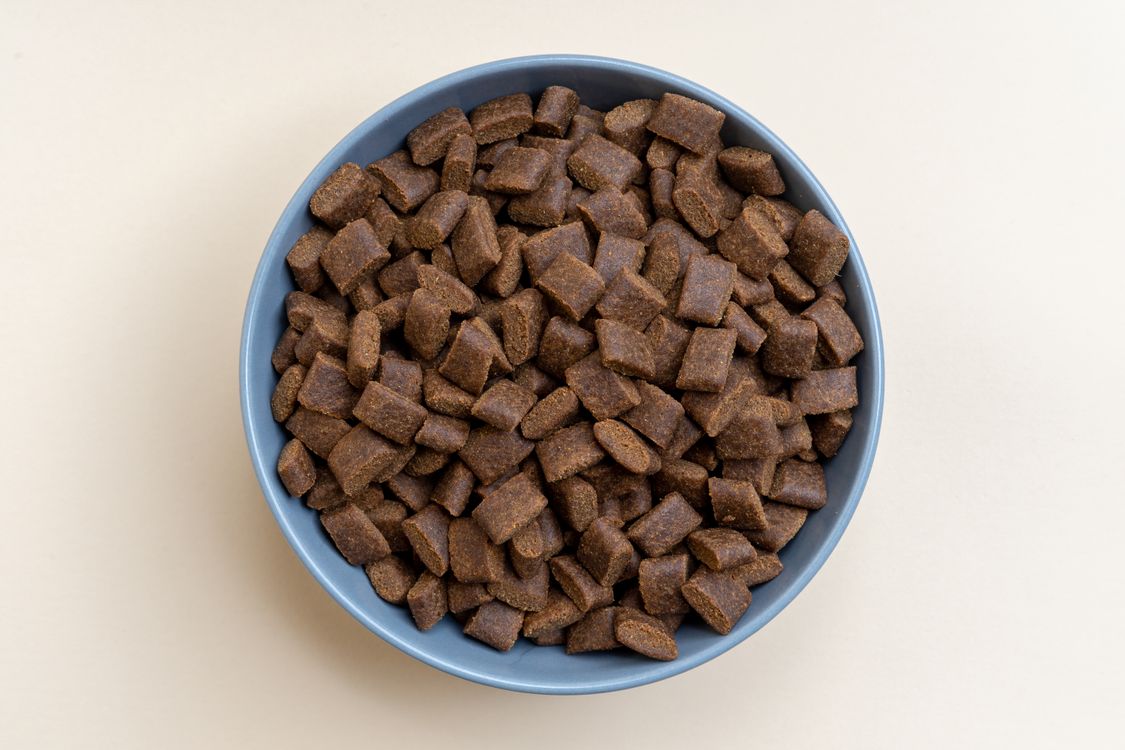
Links were checked October 16, 2026. Product ingredient lists can change, manufacturer information is not independent laboratory verification, and illustrative energy calculations are not feeding advice. This guide has not undergone licensed veterinary editorial review. The photographic illustration shows kibble, not the ingredients or nutritional quality of a specific listed product. For broader context, see Patify's separate U.S. grain-free dog food guide, which examines grain exclusion and DCM more thoroughly without treating corn-free and grain-free as synonyms.