Why Is My Dog's Nose Suddenly Dry and Cracked in Winter?

Source-checked against veterinary dermatology references. This guide explains what a dry nose can—and cannot—tell you about your dog's health.
❄️ The short answer: A dog's nose can become temporarily dry after sleep, wind exposure, cold weather, indoor heating, or mild dehydration. But a nose that becomes persistently crusty, thick, fissured, bleeding, depigmented, or sore is not just a “winter nose.” One important condition to know is nasal hyperkeratosis, where excess keratin makes the nose rough, thickened, and sometimes cracked.
The old rule says a healthy dog has a cold, wet nose and a sick dog has a warm, dry one. Veterinary sources do not support that shortcut. Some perfectly healthy dogs wake up with a warm, dry nose. Others become dry after wind, sun, exertion, or environmental exposure. Meanwhile, a sick dog can still have a moist nose.
So the useful question is not simply “Is the nose dry?” It is: “What else changed?” Texture, cracking, pigment, sores, discharge, pain, appetite, energy, and whether the change persists all provide more information than moisture alone.
What this guide will help you distinguish
- Why a dry nose does not automatically mean illness
- Why winter can make the nose drier
- The condition owners often mistake for simple dryness
- Is dehydration the cause?
- What the nose's appearance can tell you
- What you can safely do at home
- When cracked means “call the vet”
- A special note for Labradors
- Frequently asked questions
First: a dry nose is not a reliable “sick dog” test
VCA Animal Hospitals notes that the temperature and moistness of a dog's nose are not good indicators of overall health status. Healthy dogs can temporarily have dry noses, and sick dogs can still have cool, wet noses.
That is important in winter because owners often feel a dry nose, assume fever or dehydration, and start treating a diagnosis that has not actually been established. The dog's behavior, appetite, hydration status, temperature when clinically indicated, and accompanying symptoms are more useful than nose moisture alone.
A dry nose is a finding. It is not a diagnosis.
Why does my dog's nose get dry in winter?
VCA notes that dogs can develop chapped or dry noses after exposure to the elements. Winter combines cold outdoor air with wind and repeated shifts between outdoor and heated indoor environments.
Dogs can wake from a nap with a dry nose simply because they have not been licking it. If the nose becomes more normally moist again and the dog feels well, that pattern is usually reassuring.
A dog may have a dry nose during dehydration, but the nose alone cannot diagnose dehydration. Gums, fluid intake, urine output, overall behavior, and veterinary assessment matter more.
If “dry” really means rough, thick, crusted, fissured, eroded, bleeding, or losing pigment, the problem may be a nasal dermatosis rather than simple environmental dryness.
The specific condition many owners mistake for winter dryness: nasal hyperkeratosis
Hyperkeratosis means excessive keratin production in the outer skin layer. On the nose, that can create a rough, thickened, crusty surface or projections that look almost like tiny hardened fronds. It often looks much more structural than a nose that is simply a little dry.
MSD Veterinary Manual describes idiopathic nasal hyperkeratosis as a condition seen in older adult dogs, with frond-like keratin growth on the dorsal nasal planum. Importantly, classic idiopathic hyperkeratosis is generally not inflammatory and not painful. That distinction helps separate it from erosive, ulcerative, or autoimmune disease.
| What you see | More consistent with | What to do |
|---|---|---|
| Slightly dry but normal texture | Temporary dryness after sleep, weather exposure, or normal variation | Observe the whole dog, not the nose alone. |
| Rough, thickened, crusty, “horn-like” keratin | Nasal hyperkeratosis | Schedule a vet exam if persistent or worsening. |
| Cracks and fissures with heavy crusting | Hyperkeratosis, hereditary parakeratosis, or another dermatosis | Veterinary evaluation is appropriate. |
| Redness, erosions, ulcers, bleeding, pigment loss | Inflammatory, autoimmune, infectious, or other nasal disease | Do not treat as simple winter dryness; call the vet. |
| Dryness plus one-sided facial/eye/ear abnormalities | Possible neurologic or facial-nerve problem | Veterinary examination is warranted. |
Can dehydration make a dog's nose dry?
It can be associated with a dry nose, but this is where internet advice often becomes too simplistic. A dry nose cannot confirm dehydration on its own. VCA specifically notes that some healthy dogs have dry noses and that moisture is not a reliable overall health marker.
If you are actually worried about dehydration, look at the bigger picture: Is your dog drinking? Are the gums dry or sticky? Has there been vomiting or diarrhea? Is your dog unusually weak or lethargic? Is urine output reduced? Those findings matter far more than whether the nose feels wet to your finger.
💧 Do not use “dry nose = dehydrated” as a home diagnosis. A dog with vomiting, diarrhea, poor intake, weakness, or other dehydration risks deserves assessment based on the whole clinical picture.
Look at texture, pigment, and symmetry—not just moisture
If the normal cobblestone surface is still present and the nose is only a little dry, temporary environmental dryness is more likely.
Excess keratin raises nasal hyperkeratosis higher on the list.
Persistent fissures deserve attention, especially if the cracks deepen or become painful.
Depigmentation together with redness, crusting, erosion, or ulceration can occur with autoimmune nasal disease.
That crosses the line from “dry nose care” into a veterinary dermatology problem.
Markedly asymmetric changes, especially with eye, ear, or facial abnormalities, warrant examination rather than routine balm use.
A red flag many winter articles miss: autoimmune nasal disease
MSD Veterinary Manual notes that autoimmune conditions affecting the nasal planum can cause crusting, erosion, bleeding, depigmentation, and ulceration. Discoid lupus erythematosus is one example. These lesions do not become harmless simply because they first become noticeable in winter.
If the nose is changing color, losing its normal surface pattern, forming sores, or bleeding repeatedly, skip the “just add moisture” assumption. Those findings can require diagnostic testing, including biopsy in some cases.
Another overlooked cause: facial nerve dysfunction
The nose's moisture is partly supported by normal secretory function. MSD notes that damage affecting parasympathetic fibers of the facial nerve can cause excessive dryness of the nasal planum. Ear disease can sometimes be associated with this type of neuropathy.
This is particularly relevant if the dryness is accompanied by facial asymmetry, eyelid problems, reduced tearing, ear disease, or an unusual one-sided pattern. A jar of nose balm cannot fix a nerve problem.
What can I safely do at home for mild winter dryness?
If the nose is only mildly dry, your dog is otherwise well, and there are no sores, bleeding, thick crusts, pigment loss, or pain, simple supportive care is reasonable while you monitor the trend.
- Reduce prolonged exposure to harsh wind and extreme cold.
- Keep fresh water available and pay attention to normal drinking behavior.
- Avoid picking crusts or peeling thickened keratin. This can create pain, bleeding, and secondary infection.
- Do not apply medicated human creams automatically. Products designed for human skin may contain active ingredients or fragrances that are inappropriate for a surface your dog can lick.
- Ask your veterinarian about a pet-appropriate emollient if the dryness persists. MSD notes that emollients are part of management for certain keratinization disorders, including nasal parakeratosis.
✅ A useful home-care boundary: mild dryness with normal texture and a normal-acting dog can be watched. Thick crusting, fissures, bleeding, pain, ulceration, pigment loss, discharge, or systemic illness should move you out of DIY care and into veterinary evaluation.
When should a cracked dog nose see a veterinarian?
VCA specifically recommends veterinary consultation when a dry nose becomes red, cracked, or develops sores, because these changes can be early signs of autoimmune disease.
Make an appointment sooner rather than later if you notice:
- deep or repeatedly reopening cracks
- bleeding
- pain when the nose is touched
- yellow, green, bloody, or excessive nasal discharge
- loss of normal nose pigment
- erosions or open sores
- thick, persistent crusts
- swelling
- changes around the eyes, lips, paw pads, or ears
- lethargy, poor appetite, vomiting, diarrhea, or other systemic signs
A special note for Labrador Retrievers
Labradors have an important breed-specific differential diagnosis: hereditary nasal parakeratosis. MSD describes it as an autosomal recessive disorder associated with an SUV39H2 mutation that causes crusts and fissures of the nasal planum.
This is exactly why a young Labrador with persistent crusting and fissuring should not automatically be labeled “winter dryness.” Signalment—age and breed—changes the differential diagnosis.
MSD also notes that nasal parakeratosis is a long-term condition that can be managed but not cured, and emollients are commonly part of management. A veterinarian may use the dog's breed, history, examination, biopsy, or genetic testing to distinguish it from other nasal disorders.
Is “snow nose” the same thing as a dry, cracked nose?
No. Snow nose refers mainly to seasonal loss or lightening of nasal pigment, often from black toward pink or brown, rather than cracking from dryness. A dog can have pigment change without painful fissures or crusting.
That distinction matters because searching “winter dog nose” often mixes two separate issues: pigment change and surface damage. If the problem is truly cracking, crusting, bleeding, or rough keratin buildup, do not assume benign snow nose.
Related Patify guides
Frequently asked questions
Does a dry nose mean my dog is sick?
Why is my dog's nose suddenly dry in winter?
What does nasal hyperkeratosis look like?
Can dehydration cause a dry dog nose?
Should I put petroleum jelly or human moisturizer on my dog's cracked nose?
When is a cracked nose more concerning?
Can Labradors get a genetic cracked-nose condition?
- MSD Veterinary Manual — Nasal Dermatoses of Dogs
- VCA Animal Hospitals — Why Do Dogs Have Wet Noses?
- MSD Veterinary Manual — Hyperplastic and Seborrheic Syndromes in Animals
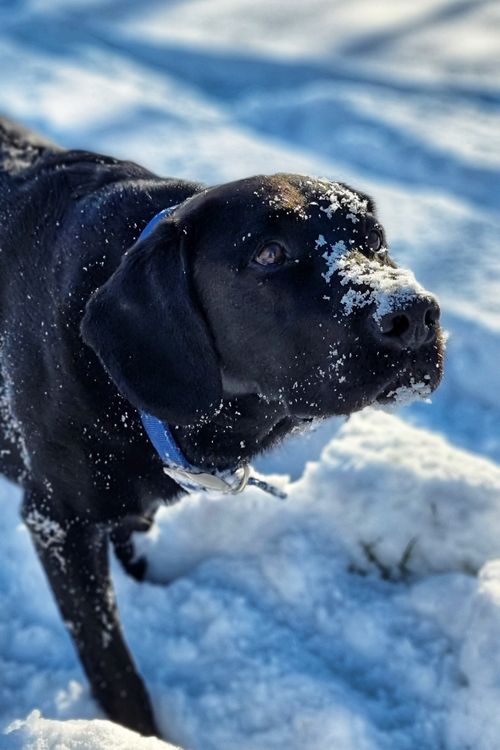
- Cover image: Steph / Pexels — “A Black Dog With Snow On Its Nose,” free-to-use stock photo; license status checked August 12, 2026.