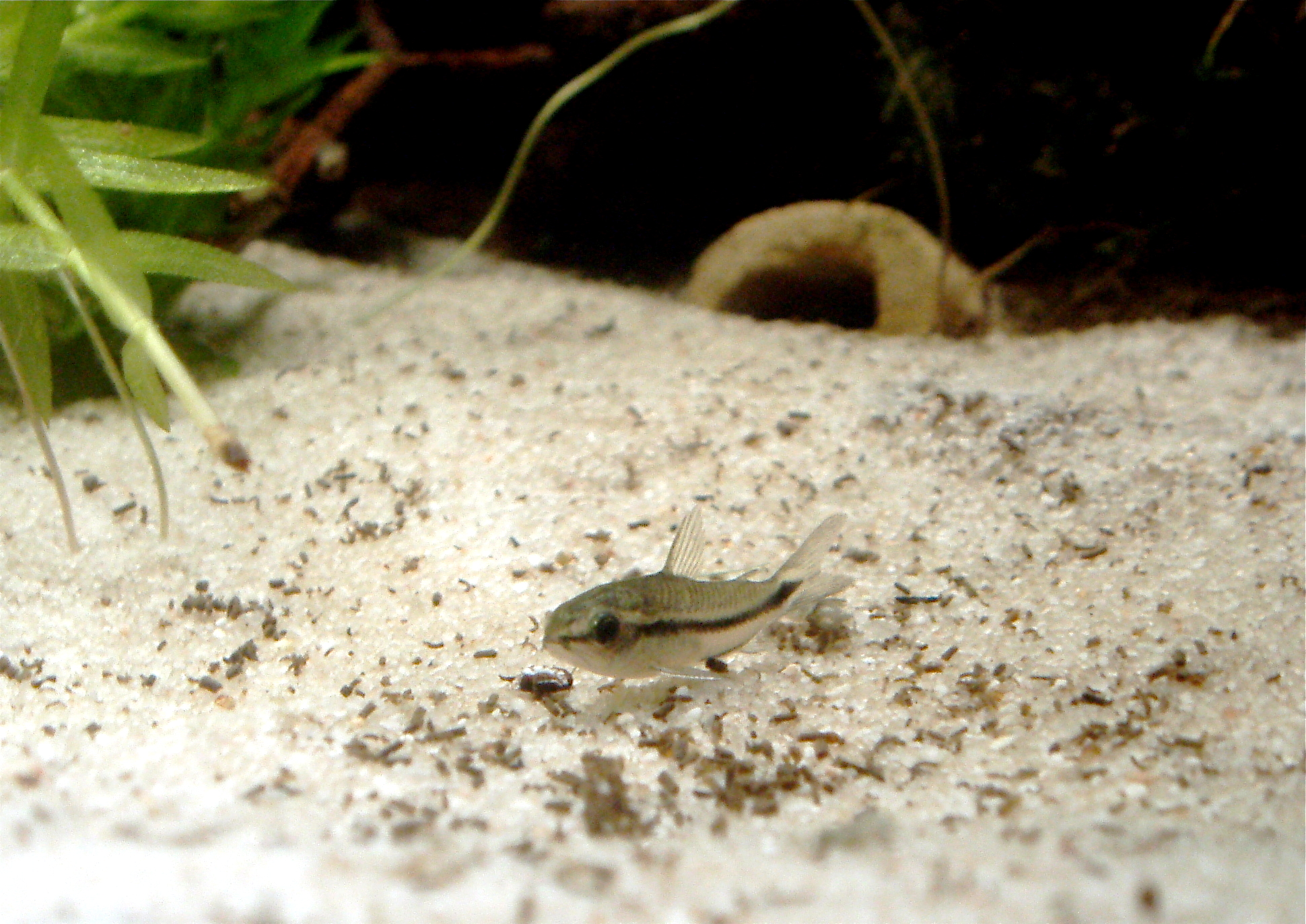
Galaxy Rasbora Care: A Better Tank Plan for Celestial Pearl Danios

A fish sold as a galaxy rasbora looks almost designed for a planted nano aquarium: a charcoal body scattered with pale spots, orange-red fins and enough character to hold your attention even when it is only a few centimetres long. Yet the sales photograph leaves out the decisions that make keeping this fish rewarding. Will a group feel secure enough to leave its hiding places? Can the quieter individuals eat before the bold ones intercept everything? Is the room warm enough in winter but not excessively hot during a summer heat wave? Those questions matter more than an impressive-looking aquascape.
The practical answer: The galaxy rasbora is the celestial pearl danio, Danio margaritatus, not a separate rasbora species. Plan a stable, planted aquarium around a genuine same-species group, accessible feeding lanes and retreats that interrupt pursuit. Seriously Fish's species account lists a 45 × 30 cm reference footprint and 20–26°C (68–79°F); Aquarium Co-Op favours around 22–24°C (72–76°F) and more swimming room for larger groups. Those are planning references, not a guarantee that any tank with the stated dimensions is stocked appropriately.
First identify what the shop is actually selling
Galaxy rasbora, celestial pearl danio, CPD, Celestichthys margaritatus and Danio margaritatus can all appear in retail listings. The first two are common names; the last two reflect taxonomic history, with Danio margaritatus used by modern species references. A listing that uses "rasbora" in the product title is not evidence the fish belongs to the genus Rasbora. The useful purchase question is whether the photographed and delivered animal is the small spotted danio with distinctly barred reddish fins.
Adults show pearly pale dots on a darker body, with red-orange and black banding on the fins. Mature males often look more vivid and slimmer; females commonly have a fuller silhouette, especially in breeding condition. Newly transported fish may look pale or keep their fins close to the body. Never identify sex or diagnose a problem from a single washed-out shop photo. Ask for the scientific name, an up-to-date photograph of the seller's actual stock and information about how the fish are currently eating.
| Label or appearance | What it tells you | Next check |
|---|---|---|
| "Galaxy rasbora" / "celestial pearl danio" | Usually two names for one fish | Confirm Danio margaritatus on the invoice |
| "Celestichthys margaritatus" | An older genus combination | No reason to create a second care profile |
| Spotted body and banded fins | Strong identification clue | Compare several individuals, not a blurred image |
| "Small danio, assorted" | Insufficient identity | Request a scientific identification before buying |
Understand the habitat before choosing decorations
The species is associated with shallow vegetated waters in Myanmar and nearby parts of Southeast Asia. Dense vegetation and comparatively gentle flow are not decorative extras; they help explain why exposed, brightly lit glass boxes can make a group appear timid. The Seriously Fish profile describes a planted layout with broken sight lines and gently moving water. The most useful interpretation is to create short routes between cover rather than one enormous unobstructed swimming corridor.
Do not copy blackwater advice from a completely different nano fish merely because both are tiny. Galaxy danios do not require a peat-stained forest-water imitation. In fact, Seriously Fish specifically notes that tannin-heavy leaf litter is not characteristic of the species' natural setting. A leaf-strewn setup may have other purposes in a mixed aquarium, but there is no reason to darken or acidify water aggressively just to follow a generic "rasbora" tutorial.
Choose a footprint a group can use
A nominal litre or gallon rating is only part of the purchase decision. A tall cube and a longer rectangular aquarium may contain similar water volumes while offering very different ways to avoid chasing fish and distribute food. The Seriously Fish reference footprint of 45 × 30 cm (about 18 × 12 inches) is a starting floor for evaluating a modest setup. Aquarium Co-Op describes 10 US gallons as a baseline it uses and recommends moving to 20 US gallons or more when keeping a group around 10–15. Those recommendations use different assumptions, so do not flatten them into a single universal stocking formula.
For an illustrative planning sketch, compare a 60 × 30 cm footprint with a 45 × 30 cm footprint before adding livestock. The longer tank can have a central feeding view, plant refuges at both ends and more than one route between them. Its suitability still depends on actual fish numbers, filtration, other species and your ability to maintain stable conditions. When shopping in Canada, record dimensions in centimetres and the manufacturer's capacity in litres or US gallons; do not silently treat US gallons as Imperial gallons.
Build a three-zone planted layout
Rather than filling every inch with hardscape, make a quick top-down plan with three functional zones. Zone A is a softly lit, partly open observation strip where you can see which fish take food. Zone B is a stand of stem plants or moss around which adults can retreat during chasing or display. Zone C is a second sheltered route and feeding location on the opposite side of the tank. The goal is to preserve opportunities for small fish to choose distance, not to force them into a decorative cave.
Use the Patify planted aquarium setup guide for the overall plant-and-equipment decisions. If you need a low-growing shelter with numerous fine branches, the Java moss attachment and trimming guide explains how to keep that moss from becoming a neglected waste trap. These are layout resources rather than proof that any given plant automatically makes a tank healthy. Leave space to siphon debris and to observe fish without tearing the aquarium apart every week.
Treat social behaviour as a design constraint
Galaxy danios are social, yet the familiar image of a permanently synchronized, tight school may mislead first-time keepers. Individuals often display, investigate plants and interact in smaller groups. Males may spar or chase, particularly when breeding behaviour intensifies. Aquarium Co-Op suggests 10–15 fish as an attractive group size; Seriously Fish treats them as a group-living species rather than a solitary display animal. Neither source supplies a magic ratio that excuses insufficient space or chronic harassment.
Watch what happens after the first few minutes of feeding. Can a pursued fish enter a second sheltered area and resume normal movement? Are fish spread between plant stands, or are most permanently pinned into one corner? Do several individuals look less well-conditioned over time? Short bouts of display are not automatically pathological, but persistent exclusion from food and resting space is a management problem. Changing the number of males without understanding the tank's footprint and cover may simply move the conflict elsewhere.
Check water temperature with the Canadian room in mind
The Seriously Fish reference is 20–26°C (68–79°F); Aquarium Co-Op highlights cooler comfort around 22–24°C (72–76°F). These are not instructions to chase a precisely prescribed number by rapidly changing heating equipment. Measure your actual aquarium over an ordinary day. A room thermostat, an online Canadian climate normal or a heater dial can all differ from the water temperature that the fish experience.
An apartment can warm sharply during a July heat wave, while a basement or window-adjacent room may cool during a January cold spell. Track daily highs and lows before deciding whether heating or summer temperature management is needed. Avoid direct window sunlight, which can add unpredictable heating and algae growth; use aquarium-rated electrical equipment with manufacturer-directed drip loops and safe placements. If the water persistently exceeds the appropriate range, reducing heat input and improving room conditions is more sensible than making sudden, drastic chemistry changes.
Compare pH and hardness without destabilizing the tank
Seriously Fish lists approximately pH 6.5–7.5 and 5–15 dGH for Danio margaritatus. Aquarium Co-Op reports somewhat broader conditions in its care experience. These figures should trigger thoughtful comparison with the water in which the seller keeps the fish, not an automatic purchase of acids, buffers and a reverse-osmosis system. A cycled aquarium with predictable chemistry is ordinarily a stronger starting point than a chemically manipulated one with large day-to-day swings.
Ask the shop for holding-water conditions and the source of its fish. If a seller's water differs appreciably from yours, plan acclimation with the actual transport and water-quality situation in mind. Bag water after shipping can develop different risks once opened, so a generic rule to drip every fish for a fixed number of hours is not a safe substitute for appropriate acclimation advice. The existing Patify fish acclimation guide covers the broader task without implying that every species or shipping duration is identical.
Finish cycling before introducing delicate livestock
Clear water tells you nothing reliable about whether nitrifying bacteria can process the ammonia generated by a stocked fish tank. Set up and test biological filtration before purchase, not after the courier has arrived. Track ammonia and nitrite through the cycling process using a dependable test method, and understand how feeding, substrate disturbance and filtration changes affect the system. A biologically stable tank also gives plants and beneficial microorganisms more time to establish.
Patify's fishless cycling explanation belongs before any shopping checklist. A newly assembled aquarium may look ready in photographs while being chemically unsuitable for live fish. Once stocked, sudden feeding increases, a complete filter-media replacement or adding several groups at once can overwhelm a previously stable system. Watch actual test results; an arbitrary promise that "the tank is safe after fourteen days" is neither evidence-based nor a substitute for measurement.
Make the tiny-food delivery test before buying
A galaxy danio's small mouth is the first feeding constraint; its sometimes hesitant midwater behaviour is the second. Tiny sinking or slow-sinking particles, appropriately crushed prepared food and small live or thawed frozen foods may all have a role. Seriously Fish notes acceptance of suitably sized dry foods but discourages exclusive reliance on them, while Aquarium Co-Op lists baby brine shrimp, cyclops, daphnia and microworms. Not all frozen food pieces are alike; thaw and inspect rather than assuming the label "small fish" guarantees suitable particle size.
Test the food path in an empty aquarium before adding the fish. Watch where a pinch of particles goes with the filter running as normal. Does it race straight to the intake? Float on the surface beyond the usual feeding area? Get stuck behind hardscape where you cannot remove the leftovers? A change in delivery location, particle size or gentle flow direction can be more effective than simply offering a larger amount. In a stocked tank, the final test is whether several individuals actually swallow food, not merely peck nearby.
Use two feeding points rather than overfeeding
An effective two-point approach is simple: offer a modest amount where the bolder fish already gather, then deliver an appropriately small second portion close to the quieter plant edge. This is not a fixed daily ration; needs depend on animal size, food density, tank load and whether other fish are present. Stop if food accumulates and remove uneaten pieces before they degrade water quality. Changing to a nutritionally complete prepared diet may be useful, but the fish still need particles small enough to ingest.
Record the result rather than guessing. "Food offered: finely crushed dry mix; observed: most fish feeding at both ends; leftovers: some near filter" is actionable. "They seem happy" is not. If fish repeatedly spit out larger particles, change size and texture. If one individual stays hollow-bellied despite abundant food elsewhere, evaluate access, competition, health and professional help instead of automatically increasing the entire tank's ration.
A practical seven-day feeding-access record
For the first seven days after settling, record three observations at consistent, low-disturbance times: locations occupied just before feeding, number of distinct fish visibly feeding, and whether any are being chased away. Add actual thermometer readings and water tests where available. Photographs taken from similar positions may reveal body-condition changes more reliably than memory, but do not net fish or use harsh flash simply to fill a spreadsheet.
| Record field | Example of useful wording | Decision it supports |
|---|---|---|
| Feeding point | "Left plant edge and centre clearing" | Whether the food reaches more than one subgroup |
| Food texture | "Crushed flake disappears; whole granules remain" | Particle-size adjustment |
| Social behaviour | "Two brief male chases, fish resumes feeding" | Normal display vs prolonged exclusion |
| Temperature | Actual °C at morning and evening | Seasonal stability rather than a guessed room temperature |
| Leftovers | "Uneaten crumbs below moss" | Waste removal and smaller portions |
Community fish: distinguish comparison from compatibility
Tiny aquarium fish are not interchangeable stocking units. Ember tetras occupy an overlapping feeding zone, while chili rasboras have their own softer-water and food-scale considerations. Compare our Ember Tetra group and feeding guide and Chili Rasbora identification guide as species-selection alternatives. A link between pages does not imply that all three should be combined in one nano tank.
If you are considering other species, list each group's adult size, social minimum, water chemistry, preferred current and typical feeding location. Predation risk matters even when a larger fish is routinely described as "peaceful". A shrimp colony may be possible in some planted systems, but tiny shrimp offspring are potential food for opportunistic fish. The Patify nano freshwater fish comparison can help generate candidates; the responsible next step is to test the entire planned stocking arrangement rather than select compatible adjectives from a list.
Buying from a Canadian retailer: ask the right questions
Ask whether the galaxy danios are captive-bred, how long the current group has been in the seller's care and whether they are accepting both prepared and small live or frozen foods. Because the species has a history of early collection pressure, provenance is an appropriate question, though a seller's unexplained "farm-raised" badge is not proof of a traceable breeding line. Request written live-arrival terms and check weather-related shipping holds before placing an order during a cold spell or a summer heat wave.
Avoid treating advertised price per fish as the total cost of responsible ownership. The tank, reliable heater if necessary, filter, water tests, foods, plants, quarantine arrangements and the ongoing electricity load may dominate the budget. Compare quotes in CAD only when the Canadian seller actually publishes a current price. This guide does not invent a national average or claim to have purchased or trialled particular brands.
Acclimation and the first quiet evening
Prepare a cycled receiving aquarium before collection or delivery. Dim the lights and minimize disturbances. Check the shipping bag's condition without allowing a prolonged delay in an unsuitable temperature. Follow responsible acclimation instructions appropriate to the actual water and transit situation; opening a bag can change ammonia risk, so do not apply a generic multi-hour drip prescription to every fish. Avoid adding unknown transport water to the display by default.
Expect caution in a new place, but do not ignore serious breathing abnormalities, inability to maintain balance or repeated failure to feed. Give the group adequate cover and a low-disturbance period. The next day's useful question is not whether every male is in perfect colour; it is whether several animals can move between refuges and accept suitable food without one subgroup monopolizing the tank.
Distinguish display, courtship and persistent intimidation
Males may flare or chase briefly, particularly around planted territory and spawning sites. The article by Seriously Fish documents male sparring and notes differences in colour intensity. A short chase followed by routine feeding differs from continual harassment that prevents another fish from accessing shelter. Evaluate the pattern over time, including what happens with the lights on, during feeding and once the room is quiet.
When aggression seems excessive, the first intervention is usually to inspect the environment: can a fish move out of sight, and are all shelters clustered where one bold male can control them? A second feeding point and more evenly distributed cover may help. Do not add incompatible tankmates to "distract" fish before fixing structural problems. Injured fish, torn fins or a steadily deteriorating body condition require prompt welfare attention.
Breeding: plan for very small fry, not instant success
Galaxy danios scatter eggs among fine plants and spawning material; adults may eat those eggs. Mature planted tanks occasionally produce juveniles without a dedicated breeding system, but producing a surviving brood intentionally demands a plan for egg protection, water quality and microscopic first foods. Aquarium Co-Op outlines java moss and spawning mops as potential media and discusses infusoria-sized foods for new hatchlings. That is a developmental sequence, not a promise that every group will spawn on a timetable.
Before encouraging breeding, decide where fry will live and how you will prevent filter intake, feeding competition and deteriorating water quality. Do not move eggs or fish compulsively without a stable prepared environment. If you lack live-food cultures, quarantine space or the capacity to raise tiny offspring, focus on adult welfare rather than using breeding as a test of whether the tank is "good enough".
Maintenance without destroying the habitat
A planted aquarium needs periodic water-quality assessment, removal of excess food, appropriate filter service and plant trimming that preserves cover. Avoid replacing all filter media at once or sterilizing every surface. Fine moss can collect detritus when it blocks flow, yet stripping it completely can remove useful shelter and disturb fish. Plan a modest, observable change, then check the effect on fish location, feeding and water tests.
Routine water-change volume should reflect measured quality and the system's actual load, not a dramatic one-size-fits-all percentage. Match replacement water conditions responsibly. Inspect the filter intake for fry or small adults and ensure food does not continually collect behind equipment. A well-designed setup is one you can maintain without dismantling every safe route that the fish use.
Troubleshooting: diagnose the decision, not just the colour
| Observation | Possible explanation | First useful response |
|---|---|---|
| Entire group stays deep in plants | New surroundings, strong light, aggressive tankmates | Observe at quiet times; review cover and community |
| One fish is repeatedly chased away | Sight lines or social pressure | Distribute sheltered routes and feeding points |
| Pale fish immediately after shipping | Temporary stress is possible | Check breathing, temperature and food intake; monitor |
| Food appears but disappears into filter | Particle delivery problem | Redirect distribution without overfeeding |
| Multiple fish show abnormal breathing | Possible environmental or health problem | Test water promptly and seek qualified advice |
Practical decision: CPD, ember tetra or chili rasbora?
Choose on your actual conditions rather than on a photograph. A galaxy danio setup benefits from comfortable cooler-to-moderate conditions and dense sight-line breaks; ember tetras have their own group-focused midwater display and somewhat broader temperature tolerance in species references; chili rasboras are particularly sensitive to immature systems and unsuitable food scale. This is not a universal ranking of beginner fish. It is a reminder that the species most suited to your existing stable tank may be less spectacular in a shop image but more responsible to own.
If your room routinely exceeds the CPD temperature reference, do not assume that buying all three species solves the issue. If you have only a newly assembled display, finish cycling first. And if you cannot obtain fine food, postpone the purchase rather than expecting a fish with a small mouth to adapt to oversized pellets. Strong fishkeeping choices often involve deciding not yet, not buying more equipment.
Check four physical dimensions before the species arrives
A useful aquarium sketch does not have to pretend to be an engineering model. Write down the real inside length and width, the height of the densest plant stand and the distance from the outflow to the nearest feeding lane. Those four observations reveal everyday constraints that advertised volume hides. Plants that are tall enough to block chasing may also block your ability to distribute food; a plant wall against the filter may catch crumbs; hardscape placed high in the tank may be easy to see but fail to protect fish near the substrate. Make these trade-offs visible while rearranging an empty setup is still simple.
Then look at the tank from its ordinary viewing position, not from directly overhead. You should be able to count a reasonable portion of the group without finding every refuge at once. If you can see all corners continuously, the fish may have no retreat from each other; if you cannot view any feeding space, you may miss the first signs of exclusion. The workable answer sits between those extremes and can change as plants grow. Record one small adjustment and its effect rather than redesigning the tank every weekend.
Canada-specific responsibility and final checklist
Before purchase, you should be able to state the scientific name, current tank footprint, normal temperature range, measured water conditions, group plan, two suitable feeding locations and where quarantine or professional help would be obtained. You should also know the actual vendor's weather-shipping policy. This is a more useful readiness test than a shopping basket full of plant species that look good in photographs.
Never release unwanted aquarium fish, eggs or tank water carrying organisms into Canadian waterways. The Canadian Food Inspection Agency's aquatic animal biosecurity guidance explicitly warns against releasing aquarium animals into natural water. Seek responsible rehoming routes and follow local disposal rules for plants and water. A responsible galaxy danio aquarium begins with good research, but it also has an end-of-ownership plan.
References and image attribution
- Seriously Fish — Danio margaritatus: scientific identity, footprint, chemistry, habitat, social behaviour and diet.
- Aquarium Co-Op — Celestial Pearl Danio: group planning, planted layouts, feeding and fry.
- CFIA — Aquatic Animal Biosecurity: aquarium release prevention in Canada.
- Photograph: Danio margaritatus by Cisamarc, Wikimedia Commons, CC BY-SA 3.0, used without alteration; credit is displayed beside the image in the article.