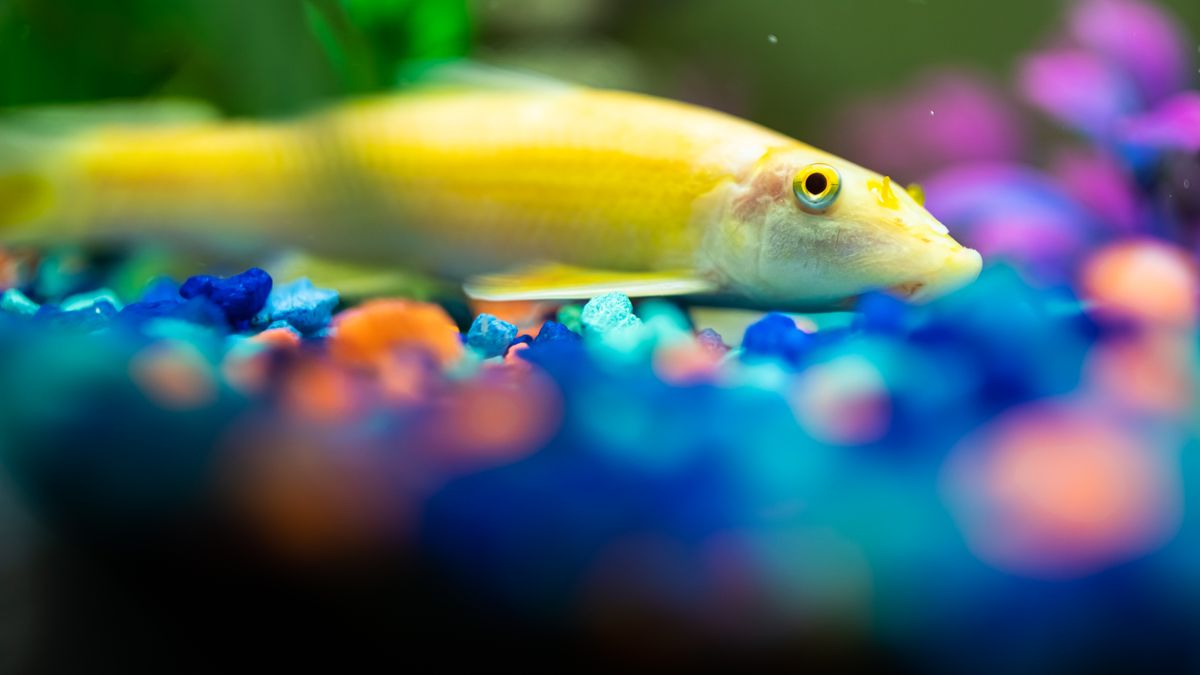
Hillstream Loach Care: Flow, Oxygen, Grazing Surfaces and Feeding

A hillstream loach looks designed for fast water: its flattened body and wide fins let it hold against rocks in a way many aquarium fish cannot. That resemblance to a tiny stingray is captivating, but it has also generated some unhelpfully absolute advice. You may read that a reticulated hillstream loach needs a roaring stream pump at all times, or conversely that the species thrives in any ordinary community aquarium because one keeper bred it there. The better answer is to understand the animal, design for excellent oxygen and stable water, and distinguish documented tolerance from an advisable starting setup.
Here hillstream loach means the commonly sold **reticulated or tiger hillstream loach, *Sewellia lineolata***. Other fishes called “hillstream loaches” differ in habitat and care; please confirm the label before applying these details. This guide synthesizes Seriously Fish's Sewellia lineolata species account and Aquarium Co-Op's experience-based care guide. Their different recommendations are explained, not averaged into an imaginary consensus. No Patify-owned fishkeeping experiment is claimed.
What matters first: readiness over equipment hype
A prepared hillstream aquarium has an established biological filter, very good surface gas exchange, extensive stable hardscape and edible grazing films supplemented with appropriate foods. Fish must be able to rest, feed and travel without being pinned by current or chased from every rock. A powerhead number cannot substitute for those outcomes. Also check the lid: these fish are remarkably capable of reaching gaps or filter compartments while moving along smooth surfaces. That vulnerability is easily overlooked because people picture them as helplessly attached to the bottom.
Seriously Fish lists a 75 × 30 cm minimum base footprint and a general temperature recommendation around 20–24°C for Sewellia lineolata. Aquarium Co-Op describes successful keeping over a broader 20–27°C range with good water quality, while noting higher temperatures may increase stress and disease susceptibility. This is a useful example of evidence types that answer different questions: a specialist reference range for planning versus experienced observations about possible tolerance. If building a new tank specifically for this species, a stable, oxygen-rich arrangement within conservative suitable conditions makes more sense than testing the highest reported limit.
| Readiness test | Pass condition | If not ready |
|---|---|---|
| Biological maturity | Repeated measurements show the filter handles ammonia/nitrite safely | Complete fishless cycling before buying |
| Oxygen and surface movement | Water is agitated appropriately, especially in warmer weather | Fix aeration and circulation before adding fish |
| Grazing and resting surfaces | Several stable flat stones; some seasonally grown film | Let the safe aquarium mature without sterilizing every surface |
| Food access | Appropriate sinking/gel foods available; placement rehearsed | Do not rely on algae alone |
| Escape prevention | Closed cover and filter gaps assessed | Fit secure equipment covers |
| Compatibility | Tankmates match conditions and do not monopolize food | Plan a species-focused arrangement or revise stocking |
Identify reticulated hillstream loaches accurately
Sewellia lineolata is associated with intricate striping or reticulated patterning across the body and fins. It has a very broad, flattened silhouette, strong paired fins and a mouth adapted to grazing surfaces. Yet similar-looking Sewellia, Beaufortia and Gastromyzon species may be offered under the broad names “butterfly loach” or “hillstream sucker”. They are not automatically one species; an online image search can easily mix them. Ask for a scientific name from the supplier and compare a clear overhead and underside photograph with a reputable identification source.
The genus matters because a reader might buy a different species with somewhat different ideal water conditions or social behaviour. The right response to uncertainty is not to invent a precise taxonomic determination from a low-quality photo. Record the name as supplied, ask for corroboration and plan conservatively around mature, oxygen-rich water while identity is checked. The species profile at Seriously Fish contains the formal name and size references; it should remain the citation anchor for this article.
Tank length matters more than a headline gallon number
The species account's suggested base of 75 × 30 cm is roughly 30 × 12 inches. A tank sold as “20 gallons” can have very different length and width depending on whether it is long, high or an unusually shaped design. For bottom and glass grazers, broad usable surfaces and alternative routes matter more than a height increase that does little for feeding access. Sketch the aquarium at its actual dimensions before choosing equipment.
Build an open front grazing terrace of stable stones, a second raised rock area for resting and a sheltered return route near wood or planted clusters. Position stones so a loach can cross from one to another without encountering a single narrow choke point. This also makes it easier to distribute food: one wafer on one rock often turns into a contest rather than a balanced meal. In a medium footprint, do not cram large rocks into every square centimetre; leave travel lanes and maintenance access.
An illustrative layout starts with three islands, not three piles of sharp boulders. Stone A is the primary smooth grazing slab in moderate flow; stone B lies across a lower-flow path; stone C sits where you can watch feeding without blocking the fish. The arrangement is a planning concept, not an experimental design that Patify has tested. Evaluate the real fish's choices after stocking and modify gently if a section is never used or becomes a trapping point.
Flow versus oxygen: two questions, two measurements
Flow refers to water movement; oxygen availability refers to dissolved gas that fish need to breathe. Moving the same water around a sealed or poorly aerated surface is not automatically equivalent to maintaining oxygen. Warmer water generally holds less dissolved oxygen, biological demand changes as waste or bacterial activity increases, and tank equipment can lose performance as sponges clog. Check surface agitation, exchange and stocking together rather than equating litres per hour with fish welfare.
Seriously Fish proposes substantial turnover and a river-style layout, with flow often described in the 15–20 times per hour range. Aquarium Co-Op, drawing on its own maintenance and breeding experience, says reticulated loaches can adapt to more varied flow conditions if the aquarium remains clean and well maintained. These positions do not require us to declare either source wrong. One is a conservative habitat-emulation recommendation; the other reports a wider field of experience. It would be misleading to say every individual needs a single exact pump output or that strong current never matters.
A practical test is to watch where fish spend time over the entire day. Can they hold at a useful grazing surface without frantic effort? Do they move voluntarily into and out of the current? Is there an oxygenated area accessible during feeding and a quieter place for rest? Is surface movement still satisfactory at lights-out? Those observations complement water testing and do not replace professional advice if the fish shows persistent respiratory distress.
Temperature and the Canadian home: track changes, not just averages
A tank in an Ottawa basement may behave differently from one in a Toronto apartment during a summer heat wave. A programmable room thermostat does not guarantee the aquarium's water temperature: lighting, pumps, direct sunlight, cabinetry and ventilation all contribute heat. Use a reliable thermometer and record actual highs and lows rather than writing “room temperature” in the care notes.
The conservative planning zone suggested by Seriously Fish is 20–24°C (68–75°F), while Aquarium Co-Op reports wider successful conditions extending upward. A fish kept near a warm limit will have less oxygen headroom when a filter slows or a room overheats. A fish moved abruptly into cooler water may also be stressed. Do not chase numbers quickly by dropping ice into a tank or changing large volumes with cold tap water. If cooling is needed, understand heat sources, increase safe gas exchange, and use a gradual, equipment-appropriate plan.
If you are balancing this fish against warm-water community animals, be honest about the compromise. A parameter can fall within a tolerable range for both species while still offering little margin for a pump failure or seasonal swing. Planning around the least tolerant animal and the expected worst summer temperature is more responsible than using the broadest ranges found online.
Set up surfaces for aufwuchs without making a filthy tank
Aufwuchs is the living coating on submerged surfaces: algae, microorganisms and associated tiny life. Hillstream loaches pick through it, which explains why clean-looking new rock may not feed a newly acquired fish well. The aquarium needs an established system with some seasoned, lit surfaces as well as prepared foods. Seriously Fish specifically cautions against introducing the species into biologically immature tanks and recommends allowing growth on many hard surfaces without surrendering water quality.
Provide a variety of accessible rock textures without sharp abrasive surfaces that damage fins. Bright enough lighting on selected stones encourages growth, but uncontrolled light is not a replacement for balanced maintenance. Avoid stripping every rock on the same day. Clean the viewing pane if needed, siphon collected waste and leave some mature grazing areas in place while maintaining ammonia/nitrite control. If algae proliferation becomes excessive, work on the root cause rather than treating the loach as a remedy.
Attached hardy plants can offer additional cover and broad leaves that collect film. But the fish is not primarily an ornamental plant purchase. If you want details on attaching anubias and arranging a low-tech aquascape, Patify's planted aquarium setup guide explains the wider equipment choices. Do not assume all plants enjoy the same current or temperature as a hillstream loach.
Food must be supplied, eaten and verified
Much of a hillstream loach's natural feeding is spent grazing rock-associated material, but captive diets can also include appropriately formulated sinking and gel foods plus small animal-origin components depending on the product and species. Aquarium Co-Op notes that these fish take a range of foods rather than living entirely on naturally occurring algae. For a novice keeper, the risky shortcut is to buy a spotless algae-cleaning fish for a spotless tank and watch it slowly lose condition.
A food-access audit is simple enough to perform without a laboratory: offer a suitable, modest portion at two or three separate spots; remain quiet; watch each fish eat; remove excess food; record what was swallowed rather than what was merely touched. A wafer still present an hour later is not proof that every fish has eaten. Some animals investigate food repeatedly before feeding, while others get excluded by a more assertive neighbour. Plan the feeding geometry around actual occupancy.
| Observation | Plausible issue | Useful next step |
|---|---|---|
| Several fish gather; one never feeds | Food competition | Add separate feeding locations and check for exclusion |
| Algae disappears and fish look thinner | Underfeeding risk | Introduce/verify suitable supplemental foods; seek help for ongoing weight loss |
| Prepared foods break apart and drift away | Wrong texture or current placement | Try an aquarium-safe stable feeding surface and suitable food format |
| No interest after shipment | Stress, poor conditioning or illness may be involved | Test water, limit disturbance and consult experienced care promptly |
| Food rots in an inaccessible rock crevice | Overfeeding and hygiene problem | Use smaller portions and accessible placements |
The correct amount varies with number, size, species, formula and natural food availability. Do not treat a retailer's universal wafer count as a physiologically complete feeding plan. A balanced product label is useful, but it cannot guarantee consumption. Body condition, repeated behaviour and water tests provide the practical checks.
Social interactions and grazing territories
Hillstream loaches may appear peaceful because they often rest attached to rocks. That does not mean territory never matters. They can contest desirable grazing surfaces with short pushes, displays and pursuits. Aquarium Co-Op describes territorial activity and breeding in aquaria; Seriously Fish also notes social tendencies. Observe whether every individual has a usable feeding site, not only whether the dominant fish looks healthy in the centre of the tank.
Keep clear resting paths and alternative patches of hardscape. A short dispute followed by ordinary grazing is not equivalent to chronic suppression. If a subordinate fish spends most of its day tucked behind the heater and misses every meal, reconsider the social arrangement, layout and density. That may require more space or separation rather than another decorative plant. The same principle applies to tank mates: combining fish because they are all sold as algae grazers can create direct competition for the same surfaces and prepared foods.
For example, a panda garra also uses rocky surfaces, but it is a different cyprinid with different adult size and social dynamics. The Panda Garra care guide is an alternative species comparison, not a recommendation to put both together. Any actual mixed stocking requires independent evaluation of space, oxygen, feeding access and behaviour.
Escape risks, filter housings and maintenance access
A close-fitting lid is not overcautious. Hillstream loaches climb glass and may enter filter chambers; Aquarium Co-Op explicitly calls attention to both issues. Map every opening above the waterline, including the surprisingly large space created by a hang-on-back return or an automated feeding hole. Check that equipment screens are appropriate for the fish's body dimensions, but do not block critical flow or create unsafe pressure on glass.
Rockwork can also create a maintenance hazard if stones are balanced precariously. Before livestock, gently test stability and access. After a cleaning session, verify that the lid and equipment covers have been returned correctly. Use aquarium-safe materials and keep electrical connections above possible splash pathways. A fish that has been found in a filter compartment needs an environmental fix; rescuing it without sealing the route only postpones the next incident.
Acclimation, quarantine and the first seven days
A loach's first week is when store conditioning, transport fatigue and actual aquarium readiness become visible. Before purchase, ask what foods it currently takes, how recently the shipment arrived and whether the seller has observed normal grazing. If transported for a long time, extended contact with opened shipping water can be risky because ammonia chemistry shifts; use the scenario-based Patify fish acclimation guide and the supplier's specific directions. Quarantine when feasible rather than assuming normal appearance proves freedom from disease.
Keep the receiving tank's temperature and aeration stable. Dim bright light at first and give access to shelter and grazable surfaces. Watch breathing, contact with rocks, feeding and group interactions. An individual remaining stationary for a short period may simply be resting; persistent abnormal breathing, inability to cling, rapid decline or obvious injury merits prompt assessment. Avoid medicating an entire display because a fish looks pale in one photograph.
A seven-day sheet should contain a row per fish per day if practical. Record actual temperature, ammonia, nitrite, visible respiration changes, the exact food offered and whether consumption was observed. Add a short note about current location and social pressure. That ledger is more reliable than an unsupported narrative that the species “always becomes tame by day three”. No fixed acclimation schedule guarantees success.
Maintenance without destroying the food landscape
Routine care has two competing goals: remove waste and preserve enough established microorganisms for grazing and biological filtration. Measure water, complete an appropriate partial change, clean accessible debris and service clogged equipment conservatively. Avoid replacing all mature filter media simultaneously or scrubbing every rock with disinfectant. If an object requires chemical treatment for a specific reason, follow a verified aquarium-safe product label and ensure residues cannot expose livestock.
Check whether water flow has changed since the last maintenance. A powerhead that becomes noisy or a clogged sponge can redirect current or reduce effective circulation. Do not fix every problem by adding a stronger pump. Sometimes clearing a safe obstruction, relocating a return or increasing surface agitation is more appropriate. Patify's whole-tank cleaning guide explains the separate filter and water-change workflow in more detail; this species article focuses on how those tasks affect a surface-grazing fish.
On a separate day each week, review the layout from above. Can you still see more than one feeding station? Did plants grow into the only quiet route? Does one fish control the best rock? These are husbandry observations rather than aesthetic judgements. A tank can look immaculate while depriving its livestock of enough food or rest.
Troubleshooting: do not confuse a symptom with a diagnosis
| Sign | Immediate checks | Avoid this shortcut |
|---|---|---|
| Fish gasps or appears weak in warm water | Temperature, surface movement, ammonia, nitrite, filter function | Assuming a bigger pump alone solves oxygen demand |
| Individual gets thinner | Verify actual meals and grazing access | Assuming rocks always grow enough food |
| Loach repeatedly climbs to lid openings | Cover integrity, disturbance, water conditions | Treating escape behaviour as harmless |
| Persistent fighting at one stone | Food concentration and retreat layout | Buying more animals as a distraction |
| White patches or injuries | Water quality, history, physical trauma, health evaluation | Blindly dosing medication from online photographs |
Observe the timeline and document changes. Was there an unusually hot afternoon, a blocked return, a new fish or a full filter-media replacement? If serious distress persists, seek advice from a qualified aquatic veterinarian or knowledgeable professional promptly. The purpose of an online guide is to identify risks and sensible observations; it is not remote medical diagnosis.
Responsible stocking and purchase in Canada
The Canadian aquarium trade involves local stores, online suppliers and shipment routes that may cross very different climate conditions. Ask whether a fish is accurately identified as S. lineolata, whether it currently eats prepared foods, and whether the seller can provide a quarantine/arrival policy. Confirm that you can be present to receive a winter shipment. Do not invent a national price or assume that low purchase cost offsets ongoing equipment requirements.
The running budget includes a suitable long footprint, safe filter and power system, emergency aeration plan where appropriate, balanced food, tests, electricity and possibly summer cooling. If those are unaffordable, waiting is kinder than buying the fish first. And regardless of whether a species could survive outdoors, never dispose of unwanted aquarium fish by release. The Government of Canada's Don't Let It Loose programme explains environmental and legal risks and recommends responsible rehoming.
A two-temperature-season risk audit for Canadian aquariums
Rather than buying livestock in an ideal month, examine the aquarium's likely worst week of the year. In winter, record the temperature before the room heating switches on and check whether the heater has enough capacity to keep water from swinging. In summer, inspect late-afternoon readings after lighting and pumps have run for hours; this is often when heat stress and reduced oxygen margin become more relevant. Do not artificially create extremes for a test. Use your normal household conditions to identify predictable weak points and plan a safe backup, such as a functional airstone powered by a suitable emergency supply where appropriate.
An owner who keeps the aquarium stable most days but loses circulation during each scheduled filter-cleaning session has a different risk from one whose apartment becomes too hot every July. Both deserve a specific solution. Write down who will check the tank during travel, what equipment can fail and which alarm or visual check would identify the failure early. None of these preparations claims the loach requires a precise oxygen concentration not provided by our cited sources; they recognise that good water quality depends on functioning systems, not optimistic assumptions.
Food-access geometry: a worked hypothetical
Imagine a tank with three reticulated hillstream loaches and one preferred flat rock. The keeper drops a single gel-food portion on that rock. Two fish approach, but the third remains behind a filter intake. The keeper sees the first two grazing and mistakenly logs “all fed”. A better method puts suitable small portions on separate reachable stones and records each fish's actual intake. If the third fish still avoids food, the problem could be social access, shipping stress or illness; it is not proof that the fish only likes natural algae.
This is an illustrative scenario, not a result from animals observed by Patify. Its value lies in showing why total food disappearance is an inadequate measurement. A repeatable log records each distinct feeding spot, whether the food was swallowed, where the fish rested afterwards and whether water quality remained acceptable. Avoid increasing overall food waste indiscriminately when the real issue may be inaccessible placement or social competition.
Frequently asked questions
Can a hillstream loach live without strong current?
Some experienced aquarists, including Aquarium Co-Op, report success with more moderate circulation. That does not negate the conservative current-loving habitat guidance from Seriously Fish. Prioritize clean, stable, oxygenated water, useful feeding surfaces and observed fish behaviour. Do not infer suitability for any neglected low-flow tank.
Do hillstream loaches eat algae?
They graze algae and associated microorganisms, but require food security beyond what happens to grow. An established aquarium can help, while suitable sinking or gel foods and actual consumption checks remain essential. They do not remove fish waste.
Are they suitable for a brand-new tank?
No. Both the need for biological stability and their surface-grazing habits argue against adding them to an immature setup. Complete the nitrogen cycle and establish suitable surfaces before introduction; calendar age alone proves neither condition.
Can I put panda garra and hillstream loaches together?
That is not a default pairing recommendation. They compete for some similar surfaces and may differ in temperature, adult footprint and social needs. Research the complete setup and have a separation plan if mixing species is contemplated.
What temperature is best?
Seriously Fish suggests 20–24°C for general care, while Aquarium Co-Op reports a wider workable range in its experience. Stable conditions with strong oxygen headroom are more valuable than testing how warm a fish can survive.
Sources and limitations
- Seriously Fish — Sewellia lineolata: identification, habitat, conservative temperature and flow recommendations.
- Aquarium Co-Op — Hillstream Loaches: documented husbandry experience and alternative flow/temperature observations.
- Fisheries and Oceans Canada — Don't Let It Loose: responsible aquarium animal handling.
The described layout and observation worksheets are editorially proposed tools. Patify has not physically compared flow configurations, bred these fish, measured dissolved oxygen or performed veterinary examinations for this guide. Claims drawn from an individual retailer's experience are identified as experience; they should not be silently promoted into universal guarantees.