
Last verified: October 3, 2026
Angelfish Tank Mates: Match Adult Size, Temperament and Breeding Behavior
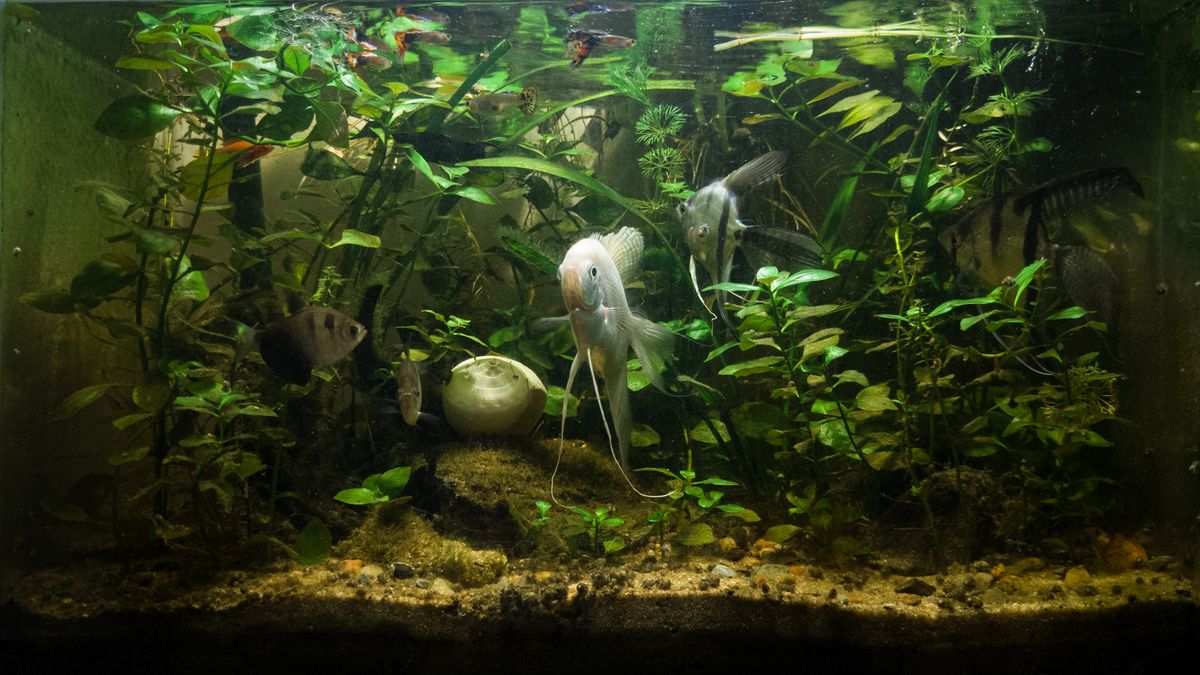
Quick answer: good freshwater angelfish tank mates are large enough not to be swallowed, calm enough not to shred long fins, and compatible with warm water around 78–86°F. Adult cardinal tetras, black skirt tetras, many corydoras and suitable plecos are common candidates. Tiny nano fish, dwarf shrimp and notorious fin-nippers are poor bets. Even a normally compatible fish can fail when angelfish pair up and defend eggs.
Patify compatibility rule: check adult mouth/prey size → fin-nipping → temperature → feeding speed → tank zone → breeding aggression → escape plan. “Compatible species” is conditional, not a guarantee.
1. Six Filters Matter More Than a “Compatible Fish” List
- Prey size: angelfish are cichlids and may eat fish/invertebrates small enough to fit in their mouths.
- Fin behavior: long angelfish fins attract nippers.
- Temperature: Aquarium Co-Op keeps angelfish around 78–86°F; tank mates must tolerate that warmth.
- Feeding speed: very fast fish can outcompete slower angels; timid fish may lose at meals.
- Tank zone: lower-zone fish often conflict less with upper/midwater angels.
- Breeding status: paired angels guarding eggs/fry can become territorial toward almost anything.
Tank volume matters too. Aquarium Co-Op suggests no more than four adult angelfish with tank mates in a 29-gallon community setup and recommends a 55-gallon tank when starting with a larger juvenile group—plus a plan to remove fish if territorial behavior develops.
2. Angelfish Tank-Mate Compatibility Matrix
| Tank mate | Compatibility | Why it can work | Main failure mode |
|---|---|---|---|
| Corydoras | Good with species/temp match | Bottom-oriented, peaceful, too large to treat as tiny prey | Some cory species prefer cooler water; group needs space |
| Adult cardinal tetras | Often good | Larger/deeper-bodied than nano tetras; warm-water overlap | Small juveniles may still be vulnerable |
| Black skirt tetras | Often good with a real school | Robust body size; Aquarium Co-Op reports success | Under-grouped/individual tetras may nip fins |
| Bristlenose-type pleco | Usually workable | Different zone, armored body, warm-water compatible | Needs own diet, cave and adult space; not a “cleaner” |
| Ram cichlids | Conditional | Warm-water overlap, smaller territory near bottom | Two cichlid species can become territorial during breeding |
| Larger livebearers | Conditional | Size may reduce predation risk | Hard-water preferences and fry predation; feeding competition |
| Gouramis | Conditional | Similar warm tropical conditions | Overlapping territory/temperament; individual aggression |
| Tiny rasboras / nano tetras | Poor | — | May become prey |
| Dwarf shrimp | Poor | — | Likely prey, especially juveniles |
| Fin-nipping barbs | Poor | — | Long angelfish fins are obvious targets |
3. Corydoras: One of the Most Reliable Zone-Separation Choices
Aquarium Co-Op specifically reports good results with cory catfish. Their bottom-focused lifestyle reduces direct competition with angelfish in the mid/upper water column.
The caveat is species temperature. Do not treat “corydoras” as one temperature profile. Choose a species whose long-term range overlaps the warmer angelfish setup, and keep a proper social group rather than one lonely cory.
4. Medium and Larger Tetras: Body Depth Matters
Aquarium Co-Op reports success with adult cardinal tetras and black skirt tetras. The word “adult” matters: a small juvenile tetra may be swallowed even if the mature fish is a reasonable companion.
Choose a school large enough that normal tetra social behavior is spread through the group. Under-grouped tetras can become more stressed and some species become more prone to fin-nipping.
Do not generalize from “tetras are compatible.” Ember tetras, green neons and other nano fish are small enough that adult angelfish may treat them as prey.
5. Bristlenose-Type Plecos: Different Zone, Different Job
A moderate-size bristlenose-type pleco can work because it occupies hardscape/bottom surfaces and has an armored body that does not resemble angelfish prey. But it still needs its own hiding cave, diet and adequate tank footprint.
Do not substitute a vaguely labeled “common pleco.” Adult pleco species vary enormously in size. Patify’s algae-eater guide explains why “pleco” is not a useful adult-size guarantee.
6. Rams and Other Dwarf Cichlids: Temperature Match, Territory Risk
Warm-water dwarf cichlids such as rams are sometimes paired with angelfish because their temperature preferences can overlap and they often occupy lower territories.
The problem appears when either species breeds. Two territorial cichlids can divide a tank into defended zones, and a setup that worked for months may abruptly become violent after pair formation or spawning.
Use only in a larger, structured aquarium with sight-line breaks and a backup tank/divider plan.
7. Larger Livebearers: “Maybe,” Not Automatic
PetMD lists mollies among potential freshwater angelfish tank mates, while Aquarium Co-Op places smaller guppies in the “maybe” category because of predation risk.
There is also a chemistry question: mollies and many other livebearers favor mineral-rich, alkaline water. Captive angelfish can adapt across a broad pH range, but you should choose a shared stable chemistry rather than force one species to the edge of its preferred conditions.
Expect angelfish to eat many livebearer fry.
8. Tank Mates to Avoid or Treat as High Risk
Tiny fish and dwarf shrimp
If it can fit in an adult angelfish’s mouth, it is prey-sized. Aquarium Co-Op explicitly warns against microrasboras and dwarf shrimp.
Fin-nipping barbs
PetMD warns that barbs can nip slow, long-finned fish such as angelfish and bettas. Avoid species/individuals known for persistent fin-nipping.
Long-finned bettas and fancy guppies
PetMD advises caution with long-finned companions, while Aquarium Co-Op considers bettas and guppies conditional rather than reliable choices.
Another dominant angelfish pair in cramped space
Angelfish aggression is often intraspecific. More angels do not automatically make an angelfish “less lonely.” Aquarium Co-Op notes that a single angelfish can function well as a community centerpiece.
9. Breeding Can Turn a Stable Community Into a Territory
Angelfish form pairs and provide parental care. PetMD notes that breeding fish guard eggs and fry, while Aquarium Co-Op warns that territorial behavior may require removing fish from group setups.
Before keeping multiple angels or other cichlids, decide what you will do when a pair forms:
- move the pair to a breeding tank;
- remove harassed fish;
- use a temporary divider;
- rehome excess adults;
- increase sight-line breaks and territory structure.
A tank-mate guide without a separation plan is incomplete.
10. A Safer Introduction Workflow
- Quarantine the new fish when possible.
- Verify adult size and temperature overlap.
- Feed the resident angelfish before introduction.
- Rearrange some décor/plants to disrupt established territories.
- Add the new fish with lights dim/off.
- Observe feeding. “No fighting” is not enough if one species cannot eat.
- Watch fins, breathing, hiding and chase duration for days, not minutes.
- Separate early if repeated cornering, injury or food exclusion develops.
For a more stable planted environment, Patify’s planted aquarium setup guide covers sight-line breaks, plant structure and low-tech setup. New aquariums should be biologically mature first; use the fishless cycling guide.
Frequently Asked Questions About Angelfish Tank Mates
What are good tank mates for freshwater angelfish?
Adult cardinal tetras, black skirt tetras, suitable corydoras and appropriately sized plecos are common candidates when temperature, tank size and individual temperament match.
Can neon tetras live with angelfish?
It is risky because small tetras can become prey. Larger adult cardinal/medium-bodied tetras are more defensible choices.
Can cory catfish live with angelfish?
Often yes. Choose a cory species whose temperature range overlaps the warm angelfish aquarium and keep a proper group.
Can bettas live with angelfish?
Possible in some large carefully managed setups, but not a dependable pairing. Long fins and overlapping territorial behavior create risk.
Will angelfish eat shrimp?
Dwarf shrimp and shrimplets are prey-sized and should be considered at high risk.
Do angelfish need other angelfish?
Not necessarily. Aquarium Co-Op reports that a single angelfish can work well as a community centerpiece.
Why did my angelfish suddenly become aggressive?
Pair formation, spawning, cramped space, food competition or territorial maturity can change behavior even after months of apparent compatibility.
Sources Checked
- Aquarium Co-Op — Freshwater Angelfish Care
- PetMD — Angelfish Behavior and Tank Mates, DVM-reviewed
- PetMD — Barb Fish Care / Fin-Nipping Context
Sources reviewed October 3, 2026.