
Last updated: September 24, 2026
Quick answer: the safest DIY cat toys are usually the simplest: plain paper, sturdy cardboard, untreated paper tubes, handle-free paper bags, and food puzzles that do not contain swallowable parts. This guide gives you eight builds with clear supervision levels. None of the projects below is presented as personally tested by Patify; the designs are based on established feline-enrichment guidance and published DIY examples from veterinary/welfare organizations.
Before you build anything: if your cat chews and swallows cardboard, fabric, foam, string, plastic or other non-food items, skip DIY toys made from those materials. ASPCA recommends active supervision with homemade enrichment and removing an item immediately if a cat tries to ingest it.
DIY Cat Toy Safety Comes Before the Craft
Cornell University's Feline Health Center notes that toys can support exercise, problem-solving and natural stalking/pouncing behavior, but warns against toys with small detachable pieces or linear strand-like parts that can be swallowed. Cornell also points out that inexpensive items such as paper bags and cardboard boxes can be useful cat entertainment without elaborate construction.
FelineVMA's environmental guidance treats play and predatory behavior as a core environmental need. The point of a toy is not merely to keep the cat “busy”; good play gives the cat opportunities to search, stalk, chase, pounce and capture.
Lower-complexity
Plain paper ball, sturdy box, handle-free paper bag. Inspect for chewing and damage.
Active supervision
Food puzzles, cut cardboard projects, anything a cat may tear apart while playing.
Skip for ingesting cats
Any project made from a material your cat repeatedly chews off and swallows.
Tool safety: adults should do all cutting with scissors, utility knives or craft blades. Remove the cat from the work area until sharp tools, scraps and loose parts have been cleaned up.
DIY Cat Toy Materials: Use, Supervise, or Avoid
| Material | Use level | Why |
|---|---|---|
| Plain office/kraft paper | Good starting material | Useful for crumpling/search play; remove if your cat eats paper. |
| Sturdy corrugated cardboard | Good starting material | Boxes support hiding, pouncing and foraging; discard when soggy or heavily shredded. |
| Plain toilet/paper-towel tubes | Supervise | Useful for food puzzles; some cats chew and swallow cardboard. |
| Brown paper bags | Supervise; remove handles | Useful hide-and-pounce space; handles can trap a cat's head/limbs. |
| Ping-pong-size rigid balls | Inspect + supervise initially | Cornell includes ping-pong balls among simple play options; size must be too large for your cat to swallow. |
| Fabric/fleece | Active supervision for chewers | Fabric can become a GI foreign body if torn off and swallowed. |
| Yarn, string, thread, ribbon, dental floss, tinsel | Avoid as unsupervised DIY toys | Linear foreign bodies can anchor in the GI tract and injure/perforate intestine. |
| Rubber bands / hair ties | Avoid | Small, elastic and easily swallowed. |
| Bells, beads, googly eyes, loose feathers | Avoid detachable pieces | Small components can break free and be swallowed. |
| Plastic bags | Avoid as cat hideouts | Use paper bags instead; plastic presents entanglement/suffocation and chewing risks. |
| Staples / exposed tape / glue blobs | Avoid access | Do not leave sharp metal or detachable adhesive pieces where a cat can chew them. |
String emergency: if thread, yarn or another linear material is hanging from your cat's mouth or anus, do not pull it. VCA and Merck describe these materials as dangerous linear foreign bodies that can damage the gastrointestinal tract. Contact a veterinarian promptly.
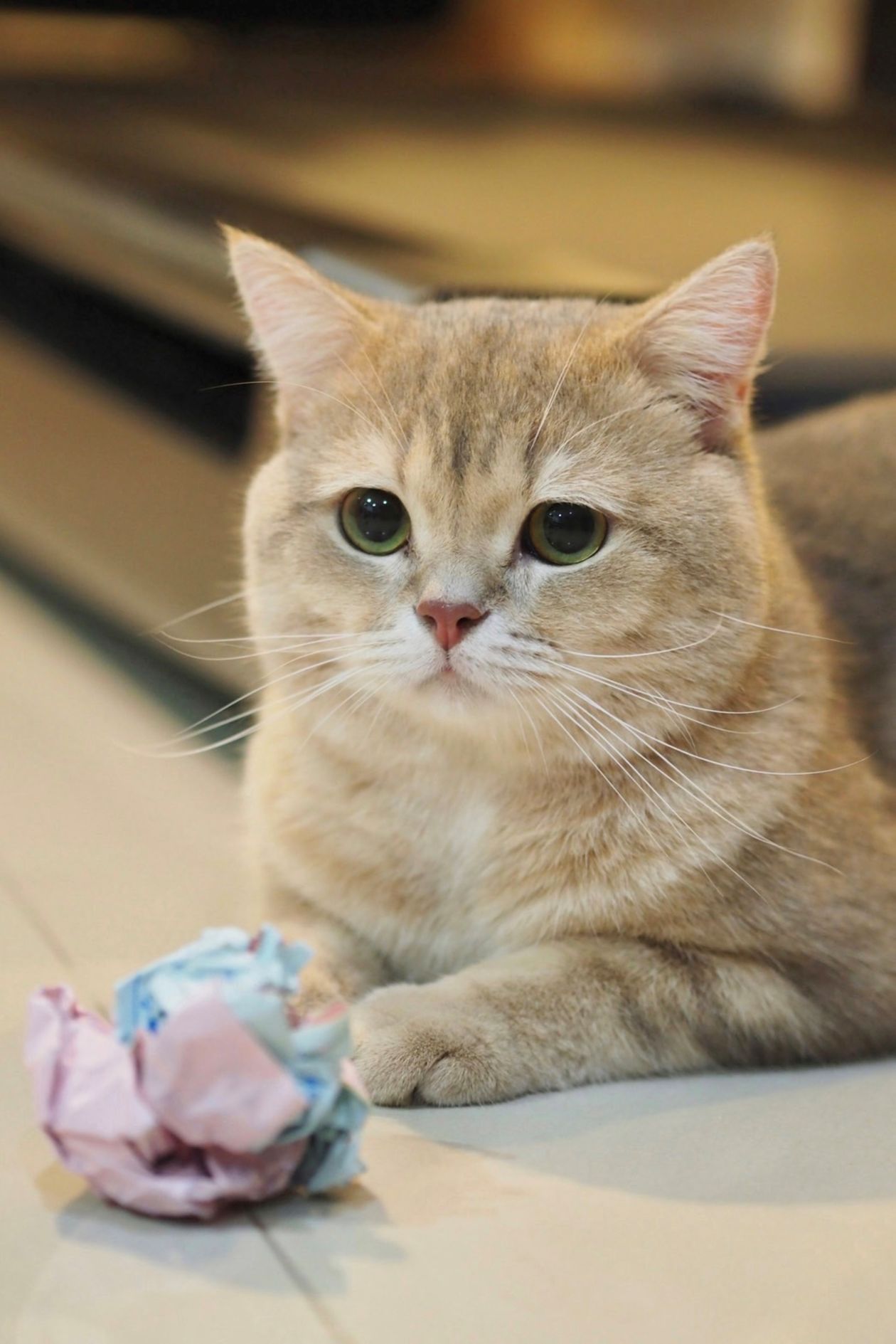
1. Crumpled Paper Prey Ball
Best for: chase, bat and pounce cats
Build time: under 1 minute
Materials: one sheet of plain paper
Supervision: inspect initially; remove if shredded/eaten
How to make it
- Use clean, plain paper without staples, tape or sticky labels.
- Crumple it tightly into a ball large enough that your cat cannot swallow it.
- Roll or toss it across the floor rather than directly at the cat.
- Let the cat stalk and capture it.
Change the movement rather than endlessly throwing it: roll it behind a chair leg, under the edge of a box or across a hard floor so the “prey” disappears and reappears.
If your cat immediately tears and consumes paper, this is not the right toy for that individual.
2. Handle-Free Paper Bag Hideout
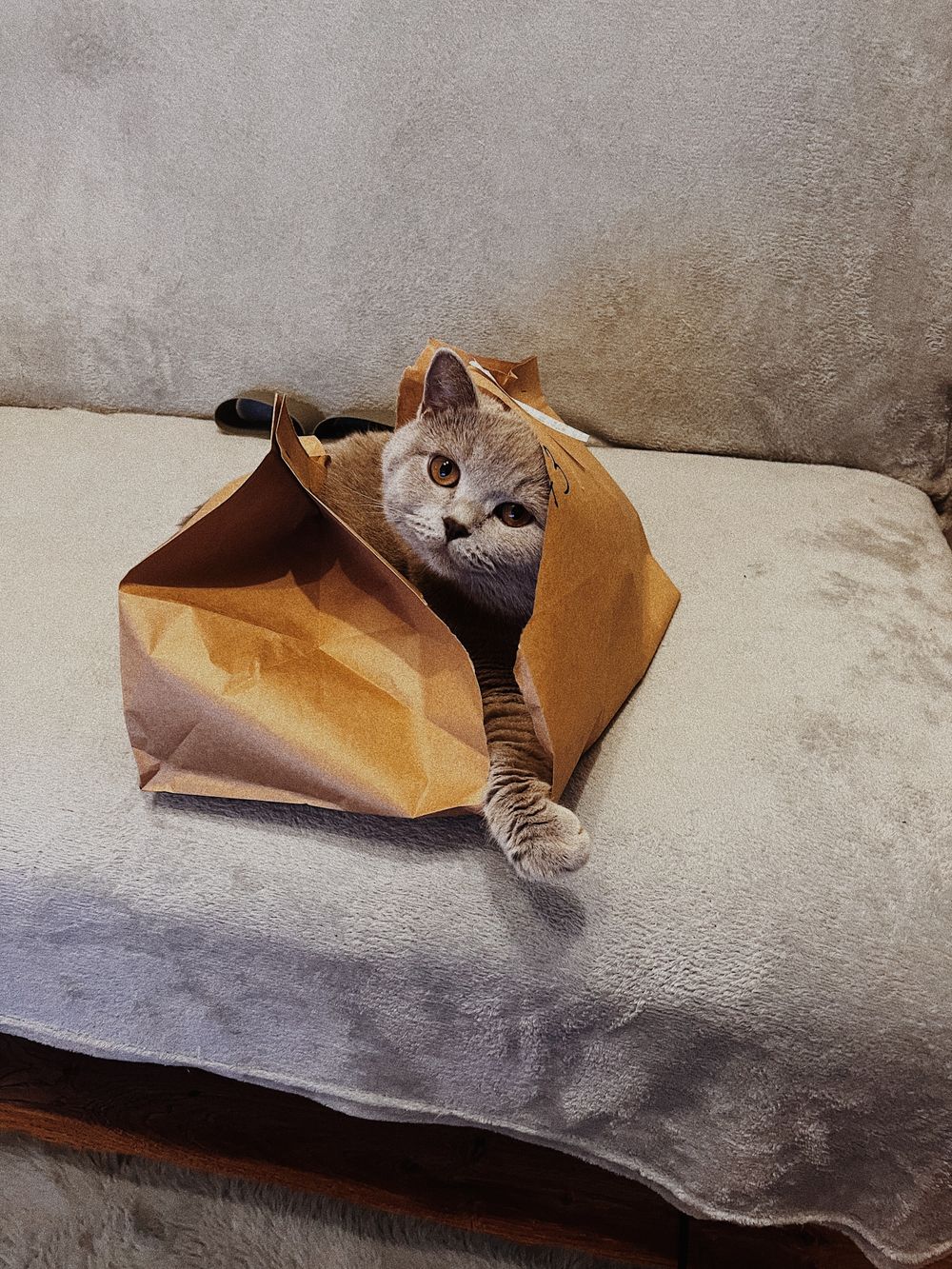
Best for: hiding, ambush and crinkle-loving cats
Build time: under 1 minute
Materials: one sturdy paper grocery bag
Supervision: recommended
How to make it
- Cut off and discard all handles.
- Open the bag fully and lay it on its side.
- Check that there are no staples, plastic windows, loose tape or torn cords.
- Place it in an open area where the bag cannot roll down stairs or trap the cat behind furniture.
- Optionally toss a paper ball past the entrance so the cat can ambush it.
Humane World specifically recommends removing paper-bag handles because cats can become caught in them. Retire the bag once it is heavily torn, wet or collapsing around the cat.
3. Cardboard Peek-and-Pounce Box
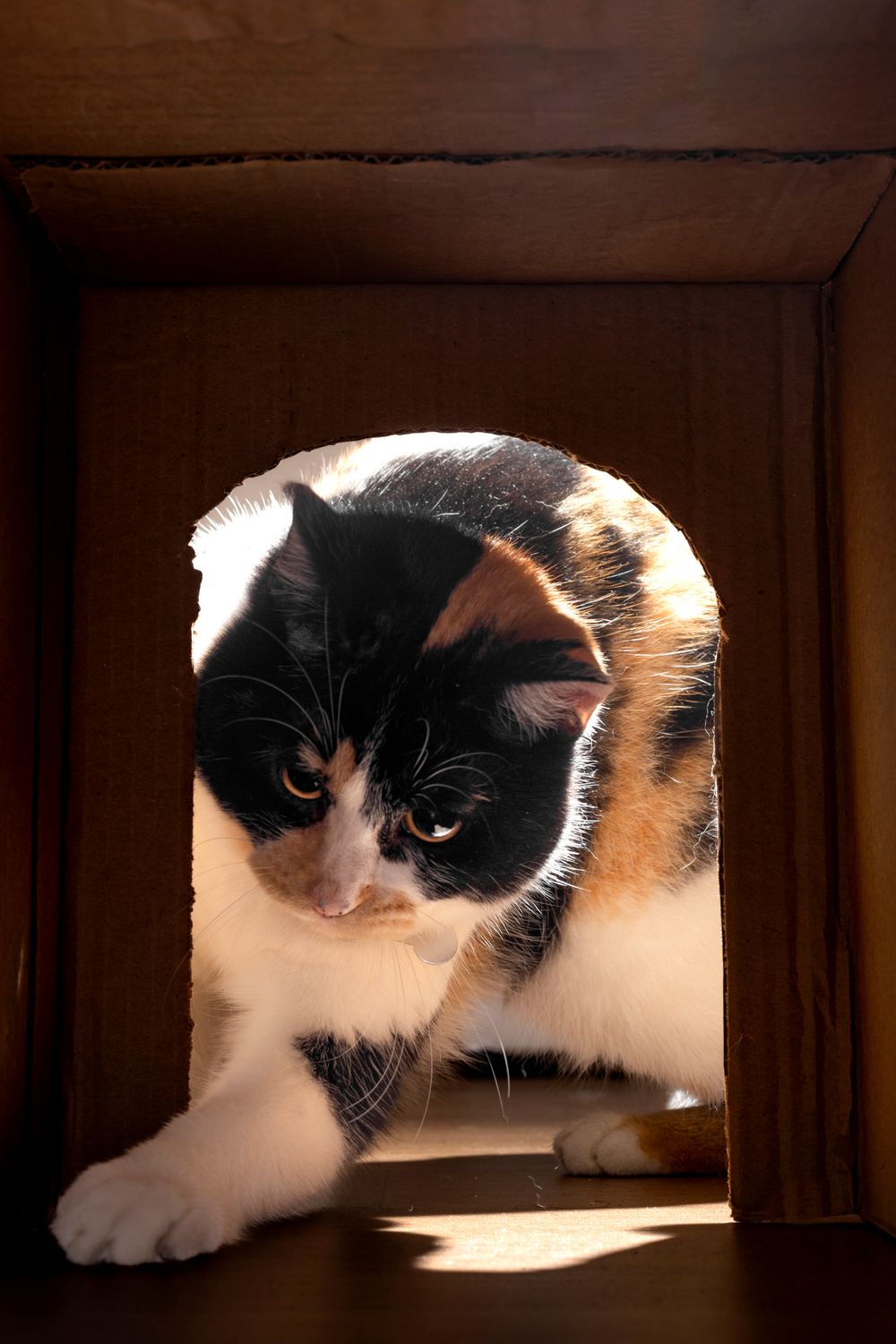
Best for: stalkers and ambush players
Build time: 5–10 minutes
Materials: sturdy cardboard box, marker, craft knife/scissors
Supervision: active supervision at first
How to make it
- Remove staples, plastic tape loops, packing straps and loose labels.
- Close or fold the bottom securely without leaving exposed adhesive edges.
- With the cat in another room, cut two or three smooth openings large enough for a paw and one larger entrance/exit.
- Remove every loose cardboard flap created by cutting.
- Return all tools to storage before letting the cat investigate.
Move a paper ball outside one of the openings, or let the cat use the box purely as a hideout. Cornell notes that cardboard boxes themselves can be highly engaging enrichment; you do not need to turn every box into a complicated craft.
Design rule: if the box is large enough for the whole cat to enter, give the cat more than one easy way out so another pet cannot trap them inside.
4. Toilet-Roll Puzzle Ball
Best for: food-motivated cats that like batting objects
Build time: about 5 minutes
Materials: one plain toilet-paper tube, scissors, a few pieces of dry food/treats
Supervision: active supervision
Blue Cross publishes a simple puzzle-ball design made from a toilet-paper tube cut into rings.
How to make it
- Cut the clean cardboard tube crosswise into four wide rings.
- Slide one ring through another to form a cross/X.
- Add the remaining rings around the first two until you have a loose open ball.
- Put a few pieces of kibble inside through the gaps.
- Leave openings large enough for food to fall out when the cat bats the ball.
Use food from the cat's normal daily ration when practical rather than adding a large amount of extra treats. Remove the toy if the rings become soggy, crushed or are being eaten.
5. Cardboard Reach Feeder
Best for: paw-oriented foragers and puzzle beginners
Build time: 10–15 minutes
Materials: small shoebox, 3–4 plain cardboard tubes, marker, craft knife, kibble/treats
Supervision: active supervision
This project is adapted from ASPCA's feline DIY enrichment “reach feeder.”
How to make it
- Stand the cardboard tubes on the box lid and trace their outlines.
- Move the cat away from the work area.
- Cut openings so the tubes fit snugly and do not wobble freely.
- Insert each tube vertically through the lid.
- Put a few pieces of kibble into the tubes.
- Let the cat reach in with a paw to retrieve the food.
The puzzle should be easy at first. If the cat cannot retrieve anything after repeated attempts, use shallower tubes or put the food nearer the top. Enrichment should create solvable work, not endless frustration.
6. Rolling Treat Tube
Best for: cats that like rolling and batting
Build time: 5–10 minutes
Materials: plain paper tube, scissors/craft knife, kibble
Supervision: active supervision
ASPCA also describes a cardboard-tube slow feeder in which openings allow kibble to drop out as the tube moves.
How to make it
- Use a clean plain tube with no plastic coating.
- Cut several smooth holes that are slightly larger than the food pieces.
- Fold the tube ends securely inward rather than adding rubber bands or string.
- Add a measured portion of dry food.
- Roll the tube and show the cat that food can fall out.
ASPCA's original instructions allow tape or folded ends; for a cat that chews tape, use folded cardboard only or skip the project. Never leave loose adhesive strips where they can be peeled off and swallowed.
7. Paper-Ball Forage Box
Best for: sniffers, paw-searchers and food-motivated cats
Build time: 3–5 minutes
Materials: shallow cardboard box, several plain paper balls, part of a dry meal
Supervision: active supervision
How to make it
- Use a shallow box large enough that your cat can reach in without getting trapped.
- Crumple several sheets of clean paper into loose balls.
- Place the paper balls in the box.
- Scatter a small portion of kibble between and beneath them.
- Let the cat nose and paw through the paper to forage.
This is deliberately simple. FelineVMA recommends opportunities for predatory behavior and food puzzles that mimic hunting/foraging. You do not need glue, bells or decorative craft materials for the enrichment mechanism to work.
If your cat eats paper rather than moving it aside, switch to a commercially manufactured puzzle designed for that cat's chewing style.
8. Cardboard Tunnel or Cat House
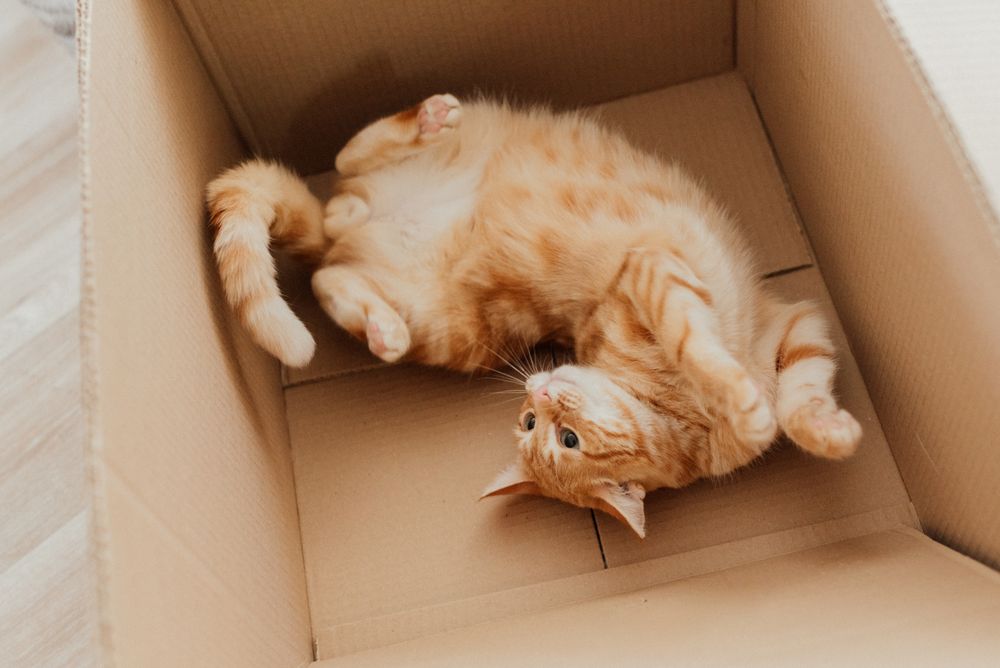
Best for: hiding, exploration and ambush play
Build time: 10–20 minutes
Materials: one or more sturdy cardboard boxes, cutting tool; optional non-toxic adhesive used where inaccessible
Supervision: inspect carefully before use
ASPCA includes DIY cardboard cat houses, tunnels and mazes in its feline enrichment material.
Simple version
- Choose a box your cat can turn around inside.
- Remove staples, shipping straps and loose tape.
- Cut at least two cat-sized openings so there is an easy exit route.
- If joining two boxes, make the connection broad and stable rather than using dangling ties or string.
- Check every cut edge for loose pieces.
- Place the structure on a stable floor away from stairs and heavy objects that could fall.
A tunnel does not need to be permanent. Cardboard enrichment is disposable: once the structure softens, tears into swallowable fragments or becomes contaminated, recycle it.
Why This Guide Does Not Give You a DIY Yarn or String Toy Recipe
Interactive wand toys can be excellent for feline predatory play. Battersea and FelineVMA both discuss chase/pounce toys as useful enrichment. But homemade string, yarn, ribbon and loose-feather builds introduce a specific failure mode: the cat can detach and swallow a long flexible piece.
VCA describes string, yarn and tinsel as classic linear foreign bodies. One end can lodge under the tongue, in the stomach or intestine while the rest moves through the bowel, causing the intestines to bunch and potentially become injured or perforated. Merck likewise identifies cats as particularly prone to ingesting linear materials during play.
Therefore:
- do not leave yarn, ribbon, dental floss or sewing thread out as independent cat toys;
- store commercial wand/string toys away after interactive sessions;
- inspect them for fraying and loose attachments;
- do not encourage a cat to chew and consume the “prey” at the end of the game;
- if your cat is an aggressive string chewer, choose a different play format.
If your cat repeatedly eats non-food material rather than just playing with it, that changes the risk profile. Patify's cat pica and litter-eating guide explains when non-food ingestion deserves veterinary investigation.
Match the DIY Toy to Your Cat's Play Style
| Your cat tends to... | Try first | Why |
|---|---|---|
| Chase anything that skitters | Paper prey ball | Fast low-to-ground movement |
| Hide and launch surprise attacks | Paper bag or peek box | Supports stalking/ambush behavior |
| Work hard for food | Puzzle ball, reach feeder, rolling treat tube | Turns part of a meal into foraging |
| Use paws to fish objects from gaps | Reach feeder | Requires controlled paw manipulation |
| Explore enclosed spaces | Cardboard tunnel/house | Adds safe hiding and movement choices |
| Chew and swallow cardboard/paper | Skip these DIY projects | Use a more durable manufactured toy recommended for the individual cat |
FelineVMA recommends routine object play, including short bursts that simulate hunting. It also notes that cats should sometimes be allowed to “capture” the prey rather than endlessly chase something they can never catch.
If play is being used because a cat constantly scratches at a door or demands attention, remember that toys are only one possible piece of the problem. Patify's cat scratching at doors guide separates learned attention-seeking, frustration and distress.
A Simple Weekly DIY Toy Rotation
Cornell suggests rotating toys to keep them interesting. Instead of leaving all eight projects on the floor at once, use a small rotating menu.
| Day | Main DIY option | Play channel |
|---|---|---|
| Monday | Paper prey ball | Chase / pounce |
| Tuesday | Reach feeder | Food / paw manipulation |
| Wednesday | Handle-free paper bag | Hide / ambush |
| Thursday | Rolling treat tube | Forage / chase |
| Friday | Cardboard peek box | Stalk / pounce |
| Saturday | Paper-ball forage box | Search / forage |
| Sunday | Cat's favorite + normal interactive play | Choice |
Rotate based on preference rather than forcing variety. Some cats genuinely prefer boxes. Others will ignore cardboard and spend ten minutes batting one paper ball. The cat's choice is useful data.
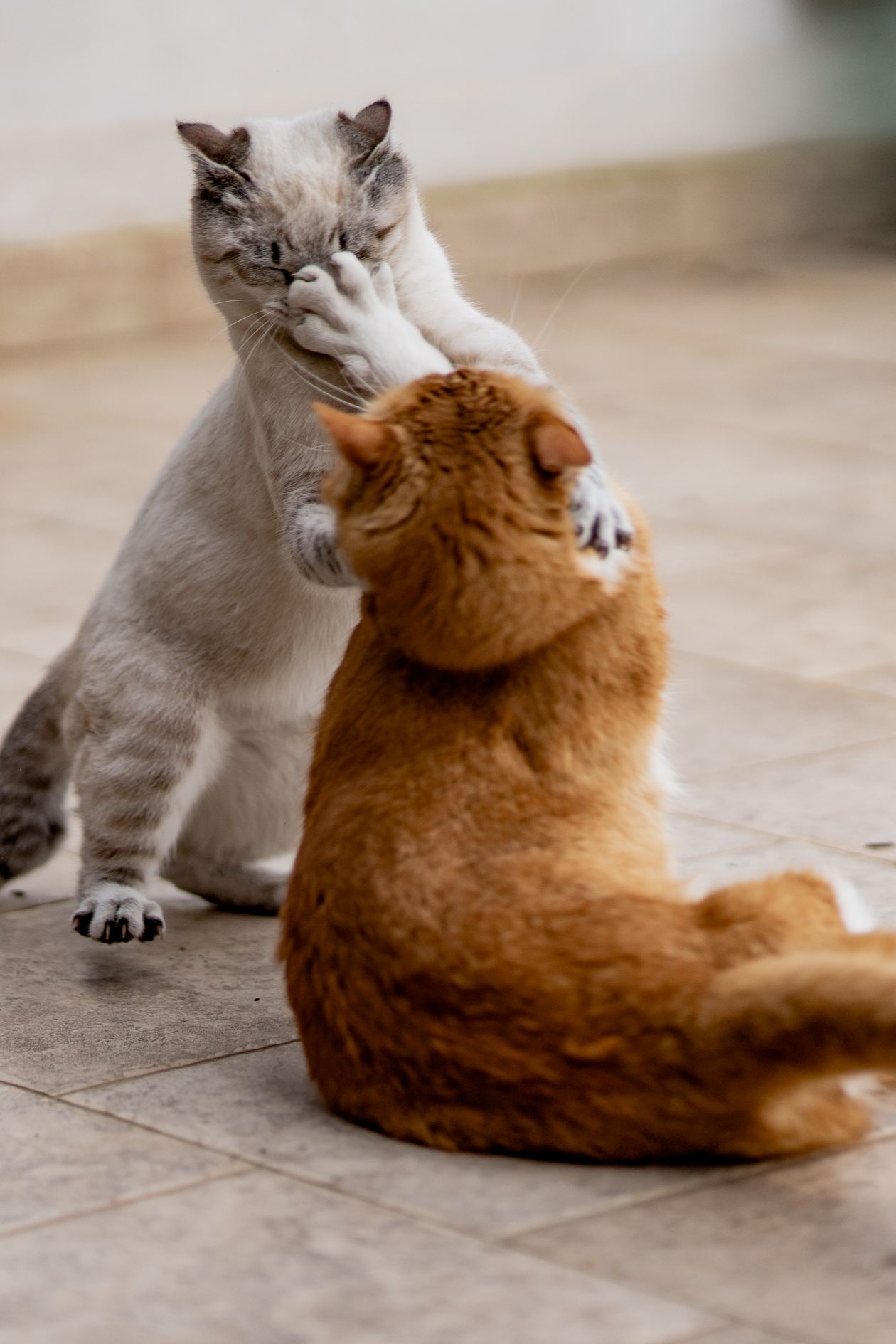
In multi-cat homes, provide more than one play opportunity and avoid forcing both cats to compete for a single high-value toy. If wrestling or chasing starts and you are unsure whether it is mutual, see Patify's cats playing vs. fighting guide.
When to Throw a DIY Cat Toy Away
Homemade toys are consumable enrichment, not heirlooms.
Retire the toy when:
- cardboard is soggy or collapsing;
- paper/tube pieces are becoming small enough to swallow;
- tape or adhesive is exposed;
- a cut edge has become sharp or ragged;
- fabric is fraying or threads are exposed;
- a component is loose;
- the toy has urine, vomit, feces or food contamination that cannot be cleaned safely;
- your cat changes from playing with the material to repeatedly consuming it.
Thirty-second inspection: before each DIY play session, squeeze, tug and look at the project from the cat's perspective. Ask, “What could break off if this is bitten hard for the next five minutes?”
Frequently Asked Questions
What is the easiest DIY cat toy?
A large crumpled paper ball is the simplest: no glue, string or craft hardware. Roll it across the floor and remove it if your cat tears and eats the paper.
Are toilet paper rolls safe cat toys?
They can be useful for supervised food puzzles when clean and plain, but cats that chew and swallow cardboard should not have them. Discard damaged or soggy tubes.
Can cats play in paper bags?
Yes, with supervision and with every handle removed. Humane World specifically advises removing bag handles because cats can get caught in them.
Can I make a cat toy with yarn?
It is safer not to leave yarn/string DIY toys accessible. Cats can swallow linear material, which can become a life-threatening gastrointestinal foreign body. Use interactive wand toys only under direct supervision and store them afterward.
Is cardboard toxic to cats?
Plain cardboard is commonly used for feline enrichment, but “non-toxic” does not mean “safe to eat.” Swallowing chunks or large amounts of non-food material can create gastrointestinal problems.
Can I use tape or glue?
Prefer designs that need neither. If a project requires adhesive, keep it inaccessible once dry and remove the toy if the cat can peel or chew it. Do not leave glue blobs or loose tape strips exposed.
How often should I rotate cat toys?
There is no universal schedule. Keep a few safe options available, store others, and rotate when interest drops. Cornell specifically recommends toy rotation as a way to renew novelty.
Do DIY toys replace playing with my cat?
No. Food puzzles and independent toys add enrichment, but interactive human-cat play remains valuable. FelineVMA recommends regular opportunities for object play and predatory behavior.
Bottom Line: The Safest DIY Toy Is Usually the Least Complicated
You do not need feathers, bells, yarn and a glue gun to make useful cat enrichment.
- Paper ball for chasing.
- Handle-free paper bag for hiding.
- Cardboard box for stalking and ambush.
- Cardboard food puzzle for foraging.
- Disposable tunnel/house for exploration.
Build around what your cat actually likes, supervise the first sessions, and retire homemade materials before they turn into small ingestible pieces. If the toy design requires you to ignore a known ingestion hazard to make it “fun,” choose a simpler project.