
Last verified: September 29, 2026
How to Groom a Goldendoodle: Start With the Coat You Actually Have
Quick answer: Goldendoodles do not all have the same grooming needs. A furnished curly coat, loose wavy coat, straighter furnished coat and unfurnished “flat” coat can behave very differently. The most reliable routine is coat-first: identify texture and facial furnishings, decide how much length you want to keep, brush in sections down to the skin, verify with a metal comb, keep friction zones dry and clear, and schedule professional grooming before mats dictate the haircut.
For many furnished Goldendoodles, home maintenance is substantial. The Goldendoodle Association of North America (GANA) recommends puppies be brushed daily with a slicker followed by a metal comb so hidden mats are found early and grooming becomes normal. PetMD’s veterinary-reviewed breed guide gives adults a broader starting point of brushing at least a few times a week and professional grooming roughly every 4–8 weeks. Those are useful baselines—not a promise that every coat can wait the same number of days.
The important correction: do not choose a grooming plan from the label F1, F1B, F2 alone. GANA says coat genetics are more dependable for predicting physical coat traits than relying only on filial generation. Curl, furnishings and shedding-related traits are influenced by different genes. Groom the coat in front of you, not the generation written on the breeder paperwork.
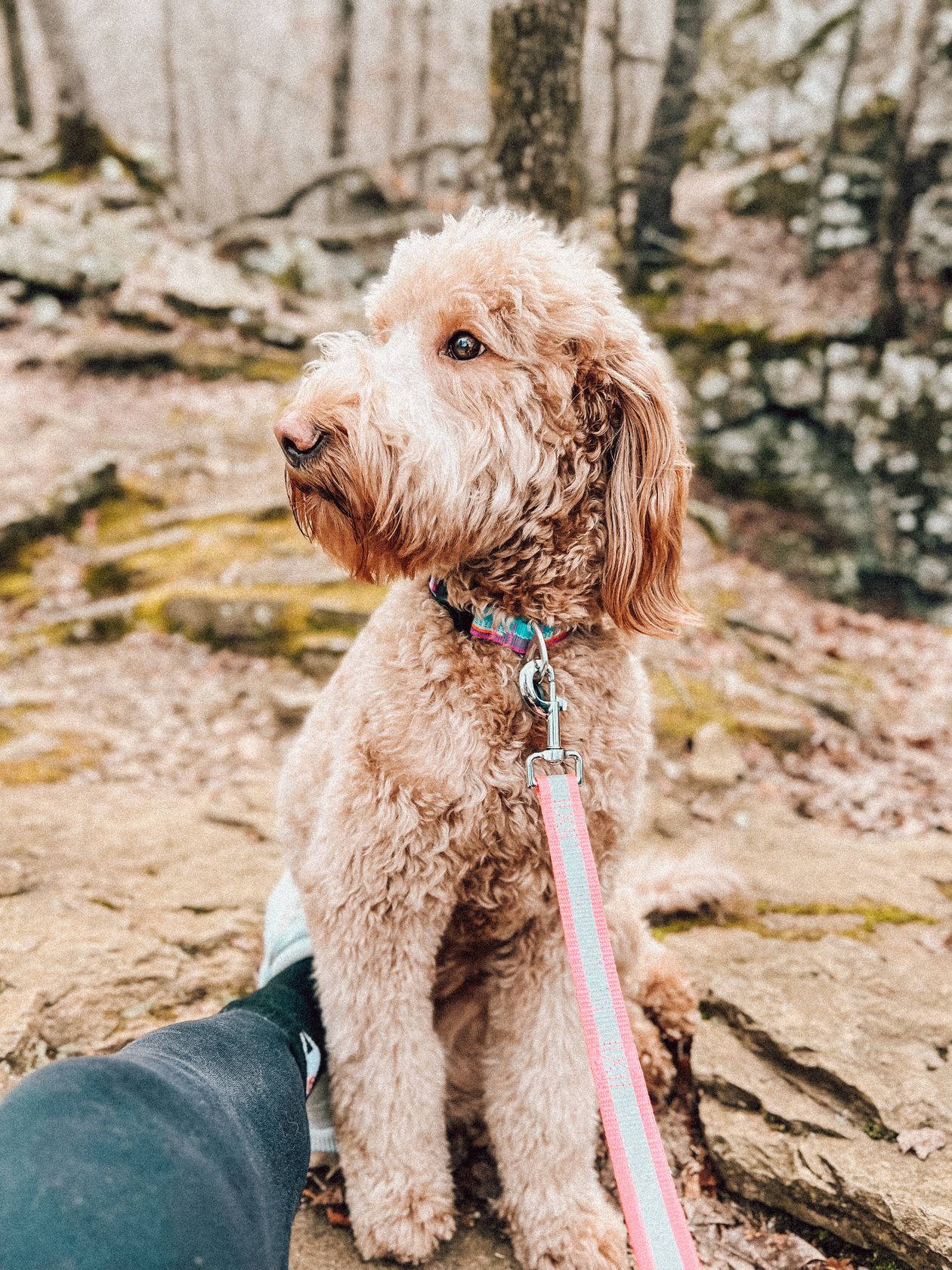
Goldendoodle Coat Diagnostic: Four Looks, Different Workloads
GANA recognizes curly, wavy and straight Goldendoodle coat textures and separately describes furnishings—the longer eyebrows, mustache and beard that create the classic “doodle” face. An unfurnished or flat-coated Goldendoodle lacks those facial furnishings and often looks more Golden Retriever-like.
| Coat you see | What it looks like | Main grooming problem | Practical approach |
|---|---|---|---|
| Curly + furnished | Tighter curls, beard/eyebrows, dense fluffy silhouette | Loose hair can remain trapped; mats hide close to skin | Systematic brushing + comb verification; shorter length if home care is inconsistent |
| Wavy + furnished | Loose waves/fleece-like coat, shaggy doodle face | Friction mats, especially when long | Section brushing several times weekly or more depending on length |
| Straight + furnished | Straighter body hair but beard/eyebrow furnishings | Owners underestimate mat risk because coat looks less curly | Comb friction zones and furnishings; adjust frequency to density and length |
| Unfurnished / flat | Shorter Golden-like facial hair; more visible shedding may occur | Loose coat and tangles rather than sculpted doodle furnishings alone | Brush for loose coat and tangles; do not assume a Poodle-style haircut is necessary |
GANA’s coat-genetics material makes an especially useful distinction: curl and furnishings are not the same trait. A straighter Goldendoodle can still be furnished. Conversely, an unfurnished dog can lack the signature beard even though it is a Goldendoodle. For grooming, “curly versus straight” is only the first branch of the decision tree.
GANA also notes that unfurnished flat-coated Goldendoodles tend to shed more than furnished Goldendoodles and often require less coat maintenance. That does not mean no grooming; it means the job can shift toward brushing loose coat rather than maintaining long beard, leg and body furnishings.
F1, F1B and Multigen: Useful Breeding Labels, Poor Grooming Instructions
Filial labels describe ancestry. They do not measure the coat currently growing on your dog.
GANA’s generation guidance says the early labels—F1, F1B, F2—can give some context about common physical traits, but for later-generation dogs it is often more informative to describe the actual traits expected. Its appearance guidance goes further: DNA testing for coat traits is a more reliable predictor of appearance and shedding intensity than relying on a generation label alone.
Embark makes the underlying point from the genetics side: furnishings (RSPO2), curl (KRT71), coat length (FGF5) and shedding-related traits involve different genes that interact. You do not need a DNA test to brush your dog. You do need to stop assuming every F1B has the same curl density or mat risk.
Better grooming question: “Can a metal comb reach my dog’s skin everywhere I am trying to keep long?” That tells you more about today’s maintenance requirement than the generation label.
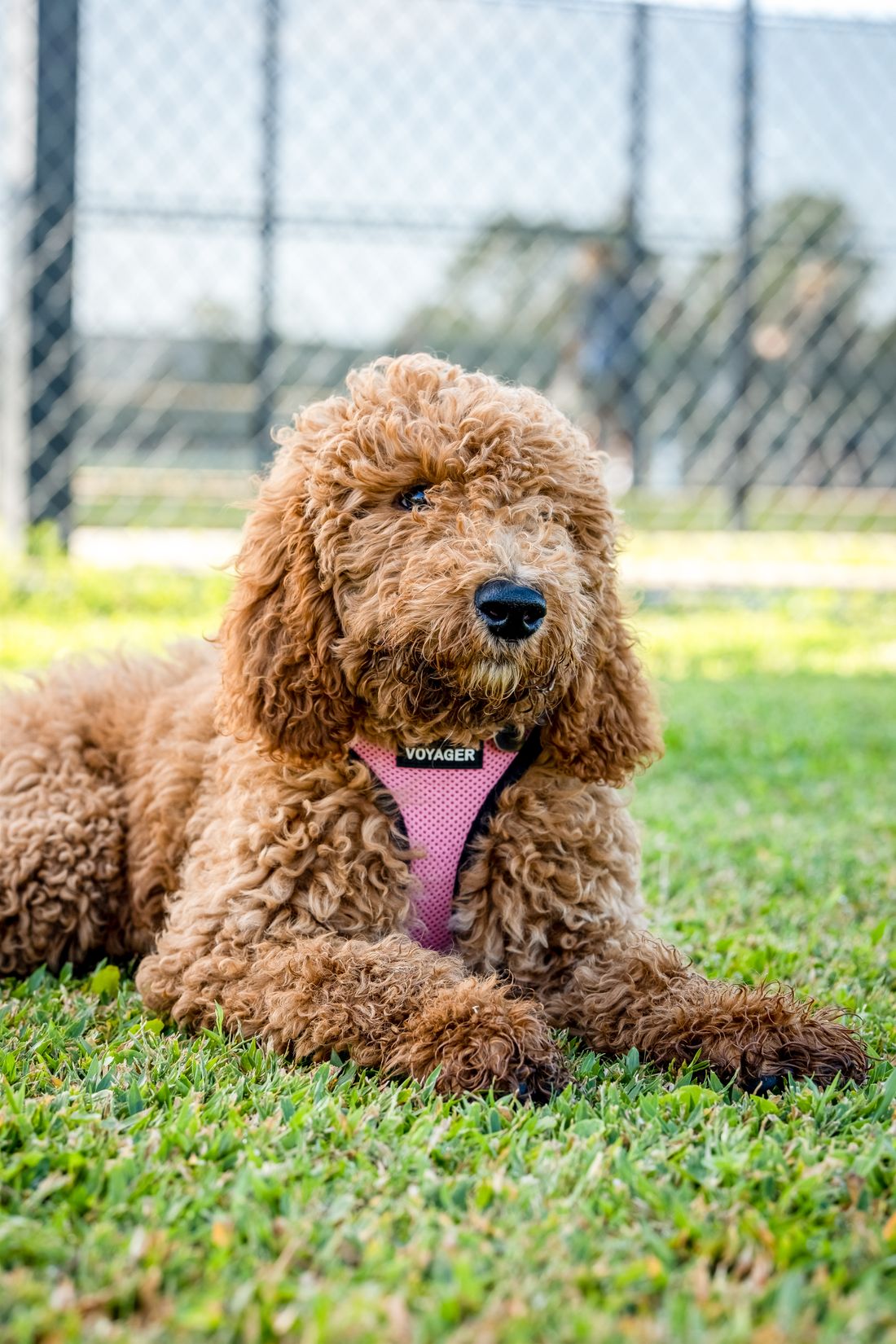
Goldendoodle Grooming Tools: The Small Kit That Does Most of the Work
You do not need a drawer full of specialty gadgets. The core home-maintenance kit is simple.
| Tool | Job | Limit |
|---|---|---|
| Slicker brush | Separates furnished/wavy/curly coat | Can leave hidden root-level mats |
| Stainless steel comb | Final comb test from ends to skin | Should not be forced through a tight mat |
| Pin brush | Useful for longer, looser coat and finishing | Not a substitute for root-level combing |
| Dog-safe shampoo + conditioner | Cleans and improves manageability | Cannot safely undo severe matting |
| Absorbent towels | Blot water before controlled drying | Rough rubbing can create tangles |
| Dog dryer or controlled cool/low-heat dryer | Dries dense coat while separating sections | Must not overheat or concentrate hot air on skin |
| Nail trimmer/grinder | Regular nail maintenance | Requires training to avoid the quick |
GANA specifically recommends a slicker followed by a metal comb for puppies because a slicker can make the surface look finished while tangles remain underneath. AKC’s professional grooming standards likewise emphasize choosing tools by coat type and assessing the coat for matted areas before deciding whether dematting or shaving is appropriate.
What is intentionally not on the beginner list: household scissors for mats. AKC warns owners not to cut mats out themselves with household scissors because skin can be pulled into the mat and injured. Clippers around eyes, ears, paw webs and tight mats also require training.
The 9-Zone Goldendoodle Mat Map
Owners often brush the back because it is easy to reach. Unfortunately, the back is rarely the only place that decides whether the groomer can keep the coat long.
| Zone | Why it mats | What to do |
|---|---|---|
| Behind ears | Fine coat + ear movement + collar friction | Separate and comb to skin frequently |
| Collar/harness lines | Continuous rubbing compresses coat | Remove gear when appropriate and comb underneath |
| Armpits | Leg movement creates friction | Lift gently and work tiny sections |
| Chest | Long furnishings + harness contact | Line-brush, then comb |
| Beard/muzzle | Food, water and saliva keep hair damp | Keep clean/dry; shorten if maintenance is failing |
| Belly/groin | Fine hidden coat + moisture | Keep practical length and inspect after wet walks |
| Legs | Outer surface gets brushed while roots are missed | Divide into horizontal sections |
| Tail base + tail | Dense coat twists with movement | Support hair and comb from tips inward |
| Feet/toes | Mud, wet grass and compacted hair | Check pads and toe webs; use trained hands for clipping |
AKC’s home-grooming guidance identifies behind the ears and under the legs as common matting sites in long or dense coats. Doodle coats add another complication: low visible shedding can mean loose hairs remain caught inside the coat instead of falling onto the floor.
How to Groom a Goldendoodle at Home: 10-Step Workflow
1. Decide what you are trying to preserve
Write down your target length. “Fluffy” is not a length. If you want a one-inch body and fuller legs, that requires more home combing than a half-inch all-over pet trim.
2. Inspect dry coat before the bath
Feel behind the ears, under the collar, armpits, chest, belly, legs and tail. Look for mats, debris, irritated skin, wounds and damp areas. A bath is not the first solution for a coat that is already tightly matted.
3. Start at the ends, not the roots
For a small tangle, support the hair near the skin so you are not pulling directly on your dog. Work the outer edge first and gradually move inward. Stop if the dog is painful or if the mat is packed against the skin.
4. Line-brush the body
Create a horizontal part in the coat so you can see a narrow line of skin. Brush that small exposed layer from root toward the end. Move the part upward a little and repeat. The goal is to groom the entire depth of coat—not flatten the outside.
5. Follow every finished section with the metal comb
The comb is the pass/fail test. It should travel through the retained coat without catching. If the slicker glides but the comb stops, you are not finished.
6. Bathe with dog-specific products
Once the coat is reasonably tangle-free, wet thoroughly, use dog-formulated shampoo, and rinse completely. Conditioner can improve manageability, but it does not turn a skin-tight mat into a safe home-dematt project.
7. Blot, do not scrub the coat into knots
Press towels into the coat to remove excess water. Aggressive circular rubbing can twist longer furnishings together.
8. Dry completely while separating coat
Dense doodle coat can stay damp close to the skin even when the surface feels dry. Use comfortable airflow and low heat. AKC professional safety standards call for low heat, moving airflow and close monitoring so dryers do not overheat skin.
9. Comb again when dry
The post-dry comb test matters because coat can settle, curl and reveal areas you missed. If a section no longer passes, work it gently before putting the collar or harness back on.
10. Leave precision clipping to trained hands unless you have been taught
Face, eye corners, ear edges, paw webs, sanitary areas and tight mats are injury-prone. AKC advises owners not to clip or shave a dog without proper training. Home brushing and salon clipping can be a very effective division of labor.
Line-Brushing a Goldendoodle: The Technique That Prevents “Brushed but Matted”
The most common Goldendoodle grooming failure is not owning the wrong brush. It is brushing only the top half-inch of a much deeper coat.
- Have the dog lie or stand comfortably on a non-slip surface.
- Choose one area, such as a rear leg.
- Lift the upper coat away with one hand.
- Create a narrow visible line of skin.
- Brush the exposed strip with short gentle strokes.
- Release another narrow layer and repeat.
- Run the metal comb from the ends toward the skin.
- Move on only when the comb passes freely.
If you cannot make a clean line because the coat is felted into one sheet, you are no longer doing routine brushing. That is a mat-removal decision, and severe cases belong with a professional groomer.
The comb test beats the visual test: a Goldendoodle can look Instagram-fluffy and still be tightly tangled underneath. The finished coat is combable to the skin.
Bathing and Drying: Why a Clean Goldendoodle Can Still Become Matted
GANA says Goldendoodle puppies generally do not need constant bathing and gives roughly monthly—or when dirty—as a puppy-care starting point. PetMD similarly recommends bathing when the dog gets dirty rather than treating one rigid schedule as mandatory. Use your dog’s skin, lifestyle and veterinary advice to individualize frequency.
The bigger grooming issue is what condition the coat is in before and after the bath. A dirty but combable coat is easier to manage than a clean coat containing hidden tight mats.
Before the bath
- remove burrs and loose debris;
- find tangles with the comb;
- do not soak a coat that is already heavily felted and assume shampoo will loosen it;
- check for irritated skin that may need veterinary attention.
During the bath
- use lukewarm water;
- use dog-specific shampoo;
- work product through without twisting hair into a ball;
- rinse until no residue remains;
- protect eyes and avoid forcing water into ears.
After the bath
- blot excess water;
- dry the roots, not just the visible curls;
- keep airflow moving and temperature comfortable;
- comb the coat after it is dry;
- do not leave the beard, ear base, armpits or feet damp for hours.
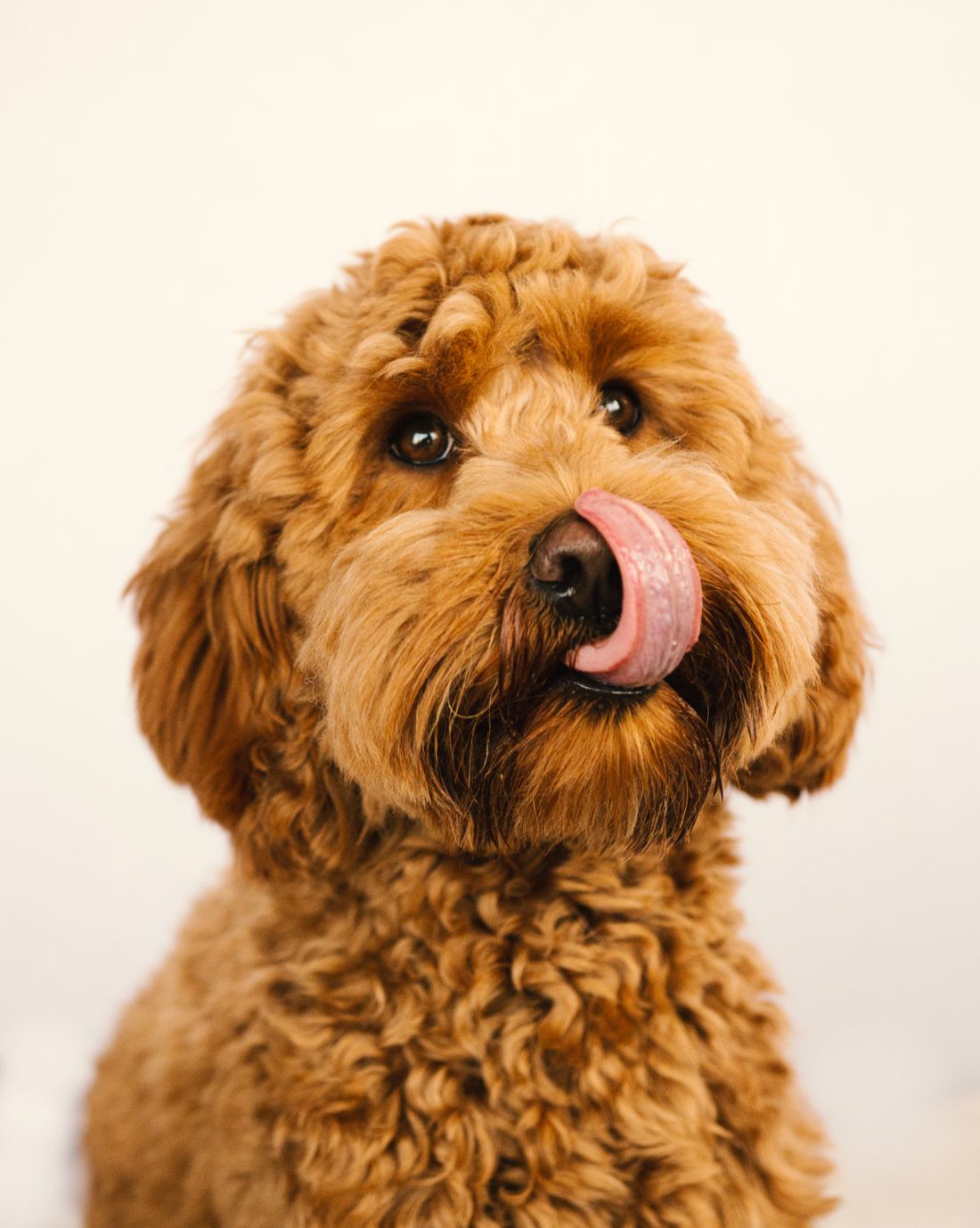
Goldendoodle Haircuts: Choose the Maintenance Level Before the Style Name
Goldendoodle haircut names vary heavily between salons. “Teddy bear,” “puppy cut,” “kennel cut” and “lamb cut” are useful visual directions, not universal measurements. Tell the groomer what length to leave and which areas should stay fuller.
| Plan | Typical look | Home workload | Best for |
|---|---|---|---|
| Short utility / kennel-style | Short body and legs, practical face | Lowest | Mat-prone dogs, swimmers, active outdoor dogs, busy owners |
| Short teddy / puppy-style | Short body with round furnished face | Low–medium | Doodle expression without long body coat |
| Medium teddy | Fluffy body, fuller legs and round head | Medium–high | Owners who can line-brush several times weekly |
| Lamb-style | Shorter body with fuller legs | Medium–high | Owners who like leg volume and will maintain it |
| Long shaggy doodle | Long body, legs, beard and ears | Highest | Owners willing to brush/comb very frequently |
| Flat/unfurnished maintenance | More Golden-like face and coat | Different, often less scissor-intensive | Focus on loose coat, cleanliness and tangles |
A Goldendoodle does not need to stay long to “look like a Goldendoodle.” If you repeatedly arrive at the groomer with a matted two-inch coat, choosing a shorter repeatable trim can improve comfort and make home care more successful.
If you are comparing the curly side of the family, Patify’s Poodle haircut guide explains why Poodle clip terminology is its own system and should not simply be copied onto a Goldendoodle.
If someone tells you a Goldendoodle should be shaved close every summer simply because it is hot, separate coat maintenance from heat safety. Patify’s dog coat and summer clipping guide explains why heat management cannot be reduced to one haircut rule.
Goldendoodle Grooming Schedule by Coat and Length
Use this as a starting framework, not a medical schedule. Coat density, activity, swimming, harness friction and retained length can move a dog up or down a maintenance level.
| Coat/length | Home brush + comb | Professional grooming starting point |
|---|---|---|
| Flat/unfurnished, moderate length | Several times weekly; increase during heavier shedding/tangle periods | As needed for coat, nails, ears, feet and hygiene rather than automatic doodle clipping |
| Short furnished pet clip | 2–4 thorough sessions weekly can be a workable starting point | Often within the broad 4–8 week PetMD range |
| Medium wavy furnished | About 3–5 thorough sessions weekly; daily on friction zones if needed | Often 4–8 weeks, adjusted before tangles build |
| Curly or long furnished | Daily or near-daily section brushing may be necessary | Often toward the shorter side of a 4–8 week cycle |
| Puppy learning grooming | GANA recommends daily slicker + metal comb practice | Early cooperative visits; first haircut commonly around 4–6 months per GANA |
Do not wait for the calendar if the comb is already catching. Conversely, a flat-coated dog that stays clean and combable may not need the same clip schedule as a long curly furnished dog just because both are called Goldendoodles.
Goldendoodle Puppy Grooming: Train the Behavior Before You Need the Haircut
GANA recommends daily brushing of puppies with a slicker followed by a metal comb and suggests finding a groomer before the first full haircut. Its grooming FAQ places the first haircut commonly around 4–6 months and notes that a groomer can do an introductory face/feet/fanny service earlier.
The biggest value of early sessions is not cosmetic. A future large dog that calmly accepts feet, ears, face, brushing and a dryer is much easier and safer to groom than a dog encountering all of that for the first time after matting has already developed.
Five puppy skills worth teaching
- Stand calmly on a non-slip surface.
- Allow gentle paw handling and toe separation.
- Allow ears to be lifted and inspected.
- Tolerate short brushing/combing sessions without wrestling.
- Become comfortable with dryer sound and airflow gradually.
Keep sessions short and positive. You are building cooperative-care behavior, not trying to finish an adult grooming session on a puppy in one sitting.
Heavily Matted Goldendoodle: When Home Dematting Stops Being the Right Goal
PetMD identifies Poodles and Doodle-type long/non-shedding coats as especially prone to matting and notes that brushing frequency depends on coat length, texture and activity. Once large mats sit tight against the skin, prolonged detangling can become painful and can irritate skin.
AKC professional grooming standards explicitly include determining when shaving is necessary for mat removal, and AKC’s home-grooming guidance warns owners not to use household scissors under mats.
Small loose tangle
Work from the edge with fingers/appropriate tools while supporting hair near skin.
Several localized mats
Ask a groomer whether they can preserve surrounding coat without excessive discomfort.
Sheeted/felted coat
A short reset may be the safest, kindest option.
Red, wet, odorous or painful skin
Grooming and veterinary assessment may both be needed.
Do not make “saving the fluff” the priority over skin comfort. Hair grows back. Skin lacerations and painful dematting are avoidable.
Ears, Eyes, Feet and Nails: The Coat Is Not the Whole Groom
Ears
PetMD advises keeping Goldendoodle ears clean and dry, especially after bathing or swimming, and asking a veterinarian whether routine ear cleaner is appropriate. If your dog has repeated head shaking, odor, redness, pain or discharge, do not keep escalating home cleaning. Patify’s head-shaking and ear guide explains why deeper problems can exist even when the outer ear looks clean.
Eyes
Keep bangs from blocking vision, but use extra caution with scissors near the face. If hair constantly contacts the eye, ask a groomer to design a safer face shape rather than repeatedly trimming near a moving eye at home.
Feet
Long hair between pads can collect mud and hide debris. AKC advises that pad hair be trimmed carefully and only with proper technique. Toe webs and pad edges are not good practice zones for an inexperienced clipper user.
Nails
GANA recommends frequent nail work in puppies to keep nails short and normalize handling, with the interval often lengthening as the dog matures. For adults, trim based on actual nail growth rather than waiting for a fixed date.
Screenshot This: Goldendoodle Groomer Brief
Coat: curly / wavy / straight / flat-unfurnished / unsure
Body length I want left: ______ inch(es)
Legs: same as body / slightly fuller / lamb-style fuller
Face: short practical / rounded teddy / longer shaggy
Ears: short / jaw length / longer
Beard: short for cleanliness / medium / full
Tail: tidy natural / shortened / fuller plume
Feet: compact / fluffy
Known mat zones: ears / collar / armpits / chest / legs / tail / none
Lifestyle: city / hiking / swimming / daycare / frequent harness / mostly indoors
My realistic home routine: daily / 3–4x weekly / 1–2x weekly
Then show one front-view and one side-view reference photo. Ask the groomer what is possible with the coat today. If mats force a shorter cut, ask them to show you the mat map so the next appointment can be different.
Frequently Asked Questions About Goldendoodle Grooming
How often should I brush a Goldendoodle?
PetMD recommends at least a few times a week generally, while GANA recommends daily slicker-plus-comb practice for puppies. Long, curly or mat-prone furnished coats may need daily or near-daily work; short or flatter coats can require less. Use the metal-comb test to adjust frequency.
How often should a Goldendoodle go to the groomer?
PetMD gives roughly every 4–8 weeks as a common professional grooming range. Longer, curlier or rapidly matting coats may need the shorter end; a flat/unfurnished coat may have a different schedule.
What brush is best for a Goldendoodle?
A slicker brush plus a stainless steel comb is a strong core combination. GANA specifically recommends using the comb after the slicker because the brush can miss mats underneath.
What is line brushing?
Line brushing means parting the coat so a narrow line of skin is visible, brushing that layer from root to tip, then releasing another small section and repeating. It prevents surface-only brushing.
Should I bathe my Goldendoodle before brushing?
Inspect and address tangles first. Bathing is not a substitute for detangling, and a heavily matted dog should be assessed before you soak the coat. For routine baths, brush/comb first, then wash, dry thoroughly and comb again.
Can I groom a Goldendoodle completely at home?
Experienced owners can learn a great deal, but precision clipping around eyes, ears, paw webs, sanitary areas and skin-tight mats carries injury risk. AKC recommends training before home clipping/shaving. Many owners do brushing, combing and coat checks at home and use a professional for haircuts.
Does an F1B Goldendoodle always have a curly non-shedding coat?
No. Generation labels do not guarantee one exact coat. GANA emphasizes genetic coat traits such as curl and furnishings rather than relying only on filial generation to predict appearance and shedding.
Does a straight-coated Goldendoodle need less grooming?
Sometimes, but “straight” is not enough information. A straight furnished coat can still be long and mat-prone. An unfurnished flat coat tends to shed more and may require less doodle-style coat maintenance. Judge density, length, furnishings and combability.
What is the easiest Goldendoodle haircut to maintain?
A short utility or short teddy-style pet trim usually lowers the brushing burden most because there is less retained hair to tangle. The face, ears, tail and friction zones still need maintenance.
Why did the groomer shave my Goldendoodle?
Severe matting is a common reason. If mats are tight against skin, clipping underneath them may be safer and less painful than prolonged dematting. Ask which areas were matted and choose a home routine or shorter repeat style that you can maintain.
When should a Goldendoodle puppy get its first haircut?
GANA says many puppies are ready around 4–6 months and encourages earlier low-stress groomer introductions, including face/feet/fanny services. Exact timing should also consider coat, salon health requirements and puppy comfort.
Are Goldendoodles hypoallergenic?
No individual dog can be guaranteed allergy-proof. GANA notes that furnishings and coat genetics influence shedding, but allergic reactions are complex and also involve dander, saliva and other proteins. Low shedding is not the same as no allergens.
Sources Checked for This Guide
- Goldendoodle Association of North America — Coat Types and Traits
- GANA — Goldendoodle Generations
- GANA — Grooming FAQ
- PetMD — Goldendoodle Health and Care
- PetMD — Matting in Dogs and Cats
- Embark — Doodle Trait Genetics
- Embark — Coat Trait Tests
- American Kennel Club — Grooming at Home
- American Kennel Club — Professional Grooming Educational Standards
- Pexels — Goldendoodle cover image
- Pexels — Goldendoodle support image
- Pexels — Goldendoodle face support image
- Pexels License
Editorial note: this guide separates genetic coat traits from marketing shorthand and avoids assuming one F1/F1B grooming routine. Grooming intervals are starting ranges rather than guarantees. Severe matting, painful skin, recurrent ear disease or a dog that cannot tolerate grooming safely may require professional grooming and/or veterinary assessment. Sources were reviewed September 29, 2026.