Green Neon Tetra Care: Identify the Right Fish and Plan a Stable Aquarium

If a retailer describes a shoal of brilliant blue fish as “green neons,” pause before treating them as ordinary neon tetras in a different colour. The distinction matters when you choose water, plan a planted tank and decide whether the stock has settled sufficiently after shipping. A green neon tetra can look almost entirely blue under shop lighting, yet it has a distinct scientific identity, a smaller adult body and a reputation for reacting poorly to unstable new aquariums. A spectacular photograph is a starting point for identification, not a stocking plan.
The short answer: Green neon tetra means Paracheirodon simulans, a small, social South American fish, not P. innesi (neon) or P. axelrodi (cardinal). Seriously Fish's species profile lists a reference aquarium footprint of 45 × 30 cm (about 18 × 12 inches), 24–27°C (75–81°F), soft water and a preference for mature, stable conditions. Aquarium Co-Op's care article describes a somewhat wider range in its captive experience. Our approach is to document the fish's source-water conditions, build a stable system and change water chemistry deliberately rather than force a number overnight.
Green neon, neon or cardinal: three distinct species
The most useful field clue is the relationship between the luminous horizontal stripe and the red on the lower body. A green neon is generally smaller and slimmer, often with a turquoise-to-blue stripe extending far back along the flank, while red is relatively faint. A classic neon tetra has a stronger red area mainly behind the midpoint; a cardinal shows red running farther forward, often beneath much of the blue line. The colour shifts with lighting, transport stress, posture and the age of the fish, however, so the pattern is a guide—not an infallible test from one smartphone snapshot.
| Retail label | Scientific name | Useful distinction | Responsible next action |
|---|---|---|---|
| Green neon / false neon / blue neon | Paracheirodon simulans | Small, mostly luminous blue-green stripe, subdued red | Confirm species on the invoice and actual stock photo |
| Neon tetra | Paracheirodon innesi | Prominent red on rear portion | Do not assume the same temperature profile |
| Cardinal tetra | Paracheirodon axelrodi | Red extends substantially farther toward the head | Plan for its own adult size and group needs |
| “Assorted neon tetras” | Unclear | Could mix three different species | Ask for a precise count and identity per species |
An especially costly mistake is buying four “greens” and six conventional neons to make a supposed ten-fish school. They are related fish but not a single interchangeable social group. Write the full species name on your shopping list. The Patify tetra types comparison is useful for choosing among tetras; this article concentrates on keeping P. simulans after you have chosen it.
What its blackwater origin tells you—and what it does not
Seriously Fish describes green neons from upper tributaries of the rio Negro and Orinoco, including shaded waters influenced by leaf litter, roots and humic substances. Those details explain preferences for subdued light, refuge and often soft acidic water. They do not instruct a Canadian hobbyist to dump an unspecified quantity of acid, botanical extract or leaf material into a fresh aquarium. Natural acidity is part of an entire ecological system; artificially creating a low pH without considering alkalinity and biological stability is not a safe shortcut.
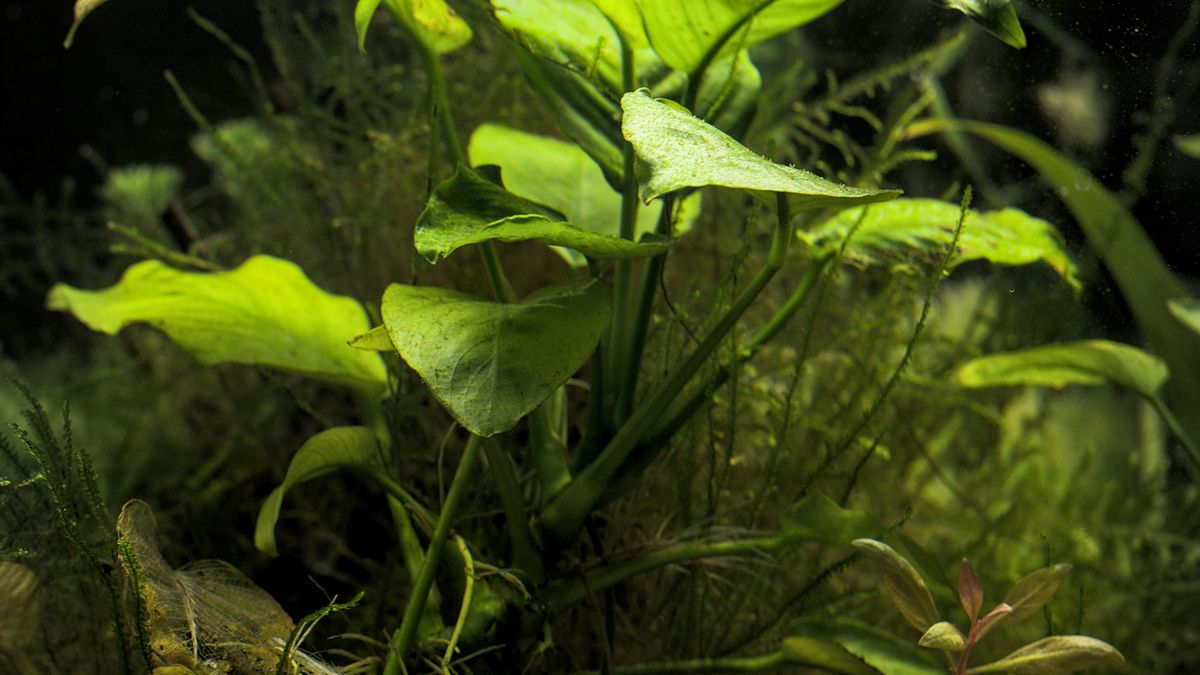
The species is associated with slow to moderate water movement under heavy shoreline vegetation. In a home setup, aim for a planted or natural-style layout with shaded areas and an open lane that still allows you to observe the whole group. Tannins from aquarium-safe leaf litter and wood can tint water, but dark water alone is not evidence that the chemistry is appropriate. If you choose botanicals, use responsibly sourced aquarium materials and measure actual changes rather than trusting colour as a pH meter.
The water-number question: wild reference versus captive experience
Seriously Fish gives approximately 24–27°C, pH 3.0–6.5 and 1–8 dGH as profile conditions, and explicitly cautions against immature or fluctuating aquariums. Aquarium Co-Op reports having kept the fish in less acidic captive conditions, even around pH 7–8. That does not make either source dishonest: one emphasizes species habitat and caution, the other reports experience with fish already acclimated to different conditions. Neither observation proves that a newly imported wild-collected group will handle sudden changes safely.
For a purchase decision, ask the seller for measured pH, GH, KH and temperature in the holding tank, plus information about how long the fish have been there. Check your own established tank at comparable times over several days. If the difference is substantial, do not improvise with rapid chemical adjustments; reconsider the species, prepare water thoughtfully or consult an experienced local aquarist. Stability and the source of the particular fish should shape the plan. A one-off test strip photograph, especially without a date, should not determine a long-term stocking decision.
Choose floor space before calculating litres
A small fish does not need an imaginary “one litre per centimetre” formula. Group movement, feeding distribution, cover and available horizontal distance all matter. The Seriously Fish baseline of 45 × 30 cm is a reference floor, not a guarantee that any container with that footprint can accommodate any number of fish. Aquarium Co-Op recommends a group around ten in an aquarium of at least 10 US gallons, while larger aquariums make it easier to build stable conditions and display a more substantial shoal. A tank in Canada marked “10 gal” should be checked for whether the manufacturer means US gallons rather than Imperial gallons.
Compare two tanks with the same claimed volume: a narrow, tall display and a longer planted rectangle. The rectangular footprint is more flexible for separate shade and feeding zones and can be easier to watch without cornering the fish. Record actual internal dimensions after accounting for thick substrate and décor. Plan filtration, heater placement and access for routine cleaning at the same time. A cramped hardscape may photograph beautifully before stocking but make later feeding and inspection unnecessarily difficult.
Draw a practical three-zone layout
Start with a pencil plan rather than a shopping basket. Zone one is a softly lit front or central corridor where you can see fish take food and check body condition. Zone two contains rooted plants, moss and hardscape that form a sheltered detour away from brighter light. Zone three is a second shaded route near the opposite end, so the group can move without being forced through one exposed choke point. Leave a visible route for a siphon and a way to reach the filter intake.
A dark background can make the stripe conspicuous, but visual contrast must not replace refuge. Floating plants can diffuse the light; avoid allowing a solid canopy to choke all surface exchange or hide maintenance issues. Fine moss on wood or rock can make a useful transitional zone but may collect waste in stagnant pockets. For the equipment and plant-selection decisions outside this single-species question, use the existing planted aquarium setup guide; it is a broader design resource, not a duplicate green neon care sheet.
Set the filter for stable water, not dramatic current
A filter must support biological waste processing and oxygen exchange without blasting a tiny shoal against the glass. A gently set sponge filter is one workable option; a larger external or hang-on-back system may also be appropriate when its intake is protected and outflow softened. Test where particles move after feeding and whether fish can voluntarily rest away from current. A “recommended filter turnover” in a product catalogue is not proof of the velocity at a fish's swimming height once media becomes loaded.
Keep the biological filter established. Do not replace every sponge or cartridge simultaneously, and do not clean colonies with untreated disinfectant simply to make the system look new. The practical pre-stocking step is to establish biological capacity before buying the animals. Patify's fishless aquarium cycling guide covers this foundational process; this species page explains why a biologically immature tank is especially unwise for newly acquired green neons.
Record winter and summer temperature, not only heater settings
Canadian indoor temperatures vary enormously across seasons and buildings. A basement aquarium might cool significantly overnight when the thermostat is lowered; an upper-floor room facing west may warm during summer even with a heater switched off. Test the water, not the room air or the number printed on the heater dial. Observe daily high and low readings for a week, including a weekend when household heating patterns change. Stable temperature inside the credible husbandry range is more useful than minute-to-minute attempts to reach a magical decimal place.
| Check | What to write down | Why it matters |
|---|---|---|
| Morning aquarium temperature | °C and time | Detect overnight drops |
| Late-afternoon aquarium temperature | °C and time | Find heat gain from sunlight or equipment |
| pH, GH and KH | Method and dated reading | Understand stability and buffering |
| Ammonia and nitrite | Test result, not “looks clear” | Detect unsafe biological instability |
| Filter outflow and behaviour | Flow changes, hiding, respiration | Connect equipment conditions with fish response |
An unexplained temperature spike or rapid water-quality deterioration is a reason to pause feeding and stocking decisions and investigate, not a reason to add medication by guesswork. Preserve the record so that a qualified aquatic veterinarian or experienced store professional can see what changed.
How many green neon tetras should you buy?
A green neon is a group fish. Aquarium Co-Op recommends six as a broad minimum for schooling fish but favours ten or more of this species, with a suitable aquarium. The meaningful choice is a full same-species group that fits the actual tank and bioload, not a one-by-one collection bought over six months without quarantine planning. A larger group can spread social attention and make normal movement easier to observe, but you still need room, food access and maintenance capacity.
Do not add several different nano species just because each individual is tiny. Each species has its own grouping needs and feeding behaviour. A green neon group should not be treated as spare decoration to fill the water column above a bottom-dwelling species. Instead, select your primary shoal first, plan around its water and environmental requirements, and add any second species only after a cautious compatibility review. The Nano Freshwater Fish comparison can help narrow the choice before purchase.
Feed for tiny mouths and observable intake
Green neon tetras can take small prepared foods and a range of suitably sized frozen or live foods; Aquarium Co-Op mentions crushed flakes, nano feeds, cyclops, daphnia and baby brine shrimp among options. The key word is suitably sized. A pellet advertised for “small tropical fish” may still be too hard or broad for a newly purchased green neon. Watch the fish actually swallow pieces. If they strike and spit repeatedly, reconsider particle size and texture before adding more food.
Try a modest first delivery near the visible open lane and a second smaller delivery near a shaded edge when necessary. The purpose is to see whether late-arriving or subordinate fish gain access, not to double the ration. Excess food that falls behind wood can degrade water quality. Record how quickly food is consumed and whether one part of the group remains thin or inactive. The question is not “Did I feed twice?” but “Did the animals eat without persistent competition?” No arbitrary minute-by-minute feeding schedule can replace that observation.
Buying imported fish in Canada: a safer checklist
Ask a shop how recently its green neons arrived and whether it has observed feeding after import. Seriously Fish notes that traded P. simulans are wild-collected and may be sensitive soon after import; that statement should make you more careful, not more suspicious of every responsible seller. Request a clear scientific-name label, a description of current holding-water conditions, and whether fish have been isolated from visibly ill stock. A low advertised price does not compensate for weak answers about food, transport or fish condition.
During a Canadian winter, also ask whether live shipments are held for weather and whether delivery requires a person to be present. Summer heat waves present a separate risk. A shipping policy cannot guarantee live arrival in every condition, so check its exact restrictions and any local pickup options before payment. Do not invent national average fish prices; if you calculate cost, quote a dated real retailer listing and separate fish, equipment, food and quarantine expenses.
Acclimation: the transport water changes the method
Local pickup and overnight shipping are not necessarily equivalent. Bag temperature, transit duration, source-water chemistry and possible ammonia accumulation can change the safest acclimation procedure. Before fish arrive, prepare a cycled quarantine or receiving system, matched as responsibly as possible to their known holding conditions. Keep the container away from direct sunshine and aim for a quiet, predictable transfer. It is a mistake to treat an online “drip for three hours” rule as universally safe for opened, ammonia-loaded transport bags.
Patify's fish acclimation guide compares local and shipped scenarios. For green neons, apply that framework while prioritizing the particular shipment and measured water parameters. Avoid adding bag water to the display by default, and do not use medication preventively without an appropriate indication. Following arrival, watch breathing, orientation, skin integrity and feeding as well as coloration. A fish hiding briefly may be settling; a fish unable to maintain position or showing severe breathing trouble needs urgent attention.
Use a seven-day feeding and behaviour log
The purpose of the first-week log is not to certify perfect health. It creates a consistent record that helps you spot problems before they become normal. Observe at similar times with gentle lighting, and note any changes in temperature, feeding or filtration. Check that the group has access to two sheltered routes and that a significant proportion visibly takes food. A whole-group impression (“they seem okay”) is less useful than a note on the one fish repeatedly excluded from meals.
| Day | What to observe | Decision if the result is poor |
|---|---|---|
| 1 | Breathing, balance, quiet refuge | Recheck water and minimize disturbance |
| 2 | First small feeding, food size | Reduce particle size; do not overfeed |
| 3 | Distribution across cover | Adjust bright light and sight lines |
| 4 | Water results after normal feeding | Investigate detectable ammonia or nitrite |
| 5 | Body condition and excluded fish | Add a second feeding approach, not more total food |
| 6 | Filter, temperature trend | Correct persistent environmental instability |
| 7 | Group pattern across the week | Decide whether the setup is stable enough to maintain |
This table is an observation template, not a claim that Patify ran a seven-day experiment. Real fish that show sustained distress require timely welfare action; do not wait for day seven to finish a checklist.
Selecting peaceful tankmates without assuming compatibility
The phrase “peaceful community fish” conceals important differences. A nonaggressive fish can still be fast enough to intercept every tiny food particle. Large or curious species may intimidate green neons or see them as prey. Even other small tetras can need different water chemistry or social space. Compare adult size, preferred temperature, water hardness, temperament, swimming level, feeding speed and any predation risk rather than deciding from colour harmony.
A honey gourami can sometimes be considered in a suitably spacious, planted community—a suggestion made in the Aquarium Co-Op green neon profile—but it is not an automatic green light. The real question is whether the particular fish, water, amount of cover and feeding plan fit. The Honey Gourami care guide addresses that fish’s identification and surface-habitat needs. This connection is an option to evaluate, not proof that the two must be housed together.
Shrimp, fry and the false promise of “100% shrimp-safe”
Adult dwarf shrimp sometimes coexist with green neons in established planted aquariums, but very small shrimplets can be eaten by many small fish. There is a meaningful difference between a display where adult shrimp are seen regularly and a breeding project aiming to raise large numbers of young. Fine plant cover can reduce exposure, not guarantee survival. Avoid labelling any fish “shrimp-safe” without specifying life stage and conditions.
If shrimp reproduction is a primary goal, consider whether a species-only shrimp setup would meet it more consistently. Also resist feeding extra fish food to compensate for invisible shrimplet losses; uneaten food can harm both fish and invertebrates. Good community planning begins with the goals of all animals, not with a list of online endorsements claiming that their preferred tankmate combination “works fine.”
What about breeding green neon tetras?
Breeding P. simulans is a specialized project rather than an effortless by-product of owning a colourful shoal. Aquarium Co-Op outlines a low-light breeding setup with attention to water chemistry, egg protection and microscopic early foods. Adults can consume eggs, and fry can be too small for a typical prepared diet at first. Simply seeing adults court or deepen in colour does not establish that eggs hatched, survived or received the correct first food.
Plan where the fry will go before attempting a spawn. A stable dedicated setup, suitable starter cultures and the ability to monitor very small changes in water conditions are more important than an elaborate online breeding “hack.” Avoid forcing the main aquarium to extreme acidity simply to try one spawning technique while its existing livestock needs stable conditions. For most keepers, documenting normal feeding, water stability and behaviour should be the first achievement.
Common problems: interpret the pattern before acting
| Observation | Possible causes worth checking | First response |
|---|---|---|
| Brilliant stripe looks dull after delivery | Transport, lighting, stress | Check breathing and water; observe calmly |
| Group hides all day | Exposure, unsettled arrivals, tankmates | Add diffuse shade and sheltered travel routes |
| A few fish take all food | Too large a particle, wrong delivery point | Offer smaller pieces across two zones |
| Several fish gasp or lose balance | Environmental or medical emergency | Test water urgently; seek professional guidance |
| Fish are active but slowly lose body condition | Inadequate intake or possible illness | Document individual feeding and consult expertise |
| Unexplained fatalities after restocking | Acclimation, source stock, disease, water instability | Stop new purchases; investigate systematically |
Avoid treating every pale stripe as disease or every hidden group as a “shy personality.” Compare today's observations with dated water readings and yesterday's feeding record. An aquarium can appear crystal clear while chemically unsafe. Conversely, naturally tinted water can be appropriate when the actual chemistry is understood and maintained.
Maintenance: protect stability while doing real upkeep
A mature setup still needs water testing, partial water changes suited to measured conditions, thoughtful filter service and removal of excess organic waste. Keep notes when you clean a major part of the filter or prune a large area of plants; those tasks can alter current and shelter at the same time. Wash biological media in a manner that protects the beneficial microorganisms rather than sterilizing it. Use replacement water prepared to compatible temperature and chemistry, avoiding sudden unexplained swings.
A useful maintenance question is whether the aquarium can be serviced without frightening every fish into the same corner. Open a route for the siphon while preserving an alternate refuge. Remove decaying material gradually and keep access to the food-observation lane. If green neons spend a week recovering their confidence after every cleaning, inspect the design and intensity of your routine rather than blaming the species for being permanently timid.
Green neon versus ember tetra: choose the aquarium first
Both fish are attractive small shoalers but they are not equivalent. Green neons are blackwater-associated Paracheirodon simulans whose care profile emphasizes mature stability and softer acidic conditions. Ember tetras are Hyphessobrycon amandae and have a separate warm-water, planted-group profile. A generic “nano fish” recommendation can hide those differences. Shop for the fish that suits your current tested water and tank footprint, not the one that produces the brightest digital image.
The Patify tetra types comparison introduces ember and other alternatives. Green neon, conventional neon and cardinal are likewise distinct choices: a handful from each is not a shortcut to one good shoal. Build a proper same-species group first and consider every additional animal a new husbandry decision.
Before adding a second group, calculate the actual maintenance load
A species checklist is only part of a stocking decision. Consider an aquarium already containing a bottom-dwelling group: its feeding places, waste production and response to water changes must be included before green neons are added. Write down the existing number of animals, adult sizes and how much food reaches the floor. Then compare the additional shoal with the available sheltered midwater routes and the filtration you can maintain. The answer is not a neat mathematical stocking ratio. It is whether all animals have space, food access and stable tested water under ordinary conditions.
If your current routine only works by skipping water tests or feeding so sparingly that timid fish remain thin, adding another species will not solve the problem. Equally, building a larger tank does not excuse sudden chemical changes or poor quarantine. Make one improvement at a time—more practical shelter, better food delivery, reliable testing—and observe its effect before introducing more livestock. A defensible stocking plan is a manageable workload as well as an attractive population.
A final buying decision you can defend
Buy green neons only if you can identify P. simulans, document the seller's water and feeding conditions, maintain a stable biologically mature aquarium and provide a meaningful same-species group. Check that your tank offers shaded cover without sacrificing a visible feeding route. Confirm suitable tiny foods before delivery, not afterward. Be ready to observe the whole group during the first week without creating a disruptive testing ritual.
If you are uncertain about the available fish, the seller's evidence or your own water stability, postponing the purchase is a better result than forcing a beautiful species into a mismatched tank. A responsible green neon setup is not measured by how blue the fish look in the first photograph. It is measured by whether the group can feed, move and maintain condition in a system you can care for through the year.
Sources and image credit
- Seriously Fish — Paracheirodon simulans: species identity, habitat, aquarium footprint and reference conditions.
- Aquarium Co-Op — Green Neon Tetra: practical captive care, schooling, food sizes and contrasting water experience.
- Wikimedia Commons — Paracheirodon simulans image by Sascha Biedermann, CC BY-SA 2.5, displayed with attribution; no claim of Patify ownership or original field photography.
Editorial note (15 October 2026): The sources were reviewed for an informational husbandry guide. Patify did not conduct a live-animal trial, photograph the featured fish or provide an individualized aquarium veterinary diagnosis.