
Last updated: September 24, 2026
Quick answer: the best “toys” for a bearded dragon are usually not pet-store toys at all. They are safe opportunities to climb, dig, forage, investigate, choose routes, hunt appropriate live food and learn simple reward-based tasks. A 2025 bearded-dragon enrichment study found that dragons used all provided enrichment, were more active, showed fewer stress-associated behaviors and preferred enriched enclosures—especially naturalistic ones. The goal is therefore species-relevant activity, not filling the tank with colorful objects.
Enrichment test: ask, “What behavior does this item make possible?” If the answer is only “it looks cute,” it is decoration. Strong enrichment gives the dragon a safe choice to climb, hide, dig, forage, explore, hunt or interact with a simple task.
What the Bearded-Dragon Enrichment Research Actually Found
A 2025 study in Applied Animal Behaviour Science directly compared standard housing with two enriched conditions in 12 Pogona vitticeps. The enriched enclosures added more environmental choice and complexity, including additional hides, a ramp/elevated platform system, a hammock, plants and a more naturalistic substrate; the naturalistic condition also included real plants and invertebrates.
The dragons:
- used all available enrichment;
- were more active in enriched housing;
- rested less;
- showed fewer behaviors associated with stress, including less barrier interaction;
- were more confident in novelty tests;
- preferred enriched enclosures over standard ones;
- preferred the naturalistic enriched enclosure over the non-naturalistic enriched condition.
Read the 2025 bearded-dragon enrichment study.
But “natural-looking” does not automatically mean better
A separate 2025 PLOS ONE bearded-dragon study found that structural complexity alone was not enough to clearly improve welfare outcomes. The authors emphasized that enclosure design must consider the animal's motivations, not simply replicate a visually natural scene.
Read the 2025 enclosure-design study.
Practical interpretation: do not ask “How many toys are in the tank?” Ask “How many useful choices and species-appropriate behaviors can the dragon perform?”
The 6 Jobs of Good Bearded Dragon Enrichment
| Enrichment job | Natural or useful behavior | Examples |
|---|---|---|
| Climb | Use elevated vantage/basking routes | Low branches, rocks, ramps, broad platforms |
| Dig | Excavate and investigate substrate | Dig box, appropriate loose-substrate zone |
| Forage / hunt | Search for and acquire food | Controlled feeder bowl hunt, greens in multiple stations |
| Explore | Move through changing but safe surroundings | Route changes, supervised pen, novel object |
| Choose | Select microclimate, hide, route or activity | Multiple hides, alternative ramps, shade vs basking |
| Learn | Associate a cue or location with a reward | Target training, station training, scale training |
RSPCA specifically recommends branches and stones for climbing, hides, a digging box and supervised outdoor time as enrichment. Recent reptile-welfare research also identifies structural/habitat and dietary enrichment as common, useful categories.
1. Build a Low Climbing Route
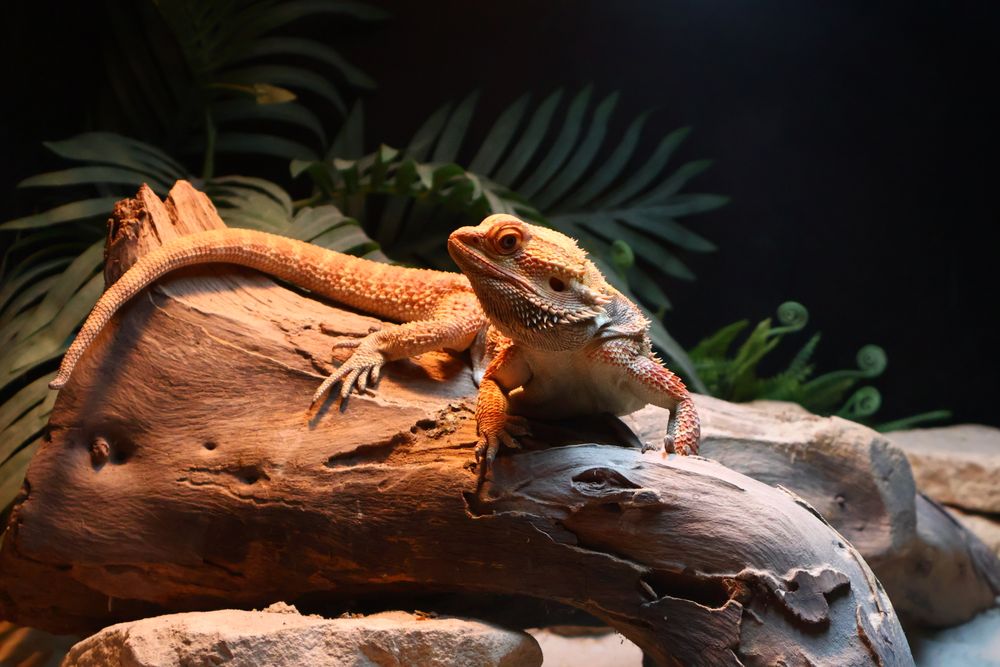
RSPCA describes bearded dragons as mainly ground-dwelling but notes that they also climb short distances onto rocks and branches. The 2025 enrichment experiment included a ramp attached to elevated platforms, and the dragons used the enrichment provided.
Easy setup
- one broad branch or cork/log section;
- one stable rock or slate platform;
- a low ramp between levels;
- enough floor space to bypass the route completely.
The dragon should be able to turn, descend and rest without balancing on a narrow edge.
Do not stack loose rocks. Heavy furnishings should rest securely so digging cannot undermine them. Avoid high drops and narrow unstable branches.
For the full habitat geometry, see Patify's bearded dragon enclosure setup guide.
2. Add a Digging Zone
Digging is one of the clearest species-relevant enrichment opportunities recommended by RSPCA. If the main enclosure floor is tile, slate or paper, a separate dig box can preserve this behavior without converting the entire enclosure to loose substrate.
Dig-box checklist
- wide enough to enter and turn around;
- stable and difficult to tip;
- placed where it does not overheat;
- filled with an appropriate substrate for the individual dragon;
- kept free of feces and spoiled food;
- not located beneath an unstable heavy rock.
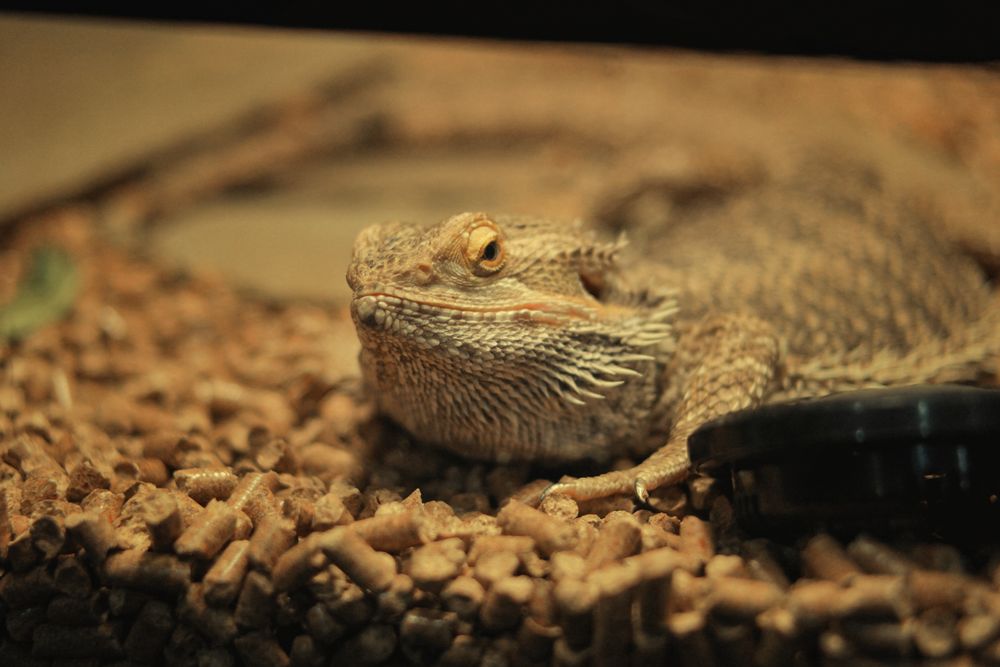
Substrate choice is controversial enough to deserve its own decision framework. Use Patify's bearded dragon substrate guide before adding a full loose-substrate floor.
3. Create a Controlled Feeder Hunt
Live prey already creates movement and sensory stimulation, but “enrichment” does not justify turning the enclosure into a cricket infestation.
Safer version
- Use appropriately sized live feeders.
- Place them in a large smooth-sided feeding bowl or controlled feeding area.
- Let the dragon visually locate, approach and capture the insects.
- Remove uneaten insects after the session.
RSPCA recommends varied live invertebrates and warns that uneaten livefood should be removed because some insects can bite the dragon. The 2025 enrichment study's naturalistic condition also allowed potential feeding enrichment from invertebrates in the substrate, but that research setup should not be copied casually into a pet enclosure.
Do not scatter feeders directly across loose substrate merely to increase “hunting.” Patify's feeding guide covers feeder size, rotation and gut-loading.
4. Turn Greens Into Simple Foraging
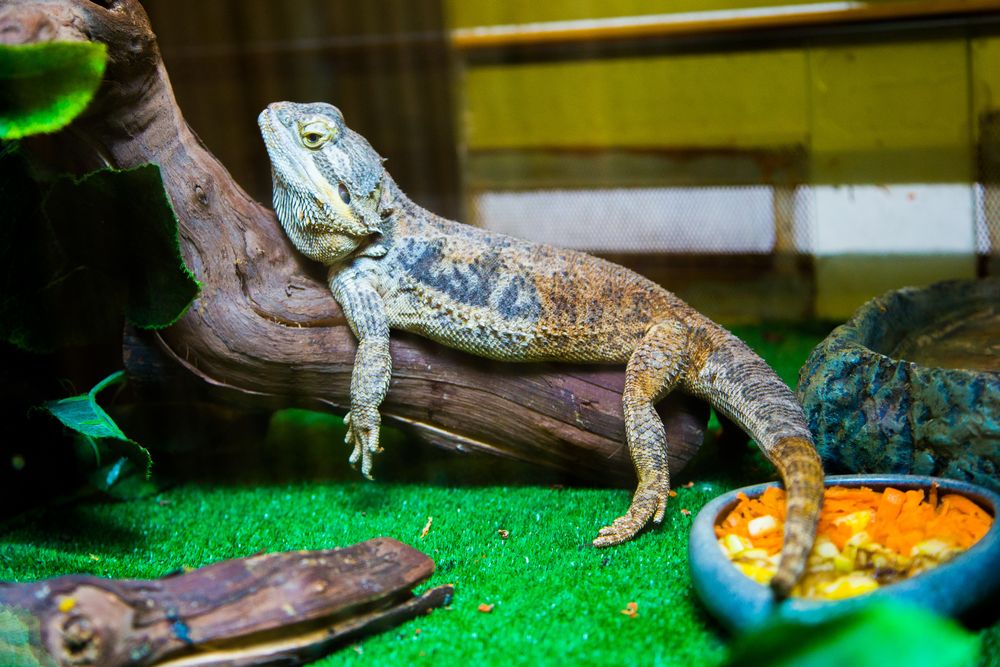
You do not need a plastic puzzle toy to create foraging. Use the dragon's normal plant ration and change presentation, not total calories.
Low-risk ideas
- split the salad between two shallow bowls;
- move one bowl to a different safe area of the enclosure;
- place a few normal ration leaves on a clean broad rock;
- use a stable food-safe holder with no sharp clips or small detachable parts;
- rotate which safe greens appear, following the normal nutrition plan.
Food enrichment should not force an older or mobility-limited dragon to climb dangerously just to eat.
5. Try Simple Target Training
Bearded dragons can learn. Laboratory research has demonstrated social learning, association learning, location-reward learning and reversal learning in Pogona vitticeps. A 2024 ReptiLearn study trained bearded dragons to enter specific areas for live-food rewards and later change their response when the rewarded location moved.
Read the ReptiLearn bearded-dragon learning study.
Simple home target exercise
- Choose one large, easy-to-see target that cannot be swallowed.
- Present it a short distance from the dragon.
- When the dragon looks at or approaches it, deliver a tiny normal food reward.
- Gradually reward closer approaches.
- End after a few successful repetitions.
The goal is not circus performance. Target training can become a useful way to encourage voluntary movement onto a scale, into a carrier or toward a station.
Evidence limit: bearded dragons have demonstrated learning ability, but a specific five-step “target training protocol” has not been validated as a welfare treatment for pet beardies. Keep sessions short, reward-based and optional.
6. Rotate One Safe Novel Object
Novel-object exposure appeared in the 2025 enrichment study's welfare testing, and enriched dragons approached novel objects more frequently in the anxiety tests. That does not mean every new object is enriching.
Good novelty object
- too large to swallow;
- no loose parts;
- no strings, loops or adhesive;
- stable and washable;
- does not block access to heat, UVB, food or hides;
- can be avoided if the dragon is uninterested.
Examples can include a large smooth cork piece, a new broad rock arrangement, a low tunnel or a large non-edible object placed briefly in a neutral zone.
If the dragon repeatedly black-beards, retreats, glass-surfs or attempts to attack the object, remove it. “Novel” is not automatically “positive.”
7. Create a Supervised Exploration Route Outside the Enclosure
A secure indoor pen can provide a temporary change of environment without allowing unrestricted free roaming.
Build a simple exploration circuit
- non-slip floor;
- low cardboard tunnel or open-ended box;
- one broad stable platform;
- a hide;
- short target-training station;
- warm room with no drafts.
RSPCA advises limiting routine out-of-vivarium handling because the animal's core temperature can fall. Its care sheet suggests roughly 10–15 minutes at a time depending on air temperature.
Never allow unsupervised floor roaming. Block stairs, furniture gaps, electrical cords, other pets, houseplants, dropped medications, cleaning products and small swallowable objects.
8. Use a Secure Outdoor Pen on Suitable Days
RSPCA specifically lists supervised outdoor access in a secure pen on bright summer days as natural UV and enrichment, provided the dragon has shade and is constantly supervised.
Outdoor rules
- secure escape-proof enclosure;
- constant supervision;
- shade available at all times;
- no contact with pesticides or herbicides;
- no access to unknown plants or wild insects;
- no dogs, cats, birds or other predators nearby;
- stop if weather is unsuitable or the dragon is stressed.
Outdoor time is optional enrichment, not a substitute for correctly installed indoor heat and UVB.
9. Offer Route and Hide Choices
Choice itself has welfare value. The 2025 enrichment experiment provided multiple hiding/resting opportunities and a ramp/platform system, while RSPCA recommends hides at both ends of the enclosure.
A useful habitat might allow the dragon to choose among:
- basking openly;
- resting on a low raised platform;
- retreating into a warm-side hide;
- using a cool-side hide;
- digging;
- moving around the route rather than over it.
The enrichment is not the second hide as an object; it is the ability to choose security without sacrificing thermoregulation.
10. Refresh One Zone Instead of Rebuilding Everything
Constantly tearing apart the enclosure can turn “enrichment” into instability. A better rotation is to keep the thermal/UV layout and secure refuges predictable while changing one low-risk detail.
Examples
- rotate a safe branch or cork piece;
- change one foraging location;
- replace a worn dig-box substrate;
- add a new safe tunnel for several days;
- move an optional platform without changing the basking distance;
- run a short target-training session.
A 2024 enrichment review argues that good enrichment should provide opportunities to acquire information and interact with a variable environment. But the 2025 PLOS ONE bearded-dragon study reminds us that complexity itself is not enough. Watch the animal's response.
Do Bearded Dragons Like Balls, Mirrors, Laser Pointers and Cat Toys?
| Item | Recommendation | Why |
|---|---|---|
| Small balls | Usually unnecessary | A large smooth ball may be investigated as novelty, but there is little reason to expect dog-like ball play; avoid anything swallowable |
| Mirrors | Avoid as routine enrichment | Reflections can provoke territorial/social displays rather than useful positive activity |
| Laser pointers | Skip | No meaningful beardie-specific welfare evidence; creates an uncatchable moving stimulus and can drive frantic chasing |
| Cat feather/string wands | Skip | Strings, feathers and small detachable pieces create ingestion/entanglement risks; food-based target work is cleaner |
| Hammock | Can be used if secure | A seagrass hammock was used in the 2025 enrichment study; inspect for loose fibers and ensure safe access |
| Tunnels | Useful when correctly sized | Can create route/retreat choice; both ends should remain accessible |
| Branches / rocks / ramps | High-value | Support species-relevant climbing, basking and route choice |
| Dig box | High-value for suitable dragons | Directly supports natural digging behavior |
“My dragon pushed a ball once” can be a real observation without proving balls are a required species-level enrichment item. Give higher priority to options supported by natural history and welfare evidence.
Bearded Dragon Toy and Enrichment Safety Checklist
Before adding anything, check all of these:
- Swallowing: no small detachable or bite-sized pieces.
- Entanglement: no long strings, loops or frayed fibers.
- Stability: rocks, platforms and ramps cannot collapse.
- Falls: climbing height and landing area are reasonable.
- Heat: object cannot overheat under the basking lamp or move the dragon too close to it.
- UVB: new furniture does not accidentally change basking distance into an unsafe range.
- Cleaning: item can be washed/disinfected or replaced.
- Materials: no sharp metal, peeling paint, exposed adhesive or unknown coatings.
- Escape: enrichment does not create a ladder to an unsecured opening.
- Choice: dragon can move away from the item.
If you raise a platform or change the basking geometry, recheck temperature and UVI using Patify's heating and lighting guide.
A 7-Day Bearded Dragon Enrichment Rotation
This is an example rotation, not a requirement to stimulate the animal every day. The core enclosure stays stable; only optional enrichment changes.
| Day | Enrichment | What to observe |
|---|---|---|
| Monday | Short target-training session | Approach, avoidance, food motivation |
| Tuesday | Dig-box access / refresh | Digging, resting, no deliberate substrate eating |
| Wednesday | Greens split between two safe stations | Exploration and feeding without overfeeding |
| Thursday | No new item; normal habitat day | Baseline behavior |
| Friday | Controlled live-feeder hunt | Stalking/capture, appetite, mobility |
| Saturday | Secure indoor/outdoor exploration if conditions allow | Confident exploration vs stress |
| Sunday | Rotate one branch/tunnel or repeat favorite activity | Voluntary use and recovery afterward |
A dragon in brumation, illness, recovery, severe stress or reproductive difficulty needs health-appropriate management rather than a busy enrichment calendar.
How to Tell Whether Enrichment Is Actually Working
Use the animal's behavior rather than your opinion of how entertaining an item looks.
Useful positive signals
- voluntary approach;
- exploration without frantic escape attempts;
- use of the new route, platform, hide or dig area;
- normal basking/feeding still occurs;
- dragon can disengage and return to resting;
- target-training participation remains voluntary.
Signals to remove or redesign the enrichment
- persistent glass surfing/barrier interaction after the change;
- prolonged black beard or defensive posture;
- repeated attempts to flee the object;
- loss of access to the normal basking/cool gradient;
- falling/slipping;
- chewing/swallowing non-food material;
- reduced feeding or basking that persists after the novelty period.
The 2025 bearded-dragon study measured movement, resting, barrier interaction, tongue-related behavior, responses to novelty and actual enclosure preference. That is a useful model: evaluate enrichment by what the dragon does, not by how much the product cost.
Frequently Asked Questions
Do bearded dragons need toys?
They need enrichment and behavioral opportunities more than conventional “toys.” Climbing structures, digging areas, food-search opportunities, hides, safe exploration and simple training are more species-relevant than pet-store balls or plush toys.
What are the best toys for bearded dragons?
The strongest choices are functional: stable branches/rocks/ramps, an appropriate dig box, controlled foraging/hunting opportunities, tunnels and target-training activities.
Do bearded dragons like to play?
They can explore, learn, investigate novel objects and interact with enrichment. It is safer to describe those measurable behaviors than to assume all interaction is “play” in the same sense as a dog or cat.
Can bearded dragons learn tricks?
Research shows bearded dragons can learn social and reward-based tasks, including location-reward and reversal-learning tasks. Simple target/station training is therefore plausible, but keep it voluntary and food-reward based.
Can I give my bearded dragon a ball?
A large smooth ball may function as a safe novel object, but there is little evidence that ball play is a core bearded-dragon need. Structural, digging and foraging enrichment deserve priority.
Are mirrors good enrichment?
Not as a routine activity. A reflection can trigger territorial or social display, which is different from creating a useful behavioral opportunity.
Can I let my bearded dragon roam the house?
Unrestricted roaming is risky because of temperature loss, other pets, cords, falls, gaps and ingestion hazards. A supervised secure pen is easier to control.
How often should I change enrichment?
There is no evidence-based universal schedule. Keep core heat, UVB, hides and safe routes predictable, then rotate one optional enrichment element and watch how the dragon responds.
What if my bearded dragon ignores every new toy?
That does not mean the dragon “needs more toys.” Try species-relevant functions such as digging, climbing, food search and route choice, and confirm that temperature, UVB and health are correct before interpreting inactivity as boredom.
Bottom Line: Enrich Behaviors, Not the Shopping Cart
The strongest bearded dragon enrichment plan is built around:
- stable climbing routes;
- an appropriate digging opportunity;
- controlled food-search and hunting;
- simple reward-based learning;
- safe exploration and novelty;
- multiple route/hide choices;
- observation of whether the dragon actually uses and benefits from the change.
The newest bearded-dragon welfare research supports enriched environments, but it also warns against assuming that complexity by itself solves welfare. If an enrichment does not create a useful behavior, is consistently avoided, or destabilizes heat/UVB/safety, remove it.