Last verified: October 2, 2026
Conure Species: Compare the Bird, Not Just the Color
Quick answer: “conure” is a common avicultural name for dozens of Neotropical parrots spread across multiple genera, not one biological genus. A green-cheeked conure (Pyrrhura molinae) and a Sun Conure (Aratinga solstitialis) are both called conures, yet their body size, call intensity, plumage and household impact differ substantially.
Patify species rule: compare verified species → adult scale → normal vocal style → social/enrichment needs → housing and veterinary plan. Plumage is useful for identification, but it should not be the first ownership criterion.
“Conure” Is a Useful Common Name, Not One Genus
World Parrot Trust groups many New World parrots under the common type “conures.” Current species pages place familiar companion conures in several genera including Pyrrhura, Aratinga, Eupsittula and Thectocercus.
Taxonomy can change as relationships are revised. The Nanday Conure, for example, appears in older aviculture literature under Nandayus nenday, while the current World Parrot Trust species page uses Aratinga nenday. Scientific names therefore deserve a date/source rather than being copied forever from an old pet-store chart.
This guide focuses on companion-bird identification and household planning. It is not a complete list of every wild conure and does not imply that every species is commonly or appropriately available in the pet trade.
10 Conure Species at a Glance
Reference lengths and weights below come primarily from current World Parrot Trust species profiles. They describe species scale, not a target weight for an individual pet. Body condition and an avian veterinarian are more useful than forcing a bird to match a chart.
| Species | Scientific name | Approx. length | Reference weight | Vocal clue |
|---|---|---|---|---|
| Green-cheeked | Pyrrhura molinae | About 10 in | Small Pyrrhura scale | Relatively quieter than many larger conures, not quiet |
| Sun | Aratinga solstitialis | 30 cm / 11.7 in | 120–130 g | Shrill, powerful calling |
| Jenday/Jandaya | Aratinga jandaya | 30 cm / 11.7 in | 125–140 g | Loud metallic/screeching calls |
| Nanday | Aratinga nenday | 30 cm / 11.7 in | About 140 g | Clamorous, shrill flock calls |
| Blue-crowned | Thectocercus acuticaudatus | 37 cm / 14.4 in | About 165 g | Loud repetitive flight calls |
| Dusky-headed | Aratinga weddellii | 28 cm / 11 in | 95–115 g | Shrieking flock/contact calls |
| Crimson-bellied | Pyrrhura perlata | 24 cm / 9.3 in | 85–94 g | Smaller Pyrrhura scale; individual calling varies |
| Black-capped | Pyrrhura rupicola | 25 cm / 9.75 in | About 70 g | High-pitched yapping calls |
| Maroon-bellied | Pyrrhura frontalis | 26 cm / 10.1 in | 72–94 g | Rapid screeches/contact calls |
| Peach-fronted | Eupsittula aurea | 26 cm / 10 in | 80–105 g | Shrill flight notes |
Do not convert the final column into a fake decibel ranking. Room acoustics, individual temperament, flock calling, reinforcement history, arousal and time of day all change what owners experience. “Relatively quieter” is a within-group comparison, not a promise of a quiet apartment pet.
1. Green-Cheeked Conure — Pyrrhura molinae
The green-cheeked conure is one of the smaller and most familiar companion conures. Lafeber describes it as comparatively lower in noise than many larger conures, while still social, active and capable of strong vocal behavior. World Parrot Trust confirms the species as Pyrrhura molinae.
Wild-type birds are mainly green with a darker crown, grayish/scalloped breast and maroon-red tail. Captive color mutations can change the familiar appearance dramatically.
Mutation is not species
Names such as pineapple, cinnamon, yellow-sided and turquoise are widely used for green-cheek color mutations or combinations. They do not create a separate conure species. This is one of the most common search-result mistakes.
Household fit
A green-cheek may be a better noise fit than a Sun or Jenday for some homes, but it still needs daily social opportunity, training, safe exercise, chewing material and foraging. “Smaller” does not mean low-maintenance.
2–3. Sun and Jenday Conures: Similar Size, Different Color Map
Sun Conure — Aratinga solstitialis
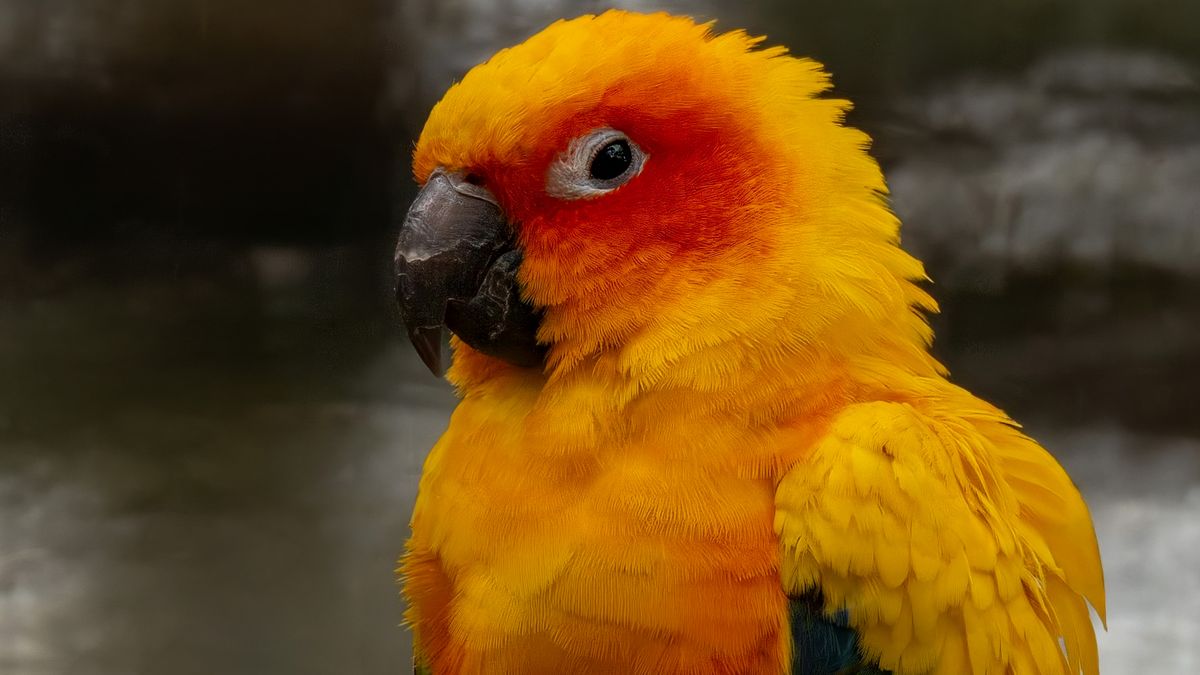
World Parrot Trust lists adults at about 30 cm and 120–130 g. Mature birds are dominated by vivid yellow and orange with green in the wings and blue in the flight feathers. Juveniles are much greener, which can confuse photo identification.
Lafeber emphasizes a major ownership fact: Sun Conures are highly vocal and their calls can be shrill and piercing. Training can improve learned screaming patterns, but it cannot ethically erase normal species communication.
World Parrot Trust lists the wild Sun Conure as Endangered. Companion ownership should favor legal, documented captive sources or rescue/adoption and should never support wild capture.
Jenday/Jandaya Conure — Aratinga jandaya
The Jenday is similar in body scale—about 30 cm, with World Parrot Trust listing 125–140 g—but mature plumage differs. Yellow/orange dominates the head and underparts while the back and wings retain much more green than on a mature Sun Conure.
The call is also described as loud, metallic and screeching. If a household cannot tolerate high-intensity parrot calls, the visual appeal of either species should not override that mismatch.
4. Nanday Conure — Aratinga nenday
The Nanday has a distinctive dark head contrasted against a green body, with blue wash around the upper chest area and orange-red on the thighs. World Parrot Trust lists about 30 cm and roughly 140 g.
Its calls are described as clamorous/shrill. Apartment compatibility therefore depends on the actual building and neighbors, not a generic “can conures live in apartments?” answer.
Older references may use the genus Nandayus. Current World Parrot Trust pages use Aratinga nenday, illustrating why species guides should not treat taxonomy as static.
5. Blue-Crowned Conure — Thectocercus acuticaudatus
At about 37 cm and roughly 165 g in the World Parrot Trust reference, the blue-crowned conure is visibly larger than the small Pyrrhura conures. Adults show blue across the forehead/face with a mostly green body and long tail.
World Parrot Trust notes that this is the only conure in the genus Thectocercus. That single fact neatly disproves the idea that “conure” is one genus.
The larger body and beak also scale up equipment requirements and bite consequences. Cage spacing, perch diameter, carriers and toy durability should match the actual bird rather than a generic “conure setup.”
6–9. Smaller Conures: Similar Scale Does Not Mean Same Species
Dusky-Headed — Aratinga weddellii
About 28 cm and 95–115 g. The head is gray-brown/dusky with a predominantly green body, blue primaries and maroon-toned tail. World Parrot Trust describes continuous shrieking calls in flock contexts.
Crimson-Bellied — Pyrrhura perlata
About 24 cm and 85–94 g. Adults have the namesake crimson belly, a patterned upper breast, blue on the cheeks/hindneck and reddish tail.
Black-Capped — Pyrrhura rupicola
About 25 cm and roughly 70 g. Key clues include the dark cap, green cheeks, pale scalloping on the neck/breast and red near the wing bend.
Maroon-Bellied — Pyrrhura frontalis
About 26 cm and 72–94 g. Green dominates, with patterned breast and a maroon abdominal area. Lafeber notes that green-cheeked and maroon-bellied conures are often confused, especially by inexperienced observers.
These species share a smaller overall scale but remain biologically distinct. Accurate species identity matters for expected adult phenotype, record keeping, breeding ethics and which care literature applies.
10. Peach-Fronted Conure — Eupsittula aurea
World Parrot Trust lists the peach-fronted conure at about 26 cm and 80–105 g. Adults are mainly green with a yellow-orange forehead/forecrown, some dull blue around the rear crown area and an orange-toned eye ring.
Its placement in Eupsittula adds another taxonomic branch to the comparison: birds in Pyrrhura, Aratinga, Thectocercus and Eupsittula may all carry “conure” in English common usage.
Noise Is the Comparison Most Owners Underestimate
Color is easy to compare online. Sound is harder, which is why visual species guides often understate the biggest household tradeoff.
| Question before adoption | Why it matters |
|---|---|
| Can neighbors hear high-pitched parrot calls through the walls? | Normal contact/alarm/excitement calls can travel even when the bird is not displaying a behavior problem. |
| Is the household expecting a “quiet bird”? | Green-cheeked conures are relatively quieter, not silent. |
| Can you reinforce alternative behaviors without punishing normal communication? | Attention can strengthen some learned screaming, while punishment may create fear and does not remove species-typical calls. |
| Did vocal behavior change suddenly with other symptoms? | Illness or pain can change behavior; training should not replace medical triage. |
If vocal behavior changes abruptly, Patify’s parrot screaming guide separates medical red flags, fear/context, contact calling and learned reinforcement.
What Every Companion Conure Still Needs
- Functional space: housing should allow climbing, movement and wing use, plus safe out-of-cage exercise appropriate to the species and household.
- Chewing and foraging: rotate bird-safe destructible materials and foraging tasks. An active parrot denied appropriate outlets will often invent its own projects.
- Balanced nutrition: do not build the diet around unrestricted sunflower/seed. A nutritionally complete formulated base plus appropriate fresh foods is more defensible; individual needs belong with an avian veterinarian.
- Social opportunity with choice: companion parrots need interaction, but social care is not forced cuddling. Positive reinforcement and readable body language are safer foundations.
- Avian veterinary care: establish an avian/exotics veterinarian before a crisis. Birds can conceal illness until significantly compromised.
- Long-term planning: many conures can live for decades. Moving, education, work schedules, partners, children and housing restrictions belong in the adoption decision.
Lafeber gives a broad 20–30 year life expectancy for conures as a group, with species and individuals varying. Treat that as a multi-decade commitment, not a guaranteed lifespan.
For a nutrition example grounded in current avian sources, Patify’s cockatiel food guide explains why complete diet, produce, treats and monitored conversion should be separated rather than reduced to “seed vs pellets.”
How to Identify an Unknown Conure
- Get neutral-light full-body photos. Include face, breast, wings, tail and eye ring.
- Estimate adult scale carefully. Perspective can make a small Pyrrhura look much larger.
- Map head color. A Nanday’s dark head, Blue-crowned blue head and Sun/Jenday warm head patterns are useful first splits.
- Map chest and belly. This is especially important among green-cheeked, crimson-bellied and maroon-bellied birds.
- Check tail and wing pattern. These can be more diagnostic than a face-only portrait.
- Ask about captive mutation lineage. Mutations can make a green-cheek look unlike wild type.
- Do not infer species from seller color names. Pineapple, turquoise and yellow-sided normally describe green-cheek mutation phenotypes, not species.
Do not use a photo identification as a breeding decision. Closely related conures can hybridize in captivity. Species identity, sex, ancestry, health and responsible breeding goals require stronger documentation.
Related Patify Bird Guides
- For a family-level companion-bird comparison, see Cockatoo vs Cockatiel.
- For diet principles, use the cockatiel food guide.
- If a bird is weak, cannot perch or has breathing changes, use Patify’s parrot emergency guide instead of troubleshooting species behavior first.
Frequently Asked Questions About Conure Species
How many species of conure are there?
World Parrot Trust groups more than 55 species under the common conure type, but exact counts can change as taxonomy is revised.
Is a conure a parakeet?
Yes in broad common-name usage: many birds called conures are also described as parakeets. Scientific species names are more precise.
Which conures are among the smaller common pets?
Green-cheeked and other Pyrrhura conures are among the smaller commonly kept conures, around the 9–10 inch range depending on species.
Are green-cheeked conures quieter than Sun Conures?
Generally they have a lower relative noise profile, while Sun Conures are known for powerful shrill calls. No individual conure is guaranteed quiet.
What is the difference between a Sun and Jenday Conure?
They are similar in size, but mature Suns are dominated by yellow/orange while Jendays retain substantially more green across the back and wings.
Is a pineapple conure a species?
No. Pineapple is a captive green-cheeked conure color-mutation combination.
Which conure is best for an apartment?
No species is automatically apartment-safe. A green-cheek may be easier than a Sun/Jenday for some buildings, but individual calling and sound insulation still decide the real fit.
Can different conure species live together?
Do not assume compatibility from the shared common name. Size, aggression, pair bonding and hybridization risks differ; separate housing may be necessary.
How long do conures live?
Many can live for decades. Lafeber gives a broad 20–30 year group-level reference, while individual species and birds vary.
Sources Checked
- World Parrot Trust — Conures
- World Parrot Trust — Green-cheeked Conure
- World Parrot Trust — Sun Conure
- World Parrot Trust — Jandaya Conure
- World Parrot Trust — Nanday Conure
- World Parrot Trust — Blue-crowned Conure
- World Parrot Trust — Dusky-headed Conure
- World Parrot Trust — Crimson-bellied Conure
- World Parrot Trust — Black-capped Conure
- World Parrot Trust — Maroon-bellied Conure
- World Parrot Trust — Peach-fronted Conure
- Lafeber — Conure
- Lafeber — Green-Cheeked Conure
- Lafeber — Sun Conure
Sources reviewed October 2, 2026.