Sterbai Corydoras Care: Temperature, Substrate and a Real Feeding Plan

Sterbai corydoras are easy to admire at a shop: pale spots stand out against a dark head, the undersides look warm and orange, and a loose group patrols the aquarium floor. Buying them only because they are described as “a hardy bottom cleaner,” however, overlooks almost everything that determines their welfare. These are active, social armoured catfish. They need suitable warm-water conditions, room to forage as adults, consistently clean substrate and a diet offered for them—not whatever happens to fall past more competitive fish.
The practical answer: Hoplisoma sterbai, formerly Corydoras sterbai, is a peaceful, group-living tropical species. The Seriously Fish profile gives a 24–28°C (75–82°F) reference temperature range and adult standard length of approximately 6.5 cm (2.6 inches). It recommends keeping a same-species group, providing quality sinking foods plus varied small live or frozen offerings, and avoiding poorly maintained substrate. These reference facts should shape your aquarium plan; they are not an excuse to ignore total stocking, oxygenation or water quality.
First solve the name change—and the identification problem
The aquarium trade still commonly sells the fish as Corydoras sterbai, Sterba's cory or Sterbai cory. Its current name in newer taxonomic usage is Hoplisoma sterbai. Patify's existing cory catfish types guide summarizes the broader 2024 classification change. Both scientific names can appear in credible sources, catalogues and breeder lists; recognizing the equivalence prevents confusion when you look up temperature or order fish online.
Look for a dark head with distinct pale spots and a pale body with contrasting darker markings. Some similar corys have the pattern roughly reversed or look more uniformly spotted. The name “false Sterbai,” used inconsistently in trade, is especially good reason to request the actual scientific identity and a current specimen photo rather than trusting a stock-image thumbnail. The orange pectoral-fin colour that people admire may be subdued after transport or under a particular light; colour alone is not enough to verify a species.
You do not need to be a taxonomist to buy responsibly. You need a seller willing to identify the fish, explain whether it is captive-bred, provide its current holding temperature and show that the stock is feeding. Seriously Fish reports that much of the trade supply is farm-produced; that does not prove the origin or health of any specific retailer's fish. Ask, rather than assuming every specimen has the same history.
Sterbai versus Pygmy Cory: a species-choice decision
These are both peaceful catfish that benefit from a same-species group, but it is misleading to treat one as a large edition of the other. Pygmy corys (Gastrodermus pygmaeus) are notably smaller and often hover through the middle of the aquarium. Sterbai generally spend more visible time searching the substrate and need greater adult room and feeding capacity. Their commonly cited temperature windows are not identical; Sterbai are often considered when planning a warmer freshwater system.
| Factor | Sterbai cory | Pygmy cory | Buying consequence |
|---|---|---|---|
| Updated scientific name | Hoplisoma sterbai | Gastrodermus pygmaeus | Names on shop labels may be older |
| Approximate reference adult length | 6.5 cm standard length | 3 cm standard length | Adult body size affects footprint and feed portions |
| Seriously Fish reference temperature | 24–28°C | 22–26°C | Do not assume every temperature suits both |
| Typical visible behaviour | Strong bottom foraging | Bottom plus regular midwater hovering | Place feeding points with behaviour in mind |
| Social planning | Keep a same-species group | Keep a same-species group | One of each is not a proper group |
Read our Pygmy Corydoras feeding and layout guide for that species' special midwater behaviour. The cross-link is for an informed choice between species. It does not mean that buying both groups automatically works in one aquarium; their combined numbers, adult needs and food competition would still need a complete stocking assessment.
Choose a floor plan based on adult fish, not shop juveniles
A store may display juvenile Sterbai in a compact tank, but that holding arrangement is not the same as a permanent adult habitat. Seriously Fish publishes a 45 × 30 cm reference base, which can help explain minimum dimensions but should not be treated as permission to crowd adult groups. For home display purposes, prioritize a long footprint with open sand for exploration, stable hiding structures and enough room for fish to turn and feed without being cornered. More usable base area is particularly helpful in a community aquarium with other bottom users.
Think about an illustrative 75 × 35 cm (approximately 30 × 14 inch) base: you could reserve an open central foraging strip, place wood or plant cover toward the back and keep access around the sides for cleaning. This is an example of spatial planning, not a trial-backed stocking recommendation or promise that a specified number of Sterbai will thrive there. The actual useful area shrinks when tall rocks, internal filters and large ornaments occupy the bottom.
Buy the aquarium for the group and the adult animal, then decide how much additional livestock it can responsibly house. An internet chart that reduces every species to one inch per gallon overlooks body form, behaviour, oxygen use, filtration and habitat. The general Patify cory species comparison is a useful selection hub, while this page addresses how Sterbai use a particular bottom layout.
Set up a clean, accessible substrate
Sterbai investigate food with their mouths and barbels, so substrate is a welfare and maintenance decision. Fine sand gives them a surface on which sinking foods are visible and prevents large pieces from disappearing into gravel gaps. Small smooth gravel can also be workable if it is kept genuinely clean and food remains accessible. Sharp, unstable decorations, jagged stones or neglected pockets of old food are poor choices regardless of the marketing name on the substrate bag.
Seriously Fish flags the risk of barbel damage in poorly maintained or dirty substrates. That means the most useful question is not simply “sand or gravel?” but “can I keep this material clean while preserving normal foraging?” Sand requires gentle waste removal and attention to compacted spots. Gravel requires careful extraction of accumulated material between particles. Neither provides biological protection merely because the store labels it suitable for bottom fish.
If you notice a fish with shortened or inflamed barbels, sores, unusual lethargy or difficulty finding food, document the condition and check ammonia, nitrite, cleanliness and aggressive interactions. Do not automatically diagnose a bacterial infection or assume replacing gravel alone will treat the condition. Appropriate aquatic veterinary assessment is important for persistent or severe problems. A general care page cannot replace examining the fish and the actual aquarium.
Construct two foraging areas without losing shelter
An effective arrangement has one broad open feeding area and one more sheltered spot under the edge of plants or wood. This permits a second distribution of food when the boldest individuals monopolize the first. Arrange rock or wood so nothing can shift onto the fish, and leave enough space around ornaments to siphon debris. A cave so tight that an adult fish may become trapped is not a safe hiding place.
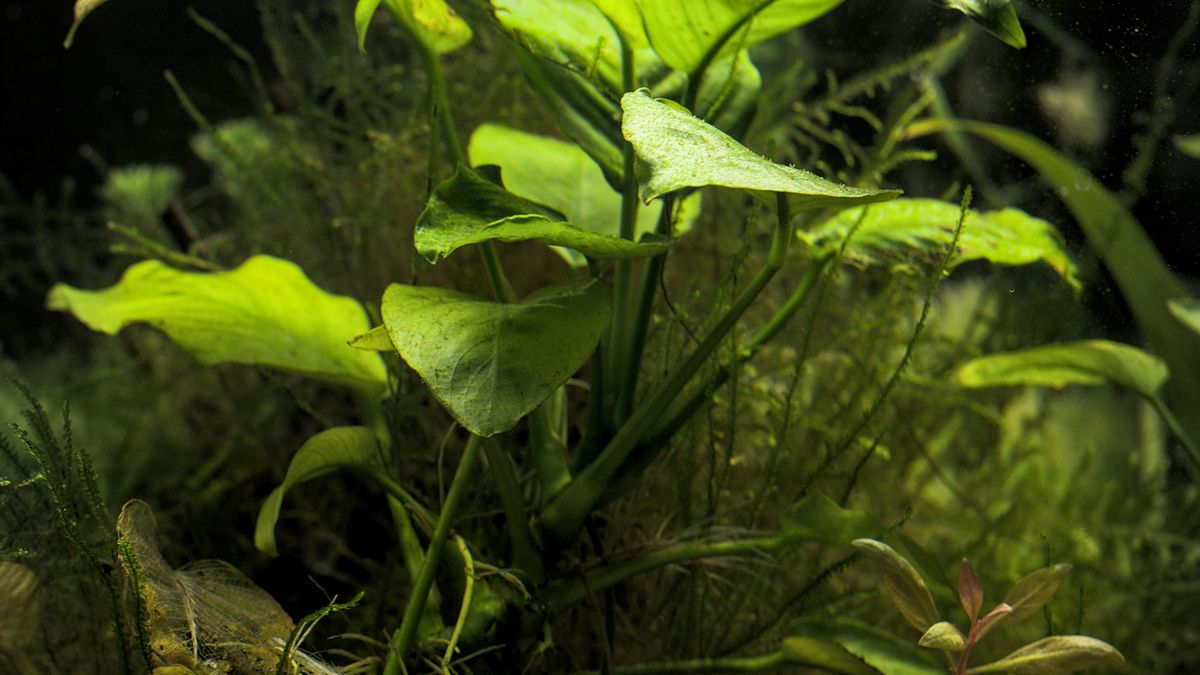
Submerged plants can provide visual boundaries while preserving open bottom. Hardy attached plants such as Anubias are useful design options if they suit the tank's lighting and water. Our Anubias installation guide describes how to keep its rhizome exposed. Plant choices should follow the fish's environmental needs; a beautiful foreground carpet is not helpful if the corys cannot reach food or the aquarist cannot remove trapped waste.
Draw your floor plan on paper before installing heavy hardscape: label the broad feeding patch, secondary feeding patch, maintenance access and the direction of filter flow. Note where the tank will be inspected each day. No one needs a costly aquascaping program to see whether a stone blocks the only accessible floor area. A pencil sketch also makes later adjustments easier than repeatedly rebuilding the habitat after livestock arrives.
Temperature: warmer water changes more than the heater setting
Sterbai are commonly selected for warmer freshwater aquariums. The 24–28°C Seriously Fish range is useful for comparing with other species. But the higher end of that range can affect dissolved oxygen, metabolic demand and how equipment performs. A warmer water preference should not be read as “keep them as hot as possible.” Choose a stable temperature compatible with the entire community and ensure good circulation and surface gas exchange.
In a Canadian winter, a tank close to a cold window can lose heat even when the room thermostat is set comfortably. In summer, a hot upper-floor apartment may warm the water beyond normal. A thermometer records the aquarium's conditions; a heater's dial is not a measurement. Verify readings at consistent times, especially after changing equipment or moving the tank. Temperature changes should be deliberate and gradual, not a response to one online chart that differs by a degree.
Do not use Sterbai as a reason to combine them casually with an unrelated fish that prefers much cooler water. Conversely, having two species with overlapping temperatures does not certify that their pH, activity, predation risk and group sizes match. Compatibility requires the complete picture, not a single shared number in a search-result snippet.
Cycling and water stability come before livestock
A filter sold as “suitable for 100 litres” is not an established biological filter on the day it leaves the box. Before purchasing fish, confirm the aquarium has been cycled and that its water quality remains stable under the actual feeding load. Monitor ammonia and nitrite according to reliable aquarium methods; avoid assuming a crystal-clear tank is mature. The site's fishless cycling guide covers this foundational process separately so this Sterbai article can stay focused on species-specific decisions.
For established tanks, plan maintenance around test results, waste production, filtration and real source-water conditions. Rapid changes in chemistry can be stressful even when the final pH happens to match a published range. If you use municipal tap water, apply a conditioner appropriate for the supply and follow its directions. If you use a more complex water-preparation method, maintain a repeatable mixing and testing routine rather than shifting parameters each week.
A biologically mature system can still be overstocked. Increasing food for a bottom-dwelling group may raise total waste and require reassessment of filtration and water changes. Stable conditions are produced by the interaction of tank size, food amount, stocking, biological processes and maintenance—not by the nationality or brand of one filter.
Food belongs to the corys, not to the leftovers category
Sterbai are omnivorous foragers. Seriously Fish recommends a quality sinking pellet or tablet as a staple, supplemented with small live or frozen foods such as Daphnia or Artemia. Aquarium Co-Op's general cory feeding guidance likewise emphasizes intentional varied feeding. They do not live on algae in the way people sometimes expect from a “bottom cleaner,” nor do they reliably get a complete diet from food that escaped faster surface fish.
Choose sinking foods that the fish can bite and handle without swallowing pieces too large for them. Use more than one accessible location if competition is evident. During a meal, make a point of identifying several different fish eating instead of inferring success from an empty dish. Larger fish may clear a whole wafer while one timid cory remains unfed; dropping a second wafer in the same contested spot does not necessarily fix the distribution.
Frozen foods should be handled and portioned according to product instructions and food hygiene practices. Do not claim a particular live feed is disease-free, and avoid unverified wild-collected organisms. Food variety is valuable, but buying five packages on the first day is less useful than learning whether the basic diet is accepted. Include the feeding routine in your total monthly livestock budget rather than assuming fish collect everything they need from the substrate.
A practical feeding-access audit for seven days
For the first week after the fish have settled, record the food type, delivery points and the number of visibly feeding individuals. You do not need to count every bite. You do need to notice whether the same fish consistently misses meals. Offer food in measured small portions, using the product guidance and tank condition rather than an invented universal number of wafers. Check that the material does not remain trapped and decompose in inaccessible cracks.
Observation 1: At the normal feeding time, note which fish arrive at the front patch and whether aggressive or fast species displace them. Observation 2: Put a small second portion in a quiet area only when appropriate. Observation 3: Look several minutes later for remaining food and remove avoidable waste. Observation 4: At the next scheduled feed, adjust one variable—particle size, feeding location or timing—so you can judge whether it helped. This is a transparent monitoring method, not a clinical experiment and not a measured Patify fish trial.
An isolated fish that becomes visibly thin, fails to eat over repeated attempts or shows abnormal breathing needs prompt husbandry review and potentially aquatic veterinary help. It should not be managed by leaving an excessive quantity of food overnight. Keeping the substrate full of deteriorating food can make an already stressed aquarium worse.
| Observation | Possible practical issue | What to do first |
|---|---|---|
| Food vanishes before Sterbai reach it | Interception by other fish | Shift delivery timing or feeding site |
| One corner accumulates pellets | Flow or inaccessible surface | Change placement and remove residues |
| Fish forage actively and visibly swallow food | Access is probably working | Maintain measured portions and observe trend |
| Barbels look irritated | Substrate, cleanliness or health concern | Water tests, surface inspection and clinical advice if needed |
| Fish linger at surface with unusual distress | Oxygen or water-quality issue may be involved | Check conditions promptly; don't assume it is normal air gulping |
Group size: social security without overcrowding
Seriously Fish recommends groups of at least six Sterbai and describes them as peaceful social animals. An eight-fish group can be attractive in adequate conditions, but the number by itself does not tell you that a particular tank has enough feeding space or filtration. Keep the core same-species group in mind instead of filling gaps with assorted solitary cory species and assuming that the label “cory catfish” gives them a common social life.
Watch how they use one another as cues. Resting near others, coordinated movement and active foraging may indicate the group is settled, but no single behaviour should be used as a medical test. Fish also pause, startle and change activity with light. A repeated pattern of hiding from one dominant tankmate deserves attention even if the fish are peaceful with each other.
If you want a mixed community, first make a table of existing inhabitants: adult size, group size, preferred temperature, water chemistry, usual feeding level and temperament. Any new fish affects all of those categories. Two groups of six bottom-associated fish can occupy more of the same feeding surface than a simple total-fish-count calculator suggests.
Are Sterbai suitable for a discus-style warm aquarium?
Sterbai often appear in discussions of warm communities, including discus systems, because their reported reference temperature extends to 28°C. That overlap does not make the combination automatically good. Discus and other larger fish have their own water-quality, feeding and social requirements, and the community may demand a significantly larger tank, more intensive maintenance or closer observation than either species would alone.
For a warm community proposal, check the actual operating temperature over several days, dissolved-oxygen management, food delivery at the bottom, adult dimensions and behaviour. In a system where higher temperatures or heavy feeding compromise water quality, selecting a compatible species on paper will not solve the practical problem. If you do not already have a well-functioning warm-water aquarium, a straightforward Sterbai species-focused setup may be a more realistic first project.
A seller's promotional “discus companion” tag is a starting question, not an evidence-based guarantee for your home. Request precise species and size information before combining livestock, especially if one fish could swallow or bully another.
Quarantine, transport and Canadian weather
Sterbai sold in Canadian shops may travel long distances and arrive during freezing temperatures or extreme heat. Review the retailer's live-arrival policy, weather-hold rules and instructions for collecting fish quickly. Ask whether the fish have been feeding normally and what holding-water temperature they were using. Order only when the aquarium is cycled, stable and ready to receive the group.
A quarantine arrangement can protect an established community, but quarantine itself must be appropriately filtered, heated, aerated and maintained. Moving fish into an uncycled plastic container because “quarantine is always good” creates different welfare risks. Choose an acclimation method supported by reputable aquarium care guidance and the actual transport conditions; prolonged open-bag handling can increase stress. Do not pour unknown bag water into the main display without assessing the risks.
Once the new fish arrive, avoid repeatedly netting them for photographs. Look for normal breathing, coordinated movement, intact fins and barbels, and an eventual food response. If serious symptoms appear, seek informed advice quickly instead of guessing a dose from a forum. Medication can be unsafe when a disease has not been identified.
Behaviour and breeding: keep the care article in its lane
Sterbai may engage in group foraging, resting and occasional surface air gulping. Corys can take air at the surface, so a brief trip is not automatically a problem. Repeated unusual gasping, loss of equilibrium or distress across several fish is a different situation requiring immediate water-quality and oxygenation checks. Observe the pattern, not only the fact that one fish touched the surface.
Breeding reports include conditioning, egg deposition and fry rearing, and Seriously Fish covers the topic in detail. However, an ordinary community setup should not be subjected to abrupt large or cold water changes in an attempt to copy spawning triggers without understanding the system. Deliberate breeding requires planning for the offspring, safe feeding, appropriately gentle filtration and long-term homes. This article is a normal-care and stocking decision guide, not a promise of breeding success or a reason to disturb stable adult conditions.
If eggs appear unexpectedly, identify them carefully and research the species' needs before removing or treating anything. Not every white spot on glass is a viable cory egg, and not every aquarium keeper is equipped to raise fry. Avoid allowing an exciting photograph to override the welfare of the existing group.
Troubleshooting: diagnose by evidence rather than a single symptom
When Sterbai refuse food, first check whether food reaches them and water is within suitable parameters. When barbels look compromised, examine substrate cleanliness and potential injuries. When fish remain in hiding, review lighting, shelters, new arrivals, aggression and group circumstances. When ammonia or nitrite tests are abnormal, address that environmental issue urgently. No one symptom reliably identifies one disease from a photograph, and this guide deliberately does not prescribe a medication or dosage.
Record the date, water temperature, food, water tests and exactly what changed. A short log is particularly useful when a problem follows adding new hardscape, an untested fertilizer, another fish or a filter change. Do not alter five things at once unless immediate animal safety requires action; otherwise you cannot judge which change mattered. Severe breathing trouble, lesions or repeated feeding refusal calls for a knowledgeable aquatic veterinarian or equivalent qualified specialist.
A Canadian purchasing and ownership checklist
Before checkout, confirm the scientific name and a viable same-species group; verify a permanent adult footprint, a stable warm-water operating range and accessible clean substrate. Ask the retailer for feeding history, shipping procedures, the date and cost of delivery, and any written refund or live-arrival conditions. Check the actual cost of enough fish, water-testing supplies, quality sinking food and suitable equipment. A low single-fish price may conceal the expense of responsibly keeping a full group.
A simple purchasing comparison should use actual CAD quotes recorded on the same day, noting tax and shipping separately. Prices from a pet shop in the Greater Toronto Area may not describe northern British Columbia or an Atlantic town. Do not compare one shop's juvenile fish with another's larger captive-bred stock as though they are identical. If the available budget cannot support the group and maintenance, waiting is the responsible choice.
Frequently asked questions
Are Sterbai corys warmer-water fish? They are often kept at 24–28°C according to Seriously Fish, but the whole tank needs compatible water conditions and adequate gas exchange.
Are they the same as Corydoras sterbai? Yes. Hoplisoma sterbai is the updated genus name; older shops and references still commonly use Corydoras.
Will they eat algae and clean the tank? They may forage on surfaces, but they are omnivores requiring intentional feeding. They do not remove fish waste or replace aquarium maintenance.
Can one Sterbai live with six pygmy corys? That is not an appropriate substitute for a same-species Sterbai group. Species identity, adult sizes and different habits matter.
Is sand mandatory? Smooth sand is often the easiest for feeding access and observation. Suitable fine rounded gravel may work if food does not become trapped and cleanliness is maintained.
What if a fish's barbels become short? Check environmental and physical factors; persistent damage warrants informed veterinary assessment rather than a simple substrate myth or self-prescribed medication.
Sources and photographic attribution
This is an editorial synthesis, not a report of fish Patify has bred, weighed, treated or observed in a controlled setup. Key references checked 14 October 2026: Seriously Fish — Hoplisoma sterbai, Aquarium Co-Op — Cory Catfish Care, Seriously Fish — Gastrodermus pygmaeus and the Patify cory-type hub. The cover shows a documented Corydoras sterbai photograph by Tino Strauss from Wikimedia Commons under CC BY-SA 3.0. Original image copyright remains with the photographer; no Patify fish trial is claimed.