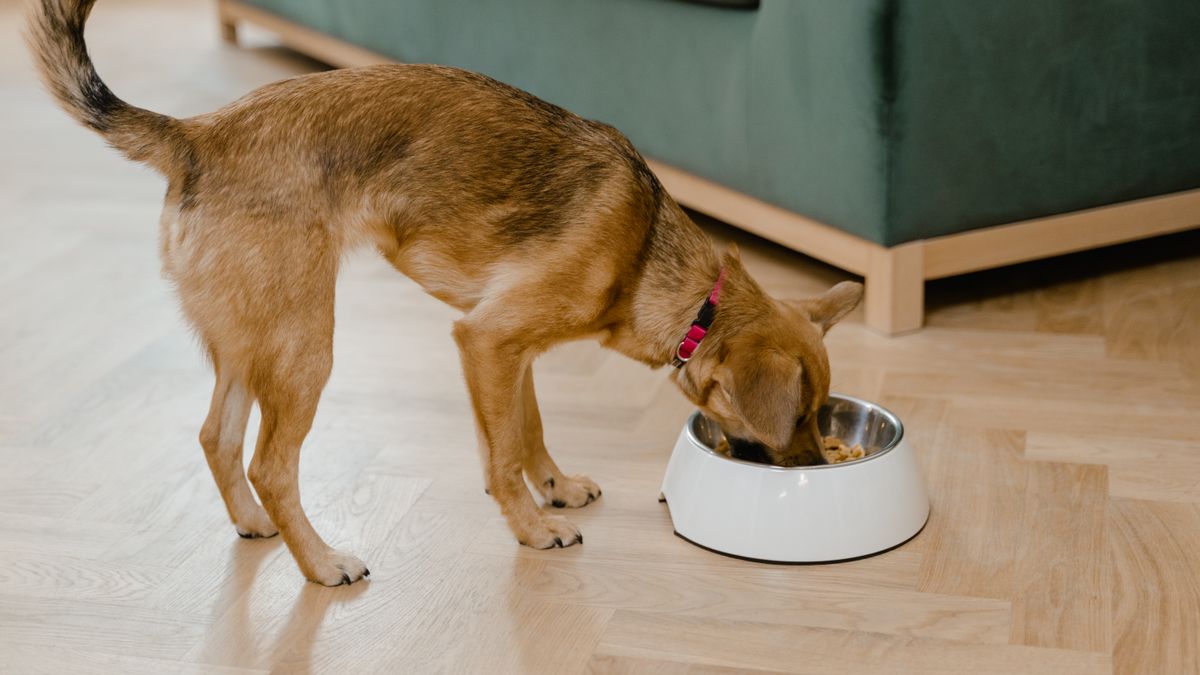


Puppy nutrition · Label reading
High-Protein Puppy Food: Growth Needs Beyond the Percentage
A bigger protein number on the bag won't make a puppy grow faster or bigger, and it isn't the number that decides whether a food suits your puppy. The useful questions are narrower: how much protein the food delivers per calorie, and whether the rest of the formula suits your puppy's adult size. Ask them separately and the choice gets much clearer.
Does it deliver enough protein per calorie?
56.3 gAAFCO's minimum crude protein per 1,000 kcal for growth. Every food labeled complete for growth must meet it.Is it built for your puppy's adult size?
4.5 gAAFCO's calcium ceiling per 1,000 kcal for foods that may be fed to puppies headed for 70 lb or more, versus 6.25 g for other foods.Figures from AAFCO's Dog Food Nutrient Profiles. The rest of this guide shows how to check both questions on a real label.
"High protein" is one of the most common claims in the puppy aisle, and it's easy to see why it sells. Puppies are building muscle, bone and organs, and protein sounds like the raw material for all of it. Brand pages lean into that, with promises of lean muscle, sustained energy and stronger immunity.
Puppies do need more protein than adult dogs. But every food labeled complete and balanced for growth is already required to provide it. Above that minimum, the evidence that more protein changes how a puppy grows is thin. What does change growth is calories, and for large and giant breeds, calcium. Several high-protein formulas are also high in fat and calories, which matters more for most puppies than the protein figure on the front of the bag.
This guide walks through both questions with label data from seven widely sold U.S. puppy and all-life-stage foods, including several marketed on protein. For the basics of comparing protein across any food, our dog food protein guide is the companion piece.
Protein checkEvery growth food already clears a protein floor
AAFCO's Dog Food Nutrient Profiles set separate minimums for "growth and reproduction" and "adult maintenance." A food can only say it's complete and balanced for puppies if it meets the growth numbers, either by formulation or through AAFCO feeding tests.
| Nutrient (AAFCO dog profiles) | Growth minimum | Adult minimum | Maximum |
|---|---|---|---|
| Crude protein, % of dry matter | 22.5% | 18.0% | none set |
| Crude protein, g per 1,000 kcal | 56.3 g | 45.0 g | none set |
| Calcium, % of dry matter | 1.2% | 0.5% | 2.5% (1.8% for large-size puppies) |
| Calcium, g per 1,000 kcal | 3.0 g | 1.25 g | 6.25 g (4.5 g for large-size puppies) |
| Phosphorus, % of dry matter | 1.0% | 0.4% | 1.6% |
Source: AAFCO Dog Food Nutrient Profiles (revision document, Attachment A). "Large size" means an expected mature lean weight of 70 lb or more. Dry-matter values assume a calorie density of 4,000 kcal per kg.
Two things in that table matter for the rest of this guide. First, protein has a floor but no ceiling in the profiles, so "high protein" on a bag tells you how the brand positions the food, not where it sits against a standard. Second, calcium has a floor and a ceiling, and the ceiling is tighter for puppies that will be large adults. That's where the real risk sits for big puppies.
The minimums are also built on an assumption. AAFCO's 2013 committee report notes that the research behind the puppy protein minimum assumed protein sources with digestibility "near 100%." Real foods vary, and the Merck Veterinary Manual classifies digestibility below 80% as low and 80% to 85% as average. That's a good reason for a margin above the minimum, which is a different idea from "more is always better."
Protein checkDoes more protein make a puppy grow faster or bigger?
The best-known direct test comes from a 1991 study of Great Dane puppies. Researchers fed three groups of 7-week-old pups diets with the same calorie content but different protein levels.
Two cautions keep that study in proportion. Body weight did differ between the highest- and lowest-protein groups, and the lowest diet (14.6%) was below today's AAFCO growth minimum, so it's not an argument for feeding less protein. What it shows is that, with calories held equal, piling on extra protein didn't change skeletal development or height in a giant breed.
Calories are a different story. The Merck Veterinary Manual warns that overfeeding speeds up growth in a way that is incompatible with proper skeletal development and contributes to obesity later in life. Tufts University's veterinary nutritionists put it more bluntly: "even before those extra calories cause a puppy to become overweight, they cause puppies to grow too quickly." And in a lifetime study of 48 Labrador Retrievers, in which one dog in each pair was fed 25% less than its partner, researchers found that median life span "was significantly longer for dogs in which food was restricted," and that the onset of chronic disease was generally delayed.
Protein supplies building material. Calories set the pace of growth. A food can be high in one without being high in the other, which is why they need separate checks.
That distinction gets blurred in marketing. One brand guide on high-protein puppy food says large-breed puppies "may need closer to the lower end of that spectrum to avoid rapid growth," as if protein drove growth rate. The evidence points at total calories instead. A large-breed puppy that needs slower growth needs measured portions of a food built for its size, not a lower protein number.
Protein checkQuestion 1: compare protein per 1,000 calories
A guaranteed analysis lists crude protein as a percentage of the food's weight. That number is distorted by moisture and, more subtly, by fat. Fat carries more than twice the calories of protein per gram, so a high-fat food is more calorie-dense, and your puppy eats less of it. A 30% protein food that's also very high in fat can deliver about the same protein per day as a 28% food with less fat.
The fair comparison is protein per 1,000 kcal, because your puppy eats to meet its calorie needs. Tufts' nutritionists note that owners "spend a lot of time looking for a certain percentage of protein" on the label; the per-calorie figure is the one that tells you something.
g protein per 1,000 kcal = (protein % × 10) ÷ kcal per kg × 1,000Example: a food with 30% protein and 3,930 kcal/kg → (30 × 10) ÷ 3,930 × 1,000 ≈ 76 g per 1,000 kcal.
AAFCO's growth minimum is 56.3 g.
Two limits on that math. The guaranteed analysis is a minimum, not the exact amount; Tufts points out that actual values can be higher. And crude protein says nothing about digestibility or amino-acid balance. For a food that's complete for growth, those are the manufacturer's job, and the adequacy statement is your evidence that it was done. If you want more, WSAVA's guidelines say companies "should be able to provide an 'average' or 'typical' analysis for all essential nutrients," so ask.
Growth-fit checkQuestion 2: is it built for your puppy's adult size?
AAFCO defines a large-size dog as one expected to weigh 70 pounds or more as a mature adult. Veterinary nutritionists often draw the line lower. Tufts' Lisa Freeman advises that "if your puppy is expected to be above 50 pounds as an adult, you should feed a large breed puppy food," and Hill's labels its large-breed puppy formula for puppies "over 55 lbs when adult."
The words to find on the bag
Puppy and all-life-stage foods use one of two phrases. A food complete for "growth including growth of large size dogs (70 lb. or more as an adult)" was formulated or tested with large-breed puppies in mind. A food complete for growth "except for growth of large size dogs" was not. Tufts explains that after AAFCO's revisions, "the range of calcium is now narrower for large and giant breed puppies," and that before the change "some diets were dangerously high in calcium for large breed puppies."
Why calcium, not protein, is the large-breed issue
Merck notes that excess calcium intake "is more problematic for growing (weaning to 1 year) large- and giant-breed dogs," and that excessive supplementation above 3% calcium on a dry-matter basis causes more severe signs of osteochondrosis. AAFCO's own committee report explains that the large-puppy ceiling exists "because of concerns for excess calcium to produce detrimental effects in growing dogs of large and giant breeds." That's also why Merck says adding calcium, phosphorus or vitamin D to a complete growth diet is rarely necessary and may be harmful. Don't add supplements to a puppy food unless your veterinarian prescribes them.
What the label won't show you
Most dry puppy labels print a calcium minimum and no maximum. Purina's Pro Plan labels, for example, list "Calcium (Ca) (Min) 1.1%" and stop there. The large-size growth statement is what tells you the food stays within the tighter range. If a bag lacks that statement and your puppy is headed past 50 pounds, either choose another food or ask the company for its typical calcium per 1,000 kcal and compare it with AAFCO's 4.5 g ceiling.
Small and medium puppies
Merck's professional manual is clear that small- and medium-breed puppies "can be fed a growth or all-life-stage diet that does not meet the criteria for growth of large-size dogs." For them, the large-size wording is neither a requirement nor a red flag.
Seven puppy labels, scored on both questions
The table keeps the two questions in separate columns, so a strong protein figure can't hide a growth-fit gap, or the reverse. All figures come from official U.S. manufacturer pages and label PDFs checked October 28, 2026. It's a label comparison, not a ranking or a feeding test.
| Food (dry) | Protein min | g protein / 1,000 kcal | Large-size growth wording | kcal per cup | Calcium on label |
|---|---|---|---|---|---|
| Bully Max 30/20 High Protein Chicken | 30% | ≈ 76 | No formal AAFCO statement on the product page; page text says "labeled for all life stages" and suitable for large-breed puppies | 535 | Not listed on page |
| Taste of the Wild High Prairie Puppy | 28% | ≈ 77 | All life stages, including growth of large size dogs | 415 | Not listed on page |
| Pro Plan Sport Performance 30/20 Beef & Bison | 30% | ≈ 74 | All life stages, including growth of large sized dogs (feeding tests) | 496 | 1.1% min, no max printed |
| Pro Plan Sport Development 30/18 Large Breed Puppy | 30% | ≈ 72 | All life stages, including growth of large sized dogs (feeding tests) | 430 | 1.1% min, no max printed |
| Pro Plan Puppy Large Breed Chicken & Rice | 28% | ≈ 71 | All life stages, including growth of large sized dogs (feeding tests) | 419 | 1.1% min, no max printed |
| Pro Plan Puppy Chicken & Rice | 28% | ≈ 67 | All life stages, including growth of large sized dogs (feeding tests) | 456 | 1.1% min, no max printed |
| Hill's Science Diet Puppy Large Breed Chicken & Brown Rice | 26.7% DM avg* | n/a* | "Growing puppies" (feeding tests); for puppies over 55 lb as adults, up to 18 months | 387 | 1.16% DM avg* |
Protein per 1,000 kcal calculated by Patify from each label's protein minimum and kcal per kg (Bully Max 3,930; Taste of the Wild 3,656; Pro Plan Sport 30/20 Beef & Bison 4,057 on the label PDF; 30/18 Large Breed Puppy 4,188; Puppy Large Breed 3,934; Puppy 4,188). *Hill's publishes dry-matter averages rather than as-fed guaranteed minimums and gives no moisture value, so we can't calculate a comparable per-calorie figure. Purina's product page for Pro Plan Sport 30/20 Beef & Bison listed slightly different calories (4,001 kcal/kg, 489 per cup) from the label PDF.
What the two columns show
The protein column barely moves. Six foods with a usable figure fall between about 67 and 77 g of protein per 1,000 kcal, all well above AAFCO's 56.3 g floor. Pro Plan's 30% Large Breed Puppy formula (about 72 g) and its 28% Puppy Large Breed (about 71 g) land within half a gram of each other, because the lower-fat food also has fewer calories. "High protein" on the front of a bag doesn't guarantee a meaningfully different diet.
The growth-fit column carries the real differences. Most foods here state large-size growth coverage, including an adult-positioned performance formula. Bully Max's product page describes the food as labeled for all life stages and suitable for large-breed puppies, but the formal AAFCO statement wasn't shown on the page when we checked; read it on the bag before feeding it to a puppy headed past 50 pounds. Bully Max's separate 24/14 puppy food lists a calcium maximum of 1.8% as fed, which is more than most labels show, but its page also had no formal AAFCO statement.
Calories per cup vary by 38%. From 387 kcal (Hill's Puppy Large Breed) to 535 kcal (Bully Max 30/20). That's the column most likely to affect how your puppy grows, and it's the subject of the next section.
Growth-fit checkCalories per cup: where high-protein foods differ most
In a Tufts look at about 60 puppy foods, calories ranged "from about 300 calories per cup to more than 500 calories per cup!" In our table, the two 30/20 formulas sit at the top, because they pair high protein with high fat. Bully Max's product page makes the point itself, advertising "535 calories per cup vs about 320 in other brands."
Calorie density isn't good or bad on its own. It just changes the size of the right scoop, and how much damage a sloppy scoop can do. Here's a worked example.
Resting energy:
70 × 9.1^0.75 ≈ 366 kcalAAHA's growth factor at 4 months and older:
× 2 ≈ 732 kcal per day (a starting estimate)
| Food | kcal/cup | Cups per day | Protein per day (min) | ¼-cup overpour adds |
|---|---|---|---|---|
| Bully Max 30/20 | 535 | ≈ 1.4 | ≈ 56 g | ≈ 134 kcal (18%) |
| Pro Plan Sport 30/20 Beef & Bison | 496 | ≈ 1.5 | ≈ 54 g | ≈ 124 kcal (17%) |
| Pro Plan Puppy Chicken & Rice | 456 | ≈ 1.6 | ≈ 49 g | ≈ 114 kcal (16%) |
| Pro Plan Sport 30/18 Large Breed Puppy | 430 | ≈ 1.7 | ≈ 52 g | ≈ 108 kcal (15%) |
| Pro Plan Puppy Large Breed | 419 | ≈ 1.75 | ≈ 52 g | ≈ 105 kcal (14%) |
| Taste of the Wild High Prairie Puppy | 415 | ≈ 1.75 | ≈ 56 g | ≈ 104 kcal (14%) |
| Hill's Puppy Large Breed | 387 | ≈ 1.9 | n/a | ≈ 97 kcal (13%) |
Patify calculations from AAHA's energy formula and each label's calorie statement. The AAFCO minimum for 732 kcal is about 41 g of protein. Growth needs change month to month; recheck with your veterinarian and your puppy's growth curve.
Look at the protein-per-day column. Switching from the lowest-protein food to the highest adds about 7 grams of protein a day for this puppy, and every option already provides well over the 41-gram minimum. Now look at the last column. A quarter-cup error, the kind that happens when someone eyeballs a scoop, changes the day's calories by 13% to 18%. For a large-breed puppy, that's the number to manage.
Labels give a sanity check. Pro Plan's 30/18 Large Breed Puppy chart suggests 1¾ to 2¼ cups a day for a 4- to 5-month-old expected to reach up to 50 pounds, which is about 750 to 970 kcal at 430 kcal per cup. Our estimate of 732 kcal sits just under that range. Charts and formulas both give you a starting point; the growth curve tells you whether it's right.
Growth-fit checkFree-feeding a calorie-dense puppy food
Some high-protein labels tell you to leave food out. The Pro Plan Sport 30/20 label says that "if fed dry, Pro Plan may be kept before pups at all times," and Bully Max's 30/20 page says that for puppies up to 6 months, "food may be kept available for puppies at all times."
Veterinary guidance leans the other way. VCA doesn't recommend free feeding for puppies, warning that it can lead to juvenile obesity and encourage binge-eating. Merck recommends three meals a day from weaning to six months and two from six to twelve months. For a large-breed puppy on a food with 500-plus calories per cup, measured meals are the simplest way to keep growth on track.
How breed size changes the answer
Bully breeds and "muscle"
High-protein foods are often marketed to owners of pit bull–type puppies and bully breeds. Muscle tone in a grown dog depends on genetics, exercise and a lean body, not on pushing protein during growth. The UKC breed standard even says the American Pit Bull Terrier "should never appear bulky or muscle-bound." Our pit bull feeding guide covers this in detail, including why it's a mistake to try to "bulk up" a puppy.
Working-line and sport puppies
Puppies from working or sport lines can be very active, and some owners choose performance formulas such as Pro Plan Sport for them. Both Pro Plan Sport foods in our table carry large-size growth wording, so they can be fed to puppies. Their calorie density means you'll need careful portions. For adult working dogs, our high-performance dog food guide covers energy needs once growth is finished.
Tracking growth: the scale, the curve and the ribs
Because calories, not protein, set the pace, the way to know whether a food is working is to watch the puppy. Tufts' growth guide gives clear steps:
- Weigh regularly. Puppies "should be weighed at least monthly until they are 6 months of age," ideally on a veterinary scale. Tufts advises against holding the puppy on a human scale.
- Plot the weights on a growth chart. Your puppy "should follow a single curve on the chart over time." If it "jumps from one curve to another, they may be growing too quickly or too slowly." Note that the charts Tufts describes stop at an expected adult weight of 88 pounds.
- Check body condition. Tufts recommends keeping puppies at a body condition score of 4 to 5 on the 9-point scale, and says "it's better to err on the side of your puppy having a body condition score of 4 or even a little lower."
Merck's professional manual recommends monitoring weight gain closely, weekly, during growth. In practice, a weekly home check of ribs and waist plus a monthly weigh-in is easy to keep up. If your puppy starts jumping curves or loses its waist, reduce the daily amount slightly and talk to your veterinarian before changing foods.
Treats count. Tufts suggests treats make up "no more than 10%" of daily calories, and training sessions can add up fast. Using part of the measured daily kibble as rewards keeps the total honest.
Reading the marketing on high-protein bags
Here's how some common claims hold up against what we found:
| Claim you'll see | What the evidence and labels show |
|---|---|
| "92.3% of surveyed Bully Max customers reported more muscle (survey of 859 customers)" | A customer survey, not a controlled study. Owners who answer may be the most satisfied ones, and "more muscle" wasn't measured. |
| Protein for "a stronger immune system" (Redbarn's guide) | Adequate protein is needed for normal immunity, but we found no evidence that protein above AAFCO's growth minimum improves immunity in healthy puppies. |
| Protein "provides a more sustained source of energy" than carbs | Protein can be burned for energy, but Merck describes that as what happens when fat and carbohydrate don't supply enough. Energy needs are best met by the food's total calories. |
| "High-quality protein to build lean muscles" (Pro Plan) | True that protein is needed to build muscle; every complete growth food supplies enough to do it. It isn't evidence that this food builds more muscle than another complete food. |
None of this makes these foods bad choices. Several in our table are well-documented products with feeding-test claims. The point is that the reason to choose one shouldn't be the protein claim.
When a high-protein puppy food is a reasonable choice
A high-protein puppy food can be a perfectly good choice when:
- It carries a complete-and-balanced statement for growth or all life stages, including large-size growth if your puppy may top 50 pounds.
- Your puppy eats it reliably and has good stools on it.
- You portion it by its calorie statement and track growth, rather than feeding by the scoop or leaving it out.
- You can afford to keep feeding it. Swapping foods often makes it harder to judge how any one of them suits your puppy.
It's worth slowing down if your puppy has a medical condition, if your veterinarian has recommended a specific diet, or if a grain-free formula is on the table. Taste of the Wild High Prairie Puppy in our table is grain-free, and our grain-free dog food guide summarizes the current picture on diet-associated heart disease. If you're comparing low-carbohydrate formulas for an adult dog later, our high-protein, low-carb dog food guide covers that separately.
Switching foods and moving to adult food
If you change puppy foods, do it gradually over several days and recalculate the portion from the new label's calorie statement. Moving from a 387 kcal-per-cup food to a 535 kcal-per-cup food with the same scoop would add almost 40% more calories overnight.
Timing the move to adult food depends on size. VCA's guidance says large dogs reach mature size between 12 and 18 months, while small breeds usually finish growing earlier. Several foods in our table are labeled for all life stages, so technically there's no forced switch. The catch is that calorie-dense all-life-stage foods can pack weight onto an adult, especially after spay or neuter surgery. When growth is done, recheck the portion with adult energy needs in mind, or move to an adult formula.
For the first weeks with a new puppy, our new puppy first 30 days guide covers the wider routine, and our wet puppy food guide explains how to compare canned foods by calories if you mix formats. Shopping in Canada? Our best puppy food in Canada guide covers brands sold there.
High-protein puppy food questions
Is high-protein food good for puppies?
It can be, if it's complete for growth and portioned by calories. It isn't better by default. Every complete puppy food already meets AAFCO's protein minimum for growth, and extra protein hasn't been shown to improve growth or skeletal development.
How much protein does a puppy need?
AAFCO's minimum for growth is 22.5% protein on a dry-matter basis, or 56.3 g per 1,000 kcal. The foods we checked supply roughly 67 to 77 g per 1,000 kcal.
Can too much protein hurt a puppy?
For a healthy puppy, the protein level in complete commercial foods hasn't been linked to skeletal problems; a Great Dane study found no effect of protein on skeletal development. The bigger risks in high-protein foods are high calories and, for large breeds, a missing large-size growth statement.
Can I feed a large-breed puppy a high-protein food?
Yes, if the label says it's complete for growth "including growth of large size dogs (70 lb. or more as an adult)" and you measure meals. Avoid free-feeding calorie-dense foods to large-breed puppies.
Is adult high-protein dog food OK for puppies?
Only if it's labeled for all life stages, including large-size growth for big puppies. Pro Plan Sport 30/20, for example, is labeled for all life stages; an adult-maintenance food is not suitable as a puppy's main diet.
Does high protein make a puppy grow bigger?
No. Adult size is set mainly by genetics. Extra calories can make a puppy grow faster, which isn't the same as bigger and can be harmful for large breeds.
What about raw or freeze-dried high-protein puppy food?
The same two questions apply: is it complete for growth (including large-size growth if needed), and how many calories does it provide? Raw diets also carry food-safety considerations for the household; our raw and BARF diet guide covers them.
References
- AAFCO: Dog Food Nutrient Profiles, revisions (Attachment A) and 2013 committee report on proposed revisions
- Nap RC et al. (1991). Growth and skeletal development in Great Dane pups fed different levels of protein intake. J Nutr
- Kealy RD et al. (2002). Effects of diet restriction on life span and age-related changes in dogs. JAVMA
- Merck Veterinary Manual: Nutritional Requirements of Small Animals and Feeding Practices in Small Animals
- Tufts Petfoodology: Large-breed puppy rules, What's the best food for your new puppy?, Growth Guide and What is guaranteed about the guaranteed analysis?
- VCA: Nutritional Considerations for Toy and Small Dogs and When to Switch Puppy to Adult Food
- AAHA 2021 Nutrition and Weight Management Guidelines: energy requirement box
- WSAVA: Guidelines on selecting pet foods
- Labels and product pages: Bully Max 30/20, Bully Max 24/14 puppy, Taste of the Wild High Prairie Puppy, Pro Plan Sport 30/20 Beef & Bison label, Pro Plan 30/18 Large Breed Puppy label, Pro Plan Puppy Large Breed label, Pro Plan Puppy label and Hill's Science Diet Puppy Large Breed
- Claims quoted from Redbarn: The ultimate guide to high-protein puppy food and Pro Plan Sport 30/18 Large Breed Puppy product page
Researched and written by the Patify Editorial Research Team from AAFCO documents, published studies, veterinary references and manufacturer labels, checked October 28, 2026. This article hasn't been reviewed by a veterinarian. Patify didn't test, buy for review or receive any of the foods mentioned. All per-calorie and portion figures are our own calculations from published label values. Ask your veterinarian about your puppy's expected adult size and growth plan.