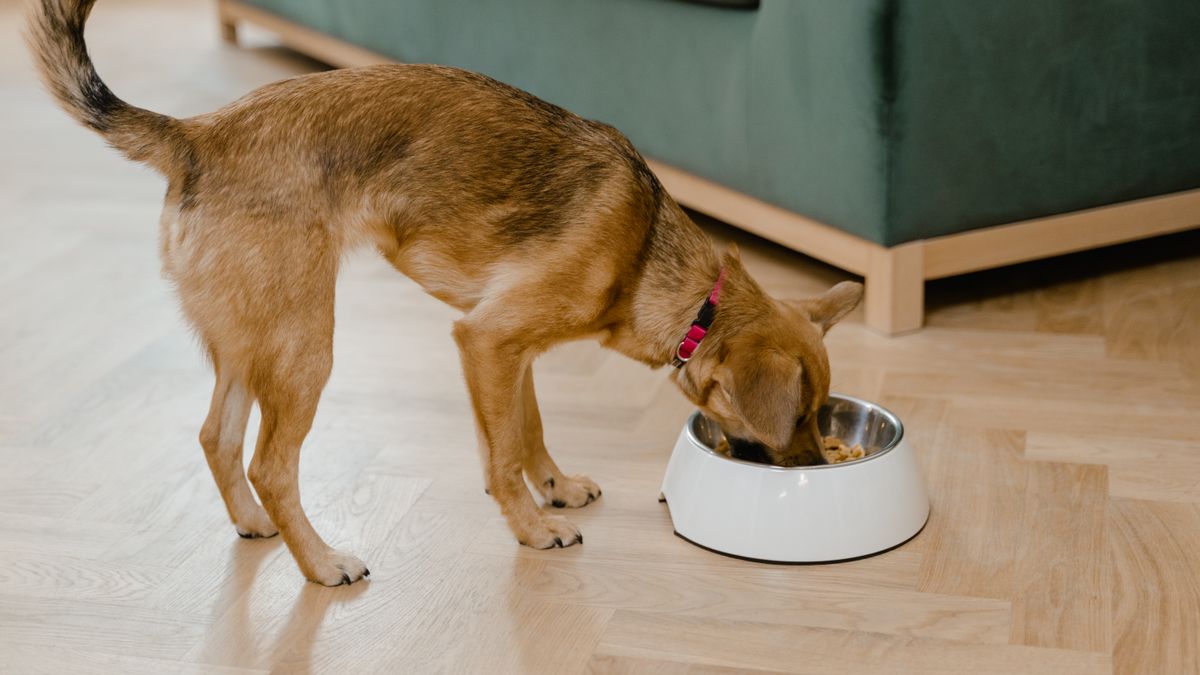


Food for Older Dogs: Choosing a Diet as Needs Change
There is no single "senior" diet, and turning seven is not a reason to change food. Here is how to decide what an older dog actually needs, using its weight, muscle, teeth and bloodwork rather than the age on the bag.
When dogs are generally considered seniors, by size. Source: VCA Animal Hospitals.
Walk down the dog food aisle and you'll see "Senior," "Mature," "7+," "11+" and "Aging" on bags from nearly every brand. It's easy to assume these words mean something specific, like a set of nutrients proven to suit an older dog, the way "puppy" food has to meet growth requirements. They don't.
The veterinary nutrition experts quoted by Cornell's Riney Canine Health Center put it bluntly: "There is no true reason to feed a senior diet to our aging dog unless there are noted problems." The American Animal Hospital Association's 2023 senior care guidelines start from a similar place, stating that "old age is not a disease." What changes with age is the dog. Some get heavier as they slow down. Others start losing muscle while their weight looks stable. Many develop dental disease, and some develop kidney or cognitive problems that do call for a different diet.
This guide is about matching food to those changes. Along the way, we compared the regular adult and senior formulas from three major brands, and the results show why the word "senior" alone tells you so little.
There is no official "senior" dog food
Every bag of dog food sold in the U.S. carries a nutritional adequacy statement saying which life stage it's complete and balanced for. AAFCO, whose model regulations shape pet food labels across the country, recognizes four: gestation/lactation, growth, maintenance, and all life stages. "Senior" isn't on the list.
WSAVA's nutritional assessment guidelines note that AAFCO provides nutrient profiles for growth, reproduction and adult maintenance, "but not for senior/geriatric pets." The clinical nutrition team at Tufts University's Cummings School explains the practical result: "there is no legal definition for 'senior' or 'geriatric' foods," and diets marketed for seniors "need to follow the same legal guidelines as diets for young or middle-aged adults." VCA's nutrition team says the same in plainer terms: "there are no established nutrient requirements for senior dogs."
So when you pick up a bag labeled for older dogs and read the fine print, you'll find the same statement you'd find on an ordinary adult food: complete and balanced "for maintenance of adult dogs." Every senior formula in our comparison below carried exactly that kind of statement. Everything else about a senior food, including its calories, protein, phosphorus, sodium and added ingredients, is up to the manufacturer.
Tufts sums up how much that leaves open. Some companies make senior diets with lower protein, while others make them with more. "The calories in commercial senior diets for dogs and cats vary widely," and senior foods "range widely in phosphorus content." In one study the Tufts team cites, sodium in commercial senior dog foods ranged from 33 to 412 milligrams per 100 kilocalories, against an AAFCO minimum of 20.
We compared adult and senior formulas from the same brands
The fairest way to see what "senior" changes is to hold the brand constant. We pulled the published label data for each brand's regular adult formula and its senior version from official U.S. product pages on October 28, 2026. Because Hill's publishes dry-matter averages while Purina and Royal Canin publish as-fed guaranteed minimums, compare rows within a brand, not across brands.
| Brand and formula | kcal/kg | kcal/cup | Protein | Fat | What the senior version adds |
|---|---|---|---|---|---|
| Pro Plan Adult Complete Essentials Shredded Blend Chicken & Rice | 3,790 | 369 | 26% min | 16% min | (adult baseline) |
| Pro Plan Adult 7+ Complete Essentials Shredded Blend | 3,672 | 366 | 29% min ↑ | 14% min | EPA and DHA guarantees, more glucosamine, antioxidant claim |
| Pro Plan Bright Mind Adult 7+ Chicken & Rice | 3,791 | 423 ↑ | 29% min ↑ | 14% min | Medium-chain triglycerides, arginine, EPA/DHA and B vitamins; "promotes alertness & mental sharpness" |
| Hill's Science Diet Adult Chicken & Barley | 3,675 | 365 | 23.8% DM | 15% DM | (adult baseline) |
| Hill's Science Diet Adult 7+ Chicken Meal, Barley & Rice | 3,550 | 352 | 18.7% DM ↓ | 13.5% DM | Glucosamine, chondroitin, carnitine; phosphorus essentially unchanged (0.68% vs 0.69% DM) |
| Hill's Adult Small & Mini | 3,699 | 357 | 25% DM | 15.3% DM | (adult baseline) |
| Hill's Adult 11+ Small & Mini | 3,807 ↑ | 378 ↑ | 22.5% DM ↓ | 17.9% DM | More calories and fat than the adult version |
| Royal Canin Medium Adult | 3,616 | 340 | 23% min | 12% min | (adult baseline) |
| Royal Canin Medium Adult 7+ | 3,658 | 315 ↓ | 23% min = | 12% min | More vitamin C; claims antioxidant support for heart, kidney and brain |
| Royal Canin Large Adult | 3,755 | 360 | 24% min | 15% min | (adult baseline) |
| Royal Canin Large Adult 5+ | 3,787 | 337 ↓ | 24% min = | 15% min | Same protein and fat minimums as the adult formula |
DM = dry-matter average published by Hill's; "min" = as-fed guaranteed minimum. Every formula listed carries an adult maintenance (not "senior") adequacy statement. Data from official U.S. product pages and Purina label PDFs, checked October 28, 2026.
What the comparison shows
- Protein went up, down, or nowhere. Purina's 7+ formulas raise the protein minimum by three points. Hill's Adult 7+ lowers protein by about a fifth on a dry-matter basis. Royal Canin's 7+ and 5+ formulas keep protein exactly where the adult food has it.
- "Senior" didn't reliably mean fewer calories. Some senior versions are slightly lighter per cup, like Hill's 7+ at about 4% less and Royal Canin Medium 7+ at about 7% less. But Bright Mind has about 15% more calories per cup than its adult counterpart, and Hill's 11+ Small & Mini has about 6% more. Even a VCA explainer states that senior formulations "typically have fewer calories"; the labels show that's a tendency at best.
- The real differences are add-ins. Fish oil fatty acids, glucosamine and chondroitin, antioxidants, carnitine, and in one case a cognition-focused blend. Some of these have research behind them for specific problems, which we cover below. None of them makes a food "right" for an older dog by default.
The takeaway isn't that senior foods are bad. Several are excellent foods. It's that you have to read the label of the specific bag, because the category name doesn't tell you which direction the recipe moved.
The protein question: why "less" is usually the wrong instinct
For years, a common belief held that older dogs should eat less protein to "spare the kidneys." The evidence points the other way for healthy dogs.
The Merck Veterinary Manual notes that older dogs "may not be as efficient in metabolizing dietary protein as younger dogs," and as a result "may actually require more dietary protein than their younger counterparts." The Tufts team is direct: "reduced dietary protein is not beneficial for the healthy older dog," and lower-protein diets "may have negative effects by contributing to muscle loss." VCA adds that "high protein food has not been shown to cause kidney disease in healthy older dogs."
"Typically, we like to see slightly higher protein diets." Cornell University's Riney Canine Health Center, on choosing food for senior dogs
Muscle matters for more than looks. Cornell's experts note that decreasing lean body mass is associated with increased risk of illness and death, and that losing muscle can be a normal part of aging or a sign of underlying disease. If your older dog is losing muscle, they suggest a diet higher in protein may be necessary, and an exam to find out why.
There is one important exception: diagnosed kidney disease. Once kidney function is compromised, VCA says protein and phosphorus should be re-evaluated, and veterinarians often move these dogs to a therapeutic kidney diet. That decision depends on bloodwork and urine tests, not on age, and it's covered in the kidney section below. If you want to compare protein between foods fairly, our dog food protein guide shows how.
Calories: older dogs go both ways
Older dogs don't all need fewer calories. Merck observes that "some dogs and cats begin old age considerably overweight, whereas others may show some loss of condition." The right move depends on which group your dog is in.
On average, needs do tend to drift down as activity drops. VCA notes that daily energy requirements may decrease by about 12% to 13% in older dogs, and that eating 20% to 25% fewer calories has been shown in adult dogs to slow the progression of some age-related changes. But averages hide the dogs at the edges: the thin 14-year-old terrier who needs every calorie, and the 9-year-old Lab who has quietly gained eight pounds since retirement from long hikes.
A worked example
The AAHA 2021 nutrition guidelines estimate resting energy as 70 × body weight in kilograms to the 0.75 power. A typical neutered adult is about 1.4 to 1.6 times that; an inactive or weight-gain-prone dog about 1.0 to 1.2 times. For a lean, neutered 50-pound dog, that's roughly 1,020 to 1,160 calories a day if still fairly active, or 730 to 870 if mostly napping. Same dog, a difference of about 300 calories.
| Food (dry) | kcal/cup | Cups for ~1,020 kcal | Cups for ~800 kcal |
|---|---|---|---|
| Pro Plan Adult 7+ Complete Essentials | 366 | 2.8 | 2.2 |
| Pro Plan Bright Mind Adult 7+ | 423 | 2.4 | 1.9 |
| Hill's Science Diet Adult 7+ | 352 | 2.9 | 2.3 |
| Royal Canin Medium Adult 7+ | 315 | 3.2 | 2.5 |
Patify calculations from AAHA's formula and each label's calorie statement. Starting points only; your veterinarian may set a different target.
If you switch an older dog from Pro Plan's adult Complete Essentials to Bright Mind and keep the same scoop, you've increased its calories by about 15% overnight. If you move from Royal Canin Medium Adult to Medium Adult 7+ with the same scoop, you've cut them by about 7%. Neither is necessarily wrong, but neither should happen by accident. Weigh the food, or at least recalculate cups from the new label.
If your senior is underweight or losing weight without trying, don't simply pick a richer food. Unplanned weight loss in an older dog is a reason for an exam first. Once medical causes are addressed, our guide to dog food for weight gain covers how to add calories safely. For overweight seniors, fat is the densest source of calories, and our low-fat dog food guide explains how to compare fat and calories on a label.
Check the dog first: weight, muscle and appetite
Because the bag can't tell you what your older dog needs, the dog has to. Three checks do most of the work.
Body condition (fat)
WSAVA's 9-point body condition score puts ideal at 4 to 5: ribs easily felt without excess fat covering, and a waist visible behind them from above. Weigh your dog monthly on the same scale. A steady drift in either direction over a few months is more meaningful than any single number.
Muscle condition (muscle)
This is the check most owners skip, and it matters most in older dogs. WSAVA's muscle condition chart assesses muscle over the spine, shoulder blades, skull and hip bones, and grades it as normal or as mild, moderate or severe loss. Loss "is typically first noted in the epaxial muscles," the muscles running along either side of the spine. Just as important, the chart notes that animals "can have significant muscle loss if they are overweight." A heavy older dog with a bony spine is losing muscle, even though the scale says it's gaining.
Appetite and how they eat
Watch how your dog eats, not just whether the bowl ends up empty. Dropping kibble, chewing on one side, eating slowly, or walking away and coming back can point to dental pain. Eating eagerly but losing weight points somewhere else entirely. Both deserve a call to your veterinarian.
WSAVA's guidelines treat nutrition screening as part of every visit, and note that senior animals need more frequent monitoring. VCA recommends veterinary visits every six months for seniors, with wellness testing that typically includes a complete blood count, biochemistry profile, urinalysis and thyroid testing. Those results, more than the birthday, are what should drive a diet change.
When teeth change what a dog can eat
Dental disease is extremely common in older dogs. VCA states that over 80% of dogs older than three have active dental disease, and signs include dropping food from the mouth and swallowing with difficulty. In a senior dog, a sore mouth can look like pickiness, weight loss, or a sudden preference for soft food.
Food texture can help a dog with mouth pain eat comfortably, but it doesn't treat the problem. Before switching to a soft diet permanently, have the mouth examined; a cleaning or extraction can bring a dog back to eating normally. In the meantime, options include soaking kibble in warm water, mixing in a complete canned food, or using a complete wet formula. If your dog also has a sensitive stomach, our guide to wet dog food for sensitive stomachs compares options. For keeping teeth healthier in the first place, see our home dental care guide.
Kidneys, phosphorus and when a renal diet makes sense
Kidney disease is where diet changes for older dogs have the strongest evidence, and also where premature changes cause confusion. Tufts notes that lowering dietary phosphorus "has been shown to be beneficial in pets with kidney disease," but that "it is not known whether low dietary phosphorus can reduce the risk of development of kidney disease." In other words, a kidney diet treats kidney disease; it isn't a proven way to prevent it in a healthy dog.
Veterinarians stage chronic kidney disease using guidelines from the International Renal Interest Society (IRIS). Its 2026 treatment recommendations for dogs suggest considering a clinical renal diet at stage 2, feeding one at stage 3, and using clinical kidney diet therapy at stage 4. At stage 1, a renal diet is suggested only if the dog is losing significant protein in its urine. IRIS also sets blood phosphate targets that tighten as the disease progresses, which is why vets recheck bloodwork after a diet change.
This is also why the phosphorus figures on senior labels matter less than they seem. Hill's Adult 7+ lists essentially the same phosphorus as its adult formula, and many brands list only a phosphorus minimum. If your dog needs phosphorus restriction, your veterinarian will usually recommend a therapeutic renal diet rather than a retail senior food. Our guide to food for dogs with kidney disease explains what to discuss with your vet.
The aging brain: can food help?
Canine cognitive dysfunction, the dog version of age-related cognitive decline, shows up as nighttime restlessness, staring, getting "stuck" in corners, forgetting house training, or changes in how a dog greets family. A Tufts Petfoodology post estimates it affects up to a third of dogs over age eight, and VCA says dogs older than 10 are at greater risk.
Diet is one of the better-studied tools here. Tufts notes that diets with increased concentrations of fish oil, B vitamins and arginine, among other nutrients, improved cognition in aged dogs in research. It also cautions that simply adding supplements on top of a standard diet "will not necessarily produce the desired effects." That's one reason a few senior foods are formulated around cognition. Purina's Bright Mind, for example, lists medium-chain triglycerides, arginine, EPA and DHA, and B vitamins in its guaranteed analysis.
VCA's guidance on nutrition for cognitive dysfunction says improvement is typically seen within 6 to 12 weeks, and "if no improvements are seen within 12 weeks, it is unlikely that nutrition alone will make a difference." That's a useful timeline: try a well-designed diet change with your veterinarian's input, track behavior, and reassess at three months. Medications and enrichment play a role too. For a look at where the research on aging dogs is heading, see our article on canine cognitive dysfunction and rapamycin.
Joints and mobility: weight comes first
Many senior foods add glucosamine and chondroitin. The bigger lever is body weight. The Orthopedic Foundation for Animals notes that the severity of hip dysplasia can be affected by caloric intake and exercise, and that "the key is weight control and exercise." A few pounds lost from an overweight arthritic dog can make more difference than any additive.
When joint pain is significant, talk to your veterinarian about treatment. Newer options include monthly antibody injections; our guide to Librela and Solensia costs covers what to expect. A dog that eats comfortably and moves without pain is far easier to keep at a healthy weight.
Making food easier and more appealing to eat
Older dogs sometimes lose interest in food because of reduced smell, dental pain, nausea from illness, or simply a slower metabolism. A few practical adjustments help:
- Smaller, more frequent meals. VCA suggests dividing the daily amount into two, three or four small meals, which can help dogs with reduced appetite or digestive changes.
- Warm it up. Cornell's experts point out that scent plays a huge role in canine appetite. Warming wet food slightly or adding warm water to kibble makes it more aromatic.
- Add, but count. A spoonful of complete wet food can make a meal more appealing. Toppers add calories, so fit them into the daily total; our dog food toppers guide shows how.
- Ask about appetite medication. When a dog won't eat enough despite these steps, Cornell notes that veterinarians have prescription options to stimulate appetite. A dog that stops eating for more than a day or two needs an exam regardless.
If you switch foods, switch carefully
Tufts' advice is worth repeating: if your senior dog is healthy, in good body condition, and eating a good-quality balanced diet, "there is no reason to change foods." Turning 7, 10 or even 15 doesn't necessarily mean a dog is biologically old.
If a change makes sense, such as weight gain, muscle loss, a diagnosis, or dental trouble, transition over about a week by mixing increasing amounts of the new food into the old. Recalculate the portion from the new label's calorie statement before you start, and weigh your dog again two to four weeks later. Older dogs can have more sensitive digestion, so a slower transition is fine if stools change.
Take this to your next vet visit
Use this as a quick conversation guide. Fill in the right-hand column before the appointment so the visit focuses on decisions rather than recall.
| Question | Your notes |
|---|---|
| Current food: exact product name, kcal per cup, and daily amount (in grams if you weigh it) | |
| Treats, chews and toppers per day | |
| Weight today and six months ago | |
| What body condition score (1–9) and muscle condition does my vet see? | |
| Any changes in appetite, chewing, drinking or urination? | |
| Any behavior changes: nighttime restlessness, confusion, accidents? | |
| Do bloodwork or urine results suggest a diet change (kidney values, protein in urine, thyroid)? | |
| Should protein, calories or phosphorus go up, down or stay the same for my dog specifically? | |
| If we change food: which product, how much per day, and when do we recheck weight? |
Older dog feeding questions
At what age should a dog switch to senior food?
There's no set age, and many dogs never need to switch. VCA considers dogs senior in roughly the last 25% of their expected lifespan, which ranges from about 4 to 5 years for giant breeds to 9 to 11 for small dogs. A diet change should follow changes in the dog, such as weight, muscle, teeth or test results, rather than a birthday.
Is senior dog food lower in protein?
Sometimes. In our comparison, Hill's Adult 7+ was lower in protein than Hill's adult food, Purina's 7+ formulas were higher, and Royal Canin's were the same. Healthy older dogs generally don't benefit from less protein, according to Tufts, and Merck notes they may need more.
Can I keep feeding my older dog its regular adult food?
Yes, if your dog is healthy, at a good body and muscle condition, and eating well. Tufts says there is no reason to change foods in that situation. Keep weighing your dog and keep up with checkups.
Should older dogs eat wet food?
Wet food can help dogs with dental pain, reduced appetite, or a need for extra moisture, and it's often more aromatic. It isn't required. Many seniors do fine on dry food, and you can combine the two as long as you count the calories from both.
Do senior dogs need supplements?
Not routinely if they eat a complete and balanced food. Fish oil, joint supplements and cognitive support can have a place for specific problems. Writing about cognitive decline, though, Tufts notes that adding supplements on top of a standard diet doesn't necessarily reproduce the benefits seen with complete diets formulated for that condition. Ask your veterinarian before adding anything.
My old dog is getting thin but eating. What should I do?
Book an exam. Weight loss despite a normal appetite can signal several medical problems that need diagnosis. Don't simply switch to a richer food until you know the cause.
For a breed-specific example of how these principles apply, the senior section of our Golden Retriever feeding guide walks through the same checks for a large breed.
Sources
- Cornell Riney Canine Health Center: Choosing food for your senior dog
- AAHA: 2023 Senior Care Guidelines for Dogs and Cats and 2021 nutrition guidelines energy box
- AAFCO: Reading Labels
- Tufts Petfoodology: When should I switch my pet to a senior diet?, Nutritional management of cognitive dysfunction and My pet has kidney disease
- Merck Veterinary Manual: Feeding Practices in Small Animals
- VCA: Feeding Senior Dogs, When is your pet considered a senior?, True or false: senior pets should keep eating their regular adult diet, Dental Disease in Dogs, Nutrition for Dogs with Cognitive Dysfunction and Wellness Testing for Senior Dogs
- WSAVA: Muscle Condition Score, Body Condition Score and Nutritional Assessment Guidelines
- IRIS: Treatment Recommendations for CKD in Dogs (2026)
- Orthopedic Foundation for Animals: Hip Dysplasia
- Product pages linked in the comparison table, plus Purina label PDFs for Pro Plan Complete Essentials, Pro Plan Adult 7+ and Bright Mind Adult 7+
Patify Editorial Research Team wrote this guide from the published veterinary and manufacturer sources above, checked on October 28, 2026. It has not been reviewed by a veterinarian, and we did not test the foods mentioned. Nothing here replaces an exam: older dogs change quickly, and your veterinarian is the right person to decide when a diet change is needed.