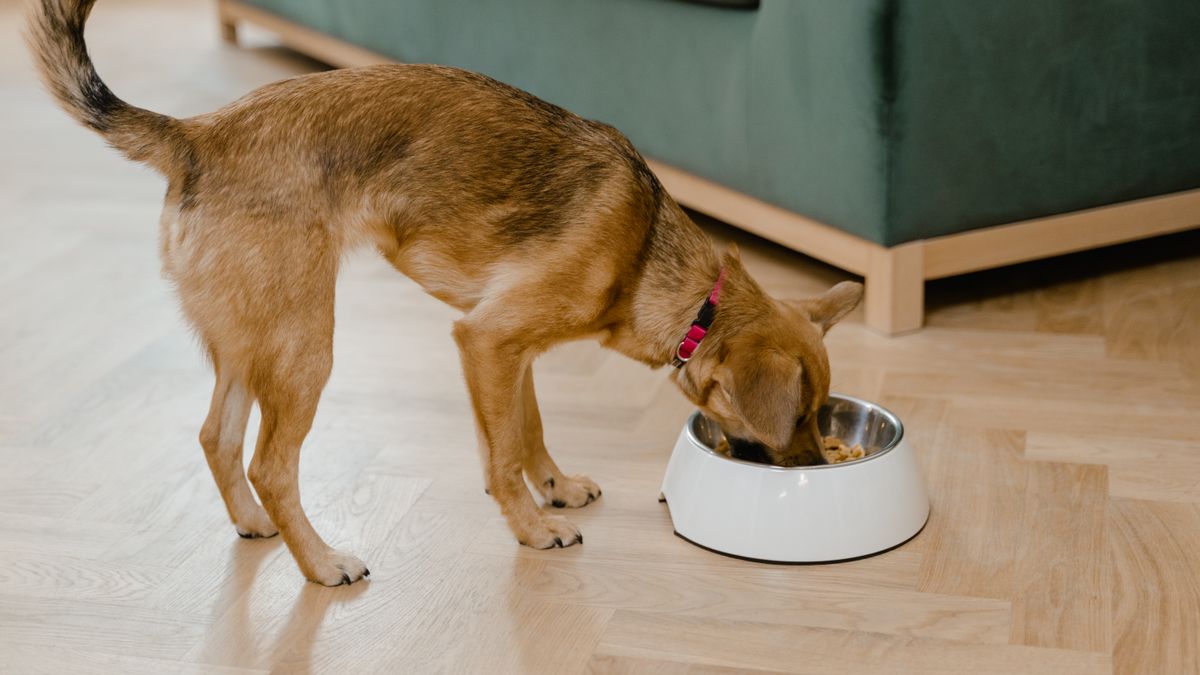


Senior dog nutrition · Small breeds
Senior Small-Breed Dog Food: Calories, Texture and Muscle Support
A small dog's senior years can last a long time, and the food questions change along the way. Can it still chew kibble? Is it gaining fat or losing muscle? Does a new diagnosis call for a medical diet? This guide answers those questions with daily calorie and texture tables built for dogs under about 20 pounds.
The texture ladder: move down only when your dog needs it
By VCA's estimates, small dogs reach their senior years later than big ones, and that stage can stretch over many years for a Yorkie, a Maltese or a small terrier. The labels in the pet food aisle don't capture that well. Bags say "7+" or "11+," and some brand guides say a small dog is senior by 7, but nothing about turning 7 changes what a healthy dog needs to eat.
What does change, often gradually, is the dog itself. Teeth wear and loosen. Some dogs put on fat as they slow down; others start losing weight and muscle. Heart and kidney problems appear and bring their own diets. This guide covers those changes as they apply to small dogs. For the broader picture on senior nutrition, including how adult and senior formulas differ and what bloodwork to ask for, see our main guide to feeding older dogs.
When does a small dog become a senior?
VCA Animal Hospitals groups dogs by size and generally considers small dogs, those weighing 20 pounds or less, senior at about 9 to 11 years of age. Medium, large and giant dogs reach that point earlier. Pet food labels, though, often start "senior" or "mature" formulas at 7. IAMS's guide to small-breed seniors, for example, tells owners that "by age 7, your small dog is mature or senior."
Neither number is a reason to change food on its own. The Merck Veterinary Manual notes that "neither AAFCO nor NRC recognizes that nutritional requirements may change in healthy, older adult dogs," so there's no official senior nutrient profile. Tufts University's veterinary nutritionists put it simply: "there is no one best diet for every older animal," and "animals are individuals."
So treat the senior years as a time to watch more closely, not a date to switch bags. A healthy 10-year-old Chihuahua that holds its weight and eats well on an adult food may not need anything new. A 7-year-old Shih Tzu with sore teeth and a fading waistline might need several changes.
Three checks that matter more than age
Tufts notes that aging is associated with "the tendency to gain fat and lose muscle." That combination is the trap with older small dogs: the scale can stay steady while the dog changes underneath. The WSAVA muscle condition chart, developed at Tufts, assesses muscle by looking at and feeling the spine, shoulder blades, skull and the wings of the hip bones, and it warns that animals "can have significant muscle loss if they are overweight." Ask your veterinarian to score both body and muscle condition at each visit, and to show you what your dog's normal feels like.
Weight can move in either direction. Tufts observes that "dogs and cats may gain weight as they age," but that "not all animals gain weight as they age, and some may lose weight." For dogs that are losing, it suggests a diet that is "more calorically dense." Tufts also lists reasons to see a veterinarian promptly: a dog that has "lost weight unintentionally," picky eating that's new for your dog, or a body condition score below 4. In a small dog, those changes deserve attention quickly, because there isn't much reserve to lose.
Senior small-breed labels: calories go both ways
It's easy to assume that a senior formula is a lighter version of the adult food. Sometimes it is; sometimes it's the opposite. Here's what two brands' official pages showed on October 29, 2026, with each brand's adult small-breed food included for comparison.
| Food | kcal/kg | kcal/cup | Protein / fat | Maker's life stage |
|---|---|---|---|---|
| Hill's Science Diet Adult Small & Mini (adult comparison) | 3,699 | 357 | 25% / 15.3% dry-matter avg | Adults 1–6, up to 25 lb |
| Hill's Science Diet Adult 7+ Senior Vitality Small & Mini | 3,649 | 341 | 22.4% / 14.5% dry-matter avg | 7 years and older |
| Hill's Science Diet Adult 11+ Small & Mini | 3,807 | 378 | 22.5% / 17.9% dry-matter avg | 11 years and older |
| Pro Plan Adult Small Breed Shredded Blend (adult comparison) | 4,075 | 397 | 29% / 17% min | Adult |
| Pro Plan Small Breed Adult 7+ Shredded Blend Chicken & Rice | 3,947 | 419 | 30% / 16% min | Adult 7+, small breed |
| Pro Plan Adult 7+ Complete Essentials Beef & Rice Entrée in Gravy (wet, all sizes) | 843 | 310 per 13-oz can | Not shown on the page | Adult 7+ |
Official U.S. product pages and Purina label PDFs. All dry foods listed carry an AAFCO claim for maintenance of adult dogs. Hill's publishes dry-matter averages rather than as-fed minimums, so its protein and fat figures aren't directly comparable with Purina's. Hill's lists the 7+ Senior Vitality food at 0.68% phosphorus and 0.36% sodium on a dry-matter basis. Blue Buffalo's Life Protection Small Breed Senior page showed no label data when we checked.
What the table shows
- "Senior" isn't a calorie claim. Hill's 7+ food has fewer calories per cup than its adult version, while its 11+ food has more. Pro Plan's small-breed 7+ food has slightly fewer calories per kilogram than its adult food but more per cup (419 vs. 397), because more of it fits in a cup.
- Protein doesn't drop as a rule. Pro Plan's 7+ small-breed formula guarantees at least 30% protein, more than its adult version.
- Switching changes the portion. Move a dog from Pro Plan's adult small-breed food to the 7+ version with the same scoop, and it gets about 5% more calories. Recalculate whenever you change foods.
For a wider comparison of adult small-breed foods, including cost per calorie, see our small-breed dog food guide.
How many calories does a small senior need?
The American Animal Hospital Association's 2021 guidelines estimate resting energy requirement (RER) as 70 × body weight in kilograms raised to the 0.75 power, then multiply by 1.4 to 1.6 for a typical neutered adult, or 1.0 to 1.2 for an inactive dog or one that gains weight easily. The guidelines don't include a separate senior factor. Merck lists age among the things that change energy needs, and Tufts notes that "aging is typically associated with lower energy requirements." For many older small dogs, the inactive range is a sensible starting point. For a thin senior, start higher.
| Lean weight | Less active (1.0–1.2×) | Typical neutered (1.4–1.6×) | Hill's 7+ Senior Vitality, grams* | Pro Plan Small Breed 7+, grams* | Wet food at 843 kcal/kg, grams* |
|---|---|---|---|---|---|
| 5 lb (2.3 kg) | 129–155 kcal | 181–207 kcal | 43–50 g | 39–46 g | 184–215 g |
| 8 lb (3.6 kg) | 184–221 kcal | 258–294 kcal | 61–71 g | 56–65 g | 262–306 g |
| 10 lb (4.5 kg) | 218–261 kcal | 305–348 kcal | 72–83 g | 66–77 g | 310–361 g |
| 12 lb (5.4 kg) | 249–299 kcal | 349–399 kcal | 82–96 g | 76–88 g | 355–414 g |
| 15 lb (6.8 kg) | 295–354 kcal | 413–472 kcal | 97–113 g | 90–105 g | 420–490 g |
| 20 lb (9.1 kg) | 366–439 kcal | 512–585 kcal | 120–140 g | 111–130 g | 521–608 g |
*Gram ranges span the top of the less-active range (1.2×) to the bottom of the typical range (1.4×), where many older small dogs land. Patify calculations from AAHA's formula and each label's calorie statement; use your dog's lean weight and adjust by body and muscle condition.
Pro Plan's own chart lands in the same zone. For dogs of 3 to 12 pounds it suggests 35 to 80 grams a day of its 7+ small-breed food, about 140 to 315 kcal, and for 13 to 20 pounds, 106 to 133 grams, about 420 to 525 kcal. The label calls these amounts a starting point to adjust for "age, activity, and environment."
Why grams matter even more now
A 10-lb senior in the less-active range eats roughly 55 to 85 grams of kibble a day, depending on the food. A slightly rounded scoop can add 10 grams, about 13% more food, without anyone noticing. A kitchen scale makes portions consistent, and it makes the monthly weight check meaningful, because you'll know exactly what changed.
Look at the wet-food column
Wet food is mostly water. At 843 kcal per kilogram, Pro Plan's 7+ wet food delivers about a fifth of the calories, gram for gram, that its dry 7+ small-breed food does, so a 10-lb dog would eat 300-plus grams of it a day. That extra volume can help a small eater feel full, and the moisture is a bonus, but the cost rises sharply. Tufts' nutritionists have estimated that feeding only wet food costs about five times as much as feeding only dry, even within the same brands.
A worked example
Here's how the numbers come together for a hypothetical 12-year-old, 12-lb neutered terrier mix whose walks have gotten shorter. Its owner has fed one level cup of Hill's Adult Small & Mini for years, about 357 kcal a day, and the dog's waist has faded over the past six months.
- Estimate the need. At 12 lb, the less-active range is about 250 to 300 kcal a day. The current cup is well above that.
- Choose the change. The owner can feed less of the same food, about 0.8 cup (roughly 80 grams), or move to the 7+ Senior Vitality formula at 341 kcal per cup, where about 0.85 cup (around 80 grams) gives roughly 290 kcal. Either works; the familiar food avoids a transition.
- Protect the treats budget. Ten percent of 290 kcal is 29 kcal. A habit of two dental chews a day may already use all of it, so check the package.
- Recheck in a month. Weigh, feel the ribs and waist, and check muscle over the spine and hips. If weight is coming down slowly and muscle is holding, keep going. If muscle is fading, talk to the veterinarian before cutting further.
The same steps work in reverse for a senior that's getting thin: rule out a medical cause, then add about 10% at a time, or move to a denser food, and recheck.
Texture: when crunchy stops working
Dental disease is the most common reason an older small dog changes how it eats. VCA states that "over 80% of dogs over the age of three have active dental disease" and that "small breeds and brachycephalics (short-nosed dogs) are more prone to periodontal disease." The Merck Veterinary Manual lists toy breeds among the risk factors, and the American Animal Hospital Association's dental guidelines warn that "untreated periodontal disease causes oral pain."
Pain changes behavior before it changes appetite. VCA describes dogs with dental disease that "chew with obvious discomfort, drop food from their mouth, swallow with difficulty." Those signs are easy to mistake for pickiness. The better first step is a dental exam, not a tastier food.
Working down the ladder
- Small crunchy kibble. Fine for a dog with a comfortable mouth. Don't count on it to clean teeth: Merck notes that the belief that dry kibble keeps teeth clean "does not necessarily always hold true." For dental benefit, look for products carrying the Veterinary Oral Health Council (VOHC) seal and keep up with brushing; our guide to safe brushing covers the routine.
- Softened kibble. Weigh the dry portion, add warm water and let it sit until soft. The calories don't change, and the dog keeps the food it's used to. VCA's appetite guidance also suggests warming food to about body temperature, around 100°F, to make it more appealing.
- Kibble plus wet. A spoonful of complete wet food mixed in adds aroma and moisture. Count it in the day's calories, and if you're using it as a topper, keep extras to about 10%. Our dog food toppers guide shows the math.
- Complete wet or soft food. For a dog with significant tooth loss or ongoing mouth pain, a complete wet food may be the most comfortable option. Use the calorie statement per can to portion it, and weigh partial cans.
Merck notes that teeth that have become loose because of lost attachment "should be extracted," and also warns that hard items such as bones and hooves "can crack teeth and should be avoided." After dental surgery, ask your veterinarian what texture to feed and for how long; we didn't find a general rule that fits every dog.
Breed-specific texture questions
Flat-faced small breeds often have crowded or rotated teeth from the start. Our Shih Tzu feeding guide covers texture choices for short muzzles, and our Toy Poodle guide covers the very small end of the size range.
Protein and muscle: don't cut it without a reason
A long-standing myth says older dogs should eat less protein to protect their kidneys. Tufts' nutritionists are direct about it: "reduced dietary protein is not beneficial for the healthy older dog or cat," and lower-protein diets "may have negative effects by contributing to muscle loss." They add that it's "not clear that high protein diets are beneficial or even optimal for seniors" either. The goal is adequate protein from a complete diet, not a low or extreme number.
Merck lists "skeletal muscle atrophy" among the signs of protein deficiency, which is why muscle condition is worth checking in an older dog that eats little. If your small senior's muscle is fading over the back and hips:
- Check that it's eating the full calculated portion. A dog eating 70% of its food may also be getting 70% of its protein.
- Look at the mouth first if intake is down.
- Keep it moving with gentle, regular walks your veterinarian approves.
- Ask your veterinarian whether a more calorie-dense or higher-protein complete food makes sense, unless a diagnosed condition calls for something different.
Kidney disease is the main exception, and it's a diagnosis, not an age. Our guide to dog food for kidney disease explains when a renal diet helps and how veterinarians stage the disease.
Small seniors and the heart: mitral valve disease
The 2019 consensus guidelines from the American College of Veterinary Internal Medicine (ACVIM) describe myxomatous mitral valve disease (MMVD) as "the most common heart disease of dogs in many parts of the world," with prevalence "higher in smaller (<20 kg) dogs." Cavalier King Charles Spaniels "are predisposed to developing MMVD at a relatively young age." If your veterinarian hears a new heart murmur in your small senior, the diet questions change as the disease progresses.
The guidelines stage MMVD and give different nutrition advice at each stage:
That last point shows why ordinary senior foods and medical diets shouldn't be mixed up. A low-protein kidney diet can be the wrong choice for a heart patient, and a sodium-restricted heart plan is "unnecessary for the general population of older dogs," in Tufts' words. Feed for the diagnosis your dog actually has.
Treats are where the sodium hides
Tufts' cardiology nutrition team points out that sodium "comes from everything a pet eats," including treats, table food, rawhides "and even toothpaste," and that some treats "contribute even more sodium than the pet food!" If your small dog has a heart diagnosis, ask your veterinarian which treats fit the plan; Tufts publishes low-sodium lists for heart patients that are updated each year.
When an ordinary senior food isn't enough
Senior formulas are everyday foods for healthy older dogs. Therapeutic diets are different: they're designed to manage a diagnosed condition, and most are sold through veterinarians. Here's how to keep the two separate:
| Situation | What usually changes | Who decides |
|---|---|---|
| Healthy, stable senior | Possibly nothing; adjust portion by condition | You, with routine vet checks |
| Gaining fat, slowing down | Smaller portion or a lower-calorie complete food | You and your veterinarian |
| Losing weight or muscle | Vet exam first; then a denser food or more food | Your veterinarian |
| Sore mouth, missing teeth | Dental treatment, then texture down the ladder | Your veterinarian |
| Chronic kidney disease | Renal diet at the stage your vet recommends | Your veterinarian |
| Mitral valve disease, stage B2 or C | Sodium control, adequate protein and calories | Your veterinarian or cardiologist |
General guidance compiled from the sources in this article; your veterinarian's plan for your dog comes first.
If your dog has more than one condition, which is common in older dogs, the diet becomes a balancing act that belongs with your veterinarian. Don't stack supplements or switch between medical diets on your own.
Mealtime habits that help older small dogs
- Two or more small meals. VCA recommends at least two meals a day for adult dogs, and smaller, more frequent meals can suit a dog with a small appetite.
- Warm the food. Warming wet or softened food to about body temperature releases aroma, which can help when smell and appetite fade.
- Keep water easy to reach. Merck notes that healthy animals given ample water regulate their own intake, and that water "should not be restricted." A shallow bowl near the dog's resting place helps a stiff senior.
- Make the feeding spot easy. A non-slip mat under the bowl helps dogs with weak back legs stand steady while they eat.
- Watch, then write it down. Note how much is eaten, how it's chewed, and any coughing, gagging or dropped food. Patterns are easier to show your veterinarian than impressions.
A quarterly check for small seniors
| Check | What to record | Act when |
|---|---|---|
| Weight | Same scale, same time of day | Steady change of about 5% in either direction |
| Body condition | Ribs and waist | Score above 5 or below 4 |
| Muscle | Spine, shoulder blades, hips | Any visible or palpable loss |
| Mouth | Chewing, dropped food, breath | Any sign of discomfort |
| Appetite and thirst | Grams eaten, water drunk | New pickiness, refusal, or big change in thirst |
| Breathing and cough | Resting breathing, coughing | New cough or faster resting breathing |
A home log to bring to veterinary visits; it doesn't replace them.
Senior small-breed feeding questions
What is the best senior dog food for small breeds?
A complete food for adult maintenance in a texture your dog can eat comfortably, fed in an amount that keeps both body and muscle condition steady. A senior label is optional; a dog doing well on its adult food doesn't need to switch.
At what age should a small dog switch to senior food?
There's no fixed age. VCA considers dogs of 20 pounds or less senior at about 9 to 11 years, while many labels start at 7. Change food when your dog's weight, muscle, teeth or health change, not because of a birthday.
How much should a 10-pound senior dog eat?
A less active, lean 10-lb senior typically needs about 220 to 260 kcal a day, and a more active one about 305 to 350. That's roughly 55 to 95 grams of a typical senior small-breed kibble, depending on the food and activity. Adjust by body condition.
Should older small dogs eat wet food?
Not necessarily. Wet food helps dogs with dental pain or small appetites and adds moisture, but it costs much more per calorie. Softened kibble is a good middle step.
Do older small dogs need less protein?
Healthy older dogs don't benefit from reduced protein, according to Tufts, and lower-protein diets may contribute to muscle loss. Protein restriction is for specific diagnoses, decided by your veterinarian.
My senior small dog has a heart murmur. Should I change food?
It depends on the stage. ACVIM guidelines recommend no diet change in stage B1, mild sodium restriction from stage B2, and a more detailed plan in heart failure. Ask your veterinarian which stage your dog is in.
Why is my older dog suddenly picky?
New pickiness is a reason for a veterinary visit, especially a mouth exam. Dental pain, nausea and other illnesses often show up first as changes in eating.
Sources
- Tufts Petfoodology: When should I switch my pet to a senior diet?, Are you sodium savvy?, Some dogs live to eat and Pet food costs by type
- Keene BW et al. (2019). ACVIM consensus guidelines for the diagnosis and treatment of myxomatous mitral valve disease in dogs. J Vet Intern Med 33:1127–1140
- Merck Veterinary Manual: Nutritional Requirements of Small Animals and Periodontal Disease in Small Animals
- VCA Animal Hospitals: When is your pet considered a senior?, Dental Disease in Dogs, Anorexia in Dogs and Feeding Times and Frequency
- AAHA 2019 Dental Care Guidelines and AAHA 2021 Nutrition and Weight Management Guidelines: energy requirement box
- WSAVA: Muscle Condition Score chart and Body Condition Score chart
- IAMS: Small-breed mature or senior dog's nutritional needs (quoted for its age claim)
- Product pages: Hill's Adult 7+ Senior Vitality Small & Mini, Hill's Adult 11+ Small & Mini, Hill's Adult Small & Mini, Pro Plan Small Breed Adult 7+ (label), Pro Plan Small Breed Shredded Blend label, Pro Plan Adult 7+ Beef & Rice Entrée in Gravy and Blue Buffalo Small Breed Senior
Prepared by the Patify Editorial Research Team from the veterinary guidelines, university sources and manufacturer pages listed above, checked October 29, 2026. No veterinarian has reviewed this article, and we did not test or receive any of the foods named. Calorie and gram figures are our calculations from published formulas and labels. Older dogs can change quickly; a new cough, weight loss or a refusal to eat is a reason to call your veterinarian.